Hello, friends!
I’ve got two things on my mind this morning for the unorganized intro: writing styles and spiders, and I’m going in that order.
Everyone has heard of the “pantser versus plotter” spectrum, right? Plotters carefully outline their characters and story before they start writing; pantsers make stuff up on the spot and then, in revisions, make it all look intentional. Most people I’m aware of describe writing on this one-line axis because it’s convenient shorthand.
But what if we took this line spectrum and made it 2D?
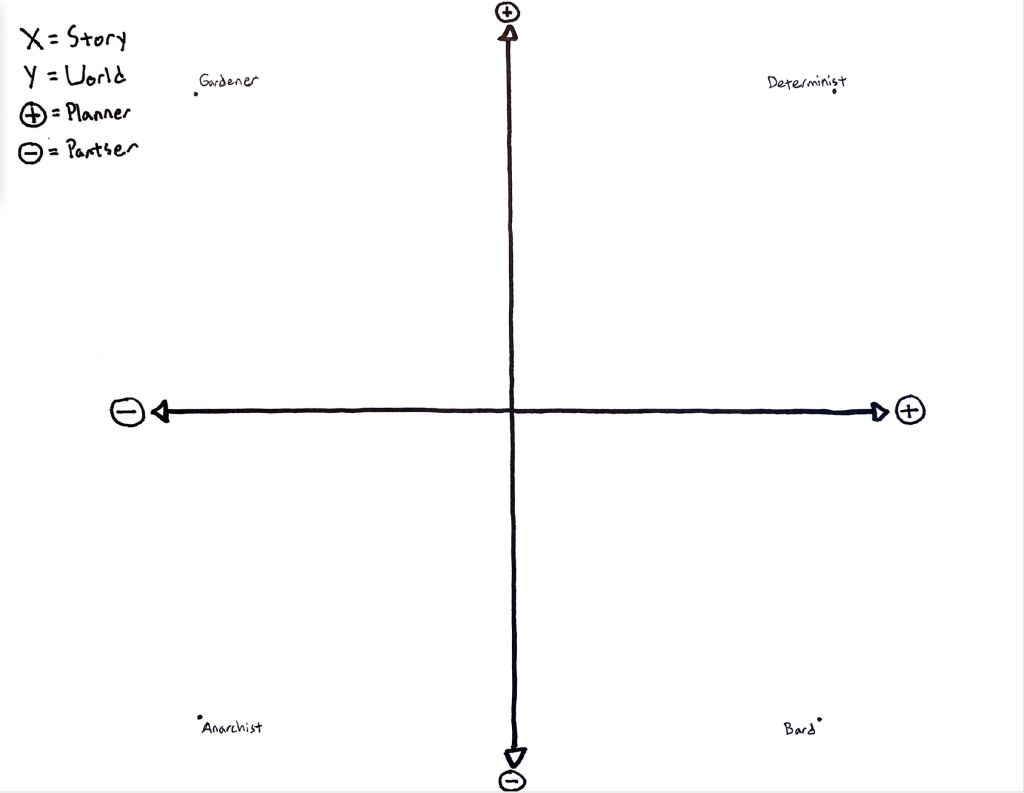
Enter, the Two-Dimensional Writer Chart! No longer do you need to arbitrarily define everything by only two measurements… now you can do it by four. After all, a good story isn’t plot alone. Worldbuilding is a very key element!
The X-Axis represents how an author handles plot (which I lazily referred to as “story” while drawing), and the Y-Axis represents how an author handles worldbuilding. (If a 3D chart were an option for me, “character” would be the Z-Axis. As it is, I think character can be lumped in with either axis, depending on the author.) Positive numbers, in my mind, suggest some degree of writing out your plans in advance (with the farthest right or highest up representing every element being outlined in advance and no room for new discoveries while writing); negative numbers suggest little to no writing out your plans in advance, but the less negative you are the more you plan things out in your mind, the more negative you are the more spontaneous you are.
With this in mind, here’s what the “ultimate extremes” I’ve named above are:
- Gardener: The extreme on spontaneous plots and extremely intricate advance worldbuilding, gardeners might be world-builders first and then allow stories (and characters) to naturally grow out of their worlds.
- Bard: The opposite of a gardener, bards put excruciating work into plot outlines and character arcs, then allow the world to spontaneously develop as needed to best serve the character or scene.
- Determinist: The most extreme outliner, determinists plan everything out in advance and then, once they start writing the novel, do not deviate at all or allow spontaneous changes or additions.
- Anarchist: The opposite of a determinist, anarchists sit down to write without anything to start with and let it all out spontaneously.
These are obviously extremes that real authors aren’t going to fall cleanly into, and different authors might fall different directions with different books, but these categories still may be useful for discussion.
(The inspiration for this little doodle came about when I was pondering a Brandon Sanderson writing lecture where he described Robert Jordan as a “gardener” writer—Jordan cultivates a lush world and then sees what stories and characters grow out of it. Well, that didn’t fit well into either pantsing or plotting, in my mind, since he had very thought-out and spontaneous elements that each felt like they belonged on opposite ends of the pantsing/plotting spectrum at the same time!)
Anyway… and now for spiders.
Have you ever heard of the portia (genus) jumping spider? It’s simultaneously the smartest and dumbest predator you’ll ever discover. And they are cannibals!
Portia spiders have brains just as small and simple as about any other bug. Despite this, “they are remarkable for their intelligent hunting [behavior], which suggests that they are capable of learning and problem solving, traits normally attributed to much larger animals.” They pull this off, essentially, by piecing together as much as they can using their tiny little brain, filing that information away for later, thinking about a different part of the same problem, filing that information away for later, and so forth, until they’ve solved a problem bit-by-sand-grain-bit and can act on the overall picture they’ve constructed. In other words, by handling problems exclusively in pieces they can handle, they effectively multiply the computing power of their brains!
The cost is time… portia spiders often take a significant amount of time to plan out a hunt that may resolve itself in seconds, something a creature with a larger brain would instinctively put together instantly. Imagine if these creatures could link their minds to even further multiply their processing powers, like the telepathic, time-manipulating mice in OSC’s Pathfinder…
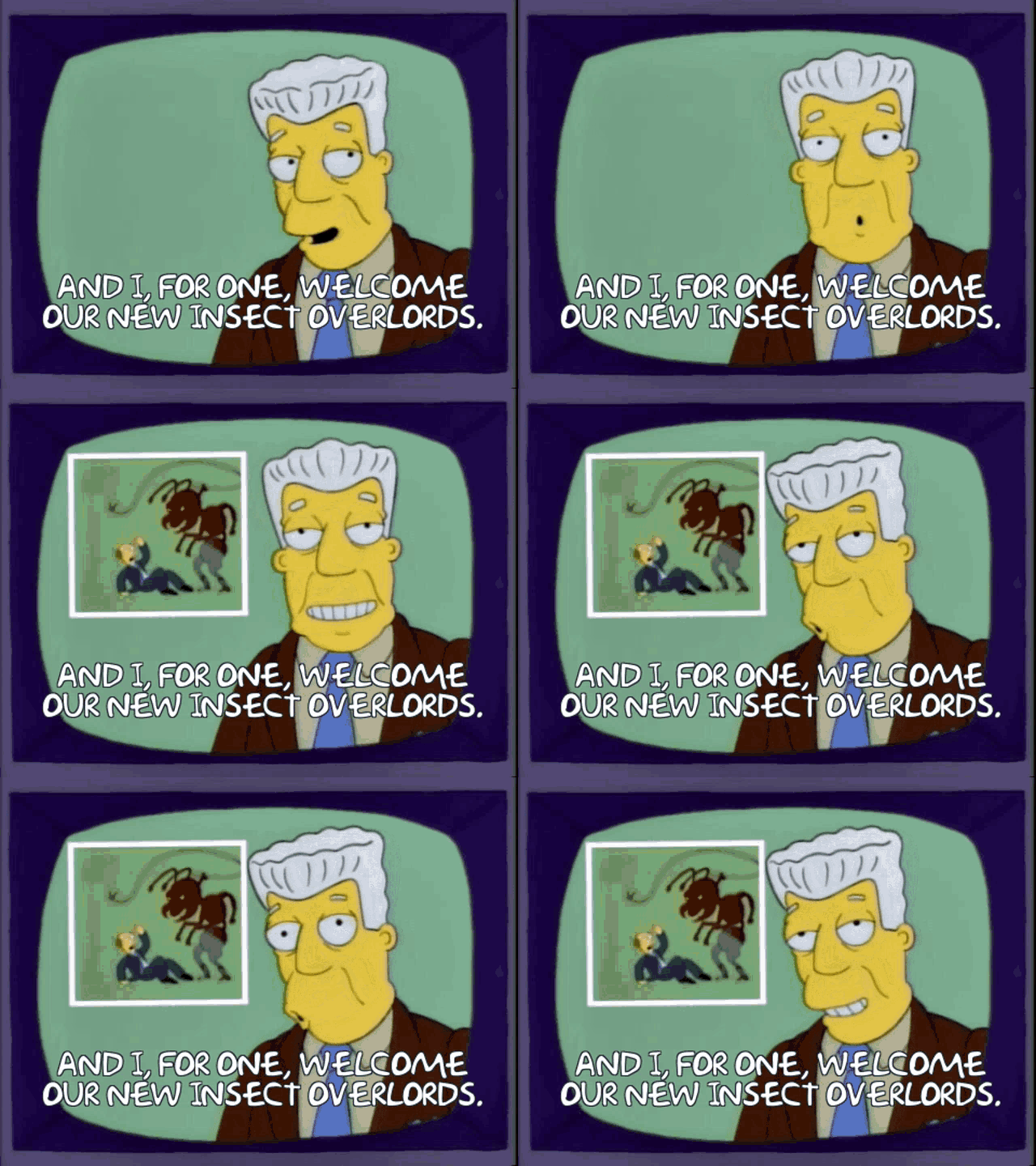
Anyway, now you know about portia. I, for one, welcome our future spider overlords.
(As a side note, I learned about the above spider in the novel Echopraxia, Peter Watts, a hard sci-fi novel that I’ll review once I finish it.)
Bloggyness Review (1): Blindsight
Blindsight is a hard science fiction novel by Peter Watts. In a nutshell, it follows the journey of Siri Keeton, a human who is… a little bit more as he travels deep into the galaxy to investigate an alien event and possibly establish first contact. This book is a must if you like hard science fiction, if you want to encounter aliens in your sci-fi that are actually alien (and not just differently-shaped or -colored humans), and if you enjoy deep philosophical quandaries and explorations. This book may not be for you if you don’t like regular (and harsh) swearing, a deeply depressing narrator, and harshly pessimistic (and misanthropic) views of humanity’s future.
I’m going to place Blindsight in my personal best-of-the-best for sci-fi (maybe above everything Ender—I haven’t decided yet). I loved this book… starting roughly halfway through it.
Blindsight is hard to start. For better, and for worse, the narrator chooses to explain very little, leaving you to piece together what is going on in this future dystopian sci-fi world—and specifically the Theseus, the space ship Siri is in for most of the novel. A lot of elements make figuring things out a lot more difficult:
- Siri (the viewpoint character and narrator) feels anything but human.
- The prose is filled to the brim with dense scientific terms and descriptions; as best as I can tell, all are either real science or very scientifically plausible.
- Characters with bizarre natures, such as a woman with four or five personalities living within her and no clear differentiation between any of them for about half of the book—I thought they were all different bodies for a while, rather than one body but multiple people
- Vampires. (I won’t explain more other than say they actually fit into the story in a scientifically justified and fascinating way, but until you figure them out they might take you out of this hard sci-fi story a bit.)
Getting into the world and characters was difficult, understanding what was happening was difficult… and, honestly, liking anyone and anything I was reading about was difficult. Siri describes so many things with hard cursing, or very crude and sexualized metaphors, and overall strictly sees the world in terms of pessimism or a hard evolutionary lens, which makes him hard to connect with and agree with. But something in the book had enough oomph to keep me engaged, because I pushed through until about halfway through, which is when everything clicked… and I went from hating Blindsight, to hating that I loved Blindsight, to just loving it.
Blindsight explores consciousness and intelligence in a fascinating way, completely separating the two concepts and asking the questions: What if our conscious minds are a detriment on a cosmological scale? What if hyper-intelligence without self-awareness provides better fitness on a survival level? This is then explored through humans that have been augmented far beyond “baseline” and aliens that are… *chef’s kiss* so amazing.
I felt extremely engaged with the discussion going on in Blindsight. It was intelligently and thoroughly handled, and despite disagreeing with what I thought the book’s conclusions were I loved the overall product. I felt very intellectually stimulated, and even emotionally stimulated throughout. And, knowing what I know now, I think I would even like the first half of the book on a reread.
Back to those aliens.
Blindsight is a sci-fi triumph with its aliens, above and beyond any other book I’ve read and can remember. These aliens—called Scramblers—are alien. They are scarily intelligent, physically different from us, and are incapable of comprehending the world or interacting with it in the same way we do, yet are at least as intelligent as us (or more so). As much as I’d love to describe the Scramblers in depth, discovering their nature is a major plot point of the book, so I’ll refrain—but my breath was regularly stolen in excitement and horror.
Given how long this review is (compared to most I’ve written), I think you can tell this book grabbed me. But before I leave it, I want to share one quote that broke me (in a good way):
I whispered something into the dead air. I don’t even remember what.
I really wanted to talk to her.
I just couldn’t find an algorithm that fit.
Firefall, p213. (Firefall is the omnibus version of Blindsight, combining it with the “sidequel” Echopraxia.)
This won’t hit you a fraction as hard as it will when you read Siri’s story and feel his journey from being, essentially, a robot to a thinking creature. But it… well, let me share a little more.
I have Asperger’s. While what used to be diagnosed as Asperger’s has been merged into the general autism umbrella today, I knew my condition as Asperger’s growing up and will probably always think of it that way. While high-functioning, I nonetheless had significant struggle socializing throughout my childhood, and still do in certain areas today. I feel emotions, but I’m convinced I engage with them quite differently than many people I know—particularly my wife and daughter. Being empathetic can be a struggle, although I think some people find me more empathetic than many because it’s something I have to pay so much active attention to.
I don’t hide my Asperger’s—my family and friends know about it—but it’s also not something I focus on or use as an excuse. I am responsible for myself, my socializing, and my interactions with other people. I like who I am, neurodivergence and all, and I strive to take responsibility for every aspect of myself.
I don’t very often encounter characters that I feel are like me in this way in stories, and most of the ones I do encounter don’t feel very well done. Siri was an exception, and honestly a scary one. After spending so much of the book really disliking Siri, finding out that I could slip him on like an old pair of pants was discomforting—but it also felt good. Especially in that line above, I felt heard in a way I rarely do. I was very nearly brought to tears.
Siri’s condition is much more extreme than my own, but hyperbole can sometimes evoke reality more powerfully than anything else.
Blindsight will always be special to me. For all its flaws (and there are many—the author, I think, was very lazy at times with his use of swearing and use of crudities), this is an amazing hard sci-fi novel that depicts an otherness within humans, and in other creatures, in a masterful way. You may find it hard to break into, but once you do… wow, the emotional resonance I was rewarded with blew me away.
Bloggyness Review (2): Mrs. Harris Goes to Paris (Movie)
I think I’ll keep this review a little shorter.
Mrs. Harris Goes to Paris was an unexpected delight that my wife chose for our movie night. The plot is simple: Mrs. Harris, a low-class widowed woman in England post-WWII, decides she deeply wishes to own a Dior dress, having been captivated by the beauty of one she saw. She saves up money, flies for the first time in her life, and discovers when she gets to Paris that Dior dresses are made custom-fit rather than mass-produced, so instead of showing up for a day and leaving with the dress she has to stay for a week while it gets fitted and sewn. Adventures ensue.
My experience with this movie: I was delighted and uplifted. Mrs. Harris’s major character flaw is too much kindness, and her constant uplifting of other characters was inspirational— and it was a treat to see the many ways her kindness and goodness came back to reward her in the long run. This book is also a head above others in how Mrs. Harris treats its “villains”! Many, but not all, are just people stuck in a rut. True, they shouldn’t be as tactless (or outright rude) as they are, but her kindness toward them, and general vibrancy toward life, helps sort them out into better people, which was much more satisfying than seeing those people “get theirs,” so to speak.
General Writing Updates
Always work on at least two projects at once. That way you can procrastinate one by working on the other; in this way, you are always increasing your productivity even if you are mostly procrastinating.
Anonymous.
I’m getting a little tired of revising my short stories, so I think this week will mostly see me focusing on the Third Realm Custom RPG, and perhaps writing sketches of scenes for The Betrayed Technomancer (before I begin writing it in earnest).
Here’s my big struggle right now: Third Realm Custom RPG (3RCRPG) is a skill-based game, with most of rules revolving around the skills themselves, so obviously I need a really good skill list. In addition, I am trying to create a system that allows layers of gameplay (combat, social engagement, exploration, etc) to layer together in interlocking systems so every player can contribute in every encounter. I also don’t want my list of skills to blossom out of control. As a result… Well, curating this skill list is proving very challenging, but it will be key to tying the whole together.
I might share my skill list at a later date and describe how I want each skill to contribute to the overall experience, but I think I’ve gotten too long in this blog post as it is. Long story short: by the time I come back next week, I’d like to have a solid skill list figured out.
Send-Off
What projects are you working on right now? What keeps you going on them?

 Boo Ludlow
Leave a comment