Regrettably, it’s been several weeks since I last posted, despite originally commenting that I only thought I’d miss a week. Well… here I am!
In line with the break, I’m going to start posting when I can, rather than as a regular weekly thing. With two daughters and other growing responsibilities on my shoulders, not to mention feeling that much of my blogging time would be better spent writing Halfwhisker, I’m having a hard time justifying weekly blog posts to myself. And maybe that’s for the best. I’m still so early on in my author journey that it’s not like I have a lot of personal updates to discuss each week, even if I find interesting things in the wider industry to comment on. I think switching to a minimum of once a month is more realistic.
So, if you want to make sure you don’t miss anything I have to share, and if you don’t want to have to rely on remembering to check back, I suggest putting your email in my subscribe box (to the left, if you’re on a computer) and making sure you get an update whenever I make a blog post. This journey has a slow ramp-up, but it’s going to be worth it.
You’ll be the first to know when I self-publish Inner Demon if you do that, and I’m not far off of finishing that journey.
On to the show.
Larry Correia
Mr. Correia is an odd cookie.
My earliest experiences with Correia did not lead me to a favorable opinion of him, nor did it leave me particularly interested in reading his books. And yet, now I plan on devouring everything he has written. Here’s how I got to that point.
My first Correia exposure (that I can remember) was through a used copy of Monster Hunter International that I found in a bookseller’s booth at a convention. The blurb on the back of the book didn’t convince me I needed it, and neither did quickly skimming the book and seeing a bunch of swearing; I put the book down and moved on.
My second remembered exposure was an issue of secondhand dislike. My mother was describing to me a panel that she attended with the following speakers: Tracie Hickman, Tad Williams, L.E. Modesitt, Larry Correia, and an Emily Something newbie. The first three authors I both knew and knew that they were exceptional at their craft, while the last two I had never heard of at the time. Someone in the audience asked how these authors crafted plots and scenarios that were believable; Hickman, Williams, and Modesitt provided very detailed responses about careful worldbuilding, plotting, and avoiding magical contrivances. To paraphrase what my mother remembered of Correia’s response, he essentially said, “If I write myself into a corner, my main character gets out because of magic; I add a new way for the magic system to operate.”
That is obviously a highly authoritative source, being something I received secondhand, a story that had happened a few years before and that my mother mostly remembered. But it was enough to annoy me, because at the time I was convinced that the only “real” way to do magic and worldbuilding was the Sanderson style—i.e., detailed to the point of it effectively being a new branch of science.
It didn’t take much for me to get over these mental blocks between me and reading anything Correia, however. All it took was a brief period of time where a library wasn’t accessible to me, where I had little money to spend on books, and where I discovered the Baen free ebook “library.” Who can say no to a free book? I gave Monster Hunter International a try.
I very quickly fell in love.
Monster Hunter International is high-octane, detail-oriented about guns, and has a fascinating patchwork world where just about any creature or magic is possible—that manages to be magical despite being set in a world that very closely matches our own. I loved the chaos, I loved the slab of muscle that is Owen Pitt, and I quite enjoyed the obvious Lovecraftian inspiration (and the jabs made at Lovecraftian creations). I even found Correia’s subversions of genre expectations interesting, at least as far as the trailer trash elves are concerned. (Honorable orcs probably weren’t as common when Correia first published Monster Hunter International, but I’d seen them everywhere by the time I read the book in 2023, making them less interesting as a group. The individual orc characters were still excellent, though.)
I didn’t even mind the swearing much. When originally skimming through the book, I thought it was excessive; in-context, though, these characters reminded me of the truckers I used to work with in high school. There’s something about that type of swearing that doesn’t bug me much, at least compared to Hollywood-style swearing (where any cuss word in existence is applied with all the restraint and subtlety of a two-year-old dumping sprinkles on her birthday cake). It still was enough to prevent me from sharing the book with most of my friends and family, though.
I also discovered something against my expectations: Larry Correia doesn’t just wave his hands and fix problems with magic. Granted, sometimes he does do that with bullets and explosions, but that works in the specific context of Monster Hunter International. No, his magic—usually—gets all the build-up and foreshadowing it needs to make sense and to feel satisfying when it comes in and saves the day. (It also typically is used to beef up the bad guys more than the heroes, and still usually follows a consistent set of internal rules. For example, destroying a creature’s brain almost always kills it, regardless of what magic is involved, and for almost everything else [particularly monsters with high levels of regeneration] you kill it with consistent, sustained damage, preferably using fire.)
Is Correia’s magic crafted like a new form of science? No—but not all magic systems ought to be that way, or fantasy would get pretty repetitive. Patchwork systems are fun here and there.
So, now I’m blitzing through the eight Monster Hunter International books and having a grand time, and I’d heartily recommend them to anyone who doesn’t mind a little cursing, blood, and guts. Hopefully I can just as enthusiastically recommend Correia’s other books when I get to them.
(With fantasy as my explicitly favorite genre, I’m particularly hopeful for the Saga of the Forgotten Warrior to be good—the following Correia tweet/X-post got me particularly pumped to have this be the next series I read:)
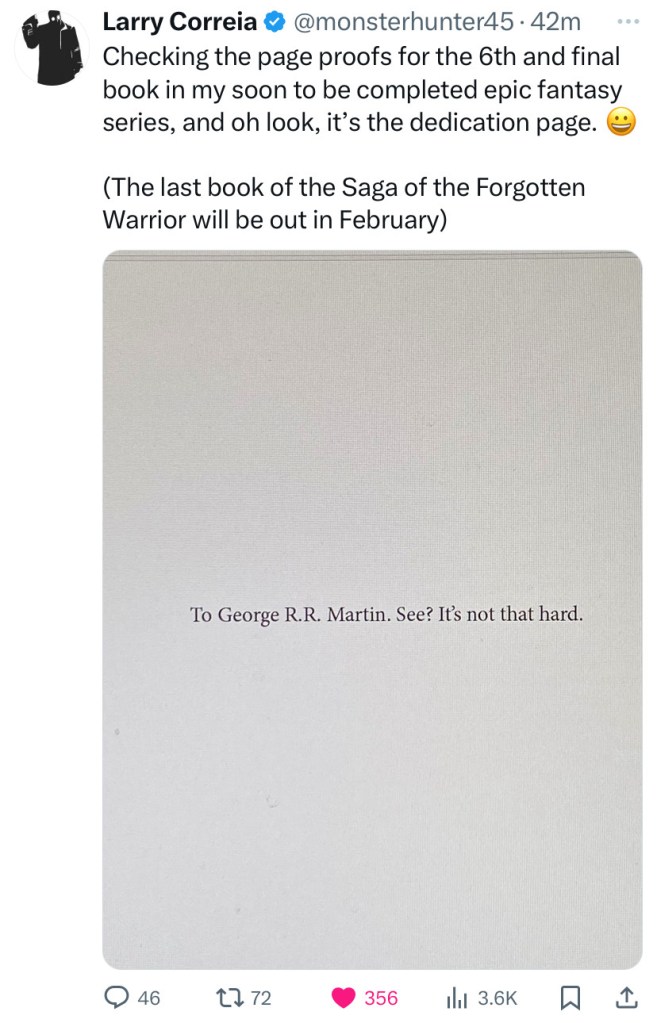
https://twitter.com/monsterhunter45/status/1849511341746225246
Anyway, here’s some rapid-fire reviews for the most recent Correia books I’ve read:
- Monster Hunter Vendetta: Pretty good—even if I didn’t like it as much as the original. That said, it was impressive how Correia managed to keep the plot of the book meaningful, despite somewhat sharing the states of the previous book (being that reality is literally at stake). I will admit, I wasn’t a fan of how Pitt… recovered from a specific ailment toward the end of the book. That one moment felt a little hand-wavey to me. That said, this is otherwise an exceptionally tight book—every line matters, either setting up something that happens later or in a future book.
- Monster Hunter Alpha: Very quickly became one of my top books of all time. Alpha is incredible—and it would make an insanely compelling miniseries, even if completely divorced from the rest of the MHI books. It did take me a little bit to get into the book, since books 1 and 2 followed Pitt and this book followed Harbinger, but once I locked in I was in.
- Monster Hunter Legion: Alpha was so good that it was hard to go back to an Owen Pitt–led book, surprisingly enough—I just ended up liking Earl Harbinger that much more than Pitt. I also, in this book, found that I didn’t quite like how… blatant the series is about Pitt’s “Chosen One” status. It’s not a dealbreaker, and the rest of the book is excellent (with several engaging moments of hard moral decisions), and the big bad monster is very creative.
- Monster Hunter Nemesis: Holy crap, Agent Franks had me busting a gut almost every chapter—and it isn’t Correia necessarily being a comedian, it’s purely character-derived humor. Franks, in book 1, was one of my most hated characters of all time, but by this book he has become one of the most interesting and compelling characters I’ve ever read.
If I were to order the MHI books from most enjoyed to still-enjoyed-but-not-loved-as-much-as-the-highers-on-this-list, I’d go Alpha, Nemesis, International, Legion, Vendetta.
Anyway. I have one last thing to say about Correia, at least with regards to the Monster Hunter International books (I doubt this note will be relevant to his other series). But first, I need to lay some groundwork.
What is the most common shared Western mythology used as a foundation (or major background element) for an enormous swath of otherwise unrelated stories? You could argue generalized elements drawn from myths and faerie tales, but I think a sort of pseudo-Catholic mythology would be more accurate. That’s probably in large part because the Western world is build upon a Christian foundation, regardless of the state of modern religiosity; almost everyone is aware of Christian ideals and values many of them, whether consciously or unconsciously, and, similarly, just about everyone knows about Heaven, Hell, angels, demons, God, Jesus, Lucifer, the Bible, and so forth. Variations of this mythology have been adapted to countless stories medieval to modern, in all forms of media, and even outside of stories these elements are very much a part of culture, with accuracy to the actual book varying wildly.
Well, as a non-Catholic Christian (who grew up close friends with a deeply devout Catholic family), it was always interesting to see what various writers did with Christian mythology (again, usually Catholic-adjacent or -inspired) in stories. I knew almost none of these tales were accurate representations of the real-world people and faith, so they reflected the author more than the gospel, and that could be interesting to pick apart a. In addition, the level to which Christian mythology was utilized, and what effect that had in a story, was interesting to think about: in grounded cop shows, it might only go as far as faithful characters being part of the cast, whereas in more explicitly magical (or Supernatural stories, heh), sometimes the characters could go so far as to travel to Heaven outside of death and meet God, which I imagine might make certain priests or bishops raise a brow. More often the characters just interacted with angels and kicked demon butt, though. Sometimes Jesus never even came into the picture, paradoxically enough, considering the source material.
As a Christian, my experiences with these stories sometimes were influenced by how respectful I sensed the authors were being (even in extremely, shall we say, imaginative takes), but there was always a barrier between me and my deep connection with my faith protecting me from the story: I wasn’t Catholic. Or any other Orthodox, or Protestant. There is a lot of overlap in Christian mythology as you zoom in and see how fractal it gets, there are also a lot of differences in beliefs about fundamental aspects of faith—and the nature and history of reality.
Well, with the Monster Hunter International stories, I finally was finally put in the hot seat, so to speak. These stories hinted at creating a fantastic cosmos inspired by Latter-day Saint mythology early on, but then Monster Hunter Nemesis made this extremely explicit by having, for example, one of the characters mention a war in Heaven and one-third of the hosts of Heaven being cast out along with Lucifer, damned to never have a body or experience mortal life. That’s… extremely specifically LDS, to my knowledge.
Of course, the book exists to entertain first and foremost, and it certainly only takes LDS mythology as a starting point, and it twists LDS mythology a little far in other areas—kind of like what commonly happens in stories with pseudo-Catholic mythologies! It’s all, ultimately, harmless fun.
I wonder if pseudo-Catholic stories made my Catholic friends squirm in the way Nemesis sometimes made me squirm. Maybe. Pseudo-Catholic mythologies are so prevalent in our modern world that I imagine believers of that specific faith either grew a thick skin or stopped engaging with such stories, whereas this is the first novel I’d read that’d created a pseudo-LDS mythology. But it feels respectful, so I try not to let little inaccuracies—or creative interpretation—with the real faith take me out of the book too much.
That, actually, might be a big part of what makes Nemesis a slightly weaker read, for me, than Alpha; even if Correia is being respectful of my faith (and his), having it so explicit in the worldbuilding of this curse-heavy, blood-and-guts excited book series, mostly engaged with through the lens of a demon (in Nemesis), I often get taken out of the book when that stuff comes up.
(I was being very intentional when I said this was the first novel I’ve read with this pseudo-LDS mythology thing going on; I’ve previously read short stories by Eric James Stone that created a pseudo-LDS mythology. While I believe that he’s being earnest and sincere with his writing, enough of his stuff came across as disrespectful or intentionally deviant, to me, that I have a hard time recommending it.)
Writing Updates
I’m thinking about shortening the title of Hazel Halfwhisker to just Halfwhisker. Even if I don’t do that, it’s easier to just refer to the book that way.
When I last gave you an update, I was at about 160,000 words in Halfwhisker. I am now sitting at about 174,000 words. Previously, I was working on a scene where Hazel had a violent encounter from an unexpected figure in her recent past. The word count since then has gotten the mice to and within the mysterious Laboratory, where they will find far more than they bargained for.
As well, I’m working on getting cover art and internal formatting for Inner Demon. The PDF for the 115,000-word book currently sits at about 435 pages, but that’s at a 5×8 book size ratio, which is an inch to half an inch too small for most print-on-demand services to both paperback and hardcover, so I may need to resize things—which, admittedly, is quick and easy with Vellum.
I’m tempted to manually format the book using Affinity Publisher… It’s a hard choice. When it comes to my time constraints, Vellum seems like the clear winner, but learning how to use Affinity to have more control in formatting my own books will probably be a critical long-term skill.
We’ll see. I need to get my rear in gear and get that book published November or December, and it probably needs to happen before I finish the first draft of Halfwhisker, so I need to find that time somewhere.
Maybe I’ll check for spare minutes that fell out of my pocket and rolled under my bed.
Send-Off
Are you a fan of Larry Correia? What’s your favorite Correia books? Or can you not stand him and you seethed your way toward me review-discussion-thing?
… If so, why, I guess?
And finally, Christian elements in stories (angels, demons, heaven, hell, the war between good and evil, God, Lucifer, etc) are everywhere, and for the most part strike me as mostly drawing from the Catholic tradition. What are your thoughts on this? What are your favorite stories in this area? What stories manage to really stand out from the crowd?
 Boo Ludlow
Leave a comment