A little over a week ago, I commented on the Ark Press, Larry Correia, and Baen publishing situation. I shared the information I knew and then speculated mostly that Baen was falling from grace as a newer, more experimental publisher moved into Baen’s niche and poached a lot of Baen’s talent. In my mind, Correia signing a deal with another publisher was a pretty bad sign for Baen, considering that as far as I knew Correia and Baen were like two peas in a pod.
Well, I was wrong. Not about the entire situation, but it appears I speculated on some things that I didn’t know nearly enough about to have any hope of making an educated guess. It turns out, Larry Correia has experimented with different publishers several times before (even while doing well at Baen); he just doesn’t like to put all of his eggs in one basket, and he enjoys experimenting with his options. Anyone with this knowledge probably would have looked at Correia writing for Ark Publishing and thought something along the lines of, “Yup, Correia goes where opportunity takes him,” then left it at that.
There have been other developments since my last post—on Correia’s part, Ark Press’s part, and Baen’s part—but I’m not interested in making further commentary or speculation given how little I know. If you’re interested, they’ve all been fairly talkative on X and in other places. As for me, we all know what happens when one assumes…
Anyway, below is the Larry Correia post that that made me want to write about this. I don’t consider my speculation to be rumormongering or outrage click baiting, but it is true that I came to some of the same conclusions as people in those crowds. Thus, I wanted to set the record straight as far as I was aware and share the direct perspective of someone involved in the situation.
I also want to state that I appreciate the many level-headed people out there who came out in defense of Baen, Correia, and Ark Press. Several of their posts emphasized the need for small, apolitical (or libertarian/conservative-leaning) publishers to support each other (not blindly, of course), and through that discourse I learned about a few more publishers whose books I might give a try in the future.
The Self-Published Science Fiction Competition
Speaking of controversy introducing me to things I might never have otherwise been aware of, here’s a little bit more drama that appears to be clear-cut enough for me to comment on. Mostly I find this situation funny, and a picture perfect example of how groups that screech tolerance the loudest tend to be the most intolerant.
But first, some context and background. The Self-Published Science Fiction Competition (or SPSFC for short) was started in 2021, although its original founders haven’t been directly involved with the contest for several years now. In its current state, it is an all-volunteer organization that collects book submissions, has them reviewed by judges over the course of several rounds (the judges usually being well-regarded bloggers and booktubers), and ultimately picks a “best of” for that year. The reward? As far as I can tell, more free publicity than independently published books normally get—which, to be fair, can be a mighty boon for indy authors.
Here are two more pieces of critical information: First, the SPSFC announced a Code of Conduct that authors must abide or be ejected from the contest—notably, the code of conduct was introduced partway through the ongoing fourth annual competition. Second, anyone may submit a book to the SPSFC contest, meaning it’s entirely possible for an author’s book to be submitted by a well-meaning fan (and even potentially win) without the author ever having any clue of what was going on.
Now enter Christine Eriksen, one of the wives of Devon Eriksen (author of Theft of Fire, a book I’ve praised before), and a remarkably talented, self-taught publicist. (And gooseposter. If you know, you know.) Christine thought that entering her husband’s book into SPSFC would be a great way to share the book with more people, and she did so without telling her husband about it. Apparently some of the judges liked the book, and it passed at least one round of judging, which all happened before SPSFC announced its new, shiny Code of Conduct.
Then this happened:
And that’s it. No mention of what part of the code of conduct Devon broke. No reaching out to Devon to give him an opportunity to defend himself. Not even a warning along the lines of, “Hey, your book is in this contest, just in case you weren’t aware, but we’re going to kick it out if your conduct doesn’t change.” Devon’s book was in the contest, progressing through the contest, a code of conduct was introduced, and then Devon’s book was ejected from the contest, without Devon ever having been aware of what was going on.
(While no formal comment has been made by the SPSFC, people with access to their Discord and Bluesky have claimed that Devon was ejected because some SPSFC fans considered Devon Eriksen to be a Nazi and essentially said that he hurt their feelings. Devon is an extremely outspoken, not to mention eloquent, libertarian. Apparently libertarians and Nazis are equivalents, at least in the eyes of the most tolerant among us. We would do well to remember that. Apparently.)
Clever and chipper, Devon responded with several tweets comparing the SPSFC’s organizers to goblins, and one describing how tolerant cultists make coexistence impossible.
Well, immediately following this announcement, many authors pointed out the hypocrisy of the SPSFC organizers—making bold claims about respecting and cultivating “diversity” while ejecting a libertarian for being libertarian—and requested that their books be withdrawn from the contest. I, and many others, immediately went out and bought several of these authors’ books, in part to support these authors for their integrity and in part because the books genuinely appeared to be bangers. (Christine Eriksen has recorded at least seven such books written by these authors: Chloe’s Kingdom [Gregory Michael], Ash [Grace Walker], Cosmic Strife Assault [Steve Gavin], Wilderness Five [CR Walton], Slipspace Terra Nullius [Zachary Forbes], The Thief [GS Jennsen], and Ghosts on an Alien World [Moe Lane].)
I now want to poke fun at the SPSFC’s Code of Conduct a little bit. I’ve linked their own blog post with their code of conduct above, but in case they decide to make some shadow edits I’ll also include below their own screenshots of said code of conduct, and I’ll follow that up with some quotes of the CoC and my commentary.

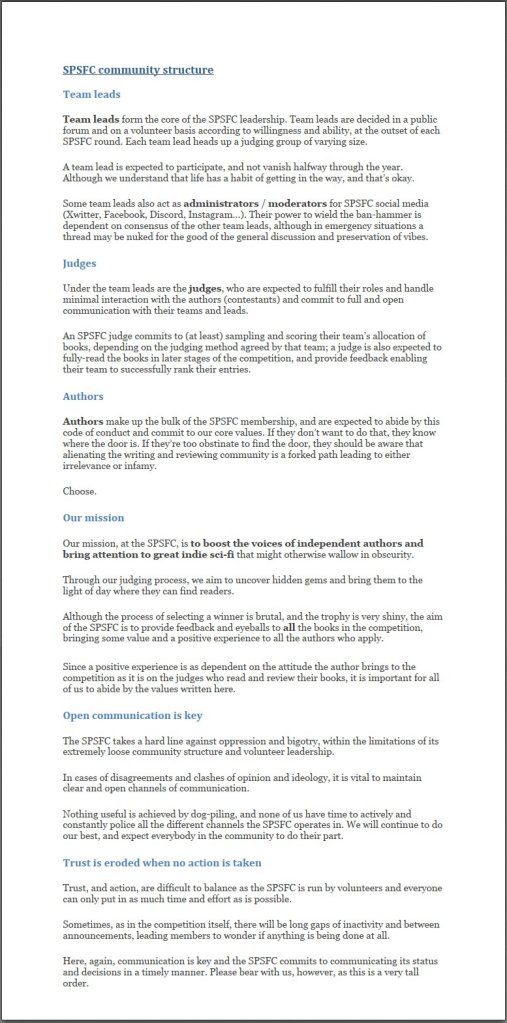
Here at the SPSFC, we believe diversity, equity and inclusion are positive things, as are all other forms of racial, cultural, gender and sexual orientation acceptance.
If you think these aspects of humanity are a net negative to our progress and prosperity, this may not be a community you want to be a part of. And the feeling is probably mutual.
The CoC opens with a statement of allegiance to a highly divisive and charged ideology (DEI), followed by immediate, passive hostility. This code, ostensibly intended to cultivate inclusivity and good feelings, is off to a brilliant start.
This does not mean we included minority-sourced books regardless of quality just to “fill a quota,” to the exclusion of other groups who may have historically enjoyed a more exclusive seat at the table. It means we include everybody, and all of our contestants’ books are judged by their own merit. [Emphasis Added]
Ah, the immediate, obligatory hedge of all DEI supporters: “No, our choices are not ‘DEI hires.’ And even if they were, that’s not a bad thing!”
Note in particular the bolded text. This should elicit pained chuckles, given that Devon was ejected for, essentially, being libertarian, and not at all because of the quality of his book. In fact:
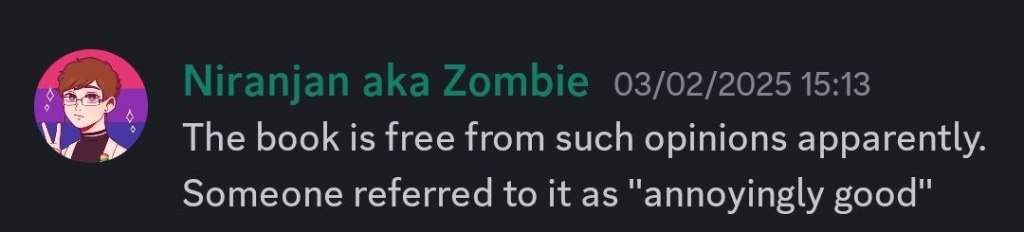
So much for integrity, I suppose.
The table is functionally infinite. Everyone gets a seat. If you don’t like it, cry about it in your Substack or whatever.
Whoever wrote this is very adept at writing with a snarky tone with a hint of bitter herbs. I would imagine they may have even finished a YA novel with a handful of reviews on Goodreads.
(And, hey, I’m punching sideways here. I have a little over ten subscribers to this blog and I’ve been here for several years. Please subscribe. I’m hungry.)
Our goal is not to eradicate these “bad” opinions or to ignore the person upset by them, because that will end with every single member of the SPSFC being removed from the competition and the last one switching the lights out as they leave.
However, we will not ignore the utterances of bigots and hatemongers in our community — while we are not here to police people’s opinions, we will not tolerate hate speech and other backwards attitudes in SPSFC channels such as Discord, X/Twitter and other social media.
“Hate speech” is code for “speech we hate,” so the above can be paraphrased thus: People are allowed to say and think things we don’t necessarily agree with, unless we change our minds.
It’s also worth noting here that SPSFC takes on the role of policing various social media sites to monitor for badthink, which would disqualify someone’s book from being a part of their contest—directly in contradiction to their third-paragraph claim that all books would be judged on merit. That probably isn’t a surprise, though; this contest that supposedly exists to discover and promote quality books doesn’t actually list that part of its mission as its first or even second priority, instead coming out of the gate espousing a political agenda and making threats against those who disagree with them.
Some team leads also act as administrators/moderators for SPSFC social media (X/Twitter, Facebook, Discord, Instagram …). Their power to wield the banhammer is dependent on consensus of the other team leads, although in emergency situations a thread may be nuked for the good of the general discussion and preservation of vibes. [Emphasis Added]
Don’t you just love how rigorous and objective a standard such as “preservation of vibes” is? *puffs a joint, sighs deeply* Good vibes only, man. I can’t handle diversity of thought, man. Mental and emotional resilience is for suckers, dude.
Authors make up the bulk of the SPSFC membership, and are expected to abide by this Code of Conduct and commit to our core values. If they don’t want to do that, they know where the door is. If they’re too obstinate to find the door, they should be aware that alienating the writing and reviewing community is a forked path leading to either irrelevance or infamy.
Choose.
This is a fascinatingly condescending and big-headed paragraph. Here, flying in the face of real inclusion and diversity, SPSFC essentially says, “Think and feel the same way we do or get out.” They then go on to suggest that not abiding by the SPSFC’s code of conduct will alienate an author from the writing and reviewing community—as if the SPSFC is the writing and reviewing community, or at least its primary representative—and then threatens the consequences ominously. “Choose.”
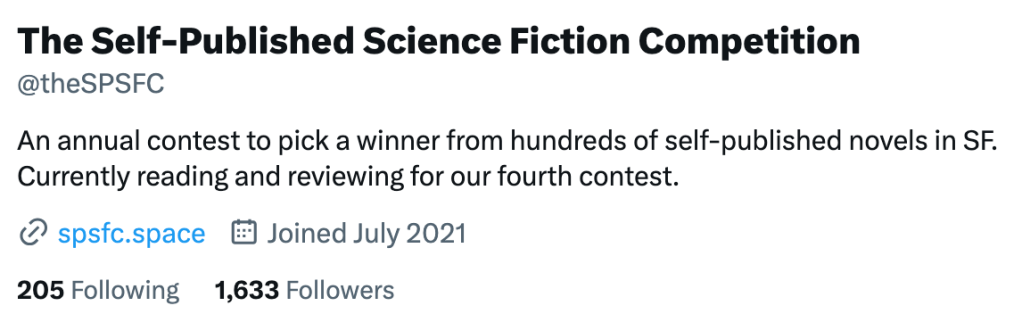
Well, let’s see here… I doubt that X will represent the entirety of SPSFC’s reach and community, but let’s make a comparison. Here are the SPSFC’s folllowers:
And here are Devon Eriksen’s:
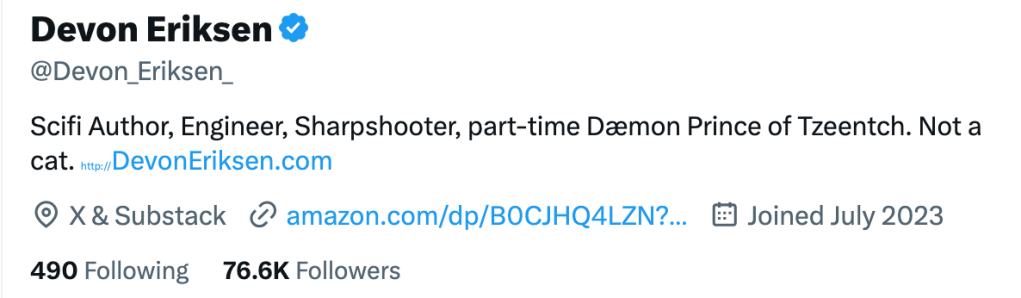
Interesting, interesting. Devon’s community on X alone has around forty-six times the followers of SPSFC. I imagine he’s quaking in his boots.
No—after making fun of how unaware he was of the contest’s existence until it decided to insult him, I imagine he forgot it existed and returned to more important things. Like helping his wife battle cancer, a real thing they are actively dealing with.
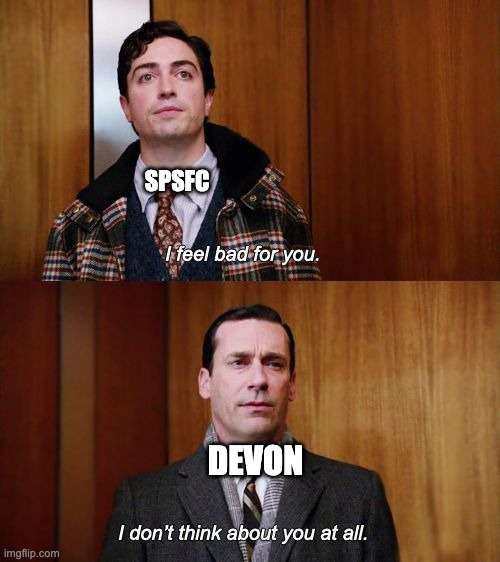
Anyway… the final item I’ll make fun of is the title of the last section of the SPSFC Code of Conduct:
Trust is Eroded When No Action is Taken
Translation: We’re renouncing our ability to take no action and to otherwise ignore foolish or flippant complaints. We will be held hostage to the loudest, most easily offended group that purports to to be one of us.
What a bunch of clowns.
(Let it be known, lest anyone is mistaken: I heartily condemn anyone attacking the authors who have not left this contest, and I heartily condemn anyone attacking the judges participating in this contest. All blame lies in the leadership of SPSFC alone. Heck, the author whose exclusion is at the center of all of this drama didn’t even know he was part of the contest until after they had booted him out. I don’t know how many judges and other authors are part of this contest, but I wouldn’t be surprised if many still don’t know what the contest organizers are up to.)
On Character Deaths
I have really enjoyed most of John Gwynne’s work. He’s a talented author, he writes incredible action scenes, and he builds fascinating worlds. The obvious viking inspiration in all of his stories (that I’ve read) only adds to the hype of his writing.
And I’m really struggling with Wrath of the Gods.
I can’t figure out why. I really enjoyed the first two books of the Bloodsworn Saga. At least, I remember loving them, and being really impatient when the wait for Wrath waxed long as the months rolled by—then I learned that the extended wait existed because of significant tragedy in Gwynne’s personal life. At that point I nodded my head in respect and became exceedingly patient, because the man had good priorities.
So it’s been more-or-less two years since I read Hunger of the Gods, and now I’m starting Wrath. And things just feel off.
Part of it is the prose. I don’t remember if Gwynne wrote like this in his previous books—though I think he did, and I don’t remember being bothered then—but he is married to the progressive tense. No one ever ran everywhere. They were running, always. No man pulls out a sword; he was pulling out his sword and was chopping it through the air and blood was splattering into chill air. It very quickly gets unnecessarily wordy and burdensome, and, for me, it creates this feeling of floaty movement in scenes where things are happening very quickly and violently. The intent is probably to provoke the idea that everything is in constant, flowing action, but without decisive beginnings or endings to movements I find that some of the weight floats away.
But, as you might guess from the title to this section, the big thing that got me wasn’t primarily the prose. It was a character who “died” at the end of Hunger—or, at least, whom I had every reason to believe had nobly sacrificed herself to save the life of another, which I spent about two years believing. Then she’s alive and doing remarkably well in the second chapter of Wrath, all things considering.
Actually, it was all too similar to Hopper’s fake death at the end of Stranger Things, season three. For me, I loved that scene. It was an extremely touching send-off to a beloved character who heroically sacrificed himself for others, followed by a heartfelt message from him for his adopted daughter. It was beautiful. I was at peace.
And then that feeling was undercut by the tease that Hopper might still be alive, later confirmed in season four. I haven’t returned to the series.
Bringing characters back to life—heroes and villains—can be done extremely well, and can greatly elevate a story. For some expert examples, go read Order of the Stick, particularly the major arcs directly following the destruction of Azure City and the following the showdown with Tarquin. Everything surrounding Roy and Durkon in their respective arcs only elevates the story and deepens the characters.
So, what’s the difference between the stories that worked and that didn’t?
Well, as far as underlying principles are concerned, I think payoff and satisfaction are two things that need to be handled extremely carefully when doing character deaths and resurrections. In most circumstances, death is expected to be permanent—it’s part of what makes death so powerful, and what makes the threat of death actually matter. If a character voluntarily chooses to sacrifice herself, that’s often extremely noble and can produce a powerful capstone to a story. Removing the consequences of death takes away the emotional resonance, removes death’s edge—and, if it happens enough, makes death effectively a non-factor. (Which then removes a lot of tension from scenes where characters are in peril. What are they going to do, die? Our protagonist died three times last week!)
But—if death can effectively be made a part of the journey, rather than a culmination or stopping point, and is properly supported as such, then I think character resurrections can be equally moving, but for very different reasons.
Orka should have died. All right, not having finished the book, it might be premature for me to say that. But I will say that I felt the air get sucked out of the room, I felt a lot of my excitement for Wrath wither away, when I realized that Orka sacrificing herself to save her son wasn’t actually a sacrifice after all. And, now, putting Orka in danger won’t give scenes the same weight they once did, and it will be nearly impossible to give her a second satisfying death, if that ends up being what happens.
However, when Durkon’s spirit managed bring peace to the evil undead that had possessed his corpse, simultaneously making peace within himself, saving his allies, and (sort of) bringing himself back to life in the process, I was nearly jumping out of my seat and cheering. When Roy Greenhilt returned as a ghost bound to his family’s ancestral sword, instead of feeling cheated about his less-then-totally-final death, all of the lore and magic around the sword that had been built up already made me go, “I should have guessed that would happen!”
Writing Updates
I have no idea how much progress has been made on Inner Demon‘s cover. As mentioned before, the artist is in school and quite busy. Letting things take their time appears to be the best route forward for now.
As for Halfwhisker, I’m at… about 213,000 words. Oof. Yeah. I have not been very productive as far as writing first drafts is concerned. Traveling for work this week has not helped in that regard at all.
—
Well, that’s all I got. Subscribe for more.

 Boo Ludlow
Leave a comment