Fortunately, I have no need to correct myself with this blog post, unlike last time. Instead, I’m coming back to talk about Wrath of the Gods once more. And a few other things.
But first… writing updates!
Halfwhisker is at… almost 217,000 words! That’s some decent progress. In addition, I’m nearing the end of the book, after which I’ll write the interludes and then put down the first draft for a month or so before returning to it. As for what I’ll work on in between… Well, I’ve got a lot I’m excited about. I want to make a graphic novel script adaptation of Courage in a Small Heart. I want to finish an article I started months ago and haven’t had the time to finish. I’d like to finally, finally, finally finish the first draft of my TTRPG rules for the World of Murid. But, most important of all… I’m going to create the audiobook for Inner Demon. I finally have an unpacked room with enough space to set up my portable sound booth, so the time is finally right.
And that might result in me publishing the print and ebook versions of Inner Demon at about the same time as the audiobook version, rather than months apart (as happened with The Failed Technomancer). We shall see…
Bloggyness Review—Wrath of the Gods
Last week, while talking about character deaths, I gave what could be a review-in-brief for Wrath of the Gods, I’ll quote myself below:
I have really enjoyed most of John Gwynne’s work. He’s a talented author, he writes incredible action scenes, and he builds fascinating worlds. The obvious viking inspiration in all of his stories (that I’ve read) only adds to the hype of his writing.
And I’m really struggling with Wrath of the Gods.
I can’t figure out why. I really enjoyed the first two books of the Bloodsworn Saga. At least, I remember loving them, and being really impatient when the wait for Wrath waxed long as the months rolled by—then I learned that the extended wait existed because of significant tragedy in Gwynne’s personal life. At that point I nodded my head in respect and became exceedingly patient, because the man had good priorities.
Well, I’ve reached the point where I’ve decided to not finish Wrath of the Gods. I think my previous comments hold true: the prose in this book just does not work for me, and Orka’s miraculous survival did not work for me. That said, I still think I would have enjoyed this book more if the wait between Hunger and Wrath had been shorter—or if I had prioritized rereading the previous books before jumping into Wrath.
But there are two other issues, issues I remembered having in the first two books, that stuck out even more to me in Wrath, and I want to talk about those.
I love a good fight scene. And John Gwynne writes good fight scenes. My advice to anyone who wants to write thrilling, detailed, long fights is to pick up literally any John Gwynne book, open to a random page, and start studying. Adds are good you’ll have landed in the middle of a good one.
But Wrath went overboard, even for me.
If you think Larry Correia writes too many fight scenes, or if you think Correia’s or Sanderson’s fight scenes sometimes drag on in word count, you’re not going to get far in Wrath. While there are slower-paced scenes that focus more on character or mood, almost all of what I remember with my time in this book involves teeth being cracked, heads being torn off, seaxes shoved in ribcages, spears driven through stomachs—you get the picture. It all starts to blend together after a while, like miscellaneous animal parts fed into a sausage grinder.
But then there’s a weirder issue with the Bloodsworn Saga, which felt particularly emphasized in Wrath, and that’s that there are no women in it. Except for maybe one prostitute, maybe one or two of the seithr-witches. That’s it.
Cue the shield walls forming in the comments: Boo, most of the main characters are women! Boo, Gwynne is meticulous and intentional in letting us know that at least half of all characters we meet are female, even the unnamed extras! Boo, the main character whom you think should be dead, Orka, is a woman and a mother!
Well, first of all, you are right that the Bloodsworn Sage is so aggressive about its number and placement of female characters that it almost feels like Gwynne was checking boxes, or perhaps making tally marks in the margins of his draft manuscripts, to ensure a very specific ratio was met. It feels very artificial. But that’s not what I mean when I say that there are no women in the Bloodsworn Saga. I mean that almost none of them would be discernible as women without the text explicitly stating as much.
There are no feminine characters in Wrath. Of course, a book shouldn’t be required to check boxes on how to represent characters, but it is extremely bizarre that, with a female cast as large as Wrath‘s, not a single one didn’t think or act like a caricature of a man. They all were very aggressive. They all immediately went to physicality and violence as their preferred solutions to problems, and in a very direct and personal manner. Nearly all of them were as sex-obsessed as male characters are often portrayed to be. (And, of course, sex held as little consequences for them as most male characters.) None were particularly interested in prioritizing community or feelings—in fact, the male characters were often more emotional than the female characters!
(As a side note, there’s nothing wrong with masculine emotion, of course—Lord of the Rings provides many excellent examples of such. But male emotionality and female emotionality tend to be expressed differently, a fact of reality Wrath didn’t seem to understand.)
Beyond lacking the deeper, internal, mental and emotional differences between men and women, Wrath also described most female characters the same way the men were described. Bulky, muscly warriors, not particularly attractive, not particularly clean—and just as big and strong as the men, if not stronger. They even generally wore the same clothes.
All of this combined to create a bizarre dissonance where female characters were technically everywhere, but not one of them felt like a woman.
Don’t get me wrong, I’m aware of the skjaldmær—shield-maiden—literary tradition in Norse mythology. Whether or not these trained female warriors actually existed, ancient Norse peoples told stories about them, as well as the valkyrja (valkyries—also female warriors). This tradition of badass women in myth and fiction has been loved by women and men throughout history. There are even modern (and, notably, universally appreciated) examples of such women, like Ellen Ripley (Alien).
Warrior women have always existed, and likely always will. Of necessity, these warrior women have some masculine traits. But they are still recognizably women. At least, the well-done ones. That’s not what I got out of Wrath.
Will I ever give Wrath of the Gods a try again? Maybe, if I go back to the first book and read my way all the way through again. As I said before, I’ve enjoyed everything John Gwynne I’ve read up until now, so that’s something I may feel inspired to do eventually. As well, there are plenty of things about the Bloodsworn Saga that I really liked—world building elements, characters, descriptions, and even the unique vernacular/spelling that Gwynne often used to great effect. (Heya, it added a lot of flavor without being overbearing!)
But… with how many other books I’m eager to read, I don’t see myself returning any time soon. And if I do start rereading Gwynne’s back catalogue, I might start with The Faithful and The Fallen, rather than going directly to the Bloodsworn Saga. I dunno, we’ll see.
Despite this book striking out for me, I’d still generally recommend Gwynne.
Discussions—Worthwhile Artificial Intelligence Uses for Authors?
Michael F Kane recently wrote about his experience testing out an “AI Manuscript Analysis” by Pro Writing Aid. I’ll link the thread below, if you’re interested in reading everything he had to say firsthand:
In short, the AI manuscript analysis of his book (After Moses) was far better than he expected, but he still ultimately compared the AI’s analysis to that of a “dumb [human] reader.” After all, while the AI could give rather detailed descriptions of characters and plot elements, it was completely incapable of grasping subtleties, subtext, and so forth.
(It turns out, Theodore DC Cox later conducted a similar AI-manuscript-analysis-test using X’s Grok and got comparable results, suggesting that you might not need a writing-specific AI to get the kind of benefits that Pro Writing Aid expensively offers.)
Like many other authors (including Kane and Cox), I have no interest whatsoever in using AI for writing or editing. I’m not anti-AI; I just don’t think that what AI has to offer (creatively and imaginatively) will ever be able to accomplish my goals. (I also think that using AI as a tool can easily turn it into a dangerous, addictive crutch.) Humans do imagination and creativity far better than computers do—and, unless AI gets advanced enough to understand subtext and other subtleties, humans will always be able to provide deeper experiences anyway.
But that said, I was hooked the moment Kane mentioned that Pro Writing Aid’s AI analysis of his manuscript also offered him a handful of comp titles, with explanations as to why those books would make good comp titles.
This is where AI belongs. At least, as far as indie writers are concerned—doing the busywork that takes time away from writing. Find me comp titles, and justify why they would be good comp titles. Discern the best keywords so I can dominate the algorithm at various marketplaces. Write the blurb for the back of the book. Those are things I, and many other authors, would actually find valuable in an AI service.
I’m sure there are limitations to AI that I can’t even imagine right now, at least as far as performing those services goes. And there are other services that I would never hand over to a machine—for example, making my cover, or formatting the book’s interior. But that, by no means, is an argument that there’s no place for AI at all in writing and publishing.
AI’s place is simply the work authors have to do to get their books sold, the stuff which takes them away from writing. Or, that’s where AI’s place should be.
Recommendation—Go Play EZD6 and Shadowdark
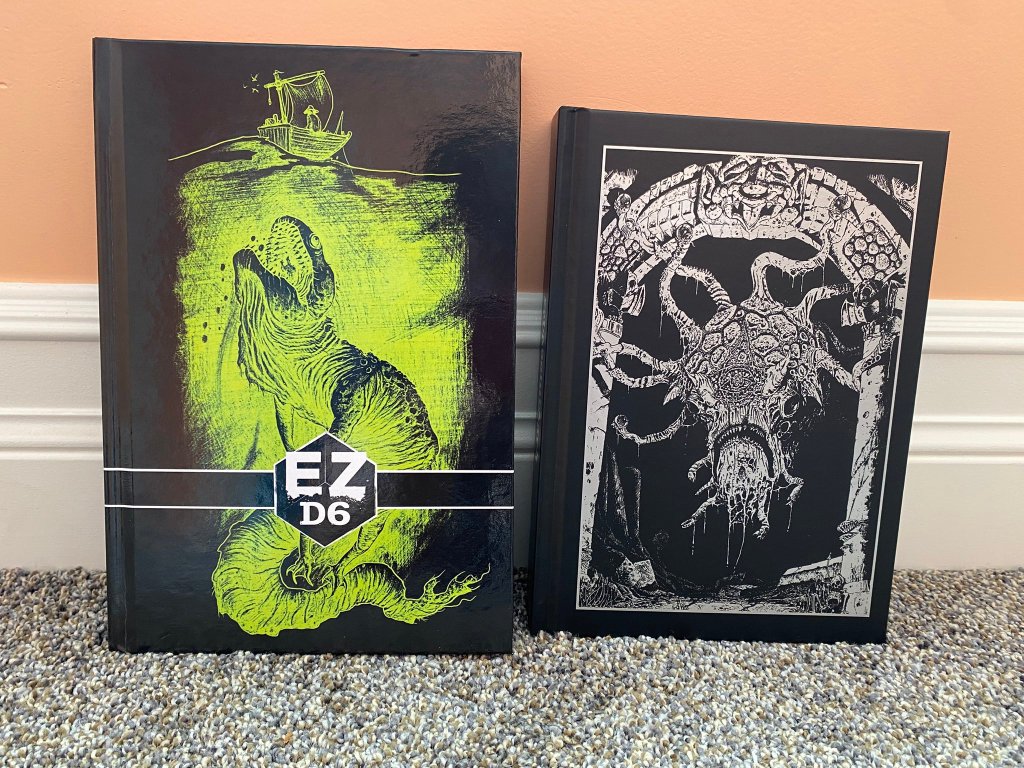
These books. These two books, right up there, contain the best TTRPGs out right now, as far as I’m concerned. And I highly recommend them. Grab some friends and have a blast.
If you don’t play tabletop role-playing games already, I’d recommend EZD6 first. As a micro TTRPG, the rules are extremely light, extremely quick to learn, and you can keep track of everything important about your character on an index card. Plus, the game only uses d6s (six-sided dice), which most people have at least one of in their home somewhere.
But for everyone else… I wouldn’t put one above the other, at least without asking more questions about what you are looking for. They are both incredible, both because of their similarities and the wildly different experiences they facilitate.
As far as similarities are concerned, EZD6 and Shadowdark are both extremely streamlined games. The rules are easy to pick up and learn, whether you’re the guy reading the rules to run the game or a player who was handed a character sheet and told to just figure it out as he went. Both games also happen to feature grim settings with high risk of death for characters—and, while this doesn’t matter much for gameplay, both rulebooks feature gorgeous and distinctive artwork.
The types of experiences facilitated by each rulebook varies widely, in my experience. EZD6 is fast, high-octane fun. You’ll run from challenge to challenge at a breakneck speed, rarely spending more than a few minutes on each, always a moment or two from utter destruction, and loving every minute of it. On the other hand, Shadowdark gives you more of a slow burn, as you tremble and trot your way through long, dark corridors, hoping that your efforts to search for traps will save you from losing a foot—or hoping that the next statue you pass doesn’t come alive as soon as you turn your back to it. (Or hoping that, worst of all, the torch won’t go out before you return to the surface.)
And apparently that’s all I wanted to say there. These games are among the best, if not the best.
…
But as a tangential item, I wish that these rulebooks, and all TTRPG rulebooks, were sold spiral-bound. It would make the books much more practical for use in the moment while playing.
Amazon Sucks
As a final note, Amazon continues to prove that it sucks as both an ebook market and service, but it controls so much of the market it doesn’t have to care. Amazon is changing its language to reveal what has been effectively the case all along, that Amazon does not sell anyone ebooks, but rather sells a license to use an ebook—a license which may be revoked at any time, which is why some readers have opened their Kindles to discover a purchased ebook has mysteriously disappeared.
The most important change about this update, however, is that in the nearby future Amazon won’t allow you to download your ebooks from Amazon and keep the files privately, or upload the files onto third-party devices.
Remember, you’re not allowed to own anything anymore, because services need to be paid for ad infinitum, while something actually owned only needs to be paid off once. Where’s the unlimited cash flow direct ownership? With no real competitors in the market, why would Amazon do anything else? Most authors make 90–100% of their sales through that giant, so they aren’t going anywhere.
Unfortunately, many readers have stated that they would rather resort to piracy than subject themselves to Amazon’s terms, citing things along the lines of “if buying isn’t ownership then piracy isn’t theft.” Please note that this mentality punishes authors more than Amazon. Authors often can’t afford to have a few sales stolen, while Amazon could easily absorb millions of stolen sales. This also completely ignores the fact that many authors sell their books directly on their websites—often cheaper than Amazon offers—and also ignores the many other ebook vendors on the marketplace, like Smashwords. Or Kobo. Or Barnes and Noble. Or–
The time for piracy has not yet come, my friends. Please. You can still legally get your ebooks elsewhere, stick it to Amazon, and support an author, allowing him/her to continue writing the books that you love. Put away your parrots, eye patches, and peg legs, for now, at least.
… Except for Amazon exclusives, I suppose. Yargh!
…
Well, that’s all I got. I’ll write again when something interesting happens, or after I finish Chloe’s Kingdom.

 Boo Ludlow
Leave a comment