As a write this, a two-year-old is screaming in my ear because it’s quiet time and she wants to be anything but.
Let’s see how this goes.
As for my writing updates, I think I’ll bullet-point it this time:
- Halfwhisker is on temporary hold, to give me some time to refresh after finishing draft one.
- Inner Demon has four chapters recorded.
- The Courage in a Small Heart graphic novel script adaptation has yet to be formally started, although I am nearly halfway through reading the short story and have made a lot of notes. (I’m so glad I have some practice with script writing.)
Bloggyness Review—Annihilation
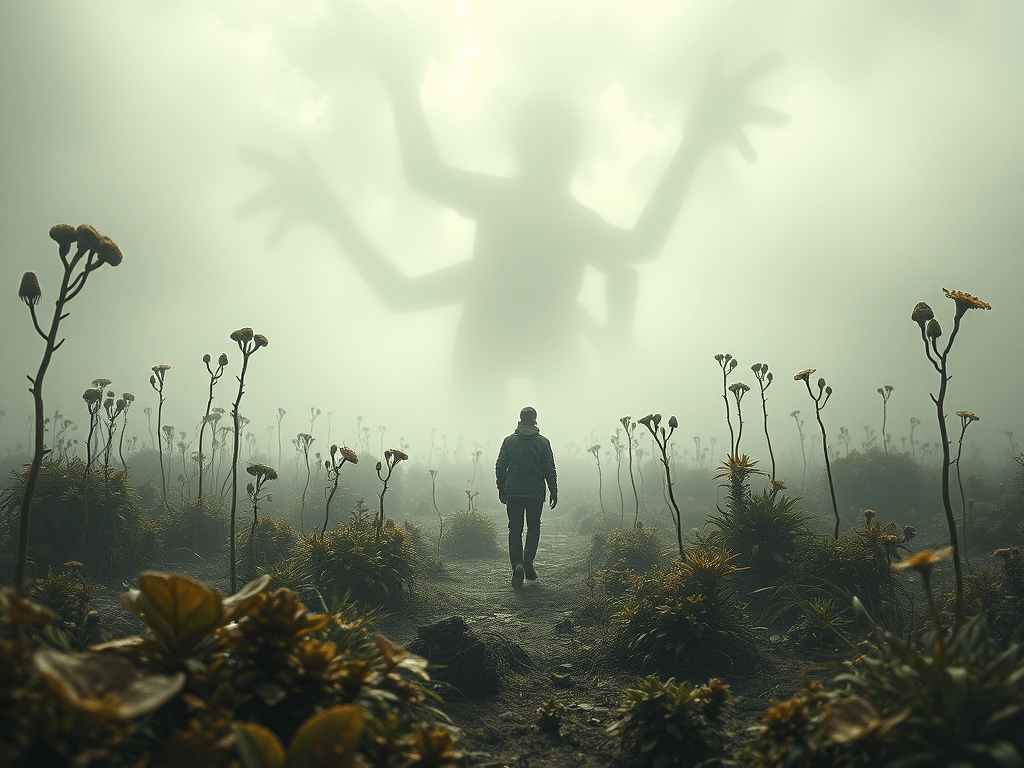
Annihilation, by Jeff VanderMeer, is a sci-fi/cosmic horror/”new weird” novel originally published in 2014. Within, our unnamed protagonist enters the mysterious “Area X” to investigate the bizarre and otherworldly activity within—and perhaps find some resolution to problems in her own past. The book is mostly a deep character study of the “biologist” (our protagonist) within a context of weird horror, with light thriller elements.
As a brief review, I found some aspects of the novel compelling, but also thought the novel got in its own way. Most of the book is spent in the biologist’s head while she wanders from location to location, wondering what is happening to her and Area X, and what happened to her husband, which I did not find compelling enough to carry as much of the book as it does. For me, I think a lot less naval gazing and some more cosmic horror, as well as more of the “government conspiracy thriller” elements, would have gone a long way to raise this novel from “acceptable” to “enthralling”—that said, in its current form, I don’t think Annihilation is an objectively bad novel, but that doesn’t mean it’s my cup of tea.
I do not feel compelled to continue the Southern Reach series, either. Reviews and summaries that I read after completing Annihilation suggest that perhaps the rest of the series provides more of what I was hoping out of this novel, but it’s not enough to entice me when I have other books to start—and when the library wait times for these books is literally months.1
That all said, Annihilation has a dedicated following, so far as I can tell.
To jump off the topic of Annihilation itself and into things surrounding Annihilation, apparently this book and House of Leaves, a novel I previously reviewed, were considered pioneer novels in the “new weird” genre. I’m not familiar enough with new weird to have picked up that connection myself, but I did notice, in both books, cosmic horror that felt either directly inspired by HP Lovecraft’s unique style or by stories with strong Lovecraftian lineage: specifically, spinning horror out of the vast, the unknowable, the unexplainable, the incomprehensible. (I’ve always referred to that as “cosmic horror”; is new weird just a subset of that larger genre?)
Lovecraft did cosmic horror better, though. And I don’t say that just because Lovecraft is recognized as the father of the genre; I think his medium, short stories, lends itself to cosmic horror better than full novels do.
In cosmic horror in general, the author often attempts to invoke horror through a concern for the protagonist, and by attempting to invoke a feeling of approaching the unknowable.2 For me, as far as the latter is concerned, it’s the kind of feeling I had once while swimming through an underground lake: staring down through the deep, perfectly clear water, like an upside-down night sky; the brilliance of floodlights fading into black that appeared infinite; gargantuan, underwater boulders and tunnels fading into the unknown; here, primal memories of tentacled, deep-sea, and subterranean horrors all surfaced at once, unnerving my twelve-year-old self in a way I don’t believe I’ve experienced since. I wasn’t frozen in place, or driven to flight or fight, but I was disturbed all the same… and that feeling lingered.
Lingers.
Short stories, at least for me, can capture a synonymous feeling of long-lived disturbance. But in full novels… well, repeatedly being told that something is unknowable, but that I should be afraid of it anyway, and here’s paragraphs and paragraphs of words attempting to somehow both describe the unknowable while reinforcing just how incomprehensible it is, overstays its welcome quickly.
As for concern for the protagonist being used to create horror… chosen medium isn’t what makes Lovecraft stronger than Annihilation or House of Leaves; writing style or novel conceit is. The latter two novels go out of their way to create distance between the reader and the characters, which inhibited my ability to form a deep connection with the characters and feel for them when they were in danger. In Annihilation, this was accomplished by withholding the biologist’s name from me all novel, as well as intentionally avoiding details about her life long enough that I still didn’t care for her health or safety even when we started receiving flashbacks; in House of Leaves, this was accomplished through the book’s conceit of being a literary analysis about the fictional found footage containing the story, rather than being a written found-footage story, or rather than just directly delivering the story. In either case, I was intentionally separated from the characters, significantly reducing my ability to feel horror when they were in danger.
This last item is where Annihilation and House of Leaves should have had a clear edge over anything written by Lovecraft. In a novel, the author can spend an enormous amount of time doing such, showing the strengths and weaknesses of the character(s), making him compelling, all before tearing his heart out before your eyes, and still feel balanced if done well. A short story, by definition, doesn’t have that kind of real estate, and, even though some short stories can present incredibly compelling and memorable characters, you still literally can’t spend as much time getting comfortable with a them as you can with a novel.
Circling back to the review, I described Annihilation as getting in its own way, and I expressed a similar feeling (though not nearly as succinctly) in my original review for House of Leaves. This conscious distance between the reader and the characters may be the heart of why I feel that way. And, if you give the books (or have given the books) a try and feel similarly, perhaps you’re in the same boat.
(Graphic sexual content warning for House of Leaves. Annihilation does have reference to sex, but I found it pretty tame.)
Discussions—Epic Indie Article
The Article: Should Indie and Self-Published Authors be blacklisted when it comes to AI book covers?
It’s both true that titles can be (unintentionally) misleading and that people ought to fully read an article rather than assume its content based on the title: the above article is NOT pro-blacklisting. Instead, this article is a very balanced (and supportive) discussion revealing how effective use of generative artificial intelligence can significantly reduce the barriers to entry for independent authors, increasing access to quality writing for everyone. (Quality HUMAN writing, I’ll emphasize.)
I heartily agree with just about everything I’ve read in this article, and a few things in there I’ve been talking about already (like how AI shouldn’t replace the art, but should reduce the busywork necessary to get the art out there).
Two of this article’s points really stuck out to me, and I want to discuss them.
AI Art Reduces Cost Barriers
The article shows how AI art can help authors acquire a solid book cover “regardless of their wealth and income [and] have an equal opportunity to attract readers, regardless of their financial resources”. But AI art resolves an issue tangential to this—dealing with certain human artists.
To be clear, there are many wonderful human artists out there who charge very fair rates and provide excellent services. I’ve been fortunate enough to have almost exclusively positive experiences with cover artists—Hannah King did an excellent job on The Failed Technomancer, and Eve Ludlow is doing fantastic work on Inner Demon. Both are very reliable. (There was one other cover artist I tried to hire who disappeared, but fortunately that was before I had sunk much time, or any money, into him.)
Not all authors are this lucky. Even fair prices can be beyond an indie author’s budget. But, beyond that, not all artists treat authors well (despite what some members of the anti-AI crowd claim). Many authors have experienced the teeth-grinding frustration of being ghosted by an artist, sometimes after paying them some or all of the final cost for delivery. That’s never been an issue with AI-generated images, to my knowledge; you put in your instructions and an image immediately pops out. Perhaps it won’t look quite like what you wanted, so you tweak your instructions and try again—and get a new image just as quickly.
If you’re on a budget or can’t find a good human artist, you couldn’t ask for a better solution.
AI Art Innovates… the Industry
Publishing in general is an industry that seems entirely opposed to innovation. Traditional publishing is particularly bad; Brandon Sanderson has exposed this on multiple occasions by describing how most of the “unique” things his company does was first pitched to a traditional publisher, and then rejected.3 (If someone as giant as Sanderson can’t get traditional publishers to innovate, who can?)
It’s unfortunate that many people in the indie community appear to be equally opposed to innovation. While independent publishing has allowed many excellent, well-written stories to be published which would not have otherwise been, there’s still a fairly high barrier to entry. Any technology that reduces that barrier to entry should be celebrated, not demonized—and attacking people who need such assistance to compete is, to put it as charitably as I possibly can, thoughtless and rude.
AI covers are not “soulless,” as many claim, and they do not steal from existing artists (many of which use generative AI as part of their process anyway). They simply reduce the cost and busywork that must be overcome to get a book to market. AI art generation is a new, and (at very specific tasks) effective, tool, and should be seen as no more or less.
Part of the backlash against AI comes from certain anti-AI advocates lumping all uses of generative AI as one, so I want to address AI writing as well, which I do consider a problem. Yes, one of the results of AI text generation is a flood of machine-written “books” that are, frankly, quite terrible. This is a real problem that needs to be addressed. But the existence of churned-out, AI-written slop isn’t a real argument against using AI to empower (rather than replace) human writing. (And the use of an AI cover is not evidence of the text within being written by AI.)
As well, such arguments sound suspiciously similar to those originally used to argue against self-publishing in the first place—that without a traditional publisher to gatekeep, the world would be flooded with cheaply written slop. Well, time has proven that traditional publishers can put out a myriad of terrible books, self-published authors can put out supernal books, and both groups can do the reverse and everything in between.
For better or for worse, all that’s really changed is more and more responsibility being put on the reader to sift through what’s out there and find what’s actually worth reading.
…
Well, that’s what I’ve got this week. Subscribe!
- There’s an entirely separate conversation that could be had here—about how a series can plant seeds for story elements intended to be explored later, and that can be a great strength to the series, which Annihilation was certainly doing. To be brief, that only works then the reader enjoys the current story enough, or finds such future promises compelling enough, to keep reading. If neither happens, such ground-laying doesn’t accomplish anything. ↩︎
- This is often accomplished through obtuse, paradoxical descriptions. This, out of context, might not sound that interesting, but go read Call of Cthulhu and you’ll see that it can be very effective when done right. ↩︎
- If I manage to find the specific source I’ll share it here—one downside of Sanderson being so prolific even outside of his novel-writing is the massive, massive amount of content so sift through to find a conversation from a few months ago—let alone years, which is how far back I think I’d need to go to find what I’m looking for.
I also want to clarify that many of the “unique” things Sanderson does—such as high-quality leatherbound editions; selling paired physical books, ebooks, and/or audiobooks; Kickstarter campaigns with swag; and more—were largely already done by indie authors, in one form or another, though not on nearly as great a scale. Sanderson hasn’t been afraid to say that he’s been inspired by independent publishing and wishes that traditional publishing would take more notes from it. ↩︎

 Boo Ludlow
Leave a comment