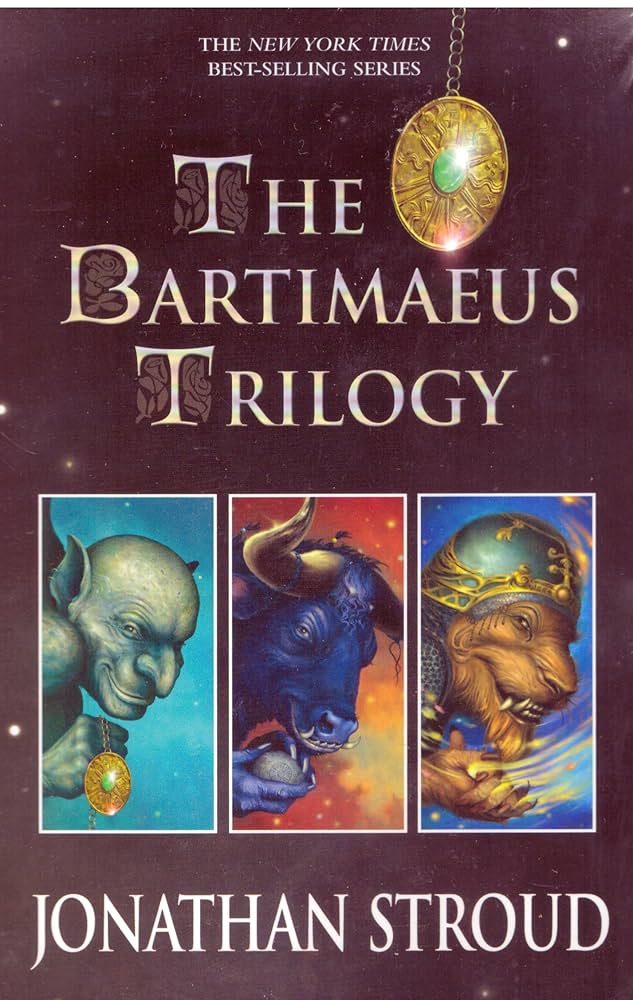
Let’s throw back to the early 2000s today. Remember Bartimaeus?1
The Bartimaeus Trilogy is an alternate history, fantasy YA series by Jonathan Stroud. Since it’s an alternate history (and events are often moved around and reinterpreted in that genre), I’m not confident about the exact years the books take place in, but for general context the American Revolution is just barely starting to boil in the second book—which would suggest 1775, but consumer cars also exist in these books, which would suggest late the 1800s. Since I don’t remember an explicit year mentioned in The Amulet of Samarkand or The Golem’s Eye, I’m just going to leave it at that. For what its worth. A world before telephones, and well before the internet, but with cars and fancy suits.
In the world of Bartimaeus, djinni are real—magical spirits from another dimension that, when summoned into our world, take physical form and can perform feats of magic. These djinni provide immense power to competent and capable magicians who bind them into service, and the existence of djinni and magician are the primary driving forces behind what makes this trilogy an alternate history. For example, Britain (the primary setting for the first two novels—I have yet to read the third) is ruled by a government of magicians that overthrew the old government run by “commoners”; magicians now make up the ruling class while the commoners do the jobs magicians can’t be bothered to. Another emphasis of this series is the rise, decadence, decay, and fall of empires (not dissimilar from real history), and the world of Bartimaeus is decidedly set in the “decay” stage of the magician-ruled British empire.
To continue with another overarching theme of the world of Bartimaeus, the corrupting influence of power is emphasized with nearly every mention of the word “magician”—those with power in this series are almost always practiced in magic, selfish, and manipulative, only thinking about the next thing they need to do to get ahead of their peers. That said, a few commoners who get big heads while resisting their magical overlords also prove that even tiny amounts of power can lead to pride, which can lead to suffering… the Dark Side… That sort of path.

All of this combined makes The Bartimaeus Trilogy truly unique. There’s a grim atmosphere, a sense that things are only going to get worse before they get better, many unlikable characters, and some really heavy topics (handled well for the intended youthful audience), all wrapped up into a very uniquely-written story that stands out from its peers—even today!
Now, per the usual, I’m going to describe what actually happens in these books I’m reviewing—Jonathan Stroud’s The Amulet of Samarkand and The Golem’s Eye. Spoiler warning going forward. If you want my quick recommendation: I really liked The Amulet of Samarkand, and I thought The Golem’s Eye was good. If you’re an adult who enjoys YA (or, arguably, Middle Grade), then there’s no reason not to pick up these gems. If you generally don’t click with YA, hand it off to your kids.2
The principle protagonist of The Amulet of Samarkand and The Golem’s Eye is Nathaniel. At the start of the first book, roughly six-year-old Nathaniel is sold to the British government to become a magician. He then spends the next five or so years of his life legally nameless and under the tutelage of a third-rate magician tasked with mentoring him; Nathaniel does most of the hard work in teaching himself how to be a proper magician, as his master is as useless a teacher as he is condescending to his charge. Nathaniel finds a real drive to excel when he’s publicly humiliated by the magician Lovelace; in secret, and far earlier than most mages, Nathaniel summons the djinni Bartimaeus and tasks him with stealing the Amulet of Samarkand from Lovelace. Despite Bartimaeus’ success, that’s when everything goes wrong.
Not only is Lovelace a powerful magician, but he’s a very gifted and vengeful one with a lot of skeletons in his closet that he needs to keep hidden—at least until he’s overthrown the British government, and the Amulet of Samarkand was a key factor in his plotting. It doesn’t take long before Nathaniel is found out, but, due to his youth, Lovelace assumes that his master is puppeting Nathaniel and opts to murder all related parties to cover his tracks.
Nathaniel barely escapes with his life, but in the process the djinni Bartimaeus learns Nathaniel’s true name, almost perfectly evening the scales of power between the two of them. Now forced to work with his slave djinni, Nathaniel and Bartimaeus break into a remote, wealthy estate on the day Lovelace plans to overthrow the British government, narrowly saving the day and killing Lovelace at the same time. Nathaniel ends the book a hero with a promising future in government.
The Amulet of Samarkand kicks things off with a bang and combines a lot of interesting and unique elements in a very satisfying way; it was even better than I remembered it. To start things off, Nathaniel is an uncommon protagonist. He’s pretty comparable to Ender Wiggin (Ender’s Game) in a lot of ways; he’s not quite as smart as Ender, and he’s a bit older, but they are still both exceptionally gifted children ripped from their families, forced to mature beyond their years, and with the world set against them. Both also have to deal with making hard decisions in the name of self-preservation. Perhaps the biggest difference between the two is that Ender’s journey is primarily about love, while Nathaniel’s is about pride. Reflecting his environment, Nathaniel is very prideful and sneaky, concerned mostly about power and status, he’s not afraid to abuse his magical slaves, and in many other ways he’s quite unlikeable—and yet I couldn’t stop myself from liking and rooting for the kid. Part of the reason is that I knew none of this is Nathaniel’s fault; after all, he was sold by his birth family at the age of six and raised by an awful man.3 Another part of the reason is how competent he is, relative to his age. And finally… Almost everyone around Nathaniel is so much worse than he is. Nathaniel showing them up feels like deserved comeuppance, often.
So much of what truly defines the flavor and experience of The Bartimaeus Trilogy belongs to the djinni himself—Bartimaeus! (There’s a a good reason that the series isn’t called The Nathaniel Trilogy.) Bartimaeus is thousands of years old, has been involved in a multitude of ancient wonders (building, protecting, or destroying them), is very wise about the workings of the world (and his place in it as a magical slave), and has more of a heart than most other djinni—not that he won’t kill a foolish master, given the opportunity, to free himself. Also, he’s quite funny. Bartimaeus viewpoint chapters are always highlights of the book.
But there’s more. While most of The Amulet of Samarkand (and The Golem’s Eye, but more on that book later) is written in third person limited, all of Bartimaeus’ viewpoint chapters are written in first person. And it just… works. It makes this inhuman creature feel meaningfully different from the other characters. It lets us get really into his amusing noggin. And it adds some really interesting flavor, and unique structure, to an already flavorful novel. It’s an amazing example of how, in telling stories, any rule can be broken if you know what you are doing and do it well—mixing different types of viewpoints is generally recommended against, but I’m glad Stroud didn’t take that advice.
Bartimaeus’ chapters are also the only chapters that feature footnotes.4 In-universe, this is representative of Bartimaeus’ ability to have multiple independent threads of thought at once, something impossible to fully represent in writing—to paraphrase the djinni himself, using footnotes is as close as he can get to fully representing how he thinks. It’s a very effective tool to further define Bartimaeus as a character and build up the world, and that’s without even mentioning how amusing, characterizing, and sometimes informative or insightful Bartimaeus’ footnotes are.
In short, there’s a lot of good going for The Amulet of Samarkand, and a lot of broken rules or unique writing elements that Stroud makes masterful use of. There’s a reason why authors making use of footnotes are often pointed toward these books to learn how to do it well.
The latter half of the book, in my opinion, doesn’t reach the heights of the first half. It’s lags a little, and there are fewer fascinating world revelations to help carry things along, but it was still a strong read. All in all, I’d hand the Amulet of Samarkand to just about anyone and expect them to have a good time.
Nathaniel’s experiences continue in The Golem’s Eye; several years have passed and he’s now fifteen, working full-time for the British government and doing his best to keep up with the Joneses. He’s got three big problems to deal with in this book:
- The Resistance (commoners trying to start an anti-magician revolution) are proving nearly impossible to track down and stamp out.
- A powerful monster (later revealed to be a golem) has been rampaging through London.
- (Later in the novel,) Nathaniel gets blamed for the above, which could result in a tortuous death if he can’t clear his name.
A good chunk of Nathaniel’s time is spent politicking, however; he doesn’t really interact with the Resistance or the golem much, or even Bartimaeus, except for a brief visit to Prague. And Nathaniel’s efforts don’t even prove to be that efficacious, in the end; while he does stop a second golem from getting made, Kitty (a member of the Resistance) defeats the first, and the Resistance effectively ends up defeating itself. Nathaniel does, at last, manage to clear his name, but in a manner that tells him—and the reader—that something far bigger than he could possibly imagine is going on, of which Lovelace and the golem were just a tiny part, and he’s just scratched the surface of the conspiracy.
I found Nathaniel a lot harder to read in The Golem’s Eye. His pride is deeper, and his sense of honor and altruism has nearly been stamped out, and his vanity is obnoxious. In fact, just about all of the traces of goodness that helped keep him compelling in the previous novel, despite his many glaring flaws, aren’t very present in this one. As well, and maybe this is just me, I don’t find angry, overly competent, self-absorbed teenagers as compelling as I do eleven-year-olds just trying to survive.5
Bartimaeus, of course, is just as good in The Golem’s Eye as he was in The Amulet of Samarkand, for largely the same reasons. We get to see a bit more of his magical prowess in this book, as well as the good heart he keeps buried fairly deep. A new bit of humor in Bartimaeus’ viewpoint comes from directly contradicting Nathaniel’s perspective of himself: in a Nathaniel chapter the boy will think about how dashing he looks with his tight suit and long hair, and then in the next chapter Bartimaeus will muse about how stupid and greasy his master looks—like a suited toothpick with a glob of oil on its head.

The Resistance was teased in The Amulet of Samarkand, but it features heavily as the newest primary element in The Golem’s Eye; specifically, one of the viewpoints (and major plotlines) follows Kitty, a teenage member of the Resistance.
A whole lot of the Kitty chapters focus on where she came from and how she got where she is in The Golem’s Eye; most of what she does in the novel is follow her foolish leaders in an attempt to steal an exceptionally powerful magical artifact, the Staff of Gladstone. Doing so involves robbing the powerful magician Gladstone’s tomb, a process which results in almost every member of the Resistance getting killed. Only Kitty escapes with her life—staff in hand—along with one other Resistance member who immediately disappears. Kitty later gets caught by Nathaniel and nearly turned in to the British government for imprisonment (and, likely, torture), but Bartimaeus ends up freeing her.
Kitty is an interesting character. Most of what she has going for her is the fact that she’s very resistant to magic—low-power djinnis and spells can’t harm her. She’s also, initially, very driven by grief and revenge (having experienced so much harm at the hands of uncaring magicians and the corrupt magician government), but by the end of the book appears to have accepted a higher calling to save her nation from itself. I’m curious to see where the third book takes her.
I also think she’s part of the reason why I find Nathaniel less interesting in The Golem’s Eye. In The Amulet of Samarkand, everyone around Nathaniel (save Bartimaeus) is awful. In this book, Kitty is a pretty good person, and even though she doesn’t interact with Nathaniel directly much, as a viewpoint character it’s still easy to compare the two pretty directly.
All in all, The Golem’s Eye didn’t work for me as well as The Amulet of Samarkand, but I still enjoyed it.
- I hate how old it makes me feel to be able to say, “Remember X?” And I’m not even old… ↩︎
- Or younger siblings. Nieces, nephews. That random neighbor kid who keeps trying to befriend you despite you being a cranky old fart that sits on your porch swing all day. Whatever works. ↩︎
- Admittedly, the kindly wife of Nathaniel’s master, and at least one kindly tutor, helps take the edge off of Nathaniel’s many bad examples and rough early life. ↩︎
- And I like footnotes. ↩︎
- This is all hopefully building up to a redemption in book three that will feel all the better for how much Nathaniel sucked in this book, but that didn’t mean I felt Nathaniel to be compelling here. ↩︎

 Boo Ludlow
Leave a comment