
Frieren: Slayer’s Journey—
No, wait. That’s not right.
Frieren: Rip and Tear—
No… No, that’s not the name of the show… What was it again…
Frieren: Eternal—
FRIEREN: BEYOND JOURNEY’S END. That’s it, that’s the show. I watched Frieren: Beyond Journey’s End. The first season. And it was pretty good. And I have some thoughts.
First off, some disclaimers. I am not generally an anime guy. I enjoyed the first season or so of Attack on Titan, same with Death Note, and Miyazaki has been extremely hit-or-miss for me (and apparently his body of works is like the Bible for anime lovers), but I’ve only ever enjoyed small pieces of anything else I’ve tried, or I’ve bounced off entirely. Despite there being many different types of anime covering a wide spectrum of genres, I find a distinctive, overarching anime flavor to every one of these shows (or movies) that I’ve watched. Some of it might be a cultural difference thing, I think a lot of it is a “Filling time to maximize limited budgets” thing, but sometimes that flavor overwhelms me and other times that flavor compliments what I’m watching. Or, at least, doesn’t distract too much.
So, to you anime nuts out there, that’s the perspective this review is coming from. No, I have not watched all ten billion episodes (each) of Naruto, One Piece, and Dragon Ball Z, and I never intend to. Sorry. But Frieren worked for me.
And for you non-anime nuts—don’t sleep on Frieren. Yeah, it has some anime-isms that are annoying at times, but I found pushing through completely worth it, and I’m excited for season two when it releases next year.
(Oh, I also really enjoyed Avatar: The Last Airbender. And yeah, I’m specifically mentioning it because whether or not an American-made animation can count as anime is a contentious topic in that community, for some silly reason. SEND ME YOUR HOT TAKES IN THE COMMENTS!1)

Back to Frieren: Beyond Journey’s End. Frieren2 is a fantasy, mostly slice-of-life animated series primarily following the titular protagonist, an elf mage named Frieren. The major element that makes Frieren stand out from the crowd is implied in its subtitle, Beyond Journey’s End: the series takes place after Frieren and her party of heroes have already successfully adventured all across the continent and slain the Demon King. As an elf, Frieren lives for centuries longer than humans do (maybe millennia), and as such struggles to make relationships with shorter-lived species. Recognizing this lack of connection in her life, a lot of time in Frieren is dedicated to Frieren recalling past (platonic) relationships and trying to do better in her current ones. In essence, she’s seeking meaning through connection, and the show beautifully meditates on relationships, time, and related topics quite frequently.
In addition, while there is an overall, series-long goal, and while every once in a while there are multi-episode story arcs, most episodes are self-contained stories or adventures that focus on some aspect of Frieren’s history, past relationships, current relationships, or interaction with a world in which enough time has passed that many people have forgotten that she saved the lives of their grandfathers. For the most part the specifics of what Frieren does doesn’t matter half as much as who she does it with, or whom the action brings to her memory.
Frieren herself is an incredibly likable character, and I don’t think it’s an exaggeration to say that she carries the show. She’s a very interesting combination of extremes—extremely competent in some areas, extremely incompetent in others, and extremely quirky anywhere else. Some moments will leave you holding your breath as Frieren shares her wisdom from centuries of experience, or as she displays chillingly powerful magic, while other moments will have you rolling your eyes or laughing at how hopelessly unaware or naive she can be. None of it feels forced, though—Frieren’s character just feels very fleshed out and believable.

I found Frieren’s companions to be a much more mixed bag. Granted, character flaws are part of what makes characters interesting, much of the time, and how character strengths and weaknesses play off of each other is a key part of a slice-of-life story—and so I must clarify that, despite the complaints I will share, I’m not saying the characters in this story shouldn’t be distinctly or meaningfully flawed. I happened to frequently find the flaws of the secondary characters grating rather than elevating, that’s all, but they didn’t ruin the overall experience for me (and they still each had many moments to shine).
Fern is the second protagonist of Frieren. She’s a young, human mage that Frieren takes on as an apprentice. Her earnestness, sincerity, and kindness makes her instantly likable, as well as her struggle to do something meaningful while standing within the shadow of such an incredibly accomplished mentor.
Most of the time, I like Fern. But as the series goes on, Fern becomes more and more of a bully to her companions, and more frequently. Particularly considering the number of times her companions offer her grace, how often she treats them harshly really rubbed me the wrong way. There’s nothing inherently wrong with bullying as an element in fiction, of course—but I never sensed a progression in Fern’s nastier tendencies, either toward her becoming a better person or toward her fully embracing her darker self. Being a bully is not a static character trait I enjoy.

I also rarely found Fern’s romantic movements with Stark interesting, simply because there never felt to be any movement. The two fight, the two become friends again, and nothing changes. No, what’s most engaging about Fern is her relationship with Frieren and her growth as a mage, in particular how she chooses to focus her talents and studies; the last spell she learns in season one, in particular, defines her as having an extremely practical and functional outlook toward life.
Stark follows after Fern in protagonist importance, and he’s a total coward. Until he’s not. But then he is again. It’s played for laughs, and my wife found Stark pretty funny at times, but I rarely did. I liked Stark most in his earnest moments—and maybe that’s just a reflection of Frieren as a whole. This show is so earnest, and can do such a good job at shining a light on a character’s soul, everything from the quirky to the wholesome to the fixer-upper-parts; these moments that show Stark as a young man trying to discover himself and his place in the world, or serving others freely, or just enjoying simple and masculine pleasures, really struck a cord in me. All of the mocking of his character I found completely forgettable.

Perhaps Stark would have worked better for me if I sensed more meaningful strides in overcoming his cowardice; alas, it appeared to be as ultimately static a trait as Fern’s bullying. Hopefully future seasons address these things.
Beyond these three, Frieren: Beyond Journey’s End doesn’t keep side characters around very long. At least twice I thought a character that joined the party was in it for the long haul, only for, a few episodes later, the character to peacefully go his own way. Putting a lot of investment into a side character, only to have him leave with no guarantee of return, felt strange—but it also fits in with one of Frieren‘s themes of coming and going, learning to value those with you while you have them. Investing in these characters, only to lose them soon after, is also effective in evoking feelings of bittersweet loss. I just wish I didn’t like these side characters (often) so much more than Stark and/or Fern!
Finally, some side characters only exist in flashbacks as Frieren reflects on prior journeys. Since these characters (mostly) only exist in memory, I consider them more of an extension of Frieren than characters in their own right, but many are memorable and have amusing moments.
Ultimately, the characters are the real heart and soul of Frieren: Beyond Journey’s End. They are what got me through the first few slooooooooooooooow episodes, and kept me going through all the rest of the highs and lows. If you find yourself intrigued by Frieren (and the others) early on, you’ll want to finish the series. If you don’t find yourself liking Frieren quickly, I don’t think this show is for you. So, yes, this is a general recommendation from me.
…
But wait! I’m not done! Yes, that could be the end of the review, but there is a lot more that’s worth at least mentioning about Frieren: Beyond Journey’s End, and a few things that deserve a deeper look, at least for those that are on the fence.
First of all. The theme song. THE THEME SONG. The theme song for Part 1 of Season 1 is SO GOOD that my wife and I never skipped it. It’s almost worth watching the series just to guarantee you get to listen to the theme song a few times.
I also think it’s worth noting that the animation is quite good—distinctly beautiful in parts, in fact.
I found the world itself of Frieren to feel rather generic. Humans are humans. Elves are elves. Dwarves are dwarves. Monsters walk around in the forests that surround various villages. Magic can do some wacky stuff and is only kinda explained. Similar to Codex Alera, it’s a really strong example of how weak or middling ideas can be substantially elevated with quality execution.3
The plot. This is a slice-of-life story, so I keep going back-and-forth on what I want to say here. What matters above all is the characters and their interactions; everything else is largely gravy dripping off of those delicious mashed ‘taters. But there is a movement in Frieren beyond character growth and change, and there are groups of episodes with specific, notable arcs that are much more plot-driven than character-driven (adding some nice variety to the show).
The first big one involves Frieren, essentially, going to war with one of the few remaining armies of demons, and it’s the inspiration behind my comparisons between Frieren and the Doom Slayer at the beginning of this review (and lots and lots and lots of awesome fan art).

This arc has a nice build up, slowly revealing the foes Frieren has to face and the true extent of the danger ahead of her. It has a lot of meaningful things for Fern and Stark to do as well, almost making them look like they were going to progress their platonic and/or romantic relationship at times. This arc also serves to reveal the purpose of the demons in this series: as creatures of pure, irredeemable, unrepentant evil. Demons are nothing more than predators who seek to hunt and kill humans. They learned language to better hunt us; they take human form to better hunt us; they pretend at compassion, empathy, and diplomacy to better hunt us. And some humans refuse to learn that lesson, entering into parlay with demons in the hope of peace, only to pay the ultimate price.4 It’s… so well done. And it makes the annihilation of demons at Frieren’s hands all the more satisfying. This was my single favorite arc of the series, with many of my single favorite moments.

The second biggest arc involves Frieren and Fern participating in a test held by a guild of mages to certify them as first-class mages.5 Stark plays no real role in these episodes (sometimes not even showing up at all), which was kind of nice. I wish I could say the real spotlight of these episodes was Fern—her journey as a mage is a core part of this series—but… Only kind of. This arc introduces a ton of new side characters also participating in the test, with enough spotlight shared among many of them that you might mistake this show for having an ensemble cast (rather than three core main characters) if you began the show at the beginning of this arc. Fern does get highlighted in interesting ways by having her compared and contrasted with these new characters, and working with or competing against them… but it was a little frustrating that I often found her at her best in these episodes and she wasn’t on screen as much as in prior episodes.
For the most part, I only watched this arc for the spectacle. There are a lot of fun magic fights and challenges, but, as mentioned before, most of the action is focused on characters new to this arc, and that I correctly suspected would leave Frieren at the end of the arc, so I had no attachments to most of them. (Some I actively despised, most notably the two girls who would not stop cat fighting each other.) Some things of interest are revealed about the world, and the very end has some very interesting characterizing moments for both Frieren and Fern, but I wouldn’t define most of this arc as required watching—even if the one new character I truly liked out of all of this, Denken, is only in this arc in the first season.
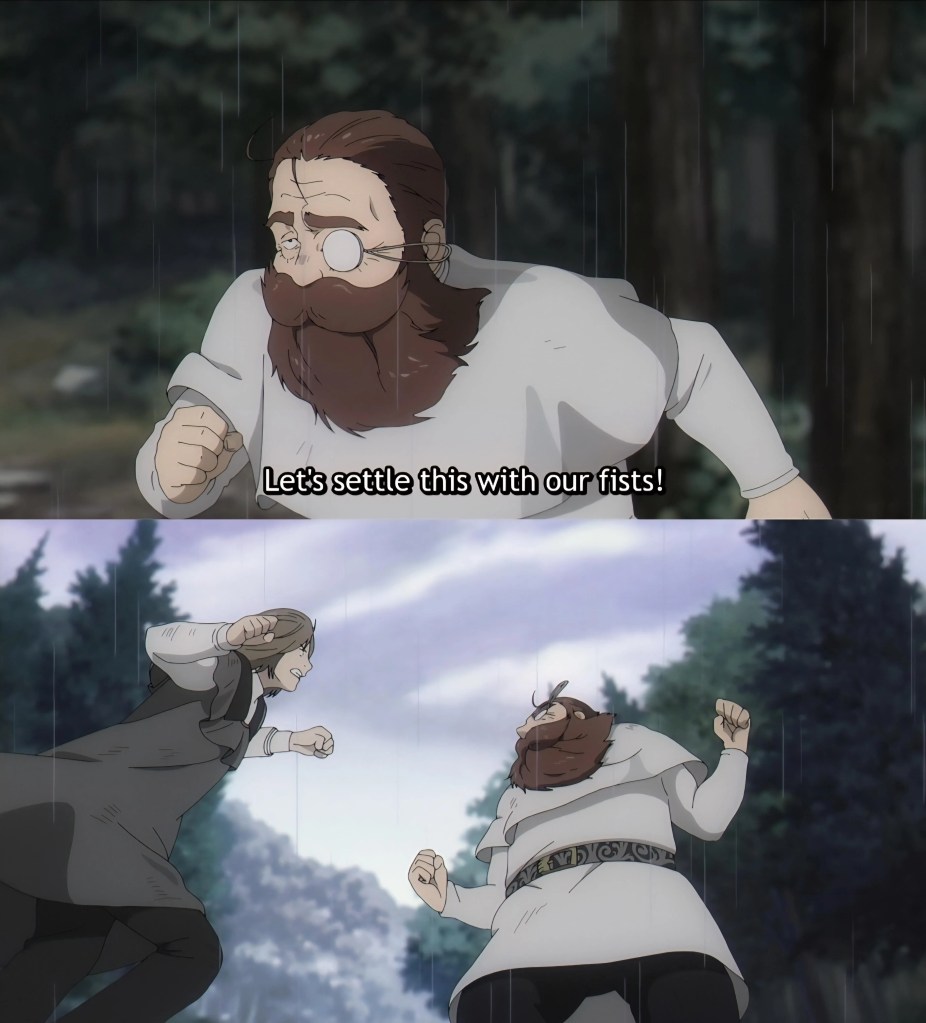
My final note is that the anime-isms of the show dragged things down for me on occasion. I don’t have the most cultured palate when it comes to anime, but I have noticed certain things that seem to show up in every one I’ve attempted, such as intentionally annoying characters, ridiculously exaggerated reactions, and out-of-character moments probably fulfilling a trope that I don’t understand. That’s all here, but it’s all forgivable for a tourist like me.
The anime-ism that got nearest to killing things for me is the show’s tendency to, at critical moments of story or character arc climax, freeze everything and spend half an episode explaining why this moment is significant, rather than naturally weaving that knowledge into the story beforehand. It grinds otherwise excellent pacing to a halt. This also happens in smaller doses scattered here and there, with characters spending significant time thinking over exactly what they are about to do, and why, and then doing (often) exactly that.
I’m not a fan of over-explaining in stories; for some reason it seems to be a trope in anime that I just don’t get the appeal of.
And that’s it. That’s what I got for Frieren: Beyond Journey’s End. It’s an anime that I enjoyed, despite rarely appreciating anime, and it’s one I’d recommend happily.

- I guess I have also seen the first season of Castlevania, which is sometimes categorized as Anime, sometimes as American Anime… whatever. Genre exists solely as a marketing tool anyway. ↩︎
- Mostly referring to the series by its shorter name, Frieren, and having its most important character named “Frieren” might make some of my references confusing. Just know that italics means I’m referring to the series as a whole, non-italics I’m just referring to the character… And hopefully I don’t mix that up at any point. ↩︎
- In worldbuilding, I have to emphasize. Part of “quality execution” involves having distinctly quality and excellent ideas elsewhere, which Frieren has in spades. ↩︎
- The internet being what it is, I need to state this: Frieren is entirely apolitical. There are a lot of morons on the internet who accuse this series of being racist because it has irredeemable, inherently evil creatures in it; while these people are fun to dunk on (they reveal their own [often racial] bigotry through the accusations they throw at others), they also kinda ruin the vibe, and I suggest ignoring them. One of the points of fantasy is to be able to do and present things that don’t—or may not—exist in the real world. ↩︎
- I don’t think those were the exact terms used in the series, but that’s the gist of it. ↩︎

 Boo Ludlow
Leave a comment