This one is for the authors out there—and not just authors, but anyone who dares to wrongthink—who is scared of the cancel mob. Or, at least, healthily concerned, or has reason to believe they may encounter the mob at some point. Because they still exist, and they still have a stronger presence in some industries than others, and they will do what they can to ruin you.
But you don’t need to fear them.
On August the twenty-fifth, in the year of our Lord two-thousand and twenty-five, I got cancelled for making the following post:
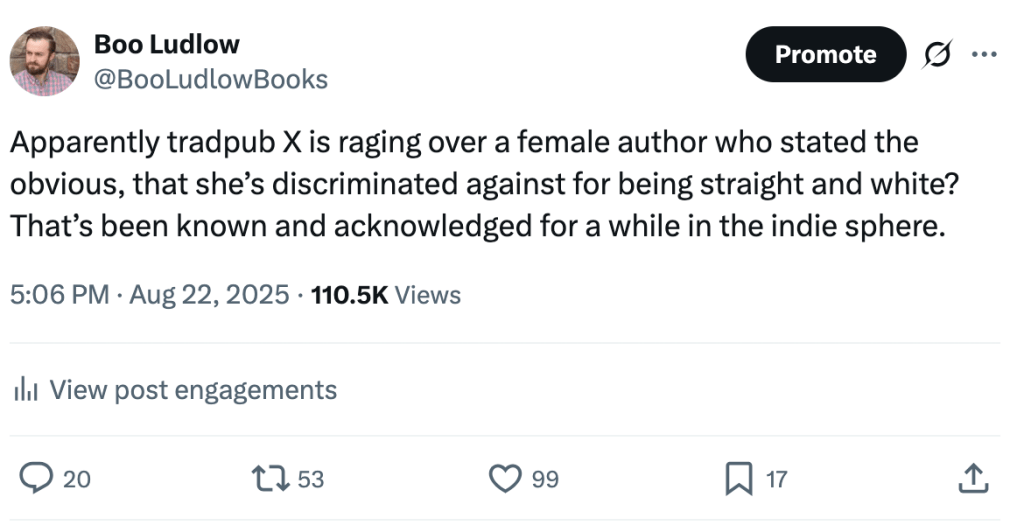
I made this post in response to learning about aspiring traditionally published author Jordan Lee‘s1 following posts (now deleted):

I’m not going to go into detail here about my other thoughts on Lee’s post, on the hate that I received for defending her (on the hate that she received directly), and everything else that happened, because that’s not what I want to reflect on here. If you want to look through a lot of what happened, you can go to my X profile and read through the posts (mostly August 22nd–25th).2 Some of the takes that were thrown at me were spicier than what you’d find in the toilet at a cheap Mexican restaurant that operates out of the back of a gas station in habanero country.
Naw. Instead, here’s what’s most interesting about this: not only did I have an amazingly thrilling day responding to all of the haters (and supporters!), I sold more books that day than I sold all of last year. Just guesstimating off the top of my head. Which still isn’t a lot—I am but a small fish in a massive ocean—but combine that with massively increased views on WordPress and Twitter, getting “cancelled” was unequivocally a win for me.
So I wanted to share some observations I had, and lessons I learned, from this experience, on the off chance they ever prove useful to anyone else who finds themselves facing down a woke mob.3 The below are shared in no particular order, and many of these items bleed into each other—for example, almost everything I’m mentioning is a form of “leaning into it.”
— Get Screenshots —
Jordan Lee’s post is solely shared in screenshot form above because it got deleted. Stuff can disappear pretty easily on Twitter—but screenshots last as long as you keep them saved on [INSERT DEVICE OF YOUR CHOICE].
Post don’t just get deleted, though—as I’ll mention later, you’re going to want to block a lot of people if you’re dealing with the woke cancel mob, and once you block someone you sometimes can’t see their posts. (Or you can’t see their posts only if they block you, maybe.) Regardless, if, I don’t know, you want to write a blog post about your experiences, it becomes tremendously more difficult to provide visual examples because sometimes Twitter lets you view those posts and sometimes Twitter doesn’t. You know, a purely hypothetical situation.
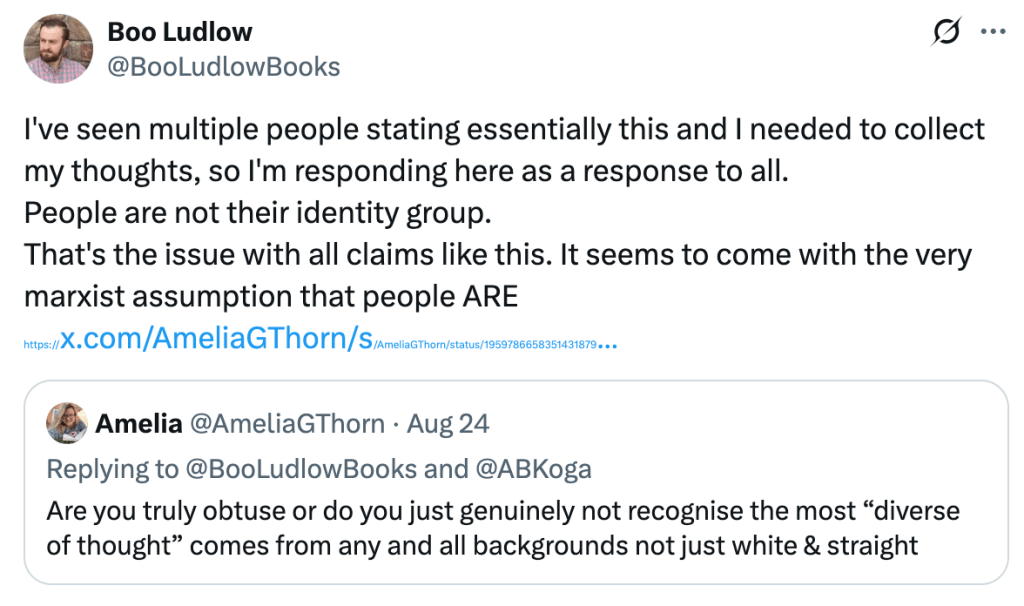

Screenshots are also useful when providing examples of conversation because they help preserve context. They allow you to ensure that what was said can be fully replicated—or, at least, the conversation snippet you chose to capture.
— Lean Into It —
Cancel mobs only win if you give up—if you take down your stuff, if you choose to back off and give up. Even if the website you’re operating on decides to side with the cancel mob—which isn’t guaranteed to happen, particularly if you stand your ground, and particularly if you’re on a platform that doesn’t moderate only to one viewpoint—you can still move elsewhere and continue to preach your good word. Or you can just make a new account and keep going. The internet is a big place, and internet anonymity a powerful thing.
But standing your ground isn’t where you should stop. Push back. Don’t let yourself be a doormat. Keep making comments. Keep putting yourself out there. Go on the offense, if needs be. But whatever you do, never, ever, give in—for the cancel mob, that’s like throwing blood in shark-infested water.
— Have Fun With It —
As part of this whole fiasco, someone called me racist,4 told me that he wanted to send me a picture of him flipping the bird—and so kindly let me pick which hand he used—so I sent him the following:
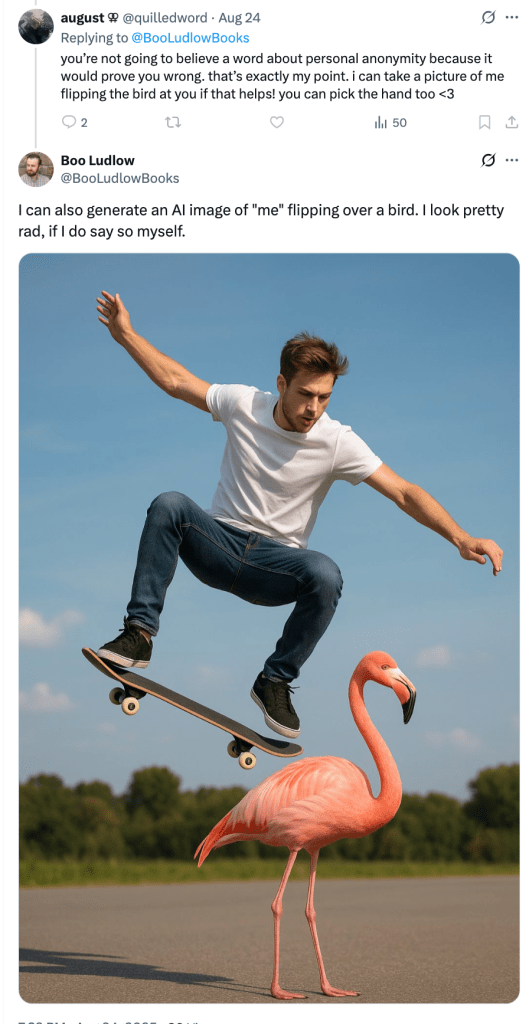
Let me tell you, I had a good laugh—and, for me, it took all edges off of the interaction. (The internet jerk continued to be annoyed, for some reason. Must have no sense of humor.)
You can choose to take offense when people are mean, or you can exercise your creativity and make things silly—take all the wind out of their sails. You don’t owe jerks on the internet legitimate responses, after all. They have no claim on you.
(Ignoring them is also an option, but more on maximizing the effectiveness of ignoring later. Here’s a hint: it involves the Block option.)
— Don’t Take Yourself Seriously —
This kind of goes hand-in-hand with the previous point… But don’t take yourself too seriously. It’s okay to make fun of yourself (in good humor), just as much as it’s okay to make fun of the cancel mob. (Which is to say, very okay.)
Part of the reason this is important is because people are going to mock you. Personally. Never before in my life have I had my hairline mocked, but once I got canceled I had people telling me I had a bad hairline and worse things besides.5 Truth be told, I do think my forehead is a little large—but so what? Nothing they say matters—but every comment they make is engagement.
No such thing as bad publicity, right?
Not taking yourself seriously also gives you the opportunity to connect yourself to other events going on in a positive way. Have you heard of Orc City? A bunch of people tried to cancel John A Douglas for writing a book with an orc protagonist and an orc city, and he rode the cancel wave into… Well, I don’t know where he started before all this attention fell on him, but to my knowledge he made hundreds if not thousands of sales—so when someone mocked my writing by saying:
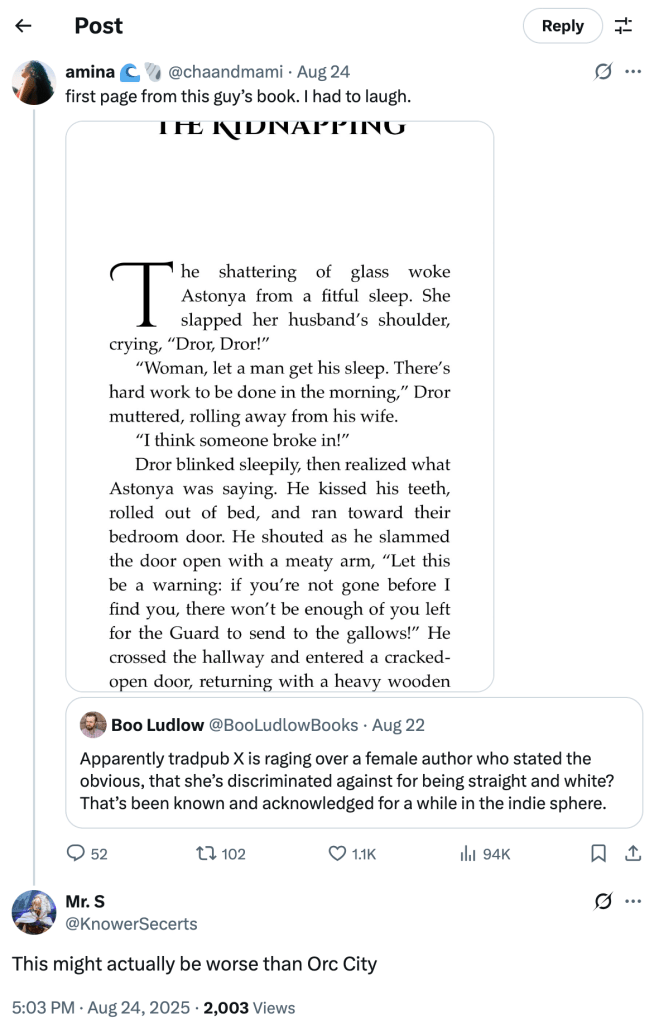
I responded with this:
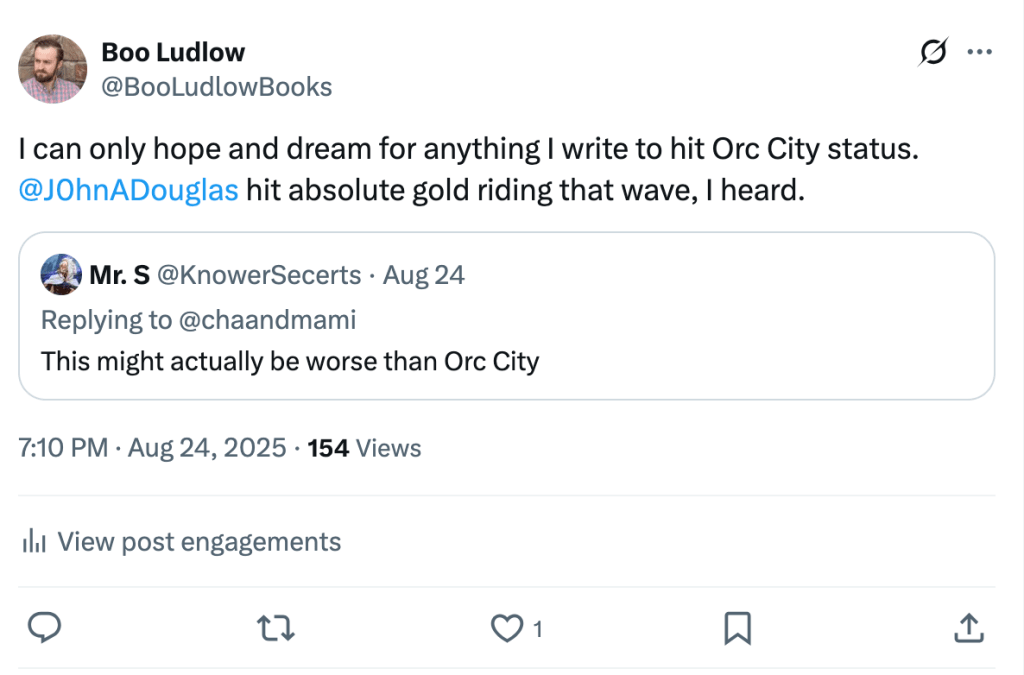
And then—even better!—Orc City man himself rode in like Gandalf on Shadowfax at the coming of dawn:
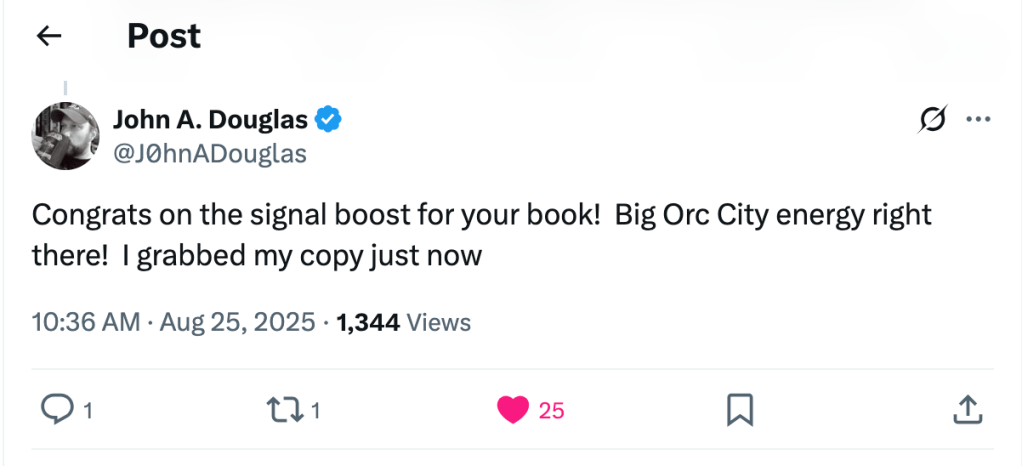
If I’d rejected orc city energy—and what a foolish thing that would have been—what good would that have done me? Instead, I got Orc City Douglas, with his massively larger-than-mine audience, shining a spotlight on my and buying a copy of my book. It was an extremely uplifting moment.
— Know Your REAL Audience —
Now, thus far I’ve been focusing on silliness, primarily—making jokes, taking things lightly, connecting yourself to memes—but making legitimate, well-reasoned responses to criticism is both a valid response and a good response. Just keep in mind that the people you’re directly responding to—the cancel mob haters—are not your real audience.6
Your real audience is everyone silently watching your interactions.
The people who give you hate, that are part of the cancel mob, will not have their minds changed by anything you do. Period. Engaging with them with the intent to somehow make them see things differently will fail every time.
The below comment is the type of statement that shows someone’s mind is completely closed:
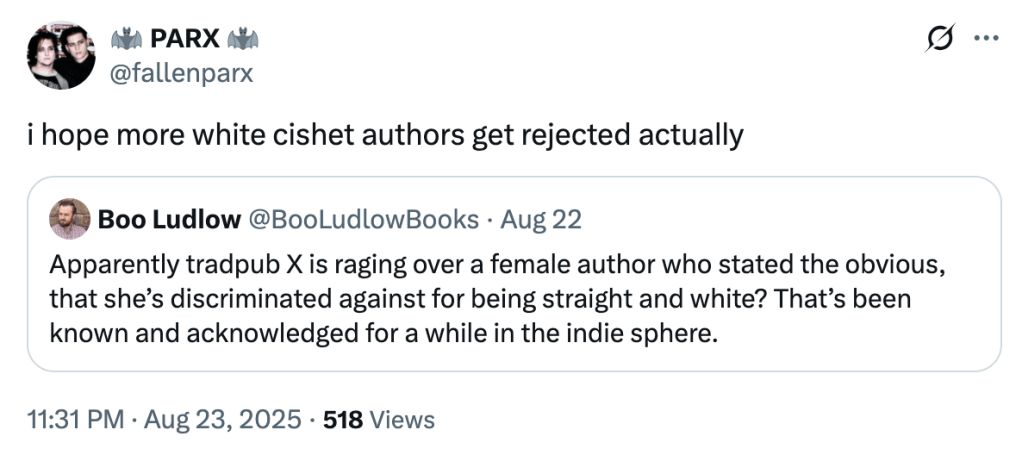
Your real audience is watching these people make asses of themselves and watching how you respond. They are watching, whether you choose not to respond, whether you choose to directly engage with these people, whether you choose to use a comment made by one of the haters as an example when directly addressing the peanut gallery, or any combination of the above. And how you respond will appeal to some people and repel others. That’s okay. Most likely your ideal audience will self-select in these moments of pressure, which helps remove the risk of you ever being turned on by your own tribe down the line. (In times of trouble you find how who your friends are, sort of that line of thinking.)
So in your every interaction with the cancel mob, I cannot recommend highly enough that you recognize you are not actually responding to them. Even if you are literally, directly responding to a mean comment with a generated image of a guy flipping a skateboard over a flamingo. The mean guy who is still going to hate me even after that instance of sidesplitting humor? He’s probably going to hate me even more, actually. but the Twitter scroller who saw my response and decided to follow me, or check out my website, or even buy my book? THAT GUY is the real target. You might say he’s…

— Market Yourself —
The most bizarre thing happened when the cancel mob came for me… I got free advertisement.
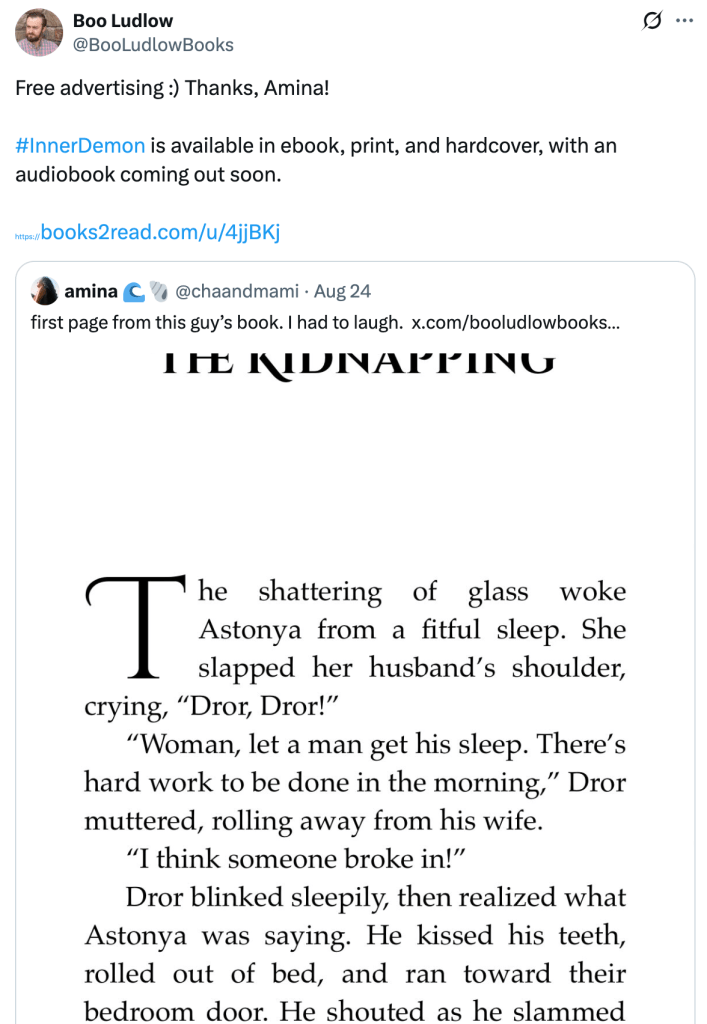
Sure. Amina wasn’t being nice with her comments. And a lot of her audience responded in pretty mean ways, too. But it still got eyes on my book. It still got my writing in front of people who might not have otherwise seen it. Sharing her post and posting a store link to my book was an opportunity to both show a good sense of humor and direct people to where they could get my book. It also resulted in comments like this:
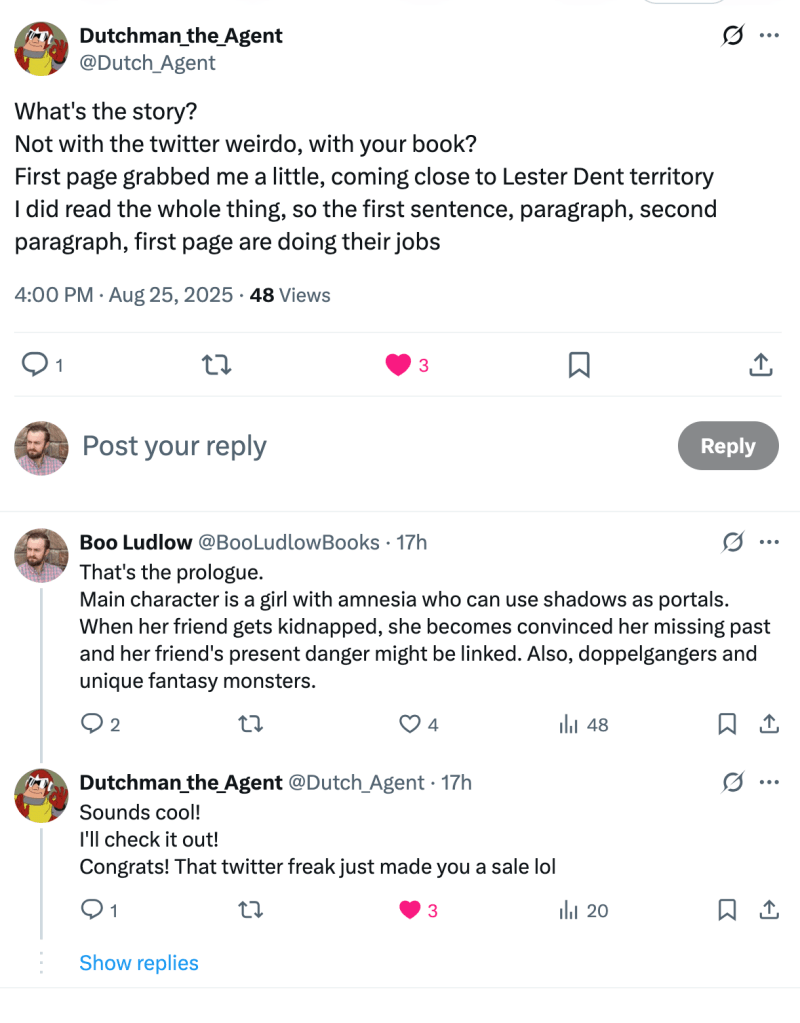
That twitter freak just made you a sale lol
If nothing else, sharing Amina’s rude review got me at least one sale, and that’s simply awesome. That’s one more sale than I would have otherwise.
And the sky is the limit on how you decide to take advantage of a cancel mob, at least with regards to getting your books sold. Posting sales links wherever you can is just one option. As another, my friend Gregory Michael7 recommended I do a flash sale—briefly put my books for free or at a steeply discounted price—and bring that up at every opportunity. I almost did that, then I remembered I already had chapters from my book freely viewable on my website, so I decided to emphasize that instead.8 I don’t know which response would have been better for me in the long run, but I made a decision and ran with it. (Probably the best decision would have been to do both, but I only have so much time and so decided to go full-bore with the one already mostly set up.)
To be honest, writing this blog post is also another form of self-advertisement. It gets people to check out my blog, become more familiar with me, and perhaps give my stuff a try. I’m still being genuine and offering these lessons and observations freely—but the hope is these cookies will entice people to stick around.
(You know what, I’ll make things easier for you and just put the Subscribe bar right here for you:)
— Know Your Limits —
As you’ve probably already noticed, the cancel mob can range from petty to downright hateful. Not everyone will enjoy grappling with them, not everyone is capable of shrugging off insults (even from people who don’t deserve the dust on your shoes), and not everyone wants to deal with this sort of thing.
My first comment there: Until you’ve experienced something like this, you don’t really know what you’re capable of. To be totally honest, I was terrified when this cancellation process began. I chose to grapple with it, but since I’ve largely avoided politicized topics as an author (but not entirely…) I was afraid I would scare away what little audience I had. Instead… my audience grew.9
My second comment: The Block option should quickly become your best friend.
Yes, you can Block the cancel mob into oblivion. If they can’t see or interact with your content, they can’t give you hate, and you don’t have to see them anymore.
And, again, this cannot be emphasized enough: You don’t owe the mob anything. If given the opportunity they may call you a coward for blocking them, but such efforts are solely a tactic on their part to tear you down and destroy you. They are like the demons in Frieren. They deserve absolutely nothing from you whatsoever, except perhaps your scorn.
For me, I found my balance was to engage with the cancel mob while it felt productive, and then generously Block them all. I got what I wanted from them, which was a ton of free publicity. And now I never have to see or interact with them again.
— Be Genuine —
This is the observation I’m having the hardest time wording quite right, because being genuine can mean a lot of different things in different contexts. Everyone chooses to present themselves in a certain way on the internet—some people, like The Lord Otter, appear to be fully a persona for an unknown person, while other people try to represent more directly as their real-world selves (I’m pretty certain Larry Correia safely falls into this camp). Still other people, like Alyssa Hazel (so far as I can tell) fall somewhere in the middle. You might not even yet know who you are in an internet context.
Whoever you are on the internet, just do your best to be true to it. I recommend not actively seeking out controversy—people can usually tell if an outrage has been manufactured—but don’t shy away if it finds you. You goal is to build an audience, after all, which means they are following you—so be you, whatever that is, and sell you, hopefully the best version of it. The peanut gallery will take notice, and the ones who want to will stick around.
Note that being genuine doesn’t have to mean being nice—or anything else. Hopefully you have flavor and variety to yourself, along with the usual ups and downs everyone has. As long as you keep in mind your audience, you should be fine.
— No One is Real —
While I do fully agree that bots are a problem on the internet, I don’t subscribe to dead internet theory. There are real accounts with real people on the other side. But at the same time… no one is real. After all, we were just talking about internet personas, and even people who try to represent themselves as themselves are still putting on somewhat of a show.
Remember that comment from me, earlier, where I generated in image of a guy doing a kick-flip over a flamingo? Earlier in that conversation, the cancel mob guy—August—claimed he was White and Appalachian, and tried to use his identity to put me down. Of course, I have no way of knowing anything he said was true—his account is of an anonymous guy on the internet, featuring a cartoon character as his profile pic. He could say literally anything he wants about his identity, and I would have no way of knowing. He could even have a picture of a White Appalachian guy as his profile picture, set his address to somewhere in Appalachia, and claim everything he said was true, and I’d still have no way of ever knowing, for certain, without meeting him in person. Anyone can create an account on most websites and claim nearly anything, after all, and generative LLMs make it pretty easy to fake “evidence.”
So guys like August are especially what I’m referring to when I say that no one is real on the internet. August could be an angry, Chinese, twelve-year-old girl living in Jamaica, for all I know. Or an Indian paid by an NGO to make angry comments on Twitter.
To be fair, for some people it would be a lot harder to ascribe that level of fakeness to their claims. Since I’ve already talked about John A Douglas a bit, I’ll use him as an example—if I ever have the opportunity to meet him in real life, I’d be very surprised if he weren’t the White, bearded, coffee-loving guy he presents as in his profile. But I still know he’s presenting as an author trying to sell books on his profile, which is going to be, at the minimum, a different side of him than the side his friends and family are most familiar with.
Note that this is not an argument to do hateful things, like doxxing. Just because no one is real on the internet isn’t an excuse to cause real-world harm.
But just remember—with the cancel mob especially, as that’s the main focus here—they are all phantoms and have no claim on you.
I sincerely hope that you have found all of this useful. Getting cancelled was an eye-opening experience for me, and it made me want to turn around and help others who might go through the same experience.
If you want to support me, there’s a lot of ways to do it! Free methods involve subscribing to my blog or following me on X/Twitter. That said, I am an author, and I think my books are pretty good—if you like sci-fi or fantasy, it might be worth your time checking them out and considering buying one!
- Jordan later reached out to me and I found out that she seemed like a pretty swell person. I look forward to when her YA dystopian novel gets published, however she goes about it. ↩︎
- You can also learn more about it on Kristin’s SubStack. ↩︎
- Some of these things I figured out myself, but the vast majority I learned from observing Devon Eriksen, Larry Correia, and Kristin (whose last name I can’t easily find, so I’ll assume she doesn’t want it out there and respect that). ↩︎
- As a side note… does being called a racist actually mean anything anymore? That insult is doled out so casually I’m surprised anyone feels it. The same thing is happening with “nazi.” The terms are becoming so far divorced from actual reality that they are about as meaningful as calling someone a doofus. ↩︎
- Another thing worth considering: If all the cancel mob can do is attack you personally, particularly superficial things like your looks, then you know they have nothing. Ad hominem is the last resort of people who don’t have anything meaningful to say. ↩︎
- More than anyone else, this lesson was taught to me by observing Devon Eriksen. ↩︎
- He’s the legend behind the Stellar Heist books, Chloe’s Kingdom and The Lost Colony. ↩︎
- Speaking of which… You can read several Inner Demon sample chapters here, and the full text of The Failed Technomancer here. ↩︎
- Please note this does NOT mean I plan on changing the focus of this website to political commentary, or doing anything ridiculous like that. I might let myself wade into the mud a little more on Twitter, but my blog will remain focused on reviews, relevant articles, and entertainment. ↩︎

 Boo Ludlow
Leave a comment