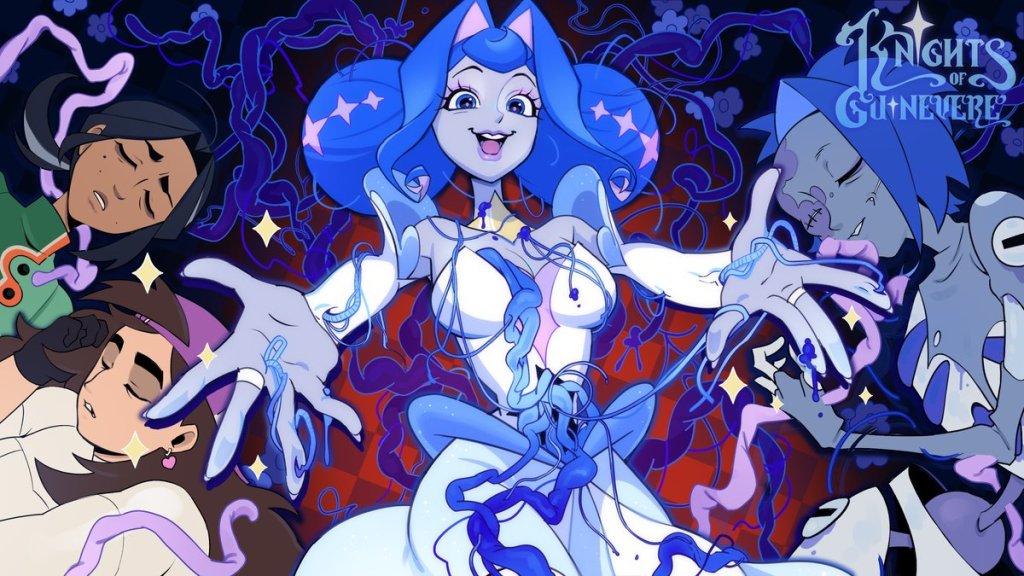
Glitch is back, and I’m really hopeful for this swing to be a home run. Today I’m talking about Knights of Guinevere (KoG).
Knights of Guinevere Overview
What Is It?
Knights of Guinevere is a psychological thriller that welcomes you to a planet-wide theme park in the clouds!… and the shadows below, where a broken Princess Android is two dreamers’ tickets to better lives, or the end of them.
In my own words—Knights of Guinevere, the Pilot, is an engaging, mystery-driven episode of animated science fiction with fairy tale elements that give it a sense of wonder. Splashes of horror, most notable in visual design, give specific scenes and characters a strong sense of dread, tension, or tragedy while upping the stakes and demanding that you keep your eyes glued to the screen. Intentional juxtaposition between a dystopian world and a clean, perfect, fairy tale fantasy helps keep things fresh while the story moves along at just the right pace.
Who Made It?
Knights of Guinevere is Glitch Productions’ fourth major project—and, notably, its first 2D-animated project. Glitch’s other projects include Murder Drones, The Amazing Digital Circus, and the Pilot for The Gaslight District (which I reviewed previously).1
Three writers are credited as the creators of Knights of Guinevere. The first is Dana Terrace, best known for creating The Owl House and for her semi-infamous falling out with Disney. The other two are John Bailey Owen and Zach Marcus, both of whom worked with Dana as staff writers for The Owl House but also have other projects to their names (such as staff writing for Star VS the Forces of Evil for the latter).
Content Warnings?
The Pilot content most likely to be offensive to viewers is the swearing, up to and including f—. To those for whom this matters, the writers of The Knights of Guinevere actually have creative vocabularies, meaning the swearing feels pretty naturalistic and is not a constant barrage—unlike, say, Hazbin Hotel.
The second most likely potentially offensive elements in the Pilot are disturbing images. There are multiple scenes where human-like animatronic creatures display “injuries” with blue “blood” and, in one instance, intestine-like internal features. There is also an android who looks mostly human and is clearly very damaged; there is also the suggestion that she, maybe, has free will and and may have been trapped and tortured for decades, psychologically and physically—again, these items are only suggested or hinted at, but the implications may be disturbing to very sensitive viewers.
Human violence and injury is minimal in the Pilot. One human character breaks her arm, but (despite some blood) depiction of the injury is not graphic—to the point where I wasn’t initially certain whether or not her arm was actually broken. Another character is seen coughing up a blue substance and is clearly in poor health. A third character bites a man’s hand and gets punched in the face. There’s the suggestion that a cruel man punishes insubordination by pulling out the teeth of his inferiors, but there’s also the suggestion this only occurs in response to the most extreme infractions. To emphasize, this is merely implied—at no point do you see a character ripping another character’s teeth out.
The Short Review (Spoiler-Free)
I really, really liked Knights of Guinevere and I really, really hope that Dana and her team are successful in their high ambitions for this show.
I first learned about KoG through its trailer, which I’ll share below.
I was initially skeptically intrigued. The trailer promised a creepy experience, weird animatronics, and a sci-fi setting that might be unique, despite the general idea having been done multiple times before—that general idea being sci-fi dystopia with a heavy focus on theme parks and animatronics made creepy or horrific.
But that’s really not what KoG is. That’s all set dressing. What KoG really is, or at least what I gathered from the Pilot, is a modern fairy tale about a princess trapped in a tower and in need of rescue by a heroic, dashing knight. (Or, in this instance, knights.)
Now, modernized fairy tales are far from original. In fact, some might say they are overdone, having been the zeitgeist once upon a time… pun fully intended.

KoG manages to stand out from other “modern” retellings by being its own thing—using ideas of knights and princesses in towers as archetypes and not the whole. It’s not here to retell any specific fairy tale, or use an existing fairy tale setting as a jumping-off point for an expanded world or effort to deconstruct former narratives. Some roles are twisted from what you might expect—for example, I have every reason to believe the real princess trapped in the tower is the escapee princess android, not the human girl literally trapped in a tower and surrounded by creepy animatronics—and the story and setting belong to no previously existing fairy tale, at least to my knowledge.
And, of course, all of these elements are wrapped into a mystery that I’ll avoid touching too much on—but it makes me really excited to see future episodes.
Everything I’ve mentioned is further elevated by KoG’s strong sense of identity. The designs all look great and like they belong in the same world, despite differing elements having wildly differing tones. The characters—where they live, what they do, what they think about—are believable and make the setting feel both possible and, at times, real. The fairy tale archetypes don’t feel forced, but feel like a very natural part of the world and story.2 In short, everything comes across as extremely well thought-out and excellently executed.
Another thing that impressed me in KoG—well, to expand a bit on something I mentioned earlier, Dana Terrace (one of the creators of the show) had a falling out with Disney while working on The Owl House. Based on what I’ve read, it’s nothing that would surprise you—creative differences, executive meddling, a popular TV show killed before its time, and a promising young creative burned by a mega-corporation. Anyway, you can feel and see heavy criticism and parody of corporations (most notably Disney) deep within the structure of KoG, but at no point it is preachy or heavy-handed. In fact, as I mentioned with previous elements, everything feels like it naturally fits together and belongs. It’s refreshing to watch a show that feels like the creators have something of depth to say while putting stories, characters, and world integrity first. I hope KoG continues that way!3
The animation is attractive and distinctive. The voice acting is largely well-done. The music and sound design was excellent—in particular, there’s a scene where Frankie and Andi are being hunted, where the discordant sound plays just loud enough to be heard (and put me on the edge of my seat).
Speaking of Frankie and Andi, the characters promise to be extremely engaging—and given that the characters are usually the heart and soul of any story, that’s an incredibly important element to get right.

Frankie and Andi play off of each other very well—they are distinctive visually and have highly differing silhouettes, making it easy to instantly tell them apart even when they aren’t clearly visible. Their personalities and drives are just as different as their visuals and sometimes clash, but you can still easily see why they are so close with each other. In the Pilot, it was easy to see that Frankie is likely to be a common instigator for events show continues, with Andi set up as a good foil for Frankie. I found myself liking Frankie almost instantly, while it took most of the Pilot for me to warm up to Andi.
Oh, one last thing: I found that the fairy tale elements of KoG helped create a sense of wonder that I don’t often feel in sci-fi or thrillers. It was small, it was mostly isolated to moments in one specific scene—when the giant knight attacks—but it made me really hopeful that this show might be able to successfully exploit feelings more common in fantasy than science fiction while still being excellent sci-fi.
The Extended Review (Spoilers)
Knights of Guinevere kicks off with one of two perspectives that you’ll follow in the Pilot—the secondary perspective, one focused on a girl named Olivia who is trapped within the “castle” of a massive amusement park. At first it appears that Olivia is the princess trapped in the tower. Her father appears to be the CEO (or equivalent) of the amusement part, putting him in the archetypal position of a king; he also admits to her being essentially trapped where she is as the result of something that he doesn’t want to mention explicitly, so as not to upset her.
A major mystery to kick things off. What happened to Olivia that can’t really be talked about, that resulted in her being locked away from the world, her only companion a human-sized and -shaped robot named Guinevere?
Well, Guinevere quickly steals the spotlight. Olivia mentions that Guinevere is broken and that she will fix her—it’s really creepy, the girl’s deadpan expression and somewhat monotone voice, in a beat where she’s hovering over Guinevere, doing something to her stomach that we as the viewers can’t see.

The shocking reveal of the true(?) nature of this situation is revealed a little later when the camera moves just enough to finally show us Guinevere’s stomach, which is sliced open with something that looks like blue intestines spilling out. Olivia then picks up the end of one of these “intestines” and tugs on it, treating Guinevere much like a dog on a macabre leash.
No, Olivia, as broken and in need of saving as she is, is not the princess trapped in the tower—Guinevere is. And we have every reason to believe that Olivia’s every effort to “fix” Guinevere only damages her further.
Guinevere is initially totally submissive to her masters, but, in a moment of lucidity, she attempts to escape by jumping off of the tower, her entrails flowing behind her like a kite’s tail as she plummets toward the ground far below. Olivia and her father are unmoved; Olivia simply comments that the guards will collect Guinevere, and that Olivia will fix her better this time.
It’s a fantastic opening segment that sets some strong expectations of tone and content and asks some really compelling mysteries. What happened to Olivia that we can’t mention? Is she a villain, or something more tragic? What’s Guinevere’s true nature? What’s the true nature of this planet theme park?
And, to a lesser extent—what’s up with the creepy, blue, blood-like substance that coated Guinevere’s insides?
I’m excited to find it all out. My current suspicion is that the event Olivia’s father hints at is related to Olivia’s mother—all little girls have a father and mother, after all, but Olivia’s is entirely absent from the Pilot. It also makes me curious if Guinevere is, in some twisted way, Olivia’s mother, or if she’s some other poor soul who was turned into an android and made to be both the mascot of this theme park and Olivia’s personal plaything.
Following this scene, the perspective of the Pilot shifts to follow Frankie and Andi for most of the rest of the episode. We first see them as little girls wandering the park as they attempt to win a Space Princess Guinevere doll from a claw machine—with no success—and then encounter Guinevere herself. At this time it’s unclear if the Guinevere they encounter is the same Guinevere we saw in the first scene—the hair is different and the body far curvier—but she’s suffering from a malfunctioning finger that Frankie quickly fixes, instantly earning Guinevere’s friendship.
Time flashes by. When we meet up with Frankie and Andi again they could be late teens or early-to-mid twenties. They live together as roommates. Andi is stressed and overworked, employed directly by the park as a mechanic doing repairs for park animatronics. Frankie admires Andi’s work and deeply wishes the two of them could work together; she hopes one day to get a chance to apply for a similar job. In the meantime, Frankie works at the park’s merchandise manufacturing plant during the day and, in the evening, works for a salvage crew who collects the park’s trash and sorts through it for anything recyclable.

These important scenes set a good pace and create good foundations for Frankie and Andi as characters, as well as give you basically everything you need to know about the world without feeling like exposition. It’s really good, efficient storytelling, with every scene accomplishing multiple things at the same time without feeling oversaturated.
Frankie is energetic and enthusiastic; she appears smarter than the people around her give her credit for, but doesn’t necessarily have the right kind of personality to fit in easily. She also might be diagnosably insane, as she has three hologram-like cartoon characters that appear to live in her head and sometimes talk to her.
Andi, meanwhile, is a bit neurotic, much more straight-laced, and no longer fits in with the people she grew up with because she works for the park now—they call her a “crownie” and shops refuse to serve her, while random people spit on her in the street.
The world itself is bleak. While the park is kept pristine for visitors, the people who live on the planet below are surrounded by pollution, trash, and vandalism. It appears that people have to work hard at multiple jobs just to scrape by. The wealthy corporation that owns the amusement park appears to rule over the planet like an authoritarian government and the people who live there are extremely resentful of that fact. This resentment probably isn’t helped by the fact that the corporation appears to have nearly extracted all useful resources from the planet, given the market niche for enterprising individuals who sort through the park’s trash and sell the choice bits to local factories, giving them the resources to churn out yet more merchandise.
Oh, and let’s not forget that a strange, blue substance is making many people incredibly sick—and is used by others as a drug.
The scene-setting ends and the main conflict kicks off when, while trolling for trash in a lake, Frankie discovers a badly damaged Guinevere android. She’s immediately taken by it—not only is this her chance to fix up an android and possibly earn her way into being hired by the amusement park’s governing corporation, but a weirdly malfunctioning finger on the android sparks memories of a time she met Princess Guinevere in the park long ago. Unfortunately for her, all salvage she finds is owned by her boss, a one-eyed man named Sparky, who wants to scrap the android and sell it for parts. (It’s later revealed Sparky is interested in expanding his operation into drug trade, but that isn’t relevant again this episode; it’s probably setup for some future plot thread, but it could just be more establishment of the setting.)
There’s a brief shift here, back to Olivia’s perspective, which confirms that the nearly destroyed Guinevere that Frankie found is the same Guinevere we saw in the opening scene. We see Olivia, now an elderly woman and bedbound, being administered to by… Well, I initially thought they were animatronics, but they could also be nurses dressed up as theme park mascots. Either way, they give strong Five Nights at Freddy’s vibes and are pretty creepy.

They inform Olivia that Guinevere escaped again and “made it to the surface this time.” Olivia, for her part, appears to be genuinely distraught—she insists that Guinevere must be found again and that, this time, she’ll fix Guinevere right. The nurses ask if the guards should be sent, but instead Olivia requests they send “him”; the camera slowly pulls back to reveal a massive robot with a gigantic sword and a creepy smiling face.
Cue an excited grin on my face.
This scene confirmed a pretty massive time jump between the opening scene and when Frankie finds Guinevere—maybe around seventy years. It also confirms that Guinevere has been essentially tortured that entire time, her many attempts at escape all failures. Finally, it led me to believe that Olivia is mostly likely as much a victim of whatever insanity is going on behind the scenes at the park as maybe even Guinevere. Either way, I’m quite curious to see where this all goes, and whether or not Guinevere and Olivia will be reunited again.
The rest of the episode is from Frankie’s and Andi’s perspectives. Frankie tells Andi about the Guinevere android and persuades her to help her steal it and break into the park’s lab’s so they can use some top-of-the-line equipment to fix up the android. Before they can enter the lab, though, Sparky confronts them and beats up Frankie for her thievery; before Frankie gets too hurt, however, Andi persuades Soarky to let them go. There’s way more money in a fixed android than a scrapped one, after all, and Andi has access to the labs.
This scene is where the majority of my criticisms with Knights of Guinevere pile up. Andi reveals that she’s been fired from her job (so, while Frankie has more idealistic motivations, Andi is just looking for cash)—yet she still has access to sensitive park labs, for some reason. I understand this is a sci-fi world, and perhaps this detail exists to suggest that the park’s bureaucracy is poor, but all I know is that I’ve been fired in real life and I knew it before my supervisor called me about it because I was locked out of my computer and everything else when I tried to log in that morning. In short, if Andi’s firing had gone anything like mine, all her access permissions should have been revoked, especially hours and hours after the fact.
But that detail is a little nit-picky. Here’s what I really thought was the weakest part of the Pilot. Sparky. I didn’t like him at all. His character felt, in many ways, like a parody of the archetype he was drawing upon. He was cranky, he was angry, he was cruel, but I didn’t feel any substance behind it. And maybe that’s the point—some people are just bad and there’s no good explanation for it. All the same, something about him felt half-baked. It doesn’t help that I felt his voice acting was the weakest of the whole cast—the gritty, raspy old man voice felt too fake, like the actor was trying too hard.
After persuading Sparky to let them go with the android, Frankie and Andi enter the bowels of the park’s laboratories with the intent of fixing up the android. And that’s when things get really interesting.
Up until this point, Guinevere had been totally lifeless—staying in whatever position she was put in, smiling blankly forward, eyes unblinking. But then, while traveling through a really creepy storage area, she surprises the girls by suddenly screaming. The giant knight-like robot that we saw earlier with Olivia appears and attacks. Frankie and Andi are horribly outmatched, struggling just to barely survive. There are some absolutely amazing visuals in this scene, coupled with incredible music and sound design that left me feeling like I was right there next to the characters.


Frankie and Andi are pretty badly beaten up, but they manage to crawl into an elevator in an attempt to escape, Andi totally willing to leave Guinevere behind—but before that happens, Frankie has what could be a hallucination, or an out-of-body experience, where she sees the holograms in her head and Space Princess Guinevere exactly as she was when Frankie first met her as a child. Guinevere talks to her, first asking her if she’s lost her parents, then offers to help protect her from the giant robot. The jarring transition from the idealized, fairy tale images we see in Frankie’s head to grim, gritty, bloodied reality really drives home the danger and desperation of the moment. Frankie and Andi enter the elevator… the doors close… We hear sounds suggesting at incredible violence, along with a lot of blood-like liquid getting thrown about… Then the elevator door opens and the giant robot appears dead, Guinevere standing there as lifeless as usual.4
The Pilot ends with Frankie and Andi dragging Guinevere to a repair station. They throw the android in and begin initiating repairs—for a moment things appear fine, but, based on the warning signs that cover the screen, something goes wrong. Then the episode ends with an idealized image from Guinevere’s perspective, where a clean, clear sky is visible, and Frankie and Andi are smiling down at her, looking like the girls they were when they first met Guinevere.
Then the credits roll.

I was absolutely hooked. I had to know what was going to happen next. I have to. Unfortunately, given Glitch’s pace with other shows, that might not happen for weeks or months.
Oh well. I will wait patiently, for Knights of Guinevere has my attention.
Wrap-up (Spoiler-Free)
I have a lot of praise for Knights of Guinevere, but I need to temper some expectations—it’s not perfect. The animation is really good, but it still has isolated moments that are stiff or weirdly floaty. As well-designed as everything is, I still (initially) really didn’t like Frankie’s design, and it took a while for other things to grow on me.
And, of course, there were the issues I had with just about everything surrounding Sparky. I really hope that character significantly improves, or that he doesn’t show up again.
Again, I say all of this to temper unrealistic expectations. Knights of Guinevere is far from perfect, and it’s certainly not for everyone, even hardcore Glitch fans. But I found this Pilot to be incredibly promising and I can’t wait to see how the show develops.
Enjoyed this? Consider subscribing below! Or, if you want a completed fantasy story that also features young women struggling against creepy, shadowy forces, consider giving my book Inner Demon a try.
- In quick summary: I thought Amazing Digital Circus was amazing; I had a hard time getting into Murder Drones, but a part of me is curious to try it again; and I really wanted to like Gaslight District but just couldn’t. It had way too many pacing issues, among other things. ↩︎
- Attention to detail really helps in this area. For example, much of the world outside the park still features park mascots built into everything—a faucet designed to look like a cartoon elephant, or a crane designed so that it’s arm sticks out of a unicorn’s head as the horn, etc. These little things are easy to miss if you don’t care to look at the background but really emphasize setting in a subtle way. ↩︎
- Something that amused me—KoG also appeared to be very critical of merch and swag culture. Considering Glitch’s financial lifeblood is, to my understanding, merchandise and swag, well, I have to wonder if the suits at Glitch were laughing at themselves as they first read through the Pilot’s script. ↩︎
- The fact that the robot’s smiling mask-face was still alight leads me to believe it’s not really dead yet. It’s coming back, scarier than before. I’m convinced of it. ↩︎

 Boo Ludlow
Leave a comment