It wasn’t that long ago that, if asked about the Amerindians (or Native Americans, or just Indians—in this blog, we don’t have a strong preference which you use), most Americans would have a mental image more or less like the below:

To use words instead of an image, some people might have described them as a people “one with nature,” or maybe “peaceful and wise.” The general idea was that Amerindians were a people who may have lived primitively, but they made up for their technological lack with a seemingly inborn wealth of spiritual or natural wisdom—in fact, this lack of technology was often pointed at as one reason for such wisdom. Such people might have even argued that such spiritualism was superior to Western technology, although the same people were nearly universally unwilling to forsake such technology and live like the ancient Amerindians to gain this fabled wisdom.
Time and improved education has done a lot of good work to correct such ahistorical perspectives. The Amerindians can be most neutrally described as humans, just like any other culture, with the all the strengths, weaknesses, and peculiarities that entails. There were good ones and there were bad ones, relatively speaking; a constant among most tribes, however, was a warlike demeanor and a strong bloodlust, particularly among young males with nothing to lose and everything to prove. Hygiene was usually poor, as were life expectancies; depending on what you view as spirituality, perhaps the one generally accepted truth about the Amerindians that was accurate was that they were a deeply spiritual people (although I’d personally prefer the description superstitious), with firm cultural traditions that changed very little, if at all, across the millennia.
As for being “one with nature”? If living primitively counts as being one with nature, then Amerindians fit the bill; but in all other ways they exploited the natural environment and the creatures living within it to the best of their abilities, just like any other culture that has ever existed in human history. A lack of knowledge, as well as cultural rigidity, slowed down their ability to exploit their natural resources to the full extent of their contemporaries on the other side of the globe, but agrarian development among various Amerindian tribes proved that, given time, they would have eventually reached the same stages of development other peoples had centuries or millennia earlier, and certainly would have continued exploiting natural resources in if not the same then comparable manners.
But why am I talking about all this? Aren’t I usually focused on reviews of various cultural artifacts, with a focus on books and other forms of storytelling, the occasional article that gets a little more philosophical? Why talk about history now?
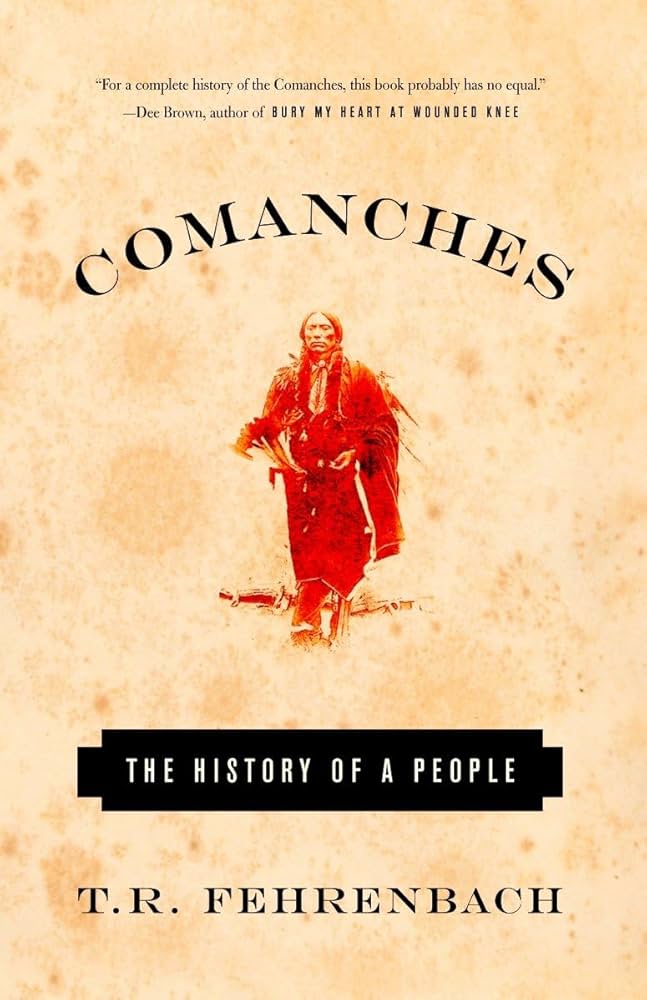
Well, the truth of the matter is that sometimes a well-written history book can be just as engrossing a read as the best fantasy novels, although usually for completely different reasons. As well, wise authors draw upon many sources for inspiration, ranging from their own genres to all the way across the fictional divide into the realm of nonfiction. I learned a lot from Comanches which I plan on putting to use in future novels.
Also, I enjoyed the book, and I think other people will, too. So I want to share my thoughts and experiences with it, making this less of a pure review and more of just a recommendation.
What this is not is a review of historical fitness. So far as I am aware, the author of Comanches, TR Fehrenbach, did his due diligence and created as accurate a record as can be compiled for an ancient people with no written histories, whose oral traditions were largely lost for generations before (Western, notably) historians tried to record and piece together what they could, whose modern ancestors poorly understand their own history (and often try to whitewash unlikable elements). In short, I think the man is trustworthy; what’s in this book appears to align with other records that I understand to be true, so I’m generally accepting the historical accuracy of this book at face value.
Overview of Comanches: The History of a People
What is It?
Authoritative and immediate, this is the classic account of the most powerful of the American Indian tribes. T.R. Fehrenbach traces the Comanches’ rise to power, from their prehistoric origins to their domination of the high plains for more than a century until their demise in the face of Anglo-American expansion.
Master horseback riders who lived in teepees and hunted bison, the Comanches were stunning orators, disciplined warriors, and the finest makers of arrows. They lived by a strict legal code and worshipped within a cosmology of magic. As he portrays the Comanche lifestyle, Fehrenbach re-creates their doomed battle against European encroachment. While they destroyed the Spanish dream of colonizing North America and blocked the French advance into the Southwest, the Comanches ultimately fell before the Texas Rangers and the U.S. Army in the great raids and battles of the mid-nineteenth century. This is a classic American story, vividly and poignantly told.
Comanches is a historical account of the Comanche people, although the book is not afraid to wander far and wide in describing a multitude of Amerindian tribes and other peoples contemporary to said tribes, such as the Spanish, French, and Texans (and Americans). The book begins as far back as when stone age humans first entered the American continent, recreates what life would most likely have been like for such peoples (as far as historical record will allow us to guess), and, in broad strokes, describes the development of these peoples into North, Central, and South American tribes and nations, narrowing in on the Comanches as they developed into the warriors and master horse-riders they are most commonly known as today, building on this record all the way up until the haunting final death of the Comanches as a wild, self-governed people.
Who Wrote It?
“Theodore Reed ‘T. R.’ Fehrenbach, Jr. (January 12, 1925 – December 1, 2013) was an American historian, columnist, and the former head of the Texas Historical Commission (1987–1991).” (Quoted from Wikipedia.)
Fehrenbach has written many other histories, including the history of Texas and the history of the Korean War (which, it appears, was held in particularly high regard).
Content Warnings
Comanches is a historical record. It doesn’t glorify the atrocious acts committed by ancient, savage1 peoples (and that were committed back upon them, if to a lesser degree, by non-Amerindians), but neither does it shy away from the gory details of war, torture, and rape; these horrors are given proper impact (and historical context) without reveling in them. In short, this is not the book to read if you want a sanitized record, nor if you want a record that only lightly touches on acts of heinous evil (and grim practicality) committed by real peoples.
My Thoughts and Experience
I first learned about Comanches: The History of a People from the YouTube channel Elephants in Rooms.
The video was extremely informative and, relative to the size of the sources it was drawing on, concise; I wanted more details, and I wanted them badly enough that I went out and bought the book.2 Thanks, Ken LaCorte!
To make a long story short, Comanches was an extremely eye-opening book for me. I already knew that ancient Amerindians were very warlike, a far cry from how they tend to be represented by modern culture, but I wasn’t fully prepared for the extent of the atrocities they had committed, as well as how casually they approached actions that their Western contemporaries had considered unthinkable for centuries.
Warlike attitudes varied from tribe to tribe in ancient America, of course, with a vanishing minority of more agrarian tribes becoming nearly peaceful, but no Amerindian tribe ever fully gave up at least a desire to earn glory through war—and those that got close were generally annihilated by their neighbors. (“Stealing” land and living on “stolen” land was the default for ancient Amerindians. Huh…)
For most tribes, spearing the infants of their enemies and watching the babies cry as they wiggled in pain; kidnapping the children of enemies to be raised as slaves (or, if strong enough, warriors genuinely accepted into the tribe); and raping the women of their enemies into submission—even young girls—were all considered acts of “bravery.” Warriors tortured captives to death on the war trail and captives brought home were tortured to death by the women and children of the tribe. Warfare usually prioritized burning homes and attacking women and children, rather than facing other warriors. The list goes on.
That all said, Comanches isn’t a harsh condemnation of the Comanches (and other Amerindians). Fehrenbach does a disturbingly good job at putting you into the heads of these ancient peoples, helping you understand what they believed and why, and giving you a good idea of day-to-day life—and the overall pattern of their harsh lives. The actions of these peoples are described without praise or condemnation, although carefully put into historical context; it is such that the reader can determine for himself what fair judgement ought to be, if judgement is merited at all. Frequently I found, simultaneously, a grudging respect and hatred growing for these ancient peoples: they accomplished incredible things relative to their few possessions and lacking knowledge, and that despite the atrocities they committed—atrocities that, it could be argued, they had some limit to moral culpability for, as they really didn’t know any better.3 I even found myself somewhat overcome by emotion in the closing pages of this book as I read of the aging Comanche warriors who, after living on a reservation for a time, hoped to teach their young men ancient arts of war and buffalo hunting—but then, after being allowed out onto the plains, waited, and waited, and waited as snow began to fall; the buffalo never came, signaling a death knell for their people that finally snuffed out the Comanche flame more effectively than any army ever did, or could.
Fortunately, Fehrenbach’s same neutrality (and recognition of strange, brutal nobility) and powerful respect of perspective is also extended to those non-Amerindians who were victims of Comanche depredations and then warred against them—most notably the Spanish (and later Mexicans) and the Texans (and later the American army)—who often discovered that they had to mimic Comanche tactics and mindsets to make meaningful warfare against the tribes.
Many chapters were suffused with a powerful sense of tragedy. It’s easy, as a modern man softened by modern comforts, to hold a historical record collecting in one body knowledge that most people of the time would only have scraps of and want to scream at how peace could have been forged between peoples, but to also know that such a thing was impossible. If my wife and children were raped and murdered, I would have wanted overwhelming justice and vengeance—and that’s exactly what the people of Texas (and other parts of the United States) sought, even if they sometimes targeted the wrong peoples. And even then I can’t blame them—again, few, if any, of them had the eagle’s eye view that this book provides, to say nothing of the pure distance from pain and tragedy of a modern reader. Seeing the full historical context, it’s more of a miracle that any Amerindians were allowed to survive at all.
Back to Fehrenbach, I often found myself frustrated with him for being a balanced historian. How could he record history so coldly, so directly, without at least a little bit of judgement as to who was in the right or who was in the wrong? Of course, to my understanding, that proves him to be a historian of high caliber, so my frustration is to his favor.
As well, most of the other issues I had with Comanches were, I suspect, not Fehrenbach’s fault. The man’s goal was to be thorough and accurate; if ancient Amerindians engaged in so much warfare that I sometimes grew bored of the repetition of this tribe fighting that tribe fighting this other tribe retaliating against yet another tribe endlessly, well, there’s not much else Fehrenbach could have done without summarizing history to the point of historical neglect. Similarly, if later sections of the book frustrated me by how much they focus on the Spanish, Texans, and Americans over the Amerindian peoples, I also needed to remember that the Amerindians didn’t keep records—and few people who interacted with the warlike Comanches wanted their ways recorded and preserved—so much of our modern knowledge had to be gleaned from accounts from non-Comanche perspectives, peoples usually in conflict with the Comanches.
I also found this book an exceptionally rich resource for one of my purposes for reading it, that being research. I don’t think going into detail on how this book helped me develop the rat clans and tribes of my mouse world is relevant to Comanches itself, but Fehrenbach’s ability to help me understand an incredibly alien perspective of life, and the very nature of reality, was invaluable, to say the least.
Some people are going to read Comanches and see the titular tribes as a noble, if brutal, people. Other people will read this book and, I think fairly, not care that this was a distinct people with a unique culture and perspective: they warred, they stole, they tortured, they raped, they lived by strength alone, and their neighbors constantly suffered for it. Such a people could only ever exist in one sort of balance with neighbors, and that balance is one ultimately destroying the other. I have no doubt in my mind that, had the Comanches been the ultimate victors of their ancient wars, they wouldn’t have provided reservations for the Mexicans, Texans, or Americans; they would have annihilated them.
To make a long story short, I would recommend anyone read Comanches. The book is extremely valuable for historical reasons, but it also can be a great resource for an author looking for inspiration while developing a rich, unique fictional take on a mounted, plains-dwelling people.
Enjoyed this review? Consider subscribing below!
I’m an indie author. I don’t write histories (nor historical fiction), but I do sometimes read history to find new inspiration, which helps me create peoples and worlds that I might not otherwise have been able to using only what’s in my head. My debut novel, The Failed Technomancer, is a dark science fiction story set in a post-apocalyptic world where robots are eating people; my second novel, Inner Demon, is a fantasy novel about a street urchin with amnesia whose friend goes missing, creating a race against the clock to save said friend—and find answers about the street urchin’s past. You can find purchase links for both novels by clicking their names, or you can read sample chapters online for free (here for The Failed Technomancer and here for Inner Demon).
- I intentionally use this word knowing it is a contentious one. In my mind, there’s only one neutral-ish way to describe cultures and peoples who value war above all else and who view torture and rape extremely casually: savages. ↩︎
- I also had to spend a lot of time learning how to convert the book through various formats in order to get it to work properly on my Kindle—this is one of the few instances I recommend buying directly from Amazon, or whatever vendor is directly associated with your ereader. Unless you want to go with the more expensive option of buying physical, of course—which I consider the superior option in terms of the fact that I like physical books more, but, as mentioned, it’s more expensive. Also requires you to figure out where to store tons of books, if you are a bit of a collector.
Where was I? Oh, right, Comanches. ↩︎ - It was astonishing to read so many accounts of Comanches who, from the perspective of Westerners, had been “liberated” from their harsh existence—particularly women and children, some of whom were not biologically Comanche but had been raised to be culturally Comanche—who fought tooth and nail to return to the plains and the tribes. ↩︎

 Boo Ludlow
Leave a comment