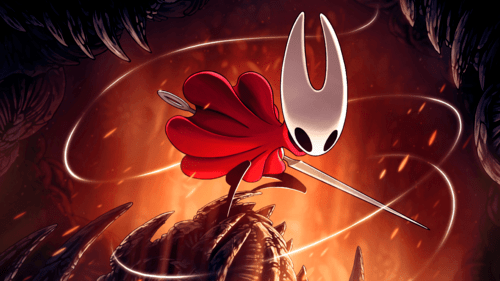
I’m really late to this party. But there’s no way I was going to skip it entirely.
Let’s go!
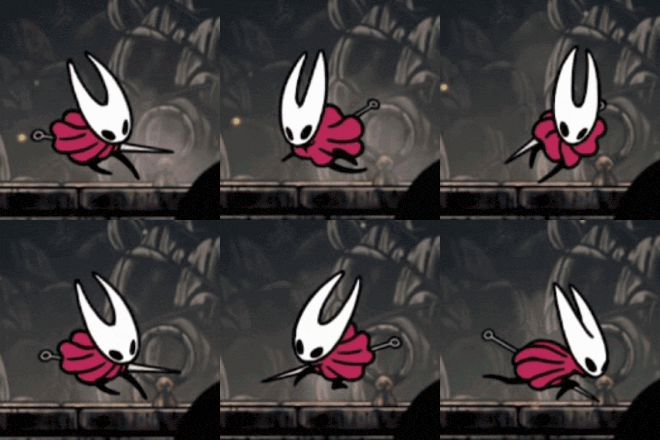
Overview of Silksong
What Is It?
Discover a vast, haunted kingdom in Hollow Knight: Silksong! Explore, fight and survive as you ascend to the peak of a land ruled by silk and song.
Silksong is a 2D soulslike metroidvania—for those whom those terms mean anything. For everyone else, Silksong is a two-dimensional game that starts you off on the edge of a vast, interconnected map filled with secrets. You will spend most of your time exploring, unlocking new powers, uncovering hidden passages and rooms, and, perhaps most memorably, battling against a plethora of deadly foes. That’s one of the things Silksong and its prequel, Hollow Knight, are best known for: gigantic, imposing, tremendously dangerous bosses that will take most players a multitude of tries to finally bring down—but victory will be all the sweeter for the immense effort it takes to get there.
Silksong is also known for being uncompromising about its difficulty. That’s, in part, where the “soulslike” comes in. The game has many systems for players to interact with, allowing them to, sort of, choose how difficult the game will be, but, at its core, Silksong is intended to be a very challenging experience.
Who Made It?
Team Cherry is an independent game studio based in Adelaide, South Australia. At its core, Team Cherry is composed of just three individuals—Ari Gibson, William Pellen, and Jack Vine—who took a massive swing with their first game, Hollow Knight, and found levels of success that most independent game developers will only ever dream of, and that even some AA or AAA game studios will be jealous of.
Our mission is to build crazy and exciting worlds for you to explore and conquer.
At the time of writing, Team Cherry has two games published, Hollow Knight and Silksong.
Content Warnings
None. There’s no swearing or innuendo. There’s no sex. Technically the game features near-constant nudity, but… they’re bugs, and not particularly anthropomorphized bugs. (If I’m not being clear enough, I’m being silly with that comment, ha ha.)
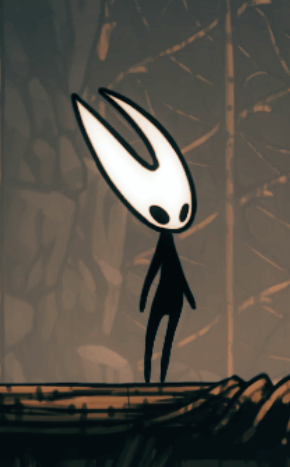
There’s a significant amount of fighting in Silksong, but nothing graphic or realistic. It’s all cartoon bugs (and sometimes robots) hitting each other until one of them falls over or explodes.
The Review
I don’t even know where to begin.
I know this is a review about Silksong, but… I hated the first game in this duology, Hollow Knight, when I first tried it. It took about three tries for the game to “click” with me. Something about Hollow Knight told me that it was worth pushing through the on-contact enemy hitboxes, the slow movement of the Knight, and other things, until I could catch what the game wanted me to feel and experience. Once I hit that point… I think I played all the way through Hollow Knight at least three times. Maybe more. For a guy who rarely repeats things even once, that’s saying something.
In other words, Hollow Knight rapidly became one of my all-time favorite games. I’ve played few games in my life that felt so carefully tuned to be just be an amazing game, completely confident in its vision while still caring deeply about player experience—Hollow Knight set an extremely high bar that most games won’t clear. It’s not for everyone—nothing is—but anyone who can’t state that Hollow Knight is, objectively, excellent, even if it’s not for them, is smoking something.
And Silksong felt like coming home.
Gameplay
Silksong plays a lot faster than Hollow Knight.1 This speed largely comes through upgrades you collect as you progress through the game, though. I’m pretty sure Hornet and the Knight, initially, move at the same glacial pace, but once you unlock your Dash ability you also unlock the ability to sprint—and suddenly Hornet is zipping across the map at speeds the Knight can only dream of. Add this to multiple other abilities that focus on burst movement, such as the Clawline, and you’ll be zipping around like a sprinter acrobat in no time.

Silksong is also, generally, more demanding of precision. Hollow Knight largely featured sweeping attacks that generally didn’t have to be aimed too precisely, but in Silksong Hornet likes to jab and poke—meaning, most of the time you will only cause injury if your enemies are in a much more narrowly defined area. This took some getting used to, but once I got into the flow of the game I quite liked it.
Exploration was always a joy. Every area of the map is extremely visually distinctive, there are (almost) always new and interesting things to discover, and I very rarely felt like I didn’t have options to progress the game. If anything, the sheer breadth of places to go and things to do can feel overwhelming at times!
I also really enjoyed the hard-as-nails exploration challenges. They were few, and you often had to go out of your way to find them, but the versatile and flexible movement options in Silksong made for some breathless escapes and timed climbs.
Things weren’t always perfect, of course. I had one moment in the middle of Silksong where the game started to drag. I couldn’t figure out where to go, what to fight, or otherwise how to progress the game, and I was stuck. I ended up having to look up a guide. Granted, when I realized why I was stuck I ended up annoyed with myself because of how obvious the path for forward progress should have been—so that’s probably more on me than Silksong, but the limits of human ability will affect your enjoyment of a game, so I think it’s fair criticism, even if it’s not one the developers may be able to do much to address. Consider it more of a warning: the game expects you to be competent, and the game is quite long, so you may run into issues where you’re tired or unobservant or forgetful and as a result you find yourself in a slog—but considering how rarely this happened to me, in the context of just how much game is in Silksong, you really won’t need to be worried about that much.
Combat is quick, snappy—and merciless. Players who put in the time to master the art of the needle will slaughter bosses in mere minutes; players like me, who don’t have the time to “master” combat, will struggle a little more, but will still have a lot of fun—and will feel like gods when a crazy idea works out just perfectly.
Alternatively, if you’re like my wife and prefer to avoid combat, that is possible to a certain extent—you’ll have less resources and every once in a while you’ll hit a point where the only way to progress is to fight a boss here, there, or over there, but you can spend most of your time avoiding combat if that’s how you have fun.
I should note that I almost entirely approached combat through mastery of the needle. There are two other systems which interact with both combat and exploration—silk skills and tools, which I’ll touch on in some detail later—but I largely ignored those two systems, the former because I used all of my silk for healing and the latter because I didn’t enjoy the grind of collecting massive amounts of shards.
The bosses are amazing—even the simpler bosses who have fewer attacks and only one or two stages, like Sister Splinter, feel grand and scary. I very rarely felt like a boss was “unfair,” even if it took me dozens of tries to defeat the boss. It was also very interesting to compare boss experiences with my wife, who played the game the same time as me—some bosses that I felt were nearly impossible she breezed through, and visa versa, and we’d sometimes compare notes to help each other out. (That didn’t happen too much, though—she avoiding fighting until there was no other option.)
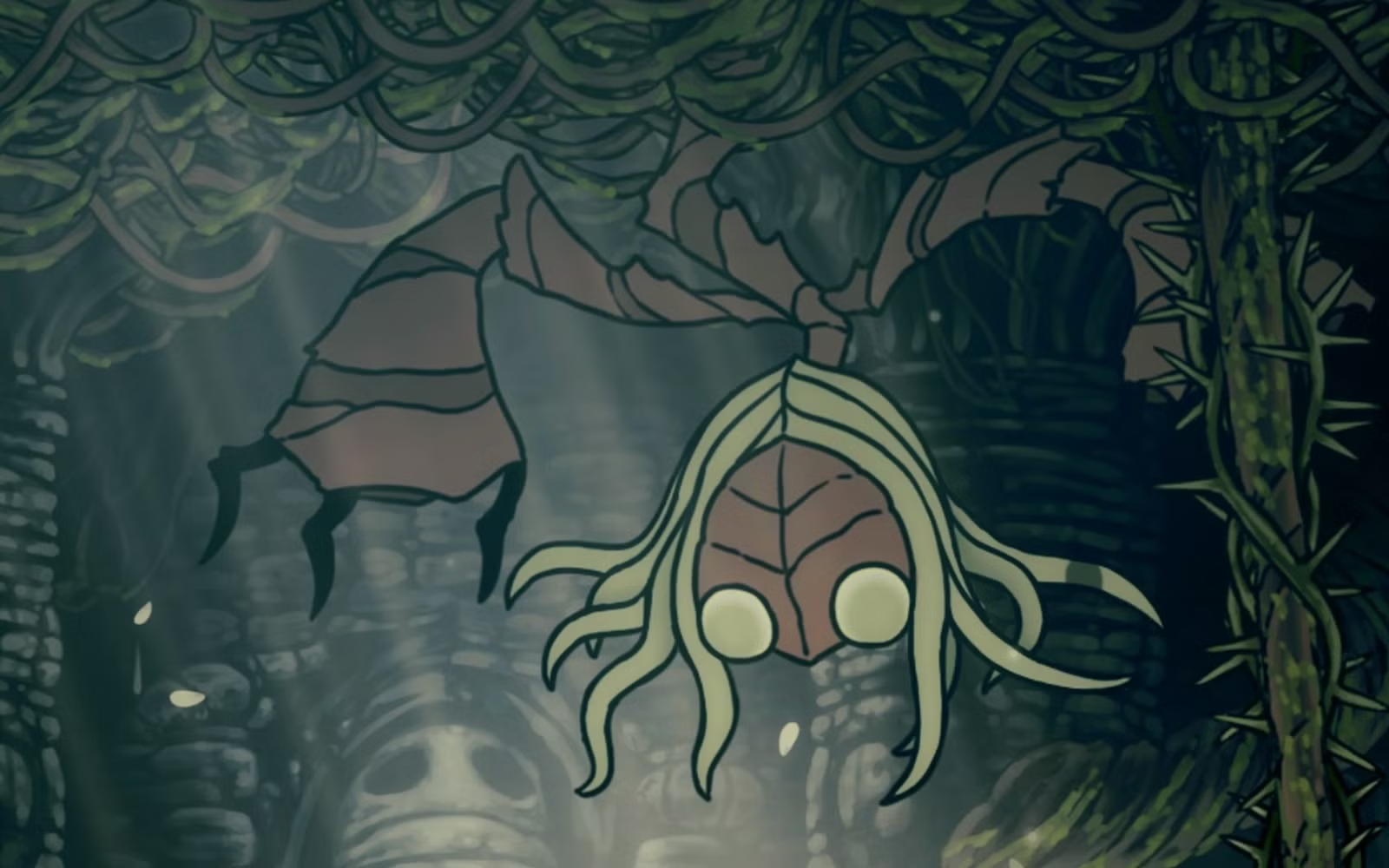
Again, I’m not saying things are perfect—Trobbio and Karmelita aggravated me to no end.2 I quit both fights multiple times, going off to do something else before returning when I’d cooled down and had a new plan.
I was extremely surprised by the sheer volumes of upgrades that you could collect throughout the game. This ranges from movement options, to items, silk skills, tools, and more; almost everything I found felt impactful, but never once did I feel bloated. This is helped, in part, by the limited access you have to most of your abilities at any given moment; as with Hollow Knight, you will swap out different attacks and upgrades while resting, sometimes completely upending how you approach the game with different combinations of abilities.
One great example of how this was handled are crests. I love crests. They might be my favorite addition to the game over Hollow Knight. My first crest was the Wanderer crest; I was shocked when I equipped it and found that my moveset was very meaningfully altered, as well as what tools I could and couldn’t equip. It completely changed the game experience and caused me to more carefully approach future challenges, asking myself which of the tools in my toolkit were best for the challenge at hand. (Most of the time when I found something I liked I stuck with it for a while, though—but I still experimented each time I unlocked a new crest, much more so than when unlocking new tools or silk skills.)
Now, I’ve mentioned tools and silk skills a lot—neither was a big part of my gameplay experience until near the end of Silksong. I rarely used silk skills because I needed my limited silk for healing and I rarely sensed that the damage I dealt with a silk skill was worth the trade-off of not being able to heal for a while. I just wasn’t very good at not getting hit. That said, once I unlocked Shaman crest, I went wild with silk skills.3
As for tools… Of all the systems in Silksong, I think tools have the weakest implementation. All non-passive tools have a limited number of uses and cost a universal resource (shards), which… is a game design decision. I had moments where I thought that decision was genius and moments where I thought it was asinine. The double cost of tools allows for some tools to be absurdly powerful (and satisfying to use); it also resulted in many scenarios where I either totally ran out of shards or preferred preserving my shards over using tools, both of which had the end result of me not using tools. This wasn’t helped by how weak early game tools are and how scarce shards are at the beginning of the game; power of first impressions, I spent the rest of the game mostly ignoring the existence of tools.

The relative scarcity of shards also plays into the game’s economy—you don’t just use shards to power your tools, you also spend them on quests or give them to NPCs at various points in the game, making them feel even more precious and encouraging hoarding. I almost always felt like I was scrambling for shards. That wasn’t the case for rosaries (the game’s “gold” equivalent), though—as someone who fought pretty much everything he could see at all times, I always had enough rosaries to get what I wanted. I could see players who want to buy everything finding the game really grindy, though, as rosaries… Well, the game isn’t stingy with them, but it isn’t overly generous either.
Finally—quests. Or, as they are referred to in-game, wishes. You can’t unlock Act 3 without completing all of them—but I don’t think any of them are required to beat the game at the end of Act 2, making them optional for anyone interested in one of the less-optimistic game endings. Some of these were fetch quests, some of them were very interesting optional challenges, a lot of them involved donating a large sum of rosaries or shards—in short, there’s good variety here, I think the existence of wishes adds flavor and variety to Silksong without risking being burdensome, even if you want to complete all of them.
To sum all of that up—and I think this phrase can be used to describe nearly every aspect of Silksong—the whole of Silksong‘s gameplay is greater than the sum of its parts. Yes, I got frustrated at times. Yes, I got stuck at times. I also had so much fun that I had dreams about Silksong. As well, while I think some of the frustrations I had with gameplay might have been resolved with a little tweak here or a refinement there, in general I felt that the satisfaction I got from overcoming an enormous challenge was worth all the obstacles the game threw at me.
Story
Soulslike games and metroidvanias are famous (or infamous, depending on who you talk to) for indirect storytelling—and Silksong is no exception. While there are far more moments of direct storytelling than in its predecessor, Hollow Knight—after all, Hornet can talk in this game, unlike the Knight—the majority of facts about the world, and most of the pieces of the plot, need to be pieced together by you as the player; what you put into the story heavily impacts what you get out of the story.
This doesn’t mean that playing the game through and not story-hunting will leave you with nothing—you’ll still have the gist of what’s going on and it will be enough to explain the gameplay. But you’ll probably end the game with a lot of questions. (And you might miss the game’s secret, entirely missable third act—oops, spoiler!4)
I am not a story hunter in these sorts of games. I play games first for the gameplay, with rare exceptions; as long as the framework of the story or scenario is good enough, and the gameplay is fun, I’m in.
That said, Silksong is a game where I had so much fun playing the game that afterward I got sucked deeply into the story and world. (This happened with Hollow Knight, too.) I still didn’t care enough to piece through the world and read every tablet containing an obscure poem or paragraph from some historical source, nor read every item description in the game, etc—it’s amazing anyone has time for that. No, I watched videos like the below to access that information much more efficiently.
And I loved it. I found the world fascinating, as well as the larger picture of what was going on and how that played into the different endings I achieved in Silksong.
That all said—I think it’s a very fair criticism of Silksong (and this genre of games in general) that many, if not most, players will discover the majority of the game’s story and plot outside of the game, if they are even interested enough to do that. Other players won’t understand the full picture unless they take notes while they play and very carefully hunt down details, and even then they will be left with lots of ambiguities. I don’t think this is an inherently weak form of storytelling, to be clear—it’s extremely compelling to me and others—but it’s certainly not for everyone.
I won’t go much into the bigger-picture story here, nor details of the world and setting, because for most people these won’t factor much into gameplay experience. For most, the ambiance and the visual and gameplay elements of each area will be enough to piece together the most important, broadest details, and that will suffice as far as the big picture is concerned.
But what everyone will experience fully are the miniature stories, the moment-to-moment interactions, and how Hornet gets fleshed out as a character—and all of that is still really gratifying.

To start with the game’s protagonist, Hornet begins largely unknown. Players of Hollow Knight, of course, will know more about her than players who played Silksong first, but that ultimately doesn’t matter; as an example, my wife and I played Silksong at the same time, she had never played Hollow Knight before, and I think she found herself invested in Hornet even more rapidly than I did; Silksong gives you everything you need to know within itself (except, perhaps, for certain elements in Act 3).
If humility means having an accurate understanding of oneself, one’s value and strengths and weaknesses in various areas, without over- or undervaluing yourself, then Hornet is perhaps the most humble character I’ve ever played. Most people probably wouldn’t describe her as humble, however, because for some reason humility is often represented with a lack of self-confidence or a dismissal of one’s own strength and virtues; Hornet has, and does, nothing of the sort. She’s half-divine and she knows it—she is fully aware of the power of the divinity within her and it’s danger, of the frailness of the mortality within her and it’s unique strengths. She’s good at assessing how she matches up against various challenges. When she states she’s more powerful than another character, she’s not bragging—she’s stating a fact as she understands it, and she’s only stating that fact because she believes it’s relevant. If she’s uncertain about her ability to accomplish something, she will state that, too, but without denigrating herself. She’s also unafraid to stick up for herself if she’s being mistreated—as is evidenced with several hilarious slaps to some of the game’s weirder characters.
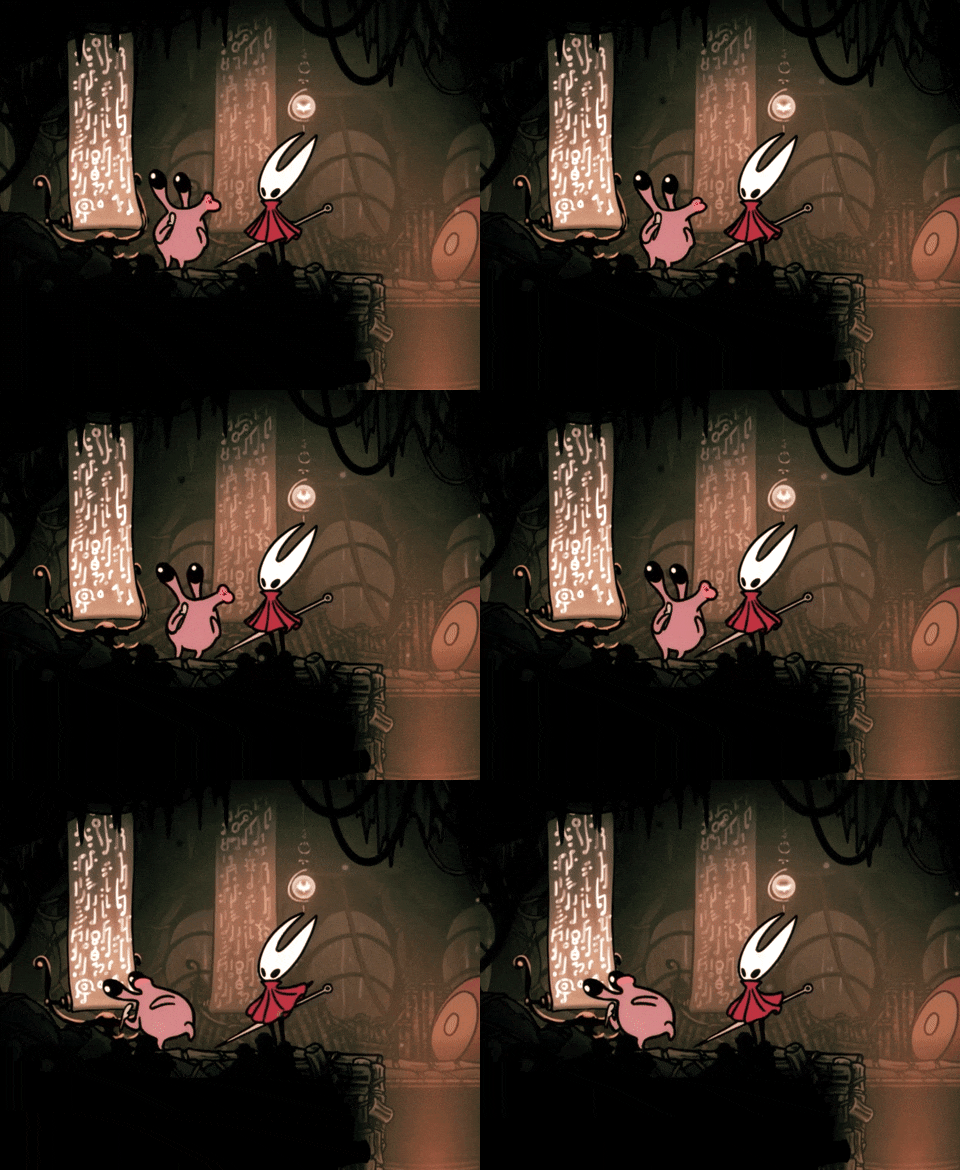
Hornet is a breath of fresh air. If I’ve ever played—or read, or watched—a character like her before, it’s been such a long time that I don’t remember.
And she’s funny, too. Hornet is not a comedian—but the plain way that she states things sometimes earned a chuckle from me. Other quirks of her personality are harder to find, but if you go looking—such as reading her descriptions of the various monsters you face—you will find them. Hornet’s interest in soft, pettable creatures was particularly endearing, especially given how tough and warriorlike she usually presents herself.
As the character you play, you’ll naturally come to know Hornet far better than any other character in the game, but that doesn’t change the fact that there’s an enormous amount of variety in types of characters you’ll encounter, many of which are distinctive enough that you’ll keep thinking about them long after even short encounters.
Sherma is a perfect example of such a character.
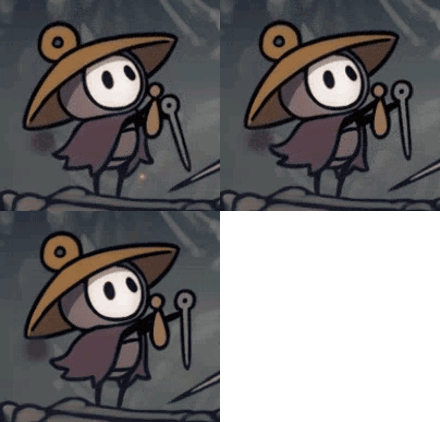
Sherma is a recurring character, but he doesn’t recur often—and when he does, your interactions with him are usually quite brief. Usually Sherma will express fervent faith, he will play a little music to invoke that faith in his gods, and then you will fix his problem for him—and he will sincerely thank you for doing so, and also thank his gods for sending you to help him. He’s adorable. He’s so wholesome. If there’s anyone who has played Silksong and doesn’t like Sherma, that person has no heart or soul.
Shakra… Criege… Trobbio… The couriers… Chef Lugolia… Grindle… Ah, how I hated Grindle! But each of my tiny interactions with him were memorable, and how I hated him elevated the game overall.
And, of course, there’s the Bell Beast. It would be pure wickedness for me not to mention the single best “pet” in all of video games.
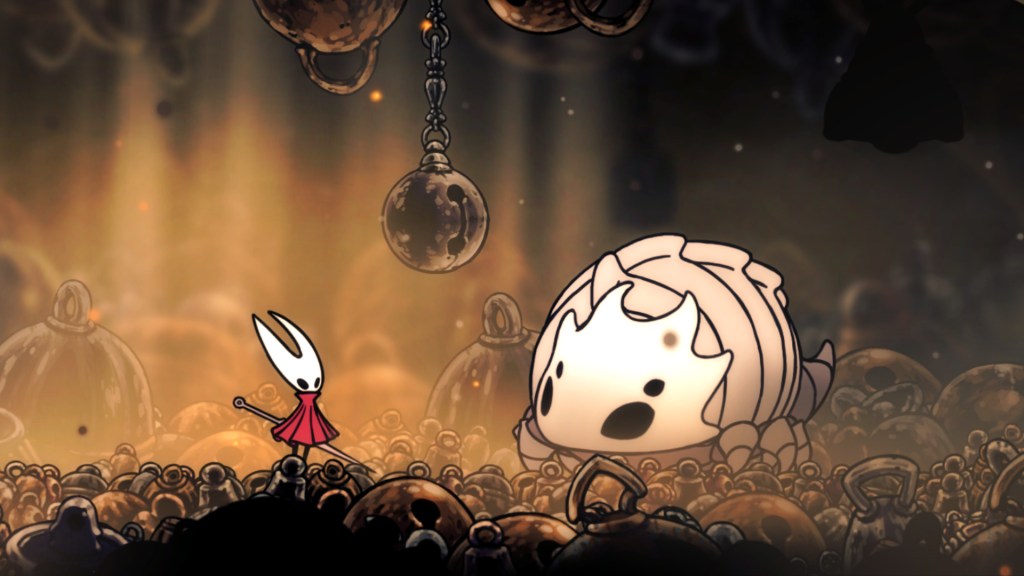
You won’t remember every side character—there’s a lot of them and not all are as distinct as others—but you will have your favorites that you look forward to running into again and again, and it’s always a little joy when that happens.
Finally—I’m going to circle back just a little to Silksong’s plot. Silksong, like Hollow Knight, has multiple endings. Most of these endings come at the end of the game’s second act and I think many (if not most) players will be satisfied with the game and put it down at that point—particularly considering the very existence of the third act is a bit of a secret. Each ending is interesting, each one is clearly derived from actions you made (so there’s nothing arbitrary-feeling about each ending); Team Cherry refuses to state which ending is “canon,” just as with Hollow Knight, so feel free to decide for yourself which ending is the “best” ending.
Really, all I want to say is this: if you want the “happiest” ending, you will need to play Act 3. Act 3 is much harder than acts 1 and 2, I’ll warn you, but it’s extremely fun—and it lets you see some very interesting flashbacks into Hornet’s past, including Hornet as a baby. I won’t spoil that with a screenshot here, but it’s extremely adorable and worth the pain and suffering it takes to get to that point. But, be warned: I think the third act of Silksong has a lot more to offer to players who have completed Hollow Knight and understand that game’s story fairly well. I think it’s still accessible and fun for all players, but parts of Act 3 are going to be confusing—or otherwise feel sudden and unexplained—to anyone who played Silksong as their first game in this duology.
Visuals
You’ve already seen a lot of pictures of Silksong so far. The game’s art style is generally pretty simple and straightforward, but I find it very attractive. Often the backgrounds will be far more detailed than the characters, but that never hurt visibility—it was incredibly rare for me to lose myself onscreen, or to otherwise have difficulty parsing what I was looking at.
Music
Christopher Larkin’s music in Silksong…
It’s beautiful. I don’t study music. I don’t have the words to properly describe the whoops and the aghs and the beautiful notes and and how tiny shifts could play my emotions exactly how the situation needed them to be played, moving me from thrill to fear to wonder easily and without any fuss. I generally don’t listen to music without lyrics, but Hollow Knight and Silksong music is on my playlist.
Difficulty
I’m going to be short here. I support artists making art that matches their vision. I think most art is made stronger with a specific audience in mind—and, seemingly paradoxically, this actually broadens the potential audience—which means most good art is not for everybody. I don’t think “accessibility” and other politically correct buzzwords are inherently valuable in art.
Silksong is a challenging game. It will be too hard for many players. Some of those players will feel FOMO as a result. Tough. That’s life. Not everything is for everyone, not everything should be for everyone, and I think it’s morally wrong to criticize Team Cherry—or any other artist—for realizing their vision as best as possible, and for having a specific audience in mind when making Silksong. There’s nothing wrong with some art being too hard, or otherwise inaccessible, for some people; there is something wrong with dumbing down, diluting, or otherwise damaging what could have been excellent in some Sisyphusian effort to appeal to every single person who exists and may or may not experience said art at some point in time.
Some games choose to have difficulty sliders, or other “accessibility” settings; these games are usually (but not exclusively) game made by developers with massive budgets that can afford the resource drain such things take. When these things are part of the game’s vision, they can genuinely improve the experience. Often, they don’t, and the best we can hope for is that they don’t bring down the experience.
To make a long story short: if you like Silksong but had to drop the game at some point because it was too hard, I empathize with you. I almost experienced that multiple times. It’s not fun to hit a wall in something you love. I hope your experience was great regardless.
To everyone using Silksong as an example of why games should be dumbed down and all games should be made easier (in this case, lesser)—kick rocks. Eat dirt. Etc, etc, etc. Stop trying to ruin great art.
Religious Themes
Silksong is yet another game that heavily features a false, corrupted religion as a core element in its world building, in its conflict, in just about every part of the game. This is such a tired, overused trope that I nearly put down Silksong early on, but I pressed forward out of my love for Hollow Knight.
It was a bit of a bummer for me and weakened my early impressions.
To be fair to Silksong, and Team Cherry, I don’t think either are trying to make some political, cultural, or social statement. I don’t think Team Cherry made Silksong the way it is because they had something specific to say about faith or God. I think this game naturally evolved to be what it is because the world of Hollow Knight is filled with godlike “pale ones” who have a powerful inner drive to rule over other bugs in a godlike manner, and it’s natural that such godlike—but not God-like—entities would create flawed religions around themselves that ultimately become corrupt. (Hollow Knight featured such things, although in different ways.) There’s nothing inherently wrong with such things in fiction, and Silksong—thankfully—has a degree of subtlety, a lack of preachiness, that other games, films, and books don’t have.
That’s not to say that people won’t play Silksong and see it as a deconstruction of religion. I think those people are wrong, but they are out there, and a small number of them actually have interesting things to say. If anything, the weakness of religion in Silksong‘s world points toward the necessity of finding true, pure religion, and how anything lesser will ultimately become corrupted; of how worshipping anything less than God will, with time, always lead to pain, heartache, and hedonism.
I bring this up mostly to buoy up anyone who, like me, sometimes feels distress over how hostile—and deliberately misunderstanding—our modern world and culture can be toward religion, whose first experiences with Silksong might lead you to believe that Silksong‘s story and approach is no different from anything else that’s gone mainstream. It isn’t. This game doesn’t appear to have any answers as to what true, pure, or uncorrupt religion is, or how such a thing can be achieved, but I don’t believe it’s a deconstruction or criticism of religion as a whole.
If You Have to Pick… Which One?
Have you played Portal and Portal 2? Have you had any part in the discussions around those games? I’m going to assume you haven’t, but I promise this is relevant.
Both Portal and Portal 2 are, in my opinion, stunning games. They both go for and accomplish slightly different things—giving me reason to, at times, prefer one over the other—but they have enough in common to remain complementary experiences. Portal is the short, sweet experience; Portal 2 is the significantly longer experience with a lot more fat on it, that only exists because of the success of what came before it. These different traits will attract different people despite very comparable core experiences. These different traits will cause some players to even deeply criticize one while loving the other.
Hollow Knight is equivalent to Portal. If you want to have a shorter, more compact experience, play Hollow Knight. If you want a bit of an exercise in more is more and more is good is great, play Silksong.
As a dad with a full-time job, who writes reviews for his blog and is writing doorstopper novels, I probably took more time out of my life than I should have to play Silksong; as a result, it’s unlikely I’m ever going to pick up the game again, despite how much I enjoyed it. But Hollow Knight? I could see myself picking up that game in the nearby future, for it’s relatively smaller—though still just as high quality—experience. Similarly, I could see myself replaying Portal in the nearby future, but I just don’t have time for Portal 2.
But if I do find myself with an oddly large amount of regular free time—boy howdy, replaying Silksong is going to be very, very tempting. Particularly once the free DLCs come out.
Wrap-up
Silksong is an incredible video game that I recommend almost without reservation, to make things short. And at only $20… My goodness. This game is priced so aggressively competitively, and Team Cherry has garnered so much goodwill, that even pirates are opting to buy the game over stealing it.5 That’s a significant achievement.
I highly recommend Hollow Knight: Silksong.
Enjoyed this review? Consider subscribing below!
If you’re already a fan of Silksong, or you’re just on the hunt for some good fantasy adventure with a unique setting, check out my book, Inner Demon. You can purchase a copy at the former link, or give it a taste test by reading a few chapters online here.
- For those who haven’t played Hollow Knight… my apologies, but I’m going to keep making comparisons between the two here and there. If it helps, think of the two as kind of a yin and yang situation—in some ways opposites, but that opposition makes them complementary. ↩︎
- When you beat Trobbio for the first time… walk just far enough away that he’s off screen for a moment, then walk back to him. Something very funny happens. ↩︎
- This is another late-game item that I wish I could play through the whole game with via a New Game+ mode or something. That would be so fun! ↩︎
- Speaking of the open secret that is the third act’s existence—it’s amazing. It was absolutely worth the grind to get there. But I don’t think the third act will have nearly as strong an impact on players who didn’t play Hollow Knight first; I understood what was going on with the void and so forth (and that amazing moment where the Knight… no, I shouldn’t), but my wife was extremely confused, wondering why so many new and terribly powerful elements had been introduced to the world after she had thought she’d crossed the finish line. ↩︎
- I’m not saying that’s happening with all pirates, but the fact that a notable number have come forward telling their usual companions in thievery to just buy the game—that’s incredible. ↩︎

 Boo Ludlow
Leave a comment