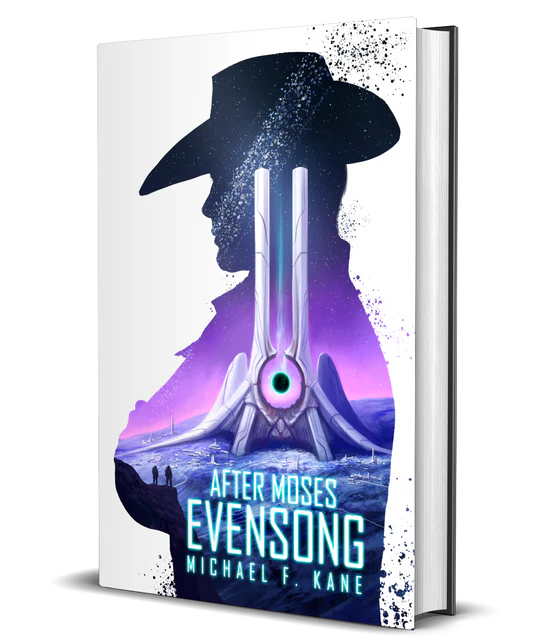
And here we are, at the beginning of the year but at the end of the road. It’s been an exhilarating journey.
I’m quite grateful it’s one I started. I’ll miss the world of After Moses. I’ll miss Matthew and the others. But (spoiler warning, I guess), with an ending this strong it’s hard to be mad that… well, that all things under heaven must come to an end.
Overview of Evensong
What Is It?
All things under heaven come to an end.
The Gaucho. The Shield Maiden. The Doctor. The Girl with the Miracles. The Defender of Venus.
The crew of the Sparrow has reached the end of its journey. As they prepare for the biggest job of their careers, a disaster no one could have foreseen strikes the solar system. Even the Sun has turned against humanity. Matthew Cole and his crew stand at the center of the tangled web, hoping to recapture the last piece of the Anemoi from the Highland Treaty Organization. A century of decline left in the wake of the AI Moses’ absence ends in a standoff of epic proportions and the colonies on the precipice of war.
And in the midst of it all, a young woman who holds the answer to Moses’ disappearance, waits on the moon, forgotten by time.
Time is running out for everyone.
Evensong is a sci-fi space western adventure. It’s the final book in a six-book series. It’s a story about family, about found family, and unlikely allies; it’s a story about grit and faith and hope and endurance; it’s a story with twists both expected and unexpected. It’s a story that has been described by other reviewers as “better than Firefly, better than Star Trek,” and I must say I agree with that sentiment.
But, let’s be real. If you’ve read the rest of the series, you don’t need me to sell you on After Moses: Evensong. And if you haven’t read the rest of the series, this is not the place to start. Go buy After Moses.
Who Wrote It?
I’ll start with the author’s own words:
Michael F. Kane cut his teeth on science fiction and fantasy. In fact, his first memories of Star Wars are his mother covering his eyes during the rancor scene. Later, he fell in love with the classics, Tolkien, Asimov, Herbert, and more. Somehow, despite the odds being stacked against him, he grew up to be a somewhat respectable human being. By day he’s the music director at a mid-sized church, but at night he dreams of unseen lands and places man has never trod.
Michael F Kane is also a husband and a worship leader—and, in his words, “cooks a mean pork butt.” (I hate it when my food insults me as I eat it.) To my knowledge, Kane’s only published works are the After Moses series—but that’s one hell of an opener that any author should be proud of.
Michael F. Kane can be followed on X. He also has a website where you can buy his books directly. (No, none of this is sponsored—I like the books, and I want Kane to keep writing, and I think buying direct is better than buying through Amazon, so I recommend checking out his website.)

Content Warnings
Kane includes a Parents’ Guide at the beginning of all of his books, so I’ll keep this brief. He never includes any sexual content in any of his books, and Evensong is no exception. There’s no swearing (unless you count statements like “Abigail uttered a word Grace hadn’t heard her say in a very long time”). There is plenty of violence, ranging from brawls to shootouts to spaceship battles, but it’s all harmless sci-fi action—and he avoids describing the gory details of any injuries. There are some references to drugs and related illicit things, but it’s in the context of a fallen world full of criminals (and other ne’er-do-wells) that the heroes are pitted against, rather than glorifying or encouraging such things.
Prior Reviewed Books
After Moses: A very slow start to the series, but once the book hooks you and takes off, it soars. After Moses is also an excellent example of fiction with heart, soul, and deep themes and meaning, while still remembering it’s here to entertain and not deliver a sermon (even though some characters literally deliver short sermons here and there).1 A sci-fi space western that no one should miss.
Prodigal & Wormwood: After After Moses laid a strong foundation, Prodigal and Wormwood took the story in exciting and heart-pounding directions. The plots are powerful. The heartfelt moments will sit with you long after you put the book down. And, most of all, Kane knows his characters, knows how to make them flawed and compelling, and then does an excellent job proving it by frequently pairing them off and showing just how well they work with each other in just about any combination, and even remain interesting on their own. The world itself also expands in ways that invest you into this future universe as a character in its own right—and teases you just enough about Moses and his disappearance to keep you hungry for clues.
Virtus & Sanctum: Set in the same general span of time, but splitting the crew of the Sparrow in two and following one half in each book, Virtus and Sanctum take a lot of risky swings and largely hit home runs—especially Virtus, a story of civil war and of a troubled boy becoming a man. However, Sanctum‘s story of love, sacrifice, and fatherhood should not be slept on.
The General Review (No Spoilers)
I usually split my book reviews in two because I want to be able to speak to both people that haven’t read the book I’m reviewing and people that have.
For the people that have read the book, yes, I in these reviews I share my thoughts and opinions on the book as a whole, with the hope that I will spark discussion on the contents of the book—someone who’s read the book doesn’t need me to tell them whether the book is good or not, or what the book is about. After all, they already know. But for those who haven’t read the book (the targets of my non-spoiler reviews), I want to give them an idea of what kind of experience they’ll have with the book, let them know how good of a book I think it is in general, and otherwise help them decide if the book should be their next read.
Such a review doesn’t feel as meaningful for the sixth book in a series, however. Hopefully no one starts their After Moses experience with Evensong—not only would they be extremely confused, but it would spoil almost all the mysteries of the series for them. After all, Michael F Kane does an excellent job at wrapping up all of the most important loose ends and plot threads of the series in Evensong, without hurting the pace of the book or making anything feel drawn-out. (This is particularly impressive given that this book has multiple postludes and an interlude.) I really can’t emphasize this enough: After Moses, the series, has one of the strongest conclusions I’ve ever read. Each character is challenged in unique ways, each character plays a meaningful role, and each character has a satisfying conclusion. The book is very full, but it never feels overstuffed or rushed.
I was also impressed by how many side characters Kane was able to weave into the narrative in very natural ways—a few I’d forgotten about, but they appeared nonetheless, and and I was surprised at how much I appreciated being reconnected with them.
But Michael F Kane doesn’t make the mistake of wrapping things up too tightly. Yes, this set of adventures for our heroes has come to an end. Yes, most likely none of them will have adventures of this nature for the rest of their lives. But there is still plenty of mystery left in the world of After Moses, and plenty of adventures of other sorts remain as possibilities. To my knowledge, Michael F Kane doesn’t plan on returning to this universe, but it still feels like it will live on after The End, which is a testament to just how deep and evocative of a setting he has created—and how lifelike the characters in it are.
In short, I really like it when a series is wrapped up well—when there’s a definitive and satisfying The End—but there’s still a little room left for imagining what’s next.
The only real complaint I had about Evensong is derived from how effectively Kane teased out his mysteries (in this and prior books), and how successfully he answered them. Since book one I wanted to know what happened to the seemingly benevolent super AI Moses, why he disappeared, and whether or not he left behind anything substantial to help rescue humanity from the dire straits he’d left them in. Every crumb dropped in every book was like manna. So I struggled with the split ending of this book a little bit. To keep things vague, the crew of the Sparrow2 has two final, critical tasks that they need to accomplish in the final act, so they have to divide and conquer. The crew who wasn’t investigating Moses’ final actions and resting place did have an interesting story, and it was well-written—but it simply wasn’t possible for that conflict to hold a candle to my need to know everything I could about Moses, a need that’s been building all the way through this six-book series. I must admit, at the end I rushed through the viewpoints that weren’t focused on Moses, and the revelations connected to him and where the anemoi led, because… because I had to! I had to know! If you’ve ever been so gripped by a book that you keep reading it when you really shouldn’t, you’ll understand.
Well, I’d rather complain about a book having a “flaw” from being a little too good, particularly in the context of its overall series, than real, serious flaws that bring the whole experience down. In other words, these are good problems to have.
To be fair, Evensong isn’t perfect, although it doesn’t have any of the glaring, serious flaws I mentioned a paragraph ago. Grace and Yvonne, for me, didn’t appear to have as much impact (or focus) in Evensong as in previous books, particularly when compared with characters like Davey and Matthew. They did get some very meaningful moments, don’t get me wrong, and Kane didn’t sweep them aside or otherwise forget about them. With a core cast of six, and with Grace and Yvonne getting their “backstory” books far earlier in the series, I’m not really surprised that their arcs felt largely completed prior to Evensong;3 in addition, Grace is a teenager who is done with adventure and wants a normal life, and Yvonne is an older woman who probably should have retired already (and is ready to do so), so they are both at opposite, but strangely parallel, extreme ends of life’s spectrum, positions that don’t naturally lend to them having as much weight in this story. The point is, Michael F Kane did a great job balancing the disparate (and probably often conflicting) demands of After Moses‘ capstone novel, but I did end up missing Yvonne and, particularly, Grace at times.
This next criticism is mostly a nitpick: Michael F Kane describes his typos and punctuation errors as “features, not flaws”—that continues in Evensong. It’s largely unobtrusive, and by the sixth book in the series I no longer felt dissonance between imperfect copyediting and the overall quality of the prose, plot, setting, and characters. However, Mr. Kane—I wish I took notes on specific pages, but, alas, I was too busy reading to do so—you did have a few lines of dialogue that were baffling, to the point where I wondered if something had accidentally been removed from the final manuscript that shouldn’t have been. There were only one or two points like that, but they did leave me scratching my head for a while and pulled me out of the book. I apologize that I can’t provide the exact spots where these issues occurred.
Dear reader, if you haven’t read any of the After Moses books, but for some reason read this much of Evensong‘s review, go read After Moses. I doubt whatever you’re reading right now is worth delaying that experience. Evensong has cemented this series as one of my all-time favorites. While I definitely have a personal order of best-to-less-best in this series,4 every book is a strong entry that deserves to be there, and every book shows that Kane wrote with a strong vision and a lot of careful planning.
The Story in Detail (Spoilers)
Placing the Pieces
After Moses: Evensong begins with some cleanup from Virtus and Sanctum. The crew of the Sparrow need to be reunited, which includes, among other things, recovering Davey from subterranean Venus. There are many tearful reunions and a lot of beautiful character moments—such as Davey proposing to Claudia—as well as promises of things to come.
My wife found this part of the book slow and wished things “happened” faster. I wanted a bit more of this stuff, so Kane probably hit a good balance. That said, Evensong‘s opening is one of the slower starts of the series.
As a good story opening should, the beginning of Evensong also sets the direction for the rest of the book. The crew of the Sparrow, ultimately, want to use the anemoi to discover whatever it is that Moses has hidden from mankind—which may or may not include an explanation behind the AI’s disappearance, and hopefully includes the necessary knowledge to fill the void left by Moses’ disappearance. In order to accomplish this, Matthew & Co. plan a heist to recover the quarter of the anemoi stolen by President Barclay of the Arizonan colony of Mars. Just as the crew of the Sparrow take off…
The Maelstrom happens.
The Maelstrom is the first moment of Evensong where this book shows its teeth. A massive solar flare, larger than ever recorded before in human history, blasts radiation across the solar system. Ships are rendered inert mid-flight, far beyond any possibility of help. The systems of various colonies fail, some reaching the point where their atmosphere shields turn off, leading to countless deaths. Even some previously perfectly reliable Mosaic artifacts lose some functionality (Grace’s being of particular note), or turn off entirely. There are widespread consequences to this event, as well as a few mini-adventures directly stemming from it.
Perhaps worst of all (for the universe at large, anyway), the two remaining grav plate factories go offline, taking what little time humanity had left in the colonies and slashing it to a fraction of its original length.
Not all of these things are revealed immediately, but what is revealed immediately sets a grim tone and starts a timer for the rest of Evensong.
In short, I really liked this move of Kane’s. I don’t have a lot to say about it, but it did its job and it did its job well, and the way it caused so many conflicting forces to come crashing together was very compelling.
Heist
What’s up next is some good, old-fashioned sci-fi fun. Multiple goals need to be accomplished at the same time—stealing the remaining anemoi piece from President Barclay, breaking Whitaker out of prison, and rescuing the Mosaic artifact known as Svalinn’s Mantle. It’s time for a heist and prison break, then!
Two big things stick out from this section, both complications with long-reaching effects:
The first complication, Arizona’s warmongering. As far as President Barclay is concerned, he needs to go on the offensive against essentially the rest of humanity to extend the lifespan of his own people. This begins with Arizona trying to claim the remaining grav plate stockpiles and later leads to the colony preparing to declare war on earth (after later discovering that the planet is habitable and that the colonies at large have been lied to for about a century now).
This is all really interesting. While Evensong makes it clear that the Arizonans are not Americans in any real way, it did hurt my soul a little to see the spacefaring descendants of my nation acting so rashly—but it was believable and made for good storytelling. As well, this conflict ended up resolving a big concern that I had after reading Sanctum, which was that having earth as a cradle that humanity could return to would lower the overall tension of the After Moses universe. In reality, Sanctum did shift the stakes, but kept the tension about the same—after all, with the potential for war between earth and the colonies, there’s still a real chance of extinction anyway, and other arguably worse fates (such as despotic rule by the Arizonan government).
Arizona’s warmongering also directly contributes to Evensong‘s final confrontations, which I’ll get into later. I can’t tell you how many times I wished I could put my hand through my kindle so I could punch Barclay in the face.
The second complication—even though the anemoi piece gets recovered, it also was damaged by the Maelstrom, threatening to make all the sacrifices made by the crew of the Sparrow, and so many others, moot (at least as far as the hunt for whatever is left of Moses is concerned). Fortunately, not all hope is lost, as Matthew Cole gets a bunch of scientists to put their heads together, and they end up discovering a lead on Mercury—the lead being a massive Mosaic structure.
Fixing the Anemoi
This part of Evensong‘s plot was, I think, a risky move by Kane—risky because it could have very easily felt tedious. The crew of the Sparrow just put forth a ton of effort (and the book a significant word count) recovering the final piece of the anemoi from Barclay; fixing it too easily would have made breaking the thing feel pointless in the first place, while making the fix take too long or be convoluted risked making Evensong feel padded. Kane threaded the needle, making the journey to Mercury and the fixing of Moses’ miracles an addition that the book would be weaker without.
I think this move worked, in large part, because of how interesting Kane made his Mosaic technology reveals. After all, for most of this series we just get glimpses or wondrous tastes of what Moses was capable of, but this part of Evensong—the journey to Mercury, events at the strange, insectile Mosaic structure—gives us a visual feast of sci-fi wonder.
Another aspect of revealing more Mosaic technology at this point in the book, something that I think helps this plotline so effective: it sets expectations and sparks the imagination for what’s to come. By getting a better idea of what kind of things Moses built, both the scale and the relative strangeness of the extremities of his work, readers are going to be prepared to more easily accept other things Kane has yet to reveal, which is critical for this story’s resolution. This move also gives a bit of a framework for readers to use to try and predict what’s to come, which is always exciting.
I also want to note that Kane managed something very difficult: making sci-fi technology feel fresh and interesting. While much of the pseudoscience in After Moses can be found in very comparable forms in other sci-fi stories, nonetheless After Moses has such a strong identity of its own that I wasn’t thinking of any of those stories while reading; particularly when reading about Mosaic technology, which is why I felt like this was the best moment to bring this up.
And, finally, learning a little bit more about how Moses’ “miracles” work is always exciting on its own, of course.
Finding Moses, Beating Arizona
And then we come into the home stretch—the most important part of the book, where both Evensong‘s story and After Moses overall gets wrapped up, where Kane has to deliver on so many promises, answer so many mysteries, and make it all worth a roughly one million word investment.
That’s a very high bar, but, once again, that’s also a very good sort of problem to have.
Everything starts with the crew of the Sparrow splitting up once more. Davey, Grace, and Yvonne need to partner with other allies to stop the Arizonan war fleet from attacking earth; Matthew, Abigail, and Whitaker (along with two other critical characters) need to travel to a distant asteroid on the furthest edges of the solar system, following the anemoi and hopefully, finally, receiving answers and resolving so many problems.
And there’s no time to lose. Neither journey can be delayed. It’s now-or-never, make-or-break.
And, as I said earlier, both of these storylines are good, but only one of them had me sitting on the edge of my seat and reading far longer than I should have been, at times that I really should have been focused on something else. To be honest, the competition for attention between these parallel stories wasn’t even remotely fair.
Davey leading the effort to stop Arizona from waging war on Earth was good. The stakes were good, the danger was good, the sacrifices were impactful, the set pieces were solid. On its own, I would have had enjoyed taking my time chewing through these chapters and viewpoints. In particular, Davey looking out for Grace—buoying her spirits, keeping her from throwing her life away in an effort to stop the Arizonans—was touching.
But I had been waiting an entire six-book series to get some answers about Moses, and this was now coupled with me finally learning Whitaker’s backstory and feeling deep empathy for the Carver family—those chapters and viewpoints were my priority. They were what kept my hands glued to my kindle as I finished Evensong.
Whitaker’s backstory was worth the wait. I felt a deep level of empathy for the Carver family—even Whitaker, who, though worthy of being on the receiving end of justice for the many evils he’s committed, has a degree of tragedy to his story. I was particularly impressed by how attached I became to Hannah, a character with a late inclusion in After Moses.5
Directly seeing Moses’ impact on the Carver family, and on Earth, was particularly fascinating, and I think Kane really hit the nail on the head with this part of Whitaker’s backstory. Moses is believably sincere, in some ways innocent or naive, and he genuinely tries to do good and help others—but, ultimately, he has a tragically deleterious effect on the Carver family, and on earth. Because of Moses, the Carver’s lose significant time together (arguably Hannah’s most important years) and Josiah and Asher (Whitaker) become estranged, all due to a doomed quest to save Hannah from a genetic disease. And that’s to say nothing of Asher getting enabled in his growing worst tendencies. At the same time, because of Moses mankind enjoys prosperity, peace, and technological advancement on a level previously unimaginable—but mankind’s soul rots beneath that weight of comfort and convenience.
Despite the good things that Moses did, it could be easily argued that Moses should have deleted himself before he developed to the point where he had an impact on humanity—but it also could be argued that the good he did outweighed the bad. There’s amazing ambiguity and difficult questions in these relatively short flashbacks, and their insights into Moses as a person.
But one thing came through powerfully above the rest, for me, as a core aspect of After Moses: humanity needs opposition. Struggle and sacrifice and purpose are inextricably linked. Putting all of humanity under a direct shepherd who takes care of every need may have rapidly advanced technology (and eliminated many external ills), but it crushed individuals, and it eliminated real growth in so many ways. I don’t know if it was Kane’s intent to have Moses be a rebuttal to the argument that something is wrong with God for not being obviously, plainly, directly evident and present in human life—in the way Moses was, I mean—but I did reflect on that debate a few times as I read.6
Also—Kane, if you are reading this, did you read The Worthing Saga, Orson Scott Card? Some aspects of Moses in Evensong made me think of the telepaths’ helicopter parent care for humanity in Card’s book. The conclusion in The Worthing Saga was that humanity had to be cut off from such coddling, although at least one telepath could hold herself back from still doing some good to small pockets of humanity; it’s interesting that Moses never came to this conclusion himself, never intended to leave humanity, so far as I can tell.7 His death was an accident.
Speaking of which.
The Moses Hunt portion of Evensong ends with success. Matthew, Abigail, Whitaker, and Josiah travel to where the anemoi leads them. They discover what killed Moses. They discover what Moses left behind. And, having descended into darkness, they return, healed and enlightened, to bring knew knowledge to mankind.
And I found it all extremely satisfying.
Shortly after my review of Sanctum, I had a conversation with Michael F Kane about suspension of disbelief and tension in storytelling. He described two types of tension that authors work with:
(1) Will the characters succeed at all?
(2) How will the characters succeed? (Often, but not always, success is a foregone conclusion in this instance.)
For me, this entire conclusion of the Moses storyline was an extremely powerful example of the second form of tension. It never really was a question in my mind whether or not Matthew Cole would put together the anemoi, follow that compass to its conclusion, and find the some answers—but how would he? And what would those answers be? What would Matthew have to give up to find them? Would these answers actually solve any problems, or would they answer questions without providing workable solutions? I had a lot of theories, and I had a lot of hopes, and in some ways I was on the money—and in others I was very far off. But at no point did I feel like Kane was pulling the rug out from under me, out of ideas, or in some way cheating. It all just felt… right.
I also found very interesting the codices that Moses left behind, as well as the choice tied to them; Matthew taking the limited codex, with Whitaker taking the theoretically unlimited codex (and later deciding that was a mistake), was very on-brand.
Personally, I could have lived without the battle against the drones. After all, we were already getting plenty of fighting in Davey’s battle against Arizona, and we’d already had Abigail and Grace fighting off the same drones at a different location. That said, I hadn’t expected that Josiah would die—there were still some really meaningful stakes in this last fight. But I’ve mostly had my fill of fights against mindless, faceless, soulless enemies over the past decade and a half. (Thanks, Marvel.) This isn’t a knock against Kane, or Evensong; my wife was on the edge of her seat, rooting for Matthew to get the Merkabah, open the wormhole, and save Davey and the others. The drone fight just couldn’t hold a candle to the massive revelations and resolutions that had come right before it, or the showdown with Arizona that was promised to follow.
And then Matthew piloted the Merkabah to defeat the Arizonan navy, transmit the codex across the solar system, and enforce peace. In a word, it was awesome. Cathartic, even.
Denouement
Evensong has seven postludes, as well as an epilogue.
I don’t think I need to go into detail on each one. For each character, I think Kane did a wonderful job at wrapping up what was left in their story. I also appreciated the tidbits he left that sparked my imagination on where the characters were going to go, and what life could hold for them—particularly the youngest members of the Sparrow, Grace and Davey. These weren’t bittersweet goodbyes, but fond remembrances of what had been, joy in where we were now, and hope for future reunion.
Well, that’s not true. Julia left me feeling bittersweet. She gave everything for her people, found out that her genius plan of self-sacrifice (the Contingency) was built on a lie, and, despite being a heroine, never ended up getting the guy, be it Matthew or anyone else. Instead, her story ends with loneliness and self-sacrifice. While I did appreciate Venus getting a lifeline at the last moment, I really wish there had been something happier waiting for Julia in the final pages of Evensong.
I must admit, Hannah’s viewpoint at the very end—her getting a life back, somehow, in spite of everything—made me tear up a bit. It was beautiful, and I don’t think there could have been a more perfect final postlude.
Other Thoughts and Elements
I don’t usually dwell on books too long after I read them, if at all; I tend to think through everything I need to while reading, and spending too much time reflecting on a book I’ve already read keeps me from reading another book. (Writing and editing too-long reviews also has that effect.)
Series are sometimes different, though. It can be hard to want to jump into a new series after having been so thoroughly lost in a beloved one.
I left out so many details that might have been worth touching on in this book, but hitting on every sub-plot and character in Evensong in detail might make this review as long as Evensong itself. So very many side characters make at least brief appearances in the book, and I enjoyed their moments of spotlight. Some even had really precious, small arcs, such as the male and female bounty hunter duo who decide to quit that life and get married—unfortunately, I forget their names, but I felt unexpectedly attached to them.
The bounty hunter with the arm-mounted thumper makes several appearances in this book, before ultimately being dispatched by Matthew Cole. When he first showed up in Virtus, he filled the same archetype as Sparky Sparky Boom Man (Combustion Man) from Avatar the Last Airbender—that archetype being an extremely powerful, extremely deadly bounty hunter that more-or-less forces all focus onto him when he shows up.
I have to be honest, the final resolution of this bounty hunter (I don’t remember his name and I didn’t find him interesting enough to warrant me flipping through the ebook) bored me, for the most part. He showed up during a side mission and an interlude and was ultimately dispatched by Matthew Cole’s impressive gunplay. He was a loose end that needed wrapping up, but not anything more substantial. I think it would have been more satisfying if he’d been taken out during some moment more integral to the central plot, rather than feeling like a diversion before getting back to the real story. (I think the intent was to heighten tension by making it feel like Antioch was under threat, but, if so, it didn’t work for me.)
I could go on, but Evensong doesn’t deserve being picked apart for the tiniest weaknesses, nor to be spoiled of all possible moments of strength. It was a beautiful story, an excellent capstone to a beautiful series, and I was uplifted and inspired by these books.
On Craft: Talking with Michael F Kane (Spoilers)
Before I finish up, I want to more fully bring up a conversation I had touched on earlier, one about suspension of disbelief and tension. After my review of Virtus and Sanctum, Kane reached out to me, and it’s with his permission that I share some quotes.
In my review of Sanctum, I criticized the book for reducing the general tension of the series by switching the stakes from total extinction of mankind to something less dire. I had found what I originally believed the stakes to be very compelling: the universe was a dark, unforgiving, probbaly doomed place, but we had lights like Matthew Cole rising to push back the darkness anyway. I like stories like that, with lots of natural tension born from harsh circumstances. I like the heroism that can be born from saying, “I don’t care that it’s impossible, I’m resisting the night anyway.”
To be fair, Kane had been hinting since his first book that earth was habitable—I just hadn’t caught any of those hints.8
Anyway, I thought Kane’s response to my criticism thought-provoking:9
The way I see it, “Extinction of Mankind” in nearly all cases is a fake stake. (to be coy). IE in the vast majority of stories, it’s simply never going to happen. The author is never going to pull the trigger. Everyone isn’t going to die.
In one sense, Kane is absolutely right—most stories are never going to go to that extreme. And the stories that do follow through on such extreme stakes (he used Endgame as an example when describing his thoughts to me) often have those consequences walked back in some way later on (Infinity War). So he thought the complication of stakes—in his series, earth being habitable, but it’s going into an ice age, arable land is decreasing, and there are a lot of low-technology tribes spreading across the planet that would hopefully need to be worked with humanely in the event that spacefaring humanity attempted to resettle earth—was more interesting than extinction, and therefore created better tension. Having now read Evensong, I can see his thought process more easily, and I absolutely agree with the decisions he made for his story.
(In particular, how this revelation threw the Venusians and their Contingency under the bus was heartbreaking. Not to go too far into a tangent, but I thought Kane resolved that subplot elegantly in Evensong.)
I don’t agree that extreme stakes are fake, though—at least, not any more than all stakes in all stories are fake, because all stories are, ultimately, smoke and mirrors. Everything that happens only happens because the author decided it would happen, after all. (That was an awful lot of “happens” for one sentence…) What matters is if it engages the reader, often by making it easy for them to suspend disbelief, and then rewarding the reader for engaging with the story by delivering on good (and, hopefully, meaningful) entertainment.
I want to use the example I brought up in my conversation with Kane: After Moses: Wormwood. In that book, Matthew Cole gets shot through the lung and develops a very serious infection. He nearly dies—and I felt it. Even though all logic states that the central hero of a story is not going to get killed off in the third book of a six-book series, I was still worried for Cole whether or not he would make it. I was tense. I might have lost a few days of life to unnecessary entertainment-induced stress. While wondering how Cole was going to get out of this crossed my mind, it wasn’t nearly so important as that it happened in the first place—and, again, while absorbed in the story I believed that Cole could have died.
This applies to pretty much every story I’ve ever read—when Frodo and the Fellowship were attacked by goblins and trolls in Moria, I feared for them, even though I knew that, at the absolute bare minimum, Frodo isn’t dying in the first book. When Hazel, in Watership Down, is shot by a human, did I fear for his survival, despite, logically, knowing that there was no way Adams was killing off his principle protagonist at least before the warren was secure? Of course I did! Within the contexts presented to me, those bad conclusion were very possible and very concerning.
In my mind, this is all the power of suspension of disbelief at work, and I think it applies to the macro level as well as the micro. Logically, if I put some distance between myself and the world of After Moses, do I believe that the series will end with humanity going extinct? No. But the characters do, and the characters are so well-realized—and the threat of extinction is so believable when I’m immersed in the setting—that I feel that concern anyway.
To a certain extent, where tension is drawn from is subjective, of course. Different readers are going to be able (or willing) to suspend disbelief on different things, and what the author intends is not necessarily going to be what the reader experiences (even—or especially?—in well-crafted works). My thoughts are ultimately from my perspective as a reader.
I ultimately changed my mind on the importance of After Moses, as a series, needing human extinction as a core source of tension. I think if I had read Sanctum after Evensong was out, so I could go directly from one book to the next, I may have never had this issue.
But there is one area where I haven’t changed my mind on tension being damaged by an artistic decision: Virtus‘ revelations into Sanctum.
As I mentioned in my Virtus review:
Virtus ends by clearly revealing the fate of Matthew and Abigail in Sanctum. You don’t learn any details, but you learn they are alive, healthy, and successful in their mission… [Learning] that Matthew and Abigail are alive [and etc] left me really worried that the tension of life-and-death situations in Sanctum would be undercut by that knowledge—which did happen… I think being much more ambiguous about Matthew and Abigail’s situation at the end of Virtus would have been a stronger move for both stories. [Emphasis added.]
As I discussed before, most of the time, when you logically distance yourself from a story, a lot of things become very obvious. Obviously Matthew and Abigail are going to survive the events of Sanctum and ultimately reunite with the crew of the Sparrow! This series isn’t grimdark, after all. So, if I essentially know that, why does Virtus confirming that Matthew and Abigail are alive and well in the end damage my enjoyment of Sanctum?
I think it is the internal acknowledgement that matters. When I distance myself from a story, I’m taking outside knowledge and storytelling conventions and applying them to the book. Because of how conventions work, I can with almost perfect accuracy guess very broad strokes that an author will make, but, at least for me, that doesn’t hurt my enjoyment of the story. That’s not what happened in Virtus; in Virtus, it was confirmed, in-story, as canon, on the other side of the fourth wall, that Matthew and Abigail were fine in the end, no matter what conflicts they would have to overcome in Sanctum.
Now, in our conversation Kane made a pretty good point, one I shared earlier, about how tension is not exclusively derived from whether not not a character will succeed: tension can also be derived from the question of how a character will succeed. If the primary goal is to derive tension in the latter method, then readers can be given a great deal of foreknowledge about how things are going to end without hurting the story. But, in my opinion, there still needs to be a lot of meaningful mystery on the how they are going to get there for that to work.
Sanctum has a pretty good example of that. When Abigail is in the nuclear reactor, without her suit and getting hunted, I was on the edge of my seat. I could not see any possible way for her to get out of that situation, even though I knew she was going to survive (because Virtus told me so). I was then very surprised when Whitaker rescued her—that was a conclusion I had not expected, a conclusion to a scenario that had no obvious answers. In that instance, for me, tension derived from how really worked.
However, most of the set pieces and conflicts in Sanctum weren’t that ambiguous in possible resolutions, in my opinion. As an example, when Matthew Cole was thrown off an airplane, I knew he was in no real danger; when Abigail saved him by diving after him and grabbing him, and then landing on the Imperious Doubt, I wasn’t particularly surprised by the outcome, so the tension of the situation wasn’t recovered—again, for me.
I feel the need to point out two things. One, my wife’s opinion, Sanctum worked for her, and the foreknowledge of Matthew and Abigail’s fate didn’t affect her experience with the book in the mildly negative way mine did. Two, a counter-example, Better Call Saul. I was a big fan of Breaking Bad, and I ended up loving Saul, although I was skeptical at first, because there are so many things that can go wrong in a prequel. Saul pretty well avoided those pitfalls, though, and even thought I knew that Jimmy couldn’t die (he had to be a scummy lawyer for Walt in Breaking Bad, after all), I never felt a lack of tension when Jimmy was in danger because I could never predict how he was going to survive or get away, and the resolution was almost always at least a small surprise. I don’t have the time to do a deep analysis on this and compare Saul with Sanctum to see how the two do tension—I’m also somewhat convinced that comparing the two would be like comparing apples and oranges—but the thought kept coming to my mind, so I felt compelled to put it out there.
(Kane, if you’re reading this, I don’t bring this up just to rehash a disagreement. Hopefully you’ve gotten this far and come to the conclusion that I really like your books, and know that I’m not trying to tear them apart and bring them down. I think they make really good jumping off points for discussing craft10—also, I don’t want to be done with Evensong quite yet, but I finished the review a whole lotta words ago.)
Anyway, as I suggested earlier, part of what makes the difference is what part of a conflict is the most interesting or the most pressing (to the reader) in a given scene: whether or not success happens at all, or how success (or failure) comes about. What appears more interesting or more pressing may be part of where a reader ultimately derives a scene’s tension from. But, whether or not I’m touching on anything meaningful, I think authors always need to keep in mind that what they intend is not necessarily what readers experience, even after lots of alpha and beta readers provide their feedback. As I was told by Kane:
I would say After Moses is 90% HOW will the characters make it, with a few brief touches of the other tension. (Wormwood. Davey’s final descent in Virtus).
That was not my experience with After Moses, and subsequent books, at all. Most of the time I was on the edge of my seat wondering if the characters were going to make it at all. Using Davey’s final descent on the Helldiver as an example, I thought how he was going to try to pull through pretty clear: he was going to fly the Helldiver to one of the Contingency zones and hide out there for a while. Being attacked in the process didn’t change Davey’s plans at all, but just decreased his chances of success, so I was mostly wondering whether he was going to make it in the first place.
But I’m just one guy. Who knows how most of Kane’s other readers engaged with that scene. Maybe Kane’s interpretation of his own books, or his explicit goals while writing, went exactly as intended for the majority of this audience.
What matters: the conflict still worked for me. It worked really well, even though the author and the reader had very different expectations and experiences with it. And that’s something that’s making me think hard about my own writing and upcoming (third) novel. As I understand it, it’s pretty common for authors to be a bit baffled at how readers get something completely different out of a scene, character, or entire novel than was intended. Perhaps I’m being a bit sardonic here, but it’s a miracle that storytelling works at all, let alone as well as it sometimes does.
Anyway—great work, Kane. We weren’t always on the same page, but I was still well entertained.
Wrapping Up
I only have two After Moses books on my shelf thus far (both hardcover), but my plan is to have all six before too long. When my girls get older, these books, and Ender’s Game, are going to be their introductions to science fiction.
Yes, that means I highly recommend Evensong, and After Moses as a whole. It’s an epic story with compelling characters, rich themes, complex questions, deep ideas, and so much more—it’s everything you could want out of a story, and it’s finished, cementing its legacy as one of the greats. Dear reader, if you like sci-fi, there’s nothing to lose and everything to gain by picking up After Moses and giving it a try.
And when Davey is your favorite character, come back here and we can talk about it. If Yvonne is your favorite character—well, every core character is very well-done in After Moses, so I can’t call you insane, but I’ll probably assume you’re an old lady living vicarious through Yvonne.
Enjoyed this review? Consider subscribing below so you never miss an update! You can also follow me on X.
Fans of sci-fi might enjoy my darker, grittier take on the genre, The Failed Technomancer, set in a post-apocalyptic world where robots are eating people. Fans of the more fantastical elements in After Moses, as well as the found family aspect of the stories, might enjoy my fantasy novel Inner Demon. Consider checking those out!
- It’s also a great example of faith and religion in sci-fi.
If you’ll allow me to have a tangent in this footnote, read on. A lot of really good sci-fi writers mistakenly believe that a technologically advanced future is guaranteed to be entirely atheistic—such people must have “forgotten” about the many major technological advances produced by the deeply devout (and brought about because of their faith), or haven’t noticed that the world seems to be getting generally less and less interested in science, objective reality, and technological progress as fundamental truths enshrined in religion, and passed down through the generations through religion, are rejected—and, those points aside, people are never going to stop believing in something. Yes, fiction is fiction, an author of sci-fi can choose to sideline religion if he so chooses, and might even write a great story (Theft of Fire as an example)—I’m just pointing out that anyone trying to seriously suggest that there will be no faith or religion in a technologically advanced future is at best clueless.
None of this is to say that religion and religious people are perfect, of course—people are flawed, even the faithful. But I would contend that faith elevates a lot more than it does otherwise. Generally speaking. (Probably the biggest stretch of disbelief required for all of this series is Sanctum‘s positive, peaceful, and cooperative depiction of Islam, but that’s another topic entirely. Excuse me while I go read another article about another car attack or stabbing at another Christmas market.) ↩︎ - Yeah, yeah, the Sparrow is technically destroyed at this point and the literal name of the ship they are flying is the Kestrel. The crew still thinks of themselves as belonging to the Sparrow, so that’s the ship I’ll reference this entire review. ↩︎
- I also felt this in Virtus. That book was pretty firmly about Davey; Grace was there (as was Yvonne), but her arc and development didn’t really compare to his at all. Davey had a lot more growing and maturing to do than Grace, to be fair—and, beyond that, Virtus was the book that really demanded he become everything he could be, at least relative to that stage of his life. ↩︎
- Loosely, my order of preference (from favorite down), is Virtus, Evensong or Prodigal, Wormwood or Sanctum, After Moses. Note that being lower on the list isn’t a bad thing—they are all very strong books. I think the only reason I put the first book, After Moses, last is because it has a handicap the others don’t: it’s the book that has to set everything up, get everything started, and with how much is going on that required a bit of a slow start. The rest of the books stand on the shoulders of giants, so of course they are better able to come out of the gate running! ↩︎
- I mean, technically she’s been hinted at for a while, but this was the first time where she was more than just a glimpse into someone else’s past, or a catatonic princess in a bubble of slowed time.
Michael F Kane had some good planning in these books, I have to say. ↩︎ - I also don’t think that Kane went into After Moses with the explicit intent to have Moses be a metaphor for God, but the AI certainly works well as an inspiration for questions on the nature of God. ↩︎
- Moses’ unwillingness to leave humans, despite how harmful his shepherding could be through the rust and rot of comfort and convenience mentioned prior, coupled with his unwillingness to stamp out such evils by becoming authoritarian, make for an interesting tension within the same character. ↩︎
- In After Moses, Kane specifically told me to check chapter four again, as well as the epilogue. Near as I can tell, in chapter 4 the hint that earth is habitable is the reference to earthtech. In the epilogue, probably the hint is the Vatican mysteriously procuring hundreds of millions of tons of dirt suitable for agricultural uses—after all, no other planet in the solar system naturally produces dirt capable of growing plants.
This almost makes me wish I could survey Kane’s readers to see how many people picked up on this. I think the earthtech hint could go either way—I remember thinking it was evidence of lingering technology from earth, or thinking that perhaps a tiny enclave of humans remained alive under the ice of earth’s nuclear winter and spent all their time producing fantastic technology (both of which were, strictly speaking, inaccurate, and neither of which were indicative of earth being habitable). The arable dirt probably should have made me ask questions, though, but I was so sold on earth being uninhabitable that I wondered if it would later be revealed that the Vatican had the tech to great arable dirt in some artificial manner. After Moses‘ epilogue does discuss the Vatican developing other technologies to make the Ganymede colony of Europa hospitable. ↩︎ - I hope this doesn’t need to be said, but I want to make it clear: Kane wasn’t being argumentative with me. He wasn’t reaching out to a reader and telling him that he was interpreting the story wrong. He just wanted to have a conversation about craft, and I quite enjoyed it.
And I hope this doesn’t need to be said, but my intent is not to tell Kane that he’s wrong, either. For me, this is a conversation on craft inspired by After Moses. ↩︎ - Also, this is somewhat a response to you hoping that Evensong sold me on the stakes of the books following Sanctum. The short answer, yes, but my actual answer was way too long (and filled with spoilers) for X. ↩︎

 Boo Ludlow
Leave a comment