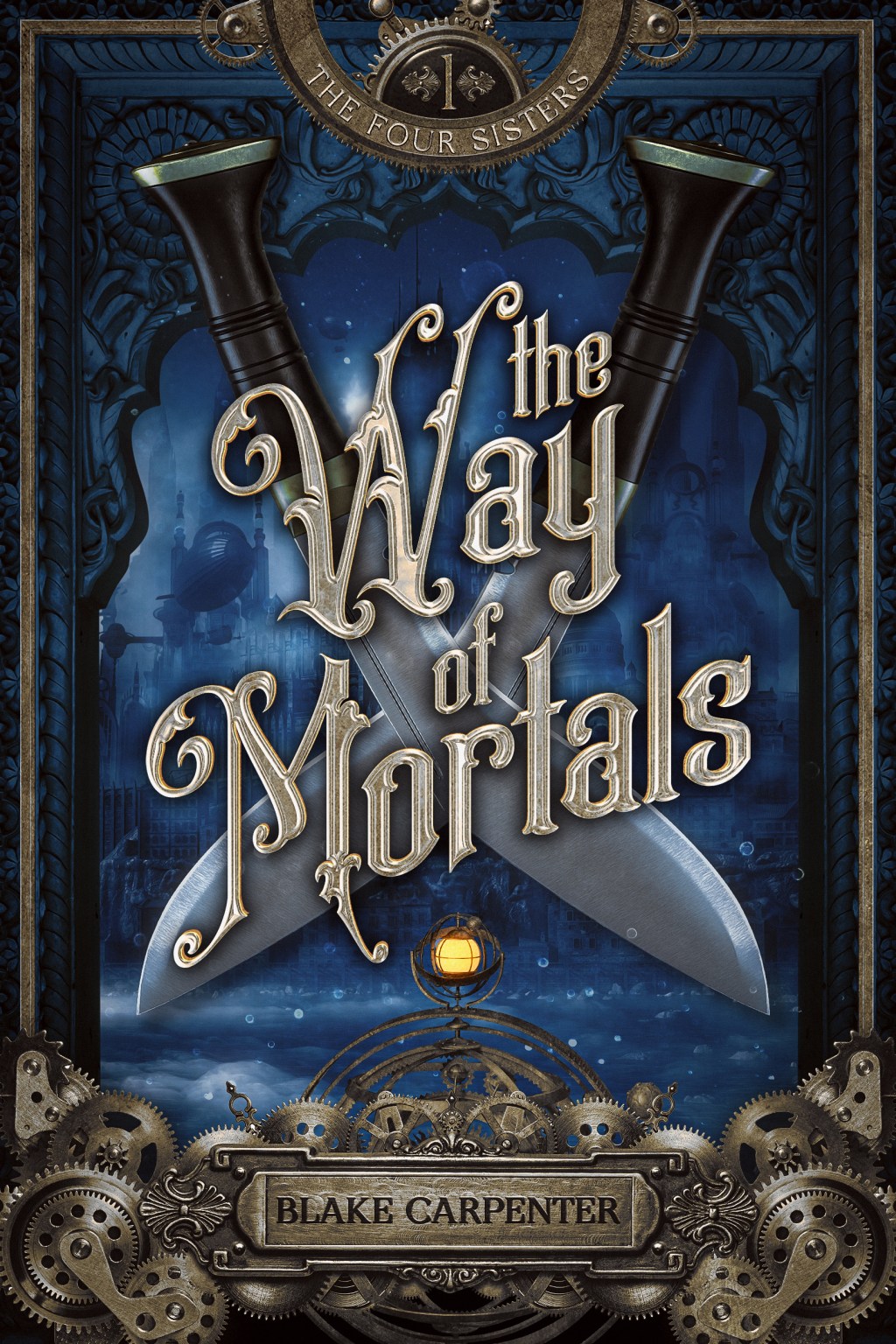
The way of mortals is to die—so expect this review to be killer!
Today we have another Blake Carpenter review, finishing off his published works as of the time of writing. Let’s get started!
Overview of The Way of Mortals
What is It?
In the city of Bhai Mandwa, towers of steel and glass reach for the sky while boiler-cars roll along streets that are inhabited by gangsters, demonic assassins, inept policemen and wandering ghosts. More than a million people call the city home, one in the midst of an industrial revolution, torn between the traditions of the old world and a new, frightening future. Below, the Genja River flows, waters possessed by spirits and magic from ancient times.
Prem Marantha, third of four royal sisters, was kidnapped and trained to kill as a child. Upon returning home after her long absence, she discovers that her parents are dead and her youngest sister has taken the throne. Now Prem must find out how to evade an assassin’s plot, elude the unwanted attention of the ruling Parliament and the police force it controls, and stop a conspiracy planning to overthrow the monarchy for good.
The Way of Mortals is a mix of Indian-flavored steampunk, gaslamp fantasy and alternate history, with the aesthetics of Larry Correia’s Son of the Black Sword and Guy Ritchie’s Sherlock Holmes films, along with a dash of political intrigue, mystery, and murder. Fans of fantasy with an Asian and Oriental twist will not be disappointed.
Unlike usual, I don’t really have more to say than the above. The Way of Mortals is a gaslamp fantasy novel with an Indian-inspired setting, following a single protagonist named Prem as she tries to uncover the secret behind the murder of a young girl and a threat against the royal family—which she is a part of, despite being an assassin. While this mystery is a core part of the book, Prem’s internal struggles with her dark past also feature very heavily, along with Prem rebuilding her relationship with her sisters.
Who Wrote It?
An indie author, Blake Carpenter wrote The Way of Mortals, as well as the previously reviewed novels Deathbringer and Lifebinder. For more on Blake, check out the author section of my Deathbringer review.
Content Warnings
Infrequent use of moderate-weight swearing. There’s also some violence and description of blood, including a description of a murdered child at the beginning of the book.
The Way of Mortals features a not-insubstantial amount of reference to disturbing topics, including rape and torture, the same but targeting children, and the training of children to be thieves and killers. As with Carpenter’s other books, there’s nothing voyeuristic or glorifying about these elements in his books: you get just enough detail to understand what’s happening, and that’s it.
Prior Reviewed Books
Deathbringer: The first book in The Spellsword Saga, although it was self-contained enough that it felt like a stand-alone. Deathbringer is a fantasy vengeance story about a woman widowed on her wedding day seeking to kill her husband’s murderer—and reclaim a magical sword that’s hers by birthright.
Lifebinder: The sequel to Deathbringer, Inga Alenir has her vengeance—but her life is still shattered. Oh, and her heart is still broken—literally. She’s only alive because of the magic of her undeath-commanding spellsword. But then Inga gets an idea of where the legendary spellsword Lifebinder resides, and decides to try and find it to revive herself…
The General Review (Light Spoilers)
I wanted The Way of Mortals to be my favorite Blake Carpenter novel.
The story starts out fascinating. The Indian-inspired world Carpenter presents feels deep, colorful, engaging, and fully realized as early as the first page. Prem, as well, promised to be an interesting protagonist—as a child she was kidnapped from her family by demon named Vati and forced to live in the streets as a magically empowered killer. Following the death of her parents, the Raj and Rani (king and queen), she managed to wrest control over herself from the demon, allowing her to return to her surviving siblings with the goal of protecting them and serving the throne.
The hook at the beginning of the story is compelling, too. A young girl, a nobody, has been murdered, but it’s clear that her death is meant to be a threat against the throne, given the obscene messages written around the crime scene. As a magical killer (an assassin), Prem is able to learn some interesting things just by observing the scene, including discerning her first lead—and, as a former street urchin, Prem simultaneously feels great pain for this lost child, giving her extra motivation to look into whatever happened, and greatly endearing her to me.
It was about at this point in the novel that I thought to myself, “I’m going to really love this book.” But then, just as quickly, my momentum came to a screeching halt.
During an early dream sequence, Vati rapes Prem. This is coupled with the pretty clear suggestion that he’s done this multiple times before, he will probably do this again, and Prem is utterly incapable of stopping the evil spirit or ever being free of him. In fact, she’s at the point where sometimes she initiates the sexual contact to have some level of control over where it will go. To be fair to Carpenter, this scene was handled as tastefully as such a topic can be, with nothing voyeuristic going on and no gross, inappropriate focus on Prem’s body—but I was still left with a bad taste in my mouth, and a worry that rape was going to be a critical topic in every Carpenter book. It was an important character issue in Deathbringer, after all, and as a result bled over into Lifebinder a bit (although that issue was basically resolved for Kale at that point).
Unfortunately, this sour taste continued throughout the book. It’s later revealed that Prem was raped as a child, that she spent significant time around other children who were also raped, and—I mean, it was all realistic for the context of the novel and, again, Carpenter handles it very tastefully, but it’s also the sort of topic that I just don’t want in head very often, if at all—especially when children are the victims.
Prem has a lot of agency in The Way of Mortals. The period of her life where she was a pure victim is clearly behind her, even though she has to grapple with the emotional consequences of those parts of her life throughout the novel—and with the demon in her head. Some people might read this as empowering: it shows there is a light at the end of the tunnel, after all. In this way, perhaps Carpenter is to be commended, even though this gradually moved the book pretty firmly into “not for me” territory.
I wouldn’t have finished the book if there wasn’t a lot that I still liked, however.
As I mentioned before, Prem is a compelling character. In some ways she’s tired and world-weary, while in other ways she’s bizarrely naive and innocent; in some areas of her life she is extremely competent, and reading about her while she’s in “the zone” is always thrilling, yet she’s amusingly incompetent in other areas. She’s got a lot of highs and lows that make her a highly textured, complicated character.
Her sisters were engaging, too. Preet least of all, perhaps, but Priya and Pranay1 consistently interested me and surprised me, and the relationship between the four sisters formed a really good core pillar holding up this novel. I wanted them to succeed together.
There’s also a lot of moments of amazing pathos in The Way of Mortals. In particular, I remember a scene where the girl murdered at the beginning of the book has to be briefly raised from the dead in an effort to find her killer. Learning that her name translates to “Unwanted,” feeling the pain and anger she had toward her life, and learning that all she really wants in the afterlife is a mother who loves her—my heart was breaking. I was locked in with these moments.
But, while there was enough to keep me going, there were also a lot of elements that ultimately led me to be uninterested in future sequels. For me, Prem’s frequent romantic interest in another character felt forced, particularly considering she was still grappling with the mental and emotional fallout of sexual assault. (Her family’s regular teasing encouragement of the romance didn’t help, and I had a few moments where I wondered if they had any motivation beyond him being conventionally attractive and her being single—after all, he was the son of their enemy. And, more importantly, they weren’t usually around when Prem had interactions with him.) I also found the final conflict with the book’s main villain to be a bit lacking—maybe rushed would be a better, more specific for it. The book spent so much time focusing on Prem and her sisters (granted, those were among the strongest parts of the book) that the villain received little to no buildup, her grand plan amounted to just chucking bombs at a crowd while Prem was in it, and things resolved with Prem holding her to the ground while she explained her entire villainous plan and motivations before killing herself. It was anticlimactic.
The wrap-up was pretty good, though. Reuniting the sisters felt right, and, for those interested in continuing the series, there are some interesting plot threads that were both left unresolved and held up tantalizingly.
Wrapping Up
Mileage may vary for The Way of Mortals. I think there’s an audience out there who will love that book, and that audience is much more resistant to heavy, dark topics than I am. (Or they will read the book before reading other books with similar topics and themes, thus approaching it while fresh and resilient.)
But, for me, while I had aspects of the book that I enjoyed, I don’t plan on revisiting the novel, nor picking up its sequels when they come out. I think it’s a genuinely well-written book, despite some flaws, but certain rougher topics present in The Way of Mortals ultimately proved to turn me off rather than pull me further in.
Enjoyed this review? Consider subscribing below so you never miss an update! You can also follow me on X.
If you like fantasy, consider checking out my novel, Inner Demon, a story about a girl with amnesia who has to rescue a kidnapped friend before it’s too later. For fans of science fiction, consider The Failed Technomancer, a story set in a post-apocalyptic world where robots are eating people.
- It’s extra impressive how well Carpenter got away with naming his central case Prem, Preet, Pranay, and Priya—I was worried I’d be constantly mixing these four up over the course of the book. I did, for the first few chapters, but once these four cemented themselves in my mind I had no more issues going forward. ↩︎
 Boo Ludlow
Leave a comment