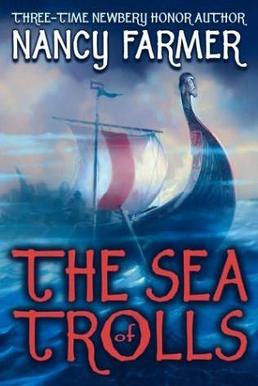
“Life and death are in constant battle. There’s no way in this world for happiness to exist alone.”
“But what are we do to?”
“Wake up.”
The Sea of Trolls, page 430
The Sea of Trolls is a book that holds a special place in my heart. I remember it as my most-reread childhood book, and therefore (by one definition) my favorite. I picked up a copy recently, with the intent of putting it on the shelf until I could share it with my girls—but seeing a book go unused for so long is somewhat depressing. I picked it up and started reading in the hopes that The Sea of Trolls, despite its target audience being preteens, would be as good for me now as it was then.
Somehow, it was even better.
Overview of Name
What is It?
Jack was eleven when the berserkers loomed out of the fog and nabbed him. “It seems that things are stirring across the water,” the Bard had warned. “Ships are being built, swords are being forged.”
“Is that bad?” Jack had asked, for his Saxon village had never before seen berserkers.
“Of course. People don’t make ships and swords unless they intend to use them.”
The year is A.D. 793. In the [following] months, Jack and his little sister, Lucy, are enslaved by Olaf One-Brow and his fierce young shipmate, Thorgil. With a crow named Bold Heart for mysterious company, they are swept up into an adventure-quest that follows in the spirit of The Lord of the Rings.
Other threats include a willful mother dragon, a giant spider, and a troll-boar with a surprising personality—to say nothing of Ivar the Boneless and his wife, Queen Frith, a shape-shifting half-troll, and several eight-foot-tall, orange-haired, full-time trolls. But in stories by award-winner Nancy Farmer, appearances do deceive. She has never told a richer, funnier tale, nor offered more timeless encouragement to young seekers than “Just say no to pillaging.”
The Sea of Trolls is a middle grade historical fantasy novel that primarily follows Jack, a Saxon boy who, along with his sister, gets enslaved by Northmen. What follows is a grand adventure wherein Jack makes the best use he can of his basic training as a bard (think more along the lines of a druid than a minstrel) to protect himself and his sister. Along the way, he makes a slew of unexpected friends and allies, all delightfully realized in Farmer’s simple-but-evocative style.
Who Wrote It?

Nancy Farmer is a writer of fantasy and science fiction primarily targeted at children and young adults. She was born in 1941 and didn’t start seriously writing until she was in her 40s; living in Africa at the time, her first stories and novels mostly focused on the peoples and cultures that surrounded her, but winning the Writers of the Future contest led to her moving back to the United States, where she started to write other stories as well.
The Sea of Trolls is the first book in a trilogy, but it’s far from the only well-known Farmer book. The House of the Scorpion, a sci-fi young adult novel about clones and opium lords, might be better-known; The Ear, The Eye, and the Arm was an earlier novel that helped things take off for Farmer and it, along with A Girl Named Disaster, are probably her African-centric novels that made the leap to the States best. She’s also the winner of several awards, including the Newbery Honor.
And now, in Farmer’s own words:
When I was growing up, I read C.S. Lewis and Roald Dahl. I love Dahl’s outlook; there’s nobody nastier! He’s the one who said, “Children are little beasts, and you mustn’t forget it.” He liked children but he didn’t have any illusions about them…
One of my main themes is self-reliance, the ability to compete against odds and to beat them. A lot of kids’ books have somebody who learns to come to terms with some dreadful situation, and it’s all about them continuing to suffer at the end of the book. I don’t want to write ‘victim’ books. I want a triumph, a hero or a heroine, and that’s what I write about.
Nancy Farmer’s bio on her website
Content Warnings
For adults, there’s absolutely nothing concerning in The Sea of Trolls.
It’s worth noting that The Sea of Trolls does hearken to an earlier attitude regarding violence and consequences in children’s media, one that might conflict with modern sensibilities.1 Parents who are afraid of their children ever coming in contact with the word “kill” are idiots—sorry, my fingers got away from me there. What I meant to say was, people die in this book, and their deaths are never peaceful. In one scene a woman gets her throat cut; in another a woman gets beheaded and a baby gets thrown into a fire. Blood is mentioned on occasion, and characters are frequently injured. Other scenes merely have implied violence, such as one where an enslaved monk is sold to a group of Picts and we as the audience are given every reason to believe that monk is gonna get eaten. Violence and death is never lingered on, however; using the slit throat as an example, it is stated that the woman’s throat is cut and she is thrown overboard, and, other than Jack’s emotional response to seeing such a terrible thing, that’s the end of it.
All said, I would personally hand this book to my future eight-to-ten-year-old, unless (as her parent) I deemed her to be highly sensitive.
The Sea of Trolls Review & Discussion
Some spoilers for a book that’s about twenty years old at the time of writing. I’m not going to review the plot in detail, as I do in some of my other reviews—I like this book and I recommend it. It’s a middle grade, historical, coming-of-age adventure novel with vikings and trolls and musical wizardry. If all that sounds good to you, please, do yourself a favor and read it.
Mostly I want to talk about a few things that struck me during this reading of The Sea of Trolls, so that’s where I’ll put the majority of my focus in this blog post.
The Review
My review for The Sea of Trolls is short, and I’ve already shared it: This book is really good. I highly recommend it. It’s a middle grade novel, so go into the book with the right expectations, but anyone from eight to eighty should be able to enjoy The Sea of Trolls.
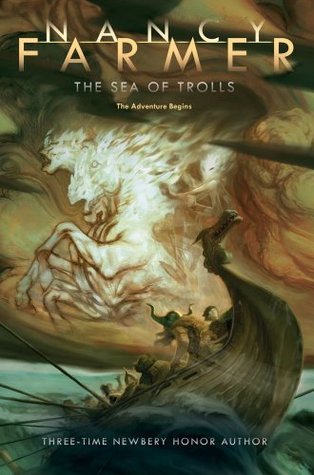
My one complaint is a silly one: I don’t like the new covers very much. I don’t find them as powerfully evocative as the cover I grew up with, but perhaps that’s just nostalgia speaking.
The Discussion
Returning to The Sea of Trolls felt like coming home. It’s an unexpectedly ambitious book that effectively explores very large themes, including:
- The battle between life and death (conceptually and practically)
- Appreciating moments of joy even in the face of strife
- Facing death with courage
- The paradox of how great good and great bad can be found in the same person (and whether or not that can be reconciled)
… and so forth, presented in a manner that allows audience members of just about any age to be able to learn something significant (and that without preaching or, nearly as bad, providing easy answers). It’s an example of the all-ages ideal: packaged so that children can read, enjoy, and learn from its story and characters, with depth and meaning that adults will find enriching as well. I quickly remembered what it was that, as a child, had me returning to this book, and then settled in as an adult to explore what I couldn’t fully appreciate when I read and reread the book over a decade ago.
While I did find moments of significance before what I’m about to share, this is the paragraph that drove home to me, as an adult, how much depth The Sea of Trolls had that went right over my adolescent head. For context, Jack and Lucy were enslaved not long ago; despite being just eleven, Jack is faced with the impossible task of trying to protect and shelter his five-year-old sister from the world:
He mustn’t cry. He mustn’t cry. He was all Lucy had, and he mustn’t fail her. Jack felt at his neck. The rune of protection spread warmth over his hand and up his arm. Taking care of Lucy wasn’t a bad thing, really. It was much better than having no one at all. How odd, Jack thought. He had no more control over his life than a dog on a chain, but caring for Lucy made him feel… well… strong.
The Sea of Trolls, page 109, emphasis added
I’ve never been enslaved, much less by vikings. Despite that, I still felt like I could connect deeply with Jack here in a way that my younger self just didn’t have the depth of experience to appreciate. I have a wife and two daughters, with one more child on the way. Holding them, caring for them, and strengthening them helps me to feel strong, even in the face of all the uncertainty and unrest going on in the world right now—even in the face of the challenges and stresses of my personal life. Men and women both have a natural need to protect, care, and provide, but that need is felt and expressed differently—and, in that moment, I was struck by how many powerful examples The Sea of Trolls provides of powerful masculinity.2 To explore this, I’m going to focus on five characters as examples: Giles Crookleg, The Bard, Olaf One-Brow, Jack, and Ivar the Boneless.
Masculinity in a Nutshell
But first, here’s the framework I’m working with in this discussion. What a man is (in addition to biological maleness) perhaps can be best defined by what men do uniquely well and uniquely naturally: Build. Explore. Fight.3 To one degree or another, all men need to do each of these things at various points in their lives, although each individual man likely emphasizes one over the others. In my mind, performing these actions to create, edify, enrich, protect, or provide is virtuous masculinity, and that will be what I care most to zoom in on.
Sounds good? Let’s continue.
Giles Crookleg—The Builder
Giles Crookleg doesn’t seem like much at the start of the story. He’s a farmer with a lame leg, making his life much more difficult than it would otherwise be; he constantly complains that he never had the opportunity to be a monk, ignoring (or perhaps unaware of) the slight insult that carries to his family (they would not exist if he had sworn celibacy); he’s never pleased with his son, no matter how hard Jack works or what he accomplishes; and he unhealthily indulges his daughter, Lucy, in her fantasies of being a lost princess. He’s a very flawed man living a very difficult life, to say the least.
I didn’t like Giles very much as a boy, but as an adult I find his lack of self-awareness hilarious. That said, his real value—despite his flaws—probably can’t be made clearer than through Farmer’s own words:
Jack didn’t think the farm was suffering. The fences looked sturdy; the field was covered with oats and barley. Mustard, lavender, and coriander bloomed in the kitchen garden, and the apple trees were covered in tiny green fruit.
It was so beautiful, it made his throat ache. He’d never appreciated the little farm until now. And he saw his father in a new light. He realized that Giles Crookleg’s complaints meant no more than the mutterings of crows in a tree. It was a habit crows fell into when things weren’t going their way. Father, too, grumbled by way of easing the disappointments in his life. What mattered was how Father went on in spite of his unhappiness, to create this beautiful place. Jack saw how lovingly the house was made, how carefully provisions were laid up so that Mother, Lucy, and he could survive.
The Sea of Trolls, page 24
Giles Crookleg is a builder, and a darn good one. It doesn’t matter whether or not his house or farm is more beautifully or artfully done than another builder’s—what matters is just that he crafted it with care, specifically with the needs of his loved ones in mind, and that he unflaggingly gave, and gives, his very best. And he does all this in spite of his many failings, which is quite admirable.
This isn’t something I appreciated realizing, but I think there’s a lot more of Giles Crookleg in me than any other character in The Sea of Trolls. I grumble a lot to ease the disappointments of life. I’m often unhappy or unsatisfied with life in general, but—whether or not that’s in any way justified—I try to work hard to ensure my family is taken care of, and I’ve found that there’s true joy to be had in the service of your loved ones. Giles is much more of a builder than I am, though, especially in a literal sense—he literally made a house and farm to care for his family, despite the impediment of his lame leg. Even his hardness on Jack is his way of trying to build the boy into becoming the best man he can be.
There is something truly noble, and virtuously masculine, in both Giles’ struggles and the fruits of those struggles. It’s probably worth noting that he probably had to channel the explorer and fighter at parts of his life, particularly while claiming and taming the land that became his productive farm—but, looming far above the rest, Giles is a sturdy example of a builder.
The Bard—The Explorer
The Bard is a clear pretty clear-cut example of an explorer. Having lived a life of travel and adventure, he’s literally an explorer, and as a result has collected a great deal of knowledge and skills (as well as connections, for good and for ill) that would never have come to him otherwise if he had remained in one town his whole life. Having pushed himself hard to become a master bard, he’s also an explorer of the boundaries of knowledge and mastery in his chosen field.
All this has also helped him to become a very wise man as well. While most of his life was spent in study, adventure, and discovery, qualities of a fighter can be gleaned from the danger he overcame while traveling the world, and his approach to teaching Jack reveals there’s a bit of the builder in him as well, particularly in how he dispenses his wisdom:
“No kindness is ever wasted, nor can we ever tell how much good may come of it.”
The Sea of Trolls, page 449
Virtuous masculinity is also found in those who risk themselves to travel into the unknown and bring back knowledge or resources with which to strengthen others, and the Bard is a powerful example of this.
Olaf One-Brow—The Fighter (and More)
And now we come to Olaf One-Brow. This is a character that would probably require thousands of words for a fair analysis, and I’ve already gone over my intended budget of words for this “review,” so I will endeavor to be concise.
Olaf is a fighter most of all. He’s one of the most successful warriors his people have ever produced. He’s a fierce berserker with hundreds or thousands of kills to his name. He’s fought, and slain, fierce monsters, including trolls, and at his feet, in his death pyre, was a massive troll-bear, slain by him just minutes before. He is utterly fearless in the face of challenge, making him a mighty shield (and sword) between those he cares about and the dangers of the world.
Not all slain by his hand were glorious foes, however. Olaf is not always a virtuous or idealized warrior. In the throes of berserk rage, women and children are just as viable targets as adult warriors.
But, perhaps by virtue of being present and explored in more detail than the previous two examples, but also by virtue of being “big and beautiful,”4 Olaf also provides an excellent example of far more than just being a fighter.
Olaf is an explorer. He’s travelled his portion of the world thoroughly, not just fighting with other peoples but also trading with them. He’s travelled into other worlds as well, such as Jotunheim, and had friendly interactions with trolls, leading to a period of peaceful treaty between trolls and men.
And, finally, Olaf is a builder. Seemingly paradoxical with the fire and destruction he’s waged upon his enemies, and upon innocent Saxon peasants, Olaf has a firm moral code and sense of honor,5 and he holds his warriors and house to it, building them into men of a sort of honor. He has twelve children and three wives, all of whom he loves and provides for, and his oldest son promises to be even greater man than his father—still a warrior, but not a berserker (to Olaf’s disappointment, admittedly), and this without the indiscriminate bloodthirst that falls upon his father. Olaf also, like Giles, built his home and shaped his land with his own hands, creating an ideal place of refuge and growth for his family.
Olaf, in many ways, is an archetype of man that is truly larger than life and somehow does it all—both the good and the bad. He terrifies Jack, yet he’s gregarious enough to befriend Jack and even earn Jack’s respect and honor, against the boy’s will; he makes slaves of what he views as “lesser men,” but he teaches his children to be great, and he promises Jack’s freedom in part because of the greatness he sees in Jack; he builds a strong and loving home, despite having looted and burned to the ground the homes and happiness of others.
Olaf is deeply complicated. Anyone who writes him off as a villain is simply wrong, ignorant at best, but I don’t think Olaf can be summed up as truly heroic either; he’s human, and there exists great opposition within him, but perhaps that tension is what allowed him to achieve such heights of greatness.
I’ll let Olaf’s own words (and an interaction with loved ones) describe him:
“Listen well, old friend. Those who spend sheltered lives are ever afraid of danger. But you know danger is what we warriors were born for. Our spirits drive us seaward to sail the salt wave. Our happiness lies in risking all in some adventure, and if we survive, so much sweeter is our homecoming. But to all men, eventually, comes doom. Our only choice is to meet it boldly. It will come to us whatever we do.” [Olaf]
Rune’s eyes were shining. “You deserve the finest poem a skald could ever write.”
“I do, don’t I?” said Olaf, brightening up.
“You deserve a kick in the backside,” cried Heide. “Who ever stuffed men’s heads full of such nonsense? Why can’t you avoid trouble and fight another day?”
The Sea of Trolls, page 220
All said, it cannot be denied that Olaf does many genuinely good, noble things—and even in his fighting, he has many instances of battling to protect those he loves, or provide for them, or to destroy threats to his people and homeland. In these instances he undoubtably is an example of virtuous masculinity.
Jack—The Boy
As for Jack, I include him on this list of examples because he is in the process of becoming a man. The Sea of Trolls is, in part, a coming-of-age story, after all. Jack’s struggles to grow and mature, and to make sense of the difficult world he will inherit, showcase pieces of the painful metamorphosis that boys must undergo to become great men.
Ivar the Boneless—When Masculinity Fails
And finally, Ivar the Boneless. Like Jack, Ivar is not an example of any bit of realized virtuous masculinity—but, unlike Jack, he’s an example of the opposite. Ivar had the potential to become just as great at Olaf but, when faced with beautiful evil, he allowed himself to be seduced by it—and it destroyed not only him, but would have destroyed his kingdom had men like Olaf not been around to greatly slow the decline.
“Troll-maidens get their husbands by capture. They’re bigger, you see. They usually find themselves a nice lout…”
“Like… you?” Jack said, looking at Olaf.
The giant winced. “I escaped that fate, though only by the greatest good fortune. Ivar wasn’t so lucky. We’d been poking around, trying to find… some gold. The Jotuns ambushed us. I fell down a cliff trying to get away and landed in a lake. The trolls thought I’d drowned, but they got Ivar. The Mountain Queen shut him up in her cave.”
“So Frith6 didn’t capture him. Her mother did,” said Jack.
“The Mountain Queen was getting a little desperate. None of the louts would have Frith… [She] could have tortured them into agreeing, but it’s a poor way to start a marriage.”
“Was… Ivar tortured?”
“Oh, no! He was delighted. He couldn’t see Frith’s true nature, as the others did. He thought he was getting the most beautiful princess in the world.”
“He was always somewhat shallow,” commented Rune. “I could have seen through her in a second.”
The Sea of Trolls, page 257
Perhaps what’s most interesting about Ivar is that he didn’t seek out evil—it came to him, and he failed to recognize or resist it. He refused to recognize the evil, destructive influence of his half-troll wife, and instead indulged or kowtowed to her, resulting in his kingdom becoming weaker, his people becoming weaker and less prosperous, and leading to increased raiding of foreign lands. His lack of virtuous masculinity brought about his own slow, rotted downfall, and brought pain and suffering to many others.
Concluding Those Thoughts
There are other characters that, perhaps, deserve similar consideration—Rune chief among them—but my point is how well The Sea of Trolls conveys these different types of virtuous masculinity, as well as naturally shows the dangers of peoples and places without. The Sea of Trolls also isn’t afraid to dabble in painful reality—with Olaf as a clear example, men are capable of doing harm as well as good, depending on how they draw upon their natural strengths and apply them to the real world. Wise children, particularly boys, won’t take this as a warning not to be builders, explorers, or, especially, fighters, but as a caution to be very thoughtful about how they choose to cultivate these aspects of their nature. After all, all three are necessary and have a meaningful place in the world.
On Opposition
Finally—I’ve waxed long enough talking about just one small part of The Sea of Trolls, but I want to briefly highlight another thing that struck me quite powerfully in the book. Good and evil absolutely exist in this world, in shades and in absolute forms—but I thought it very interesting how The Sea of Trolls also highlighted the existence of opposition that wasn’t inherently good or evil, and what ought to be done about it.
Here’s an example of such a moment:
It was necessary to kill to feed or protect one’s family and self. That was what the [giant] spider had done with the eagle. If she attacked Jack or Thorgil, he would have to slay her. But Jack also understood that if he killed the spider without need, he would lose his power and his music would go from him.
The Sea of Trolls, 390–391
In life, conflict is sometimes unavoidable. Some creatures must kill to eat—humans among them—or to otherwise provide for themselves and their families. At the same time, fighting, and killing, is justified in self-defense, even in defense against the aforementioned justified or necessary killings. While this tension could be spun in different ways, I see it as just a practical aspect of natural reality and essentially neutral in nature—competition is inevitable, and in competition there are winners and losers.
I think this is what justifies the berserkers and elevates them as more than just mindless killers, actually. This is addressed in a debate between Jack and Rune7—Jack is horrified to realize that, in essence, these people he has befriended and come to love will still raid and pillage after they return Jack to his home, though they swore an oath not to harm his village. Rune explains that it must be done; the land they come from is too cold and dark most of the year to farm, and they do not have enough other natural resources to support themselves, so they must raid and pillage. I think most readers, living with modern conveniences and comforts, would side with Jack over Rune, mentally making arguments that the Northmen should move elsewhere, thus eliminating or reducing the need to fight—probably forgetting that elsewhere has generally been claimed by someone else already, so such an action would lead to yet more conflict. The Sea of Trolls, to its credit, doesn’t narratively take sides, but lets each character explain his piece and then have their own thoughts.
Anyway—opposition, the natural battle between life and death, is woven into The Sea of Trolls from the beginning, and its nature is one of the biggest lessons for Jack to learn. Living is hard, and there’s a lot of suffering to be had in life—but, at the same time:
“One thing I do know,” the queen went on. “To ignore joy while it lasts, in favor of lamenting one’s fate, is a great crime.”
The Sea of Trolls, page 349
There’s good and bad. There’s sorrow and pleasure. Some people will build beautiful, great things, which will inevitably attract those who wish to loot and steal—and if beautiful, great things cannot be protected, then they will be destroyed. But, sometimes the wise and the prepared will be able to protect those beautiful, great things.
Such is life. We can complain that life has hardship in it; we can wish that things were different, rather than working to make them so; we can ignore or disregard the good and the pleasurable when confronted with pain; or we can… wake up.
Wrapping Up
My goal in this review-discussion is not to claim that Nancy Farmer made some sort of landmark dissertation on masculinity and the nature of our world—even better, she just made a dang good book. She made a book that, though fiction, was able to capture a lot of what I consider to be pure truths about reality, distilled into form through flawed characters and hard situations. Ideally, I think that’s what the best fiction does.
Go read The Sea of Trolls. And then come back and let me know what was the exact moment where you stopped hating Olaf One-Brow and realized that, somehow, he’d managed to become a hero in your heart—or maybe an anti-hero—perhaps against your better judgement.
Enjoyed this review? Consider subscribing below so you never miss an update! You can also follow me on X.
As well, please consider checking out my independently published novels. Fans of post-apocalyptic science science fantasy might consider The Failed Technomancer, while Inner Demon is for lovers of pure fantasy. Or consider taking a peek at both—I won’t stop you.
- “Modern” is used with a bit of disdain here, I want to emphasize. ↩︎
- Powerful femininity is also on display in The Sea of Trolls, particularly in characters like Jack’s mother and Heide, but I’ll leave it to someone else to perform that analysis. ↩︎
- I discuss this in a lot more detail in my article “Men (and Books).” The definition I’ve provided here I’m borrowing from Devon Eriksen; I consider it the neutral description of masculinity, and then you can take these actions in positive or negative directions. The positive direction is what I personally prefer to define as masculinity: “men fight” becomes “men protect”; “men build” and “men explore,” in my mind, can be summed up in the positive ideal of “men provide.” ↩︎
- Said a little tongue-in-cheek. Throughout The Sea of Trolls, several character express deep affection for Olaf, including the queen of the trolls. Each of them state, in essence, that he’s a mighty man, and that, despite his few traits that they find frustrating, they can’t stay mad at him—he’s too big and beautiful. ↩︎
- Here’s a related moment I found of note. Earlier, Jack had been set to a dangerous task by other slaves in Olaf’s house—a task which nearly killed him. Jack ended up resolving things on his own and never mentioned it to Olaf, but Olaf still learned of what had happened. He later said to Jack:
“If you’d complained to me, I would have killed the thralls involved. As you didn’t, I left them alone. It was honorable of you not to take revenge on lesser men.” (Page 272) ↩︎ - For context, Frith is a half-troll, which, in The Sea of Trolls, is an inherently evil vile, selfish creature—though also quite beautiful, under certain circumstances. ↩︎
- Chapter forty-two, for anyone curious. ↩︎
 Boo Ludlow
Leave a comment