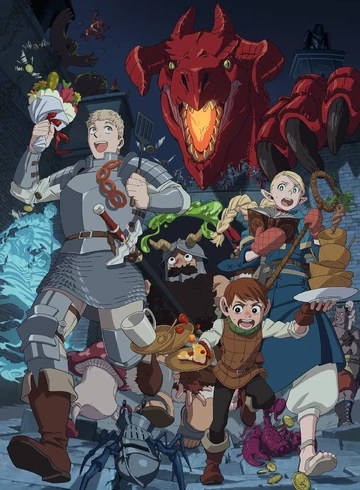
Even if it means hurting someone else… I want you and my brother to live, Marcille.
~Falin Touden
Delicious in Dungeon (also called Dungeon Meshi) is one of the weirdest anime I’ve seen in a long time—but I kinda like it. Actually, no—I kinda love it. And that surprised me, because I wasn’t very engaged by the show in the first few episodes, but once it caught me I couldn’t stop watching. It’s been a long time since my wife and I have watched a show that has had us this active with laughter, with pointing at the screen, with yelling about what just happened (and waking up the kids…), and with discussing where we think where the show is going. It’s been a blast.
Let’s talk about it!
Overview of Delicious in Dungeon
What is It?
To conquer a cursed dungeon and save his sister, Laios must make a choice: eat the monsters in his way—or become their next meal.
Delicious in Dungeon is an offbeat comedy anime strongly inspired by old role-playing games.1 Its premise is simple: Laios’ sister, Falin, was eaten by a dragon, but, for reasons explained later on, Laios believes he can still save his sister. Much of his party deserts him, but Marcille, a spellcaster, and Chilchuck, a thief, remain, both committed to saving Falin. There’s one big problem, though: none of them can afford the supplies necessary to travel deep enough into the dungeon to potentially save Falin. The situation appears hopeless.
Then again… what if they live off the land, so to speak, to take care of their needs?
Delicious in Dungeon also features regular segments where monsters are cooked and eaten, with the food animation so succulent that I have to wonder if that’s where the majority of the show’s budget went.2 Delicious in Dungeon is dangerous to watch on an empty stomach!
Who Wrote It?
The original manga for Delicious in Dungeon was written and illustrated by Ryoko Kui. The manga was published in fourteen volumes and has been translated into English—I’m tempted to pick it up! Delicious in Dungeon is Kui’s best-known work, so far as I can tell, although she has previously published short stories and one-offs.
The anime Delicious in Dungeon was produced by Studio Trigger, an independent Japanese animation studio with a long history of well-known (and loved) works to its name. Unfortunately, Delicious in Dungeon is solely available through Netflix, at least in the United States—I don’t know if other options exist elsewhere. I recommend borrowing a friend’s password and giving this a go.
Content Warnings
The human heart tires of happiness quickly, but its capacity for misery is bottomless.
~The Narrator (I think)
On Netflix, Delicious in Dungeon is rated M for violence and nudity.
As far as violence is concerned, Delicious in Dungeon features a lot of monster fighting and monster killing. Characters are often injured, and even killed—healing and resurrection are relatively cheap in this universe—but injuries, deaths, and kills are rarely gruesome, even when, for example, a monster is shown with its head chopped off. That said, there are moments that some audience members will find disturbing, such as seeing someone have his leg reattached or seeing a dragon corpse decomposed to the point where the meat is like blood pudding.
For those concerned, the cooking segments of Delicious in Dungeon feature monsters getting prepared before getting eaten. These segments are not gruesome, nor particularly graphic—not unless you consider the Food Network graphic television, anyway. It helps that “demi-human” monsters are never eaten.
As for the nudity, Delicious in Dungeon does a disservice to itself. Three or four episodes, roughly, feature brief instances where harpies with human breasts are visible on-screen. These creatures are not sexualized (beyond their borrowed human anatomy), but are solely seen chasing and battling adventurers. One character rides the edge of nudity, being a human-monster chimera with breasts that are visible but covered enough in feathers, giving her as much effective coverage as a human wearing an immodest shirt. There is also one episode where two female characters take a bath together and have an intense (non-romantic) conversation (hair or water cover the sensitive bits), and one episode where an injured female character is technically nude, but she’s so covered in blood that you can’t see the sensitive bits.
Finally, one male character’s underwear is often seen when he is knocked over or sent flying by attacks. Oh, and, I suppose, there’s that one episode where a female minotaur is seen with visible udders. That might count as nudity to some. It’s a weird moment.
Beyond the sexuality inherent in nudity, near-nudity, questionable nudity, and implied nudity, Delicious in Dungeon isn’t a sexual show at all—by that, I mean there’s no romantic tension between characters, there’s no sneaking off to have a fling while no one is paying attention, there’s no sexual relationships (or even merely chaste romantic relationships) portrayed in any way on-screen, there’s no talk of sex (or even monster reproduction), none of that. In the case of the harpies, the nudity is an accurate classical representation of a monster; in the case of the female near-nudity, I interpreted some of it as fan service, some of it as (effectively) heightening the tension of a scene; in the case of the male underwear, and the minotaur udders, such things are played for comedy.
In short, as someone extremely sensitive to (and opposed to) nudity in film, I found moments of this show uncomfortable—and, truthfully, would have stopped watching if I didn’t otherwise find the show so engrossing, if the visible breasts were on a human (or human-equivalent race, like an elf) rather than a monster, or if the show had sexualized its human-appearing monster nudity in any way. I think Delicious in Dungeon does a disservice to itself by including most of its instances of this type of content at all—it scares away audience members who otherwise would have loved the show. I was in that crowd. I wasn’t willing to watch Delicious in Dungeon until someone I trusted told me that there wasn’t any “real” nudity in it.3 (I later found out this wasn’t true, as what I described above I would consider “real” nudity,4 but I was able to easily forgive my friend and understand where she was coming from.) I don’t regret watching Delicious in Dungeon—in fact, I’m quite excited for the second season—but I am a bit apprehensive, as I hope the show doesn’t indulge any further in this type of content.
Finally, Delicious in Dungeon features a small amount of light-weight swearing, mostly coming out of the mouth of Chilchuck.
The General Review (Mild Spoilers)
That means we can kill it. That means… We can eat it!
~Laios Touden
The way Delicious in Dungeon begins… I found it surreal. Laios5 and his party are fighting a dragon and Laios is totally out of it—He’s tired. He’s hungry. He’s just not feeling this fight, despite the fact that a literal fire-breathing dragon is bearing down on him. Right before he gets eaten, his sister, Falin,6 tackles him out of the way and ends up in the dragon’s jaws instead. Before she gets eaten, Falin casts a teleportation spell—she can’t include herself, for whatever reason, but she teleports the rest of her party to the surface, out of the dungeon and to safety.
Laios and the others appear in a meadow full of flowers. The moment before was harsh flame and hot blood; this one is gentle sunlight and cool breezes. Everyone is a bit shocked they are alive.
Breaking the stillness, two party members stand and announce that they are going to find new parties to join. Laios is shocked. He can’t believe anyone wouldn’t immediately be resolved to go back into that dungeon to rescue Falin. But the others won’t be persuaded, so Laios and the remaining party members, Marcille7 and Chilchuck,8 regroup and decide to immediately head back in to rescue Falin. The problem is, they have no money, which means they can’t afford food, and therefore have no hope of reaching the floor where they fought that dragon, let alone having the strength left to beat it with fewer party members than before and rescue Falin… or, whatever is left of her, anyway.
It seems hopeless. But Laios has a grim resolve to push forward anyway.
Then Laios gets an idea that he thinks is brilliant, but that everyone around him thinks is utterly insane: why not eat the monsters they kill? With how many monsters fill the dungeon, they’d never run out of food! And, fortunately for Laios, a short time later he recruits a dwarf named Senshi to his small party. Senshi happens to love eating monsters—he’s been living in the dungeon for years, rarely visiting the upper levels, let alone the surface, and the only thing he can’t provide for himself are certain spices he needs to trade for. He’s all for teaching what he knows to the only band of adventurers he’s met with the same interests that he has.
Well… Laios, strictly speaking, is the only person with the same culinary interests as Senshi. Marcille and Chilchuck are disgusted, but, seeing no other option, they eat their first monster meal, prepared by Senshi—and are surprised to find that it’s delicious.
And so the adventure begins in earnest.
I’m not going to lie, the first few episodes of Delicious in Dungeon were a barrier that I might not have pushed through if I were actively watching another show, and if I weren’t looking for something to do with my wife and she weren’t too tired for more active activities. Stakes appear to be high and urgent in the first ten or fifteen minutes of the first episode—Falin has been eaten by a dragon and Laios wants to save her. That sounds like the kind of thing that, assuming Falin is even in a savable state, would have a hard time limit. Right?
Well, if it is, none of the characters appeared to be bothered. Laios is relaxed at most times, and his party meanders through the dungeon—granted, they do take a shortcut to get to the lower levels a little faster, but they still don’t move with any sort of hurry. They are easily distracted, particularly by Laios’ newfound interest in monster cuisine—it’s almost like they had completely forgotten their driving force as soon as eating monsters was on the table. Multiple times I said to my TV screen, “What are you doing? If Falin is alive in that dragon’s stomach, there’s no way she has much air left—If fresh (enough) air recycles into the dragon’s stomach, she’s still going to be melted by stomach acids soon—If she’s using her healing magic to survive longer in the dragon’s stomach, she’ll run out of mana eventually, or pass out from exhaustion and won’t be able to heal herself. Where is your sense of urgency?!?!?!?!?“
It was aggravating.
I’m not really sure what made me want to keep watching, but whenever my wife suggested looking for another show I said “Just one more episode.” The animation was gorgeous, but I doubt that alone was it. Delicious in Dungeon was funny at times, but not hilarious (yet). Breadcrumbs of details about the world and the secrets of the dungeon were very interesting, but not enough carry the show on their own. Maybe it was a combination of all three factors; maybe I was just mad at the show’s setup and wanted to see how it fell apart. I’m not sure, but I kept watching, and, gradually, I fell in love with Delicious in Dungeon.
You could say it was an acquired taste.
Here’s one key moment that saved the early show for me: it takes a while, but maybe around the quarter- or third-mark for the season you learn that resurrection is relatively easy in the dungeon. It can’t be done outside the dungeon, but inside the dungeon if you heal a corpse of the injuries that killed it the corpse comes back to life; suddenly, the party’s lack of urgency made sense. In the logic of this world, rescuing a living Falin wasn’t necessary at all; they just needed to rescue enough of her to bring her back to life. In that case, and under the assumption that dragon digestion is long and slow, the smartest thing for the party to do is to take their time. That way they have a higher chance of being refreshed and fully prepared when it comes time to fight the dragon—and thank goodness, because they will need all the help they can get.
Many other aspects of Delicious in Dungeon worked in the same way for me, actually. I gradually discovered that this show works really well, but you have to approach it and accept it on its own terms. Once you do that, it will reward you with genuinely excellent entertainment and beautiful moments of humanity.
I even came to look forward to the cooking segments, to the point where any episode that didn’t include at least one meal left me wondering if my wife and I should squeeze in just one more episode before bed. They add a wonderful rhythm to the show, and are ideal opportunities for the characters to interact with each other in ways where you can see their connections and relationships strengthening.
Here’s another moment that helped things click into place: It only took a few episodes for me to realize that Laios is weird. Just looking at him, and spending a little time with him, he seems like an average, not particularly interesting guy. But the more you get to know him, you learn he had a pretty tough upbringing, which is why he tends to keep things close to the chest—but he is weird. Naturally, through and through, no need for some external explanation, weird. He’s had an obsessive interest in monsters his entire life, and finally being able to eat them is very nearly heaven on earth. He even accomplishes what is apparently a lifelong goal of his, eating animated armor. I won’t tell you how, but he does it, and he ends up over the moon about it. (And, no, I highly doubt you will accurately predict how this works out.)
If Delicious in Dungeon is a hearty meat-and-potatoes dinner, the characters are the meat. Each one just gets richer as the show goes along, slowly roasting to perfection. Each character gets more interesting and proves to have unexpected depth. I genuinely came to love each member of the party—even the latecomer, who doesn’t join until about the two-thirds mark.
The potatoes are the setting, and how that setting naturally creates an expansive plot—with a surprisingly expansive cast of side characters. The scope of Delicious in Dungeon is pretty reserved in the first few episodes, but you get hints of a massive world, knowledge of which is just out of reach of the characters—in part because of how dense Laios is with regards to anything he can’t directly connect to his monster obsession. But even Laios can’t miss the grander machinations of the dungeon starting about halfway through the series—and wow, things rapidly take off and expand from that point.
Adding sautéed mushrooms and gravy on top is… Well, just about everything else! The animation is gorgeous. The sound design is excellent. The voice cast all do a great job. And Delicious in Dungeon is hilarious. Not every episode will make you bust a gut, but as you get to know the characters better, and the dungeon better, the writers very effectively use that knowledge to create exceptional character and setting humor. The next image won’t make much sense to anyone who hasn’t seen the show, but my wife and I were absolutely dying with laughter.
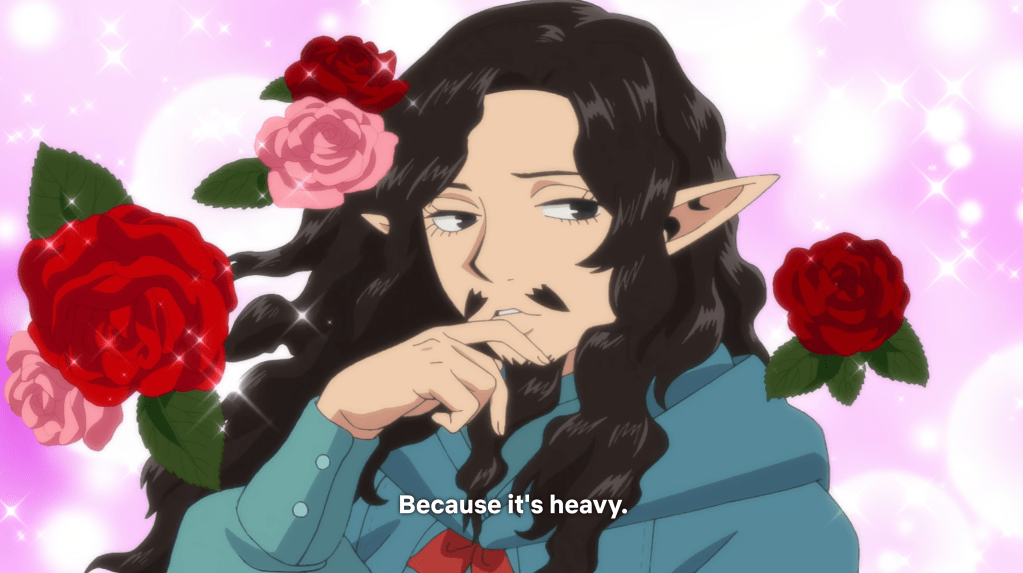
But this isn’t some stupid Marvel movie—moments of depth are allowed to retain their gravity, even linger for a bit. At multiple moments I found myself genuinely touched.
And the season finale—THE SEASON FINALE. Only Delicious in Dungeon could come up with a finale that had me literally standing, pumping my fist in the air, absolutely thrilled that a major part of the party’s grand, overarching plan was to eat a really big, really dangerous monster. It just felt right.
Metal as heck.9
I’m even more excited for season two. The first season, by reputation anyway, followed the manga pretty well, and covered about half the manga—which, given the positive reception of how the manga ended, means that following the current path to the end should guarantee a strong finish. Right? Netflix wouldn’t mess up an ending to one of their exclusive series, right?
Right?!?!?!?!?!?!?!?
I’m mostly being silly. I genuinely do have a lot of confidence that Delicious in Dungeon will finish strong.
And, in the meantime—this has never happened to me before, but I’m tempted to buy the manga so I don’t have to wait. Never once in my life have I had this urge before. I’m a book guy, not a static images but. But if Season 2 didn’t release this year, I don’t know that I’d have the self-control to not drop over a hundred dollars on the 14-episode box set.
Side Conversations
As a side note, Delicious in Dungeon does themes and messaging extremely well.
First of all, I want to say that Delicious in Dungeon isn’t a show that’s out to preach: it’s entertainment. But the show also has depth to it, and it has some genuinely interesting things to say that hit well in the context of this show, which is the right way to do things.
But what it’s doing right is going to sound bizarre, saccharine, or overly basic when taken out of the context of the show—I promise it works in-show.
One of the most striking moments of Delicious in Dungeon is a sort-of pep talk that Laios gives to a former party member, Shuro. Despite leaving the party in the first episode, Shuro ends up driving himself hard to try and rescue Falin—he’s a far more powerful warrior than Laios, and he’s a far more capable adventurer, so, with his new party, he’s able to make some truly impressive, rapid progress through the dungeon, and even teams up with Laios’ team at one point. Then they get their butts kicked by a giant monster, but Laios outperforms Shuro in the fight. Shuro is shocked, but Laios has a simple explanation for the situation: he and his party have been getting three balanced meals each day, along with eight hours of sleep every night. They are at their best at pretty much any moment because of that. Eat healthy and sleep responsibly!, the message echoes.
This is delivered in a dramatic manner, this message that could have been from an episode of Bluey, yet it hit bizarrely hard in this anime aimed squarely at adults. The characters practice what they preach, it’s presented in an entertaining and engaging way, so, against all odds, I listened to Laios’ short speech and thought, “Man, I need to up my nutrition and sleep game.”
There’s a lot of other solid messages in Delicious in Dungeon as well. Leadership is examined on several occasions. The value of finding your niche and excelling in it. Support for friends and teammates. Self-sacrifice. The show also covers the virtues of self-defense, killing for food, avoiding doing unnecessary harm—kind of like I discussed last week in my Sea of Trolls review, actually.
It was necessary to kill to feed or protect one’s family and self. That was what the [giant] spider had done with the eagle. If she attacked Jack or Thorgil, he would have to slay her. But Jack also understood that if he killed the spider without need, he would lose his power and his music would go from him.
The Sea of Trolls, 390–391
Combine this with Frieren recognizing that there are some things in this world whose whole purpose is to destroy you—making destroying them first the most moral path forward—and there’s a lot of good, practical values being pushed into mainstream conversation through anime.
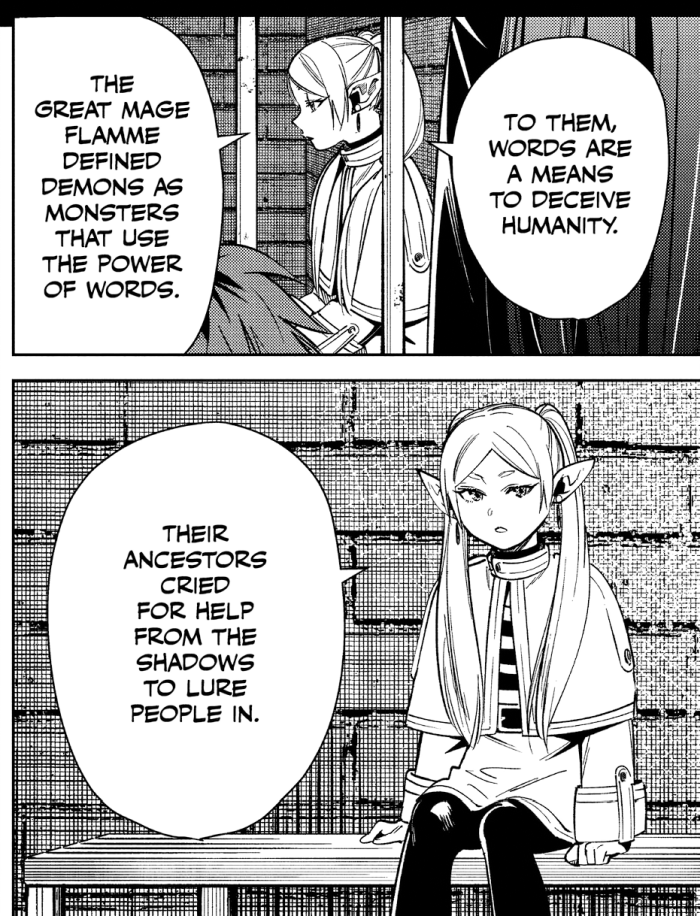
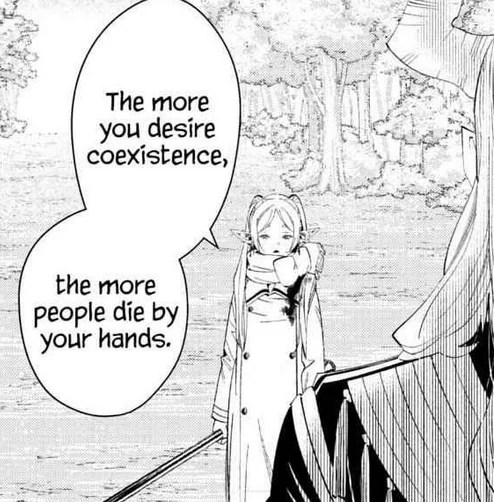
Another reason I avoided this show for a while was, actually, because of what I’d read about its messaging. I’d read several reviews about how Delicious in Dungeon was all about ecological preservation, revering and living with nature, and other eco-extremist crap—the kind of things said by people who probably should be destroyed, per Frieren logic, actually.
Fortunately, if Delicious in Dungeon is going to be accurately used as an example of any green-related messaging, it follows the most balanced, common-sense approach of good stewardship: use what you have, get what you need, don’t be wasteful. It’s that simple. I wish I could find the exact quote, but there’s a moment by Senshi that sums up this idea pretty well, when he tells Marcille not to use a spell that would kill more of a monster than they need to eat—they weren’t in danger of being harmed, so killing too many would cause unjustified harm to the dungeon. But, that said, killing a monster was otherwise never a bad thing, and the party never foolishly chose self-destruction to preserve something that was threatening them. It’s the sort of common sense that isn’t so common anymore.
Wrapping Up
When you make something easier, you may lose your edge in a skill. Convenience and ease aren’t the same thing.
~Senshi
Delicious in Dungeon had a rocky start for me, but the show ultimately proved to have it all—exceptional characters with genuine depth, an expansive world fed to me in bite-sized pieces, heart, humor, and fantastic artistry on display. I began the show unsure if I would finish the episode, let alone move on to the next one, and I ended it with the series as one of my new all-time favorites. I might even like it more than Frieren—and given how excellent Frieren is, that’s a mighty compliment indeed.
I doubt I’ll hold too strongly to that idea, though. Comparing Delicious in Dungeon and Frieren is like comparing apples and oranges. Or apples and peanut butter—the two are better put together.
Anyway, here’s the long story short: I highly recommend Delicious in Dungeon. It’s not perfect, but it became perfect for me, if that makes sense. If you don’t like the first few episodes, I encourage you to keep watching—what’s to come is absolutely worth the groundwork slowly laid at the beginning of the show.10
Enjoyed this review? Consider subscribing below so you never miss an update! You can also follow me on X.
I’m an indie author! If you enjoyed my writing, and if you are already a fan of Delicious in Dungeon, consider checking out my fantasy novel, Inner Demon. If sci-fi is more your cup of tea—and for some reason you made it this far—consider checking out The Failed Technomancer.
- This show isn’t a LitRPG, though, or whatever the anime equivalent is—it feels inspired by old TTRPGs, but it has its own identity, the characters don’t have explicit stats or levels or anything like that, etc. ↩︎
- The show as a whole is beautifully animated—so I don’t say this to suggest that the animation of other scenes is lacking. Theres a lot of gorgeous animation in Delicious in Dungeon even outside the cooking segments. ↩︎
- I suppose this could also be flipped the other direction—audience members who seek out “mature” television specifically for content like nudity will likely be disappointed by Delicious in Dungeon‘s restraint. ↩︎
- I find it interesting that some people feel human anatomy on non-humans—such as monsters—doesn’t count as “real” nudity. I do.
I’m not being judgmental here, to be clear. Everyone has their limits and lines and, while I think some depictions of nudity on non-humans (and humans) are objectively inappropriate and/or morally wrong, other depictions are more subjective.
This makes me thing of various debates I’ve heard about paintings and statues of naked people. Some reverence and elevate the human form, using nudity in tasteful ways to showcase beauty and grace, power, or elegance, or to beautify and showcase masculinity and femininity; others claim to do such a thing, but are a little too self-indulgent (or too focused on genitals), in my opinion, to be making such a claim honestly. Monsters with human body parts don’t exactly fall into the same category of art, so perhaps this debate isn’t directly relevant, but I still see a connection. ↩︎ - Human warrior (male), for any concerned. ↩︎
- Human mage (female). ↩︎
- Elf mage (female). ↩︎
- Half-foot thief. Think hobbits or halflings, but with a lot shorter lifespans than either—and a bit crankier. ↩︎
- *said in an embarrassing dad voice while wearing a Hawaiian shirt and sandals with black socks ↩︎
- And I swear this is nothing like the time your friend told you that he swears “Wheel of Time is really good, you just have to push through the first three books, bro, then it really takes off until like book nine, man, but it gets good again after that, hombre.” Delicious in Dungeon episodes are about thirty minutes long. That’s not even remotely the same level of commitment. ↩︎
 Boo Ludlow
Leave a comment