When the war was over… God called this third group [of angels] before His throne. “Be gone from Heaven, you lukewarm cowards,” He said. “You have lost your souls through indecision. Yet because you did not take up arms against Me, I will show you mercy. You will live among My children on earth and not be cast into Hell. Your years will be long and your powers great, but your path to Heaven will be hard. My mortal children will have souls, but you must create yours through suffering and good deeds.”
The Land of the Silver Apples, pg 158
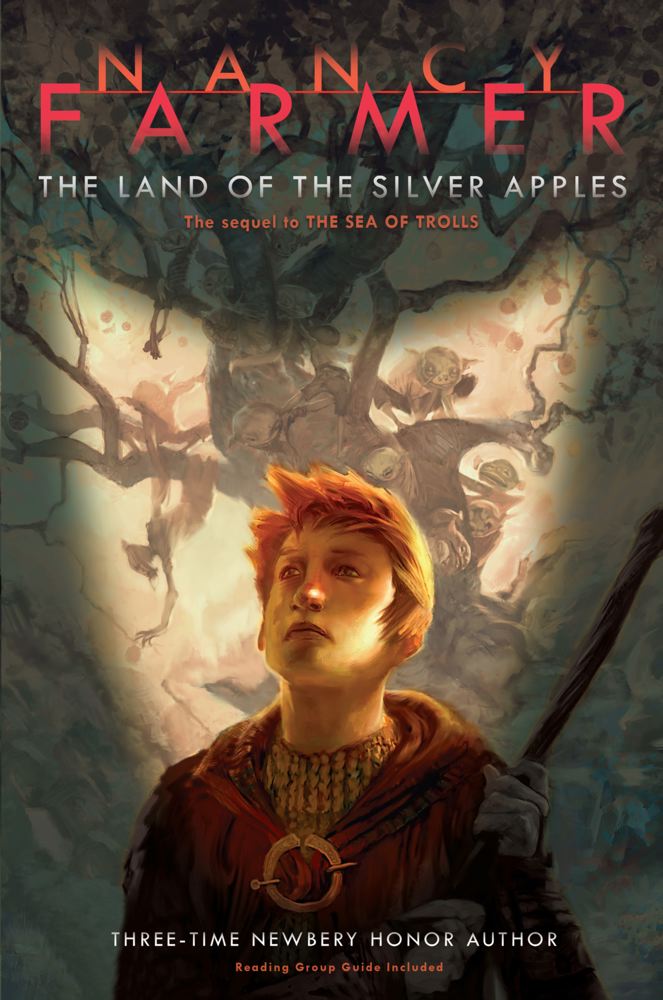
The Land of the Silver Apples is the sequel to Nancy Farmer’s The Sea of Trolls, which I reviewed two weeks ago. As a child, The Land of the Silver Apples lost me—it was too different from everything that I had loved in The Sea of Trolls. I couldn’t get into it. As an adult… Some gripes remained, but I found myself appreciating the book significantly more this time around. In fact, for the first two chapters I wondered if I’d end up preferring The Land of the Silver Apples. That feeling didn’t prove to have staying power, but—well, I’m getting ahead of myself.
Overview of The Land of the Silver Apples
What is It?
The children from The Sea of Trolls brave their worst nightmares—underground.
Jack is amazed to have caused an earthquake. He is thirteen, after all, and only a bard-in-training. But his sister, Lucy, has been stolen by the Lady of the Lake; stolen a second time in her young life, as he learns to his terror. Caught between belief in the old gods and Christianity (AD 790, Britain), Jack calls upon his ash wood staff to subdue a passel of unruly monks and, for his daring, ends up in a knucker hole. It is unforgettable—for the boy and for readers—as are the magical reappearance of the berserker Thorgil from a burial by moss; new characters Pega, a slave girl from Jack’s village, and the eager-to-marry-her Bugaboo (a hobgoblin king); kelpies; yarthkins; and elves (not the enchanted sprites one would expect, but the fallen angels of legend). Rarely does a sequel enlarge so brilliantly the world of the first story.
As with The Sea of Trolls, The Land of the Silver Apples is a middle grade historical fantasy novel that primarily follows Jack, a Saxon boy and a bard-in-training; also along for the ride this time is Pega, a slave girl whom Jack frees, Thorgil, a young Northman shield-maiden, and a handful of hobgoblins. After a ceremony known as the need-fire is disrupted, it’s revealed that Jack’s sister, Lucy, is not Jack’s biological sister, and perhaps not even human; his real sister was stolen as a baby. Thus begins a long rescue adventure to the Land of the Silver Apples, where glamour-coated elves live in ethereal and aching beauty—and emptiness.
Who Wrote It?

Nancy Farmer is a writer of fantasy and science fiction primarily targeted at children and young adults. I went into detail with my The Sea of Trolls review, but Nancy has written multiple impactful novels for young adults and children, perhaps her best-known being the sci-fi novel The House of the Scorpion.
Content Warnings
For adults, there’s absolutely nothing concerning in The Land of the Silver Apples. I would say as much for children as well. There’s less violence in this book than the former, although there are still many moments of mature topics handled well for children, including that of death, repentance, tolerance (and even friendship) between faiths, and so forth.
Prior Reviewed Books
The Sea of Trolls: The Sea of Trolls is a middle grade historical fantasy novel that follows Jack, a Saxon boy who, along with his sister, gets enslaved by Northmen. What follows is a grand adventure wherein Jack makes the best use he can of his basic training as a bard (think more along the lines of a druid than a minstrel) to protect himself and his sister.
The General Review (Mild Spoilers)
Here’s the first hurdle you need to overcome with The Land of the Silver Apples: it isn’t The Sea of Trolls. At least, if you’re like me and you expected more viking-flavored adventures, then the excellence of the prior book casts a long shadow over this book. Instead, The Land of the Silver Apples is much more Christian- (and pagan-)flavored in its creatively adapted mythology; there’s nothing inherently wrong with this, of course, and in fact I think the book does a lot of really interesting things with its characters and world. The problem is that The Land of the Silver Apples feels like its own thing rather than a continuation of the story in The Sea of Trolls. You probably could read this book first and be just fine. (If you have please leave a comment; I’m really curious what your experience was.)
Anyway, that said, I’m going to try and set aside The Sea of Trolls as much as I can for the rest of this review.
On paper, the adventure here is pretty straightforward, and the stakes are clear: Jack is a Saxon boy and a bard-in-training (think musical druid rather than minstrel). Early in the book, it’s revealed that Jack’s sister, Lucy… isn’t actually Jack’s sister. As far as blood relation is concerned, anyway. Jack’s true sister was taken by small creatures as an infant, and in her place was left the angelic Lucy. Jack’s mother didn’t realize this because of how sick she was after her labor, and because the baby swap happened after only a day or two; Jack’s father, on the other hand, did know about the swap, and to his shame has carried this secret all of Lucy’s life. Thankfully, the Bard, being the wise man that he is, has an idea of where Jack’s original sister has been taken, and has an idea of what Lucy’s true nature might be; thus, they need to set off on an adventure of rescue and discovery to the homeland of the elves. (Elves are well-known for kidnapping children, after all.)
Jack’s quest is initially clear, but immediately gets muddied when they travel to the next town over and visit a monastery full of corrupt monks. They threaten Lucy, so Jack destroys the monastery with an earthquake, which also results in a trapped elf known as the Lady of the Lake being freed and taking all of the land’s fresh water with her as she returns to her ancestral home—and Lucy. Now it’s a double rescue, and Jack is also charged by the cruel local king to return the land’s water, otherwise his father will be executed. Extenuating circumstances force Jack to move forward without the bard, his only companions being a slave named Brutus and a former slave named Pega.
Brutus almost immediately disappears and spends most of the book gone, so I won’t speak about him much—he also resolves the issue of the missing water off-screen, which is a bit anticlimactic.
Pega is a really interesting addition to The Land of the Silver Apples. She is a slave girl whom Jack purchases early in the story to save her from being tormented by his father and Lucy, and then immediately frees. Due to her mistreatment as a slave, Pega’s growth was stunted and her appearance is quite ugly; however, she has a divine singing voice, so beautiful that Jack, a bard-in-training, becomes jealous and wishes that he had never met the girl. The balance of budding friendship and competition—mostly one-sided and fueled by Jack’s jealousy—between the two is an interesting source of conflict, but you almost always feel for Pega more than Jack. She’s a sweet, hardworking soul who has made the best of an absolutely rotten life (thus far—Jack was a turning point for the better, despite his immaturity), and as such I pretty much exclusively wanted to whack Jack on the head whenever he acted thoughtlessly toward her.
For me, the addition of Pega and events up until Jack and Pega headed underground were the golden parts of The Land of the Silver Apples. The quest was clear: rescue Jack’s lost sister. Go to the land of the elves to do so. (Also rescue Lucy, since that comes up.) The book has given clear promises of what comes next, in broad stroaks.
Unfortunately, most things after this point gradually lost my interest. To keep light on spoilers, Jack finds his lost baby sister about halfway through the book; it’s quickly made clear that the child is happy and that rescuing her would actually be quite cruel, so that quest can’t be resolved—much to the eventual dismay of Jack’s mother, waiting at home for her baby to be returned to her. Jack then discovers where Lucy is and, similarly, learns that attempting to rescue Lucy would be more similar to a kidnapping than anything else, as Lucy vastly prefers where she is—and belongs there. Add on top of this the issue of the stolen water is resolved off-screen, and about two-thirds of the way through the book I was left feeling that Jack’s quest was rather pointless.
Fortunately, the world Nancy Farmer has built is interesting enough to largely carry The Land of the Silver Apples most of the way to the end. It has a great deal of magic, creatures both dangerous and benign, and surprises. There’s a lot of humor, particularly coming through with the hobgoblins, Father Severus, and the half-elf Ethne. (Oh, Ethne’s prideful attempts at humility are hilarious.) The story ends off with some promises that I hope get paid off in the final book of this trilogy, The Islands of the Blessed. But those are, by and large, the highlights of this book’s slow second half—by the final page, The Land of the Silver Apples was too disjointed for me to remain as excited and engaged as I had been at the beginning of the book. It was missing some sort of hook to replace the original purpose of this adventure, one more interesting than what we had started with.
I’d also go so far as to say that this book felt a little too silly. The Sea of Trolls absolutely had silly elements in it—I promised to avoid mentioning that book too much, and I’ve succeeded so far—but it still felt like a mature novel written for children. This book feels like half of it is a mature novel with silly elements, half of it a silly novel with mature elements, written for children, and I just didn’t find mixture as engaging or focused.
Other Details
A key building block in Farmer’s mythology is that characters experience what they expect, at least as far as the supernatural and the divine is concerned. This idea came up in The Sea of Trolls, but it’s explored much more in The Land of the Silver Apples.
As an example, later in The Land of the Silver Apples it is revealed that the elves don’t experience the passage of time because of a deal they made with some diabolical entity—but they have to make sacrifices to it every so often to remain outside of time’s passage. Jack and his companions see this creature, and there’s this interesting paradox where everyone has the same experience, as far as the most important details are concerned, yet completely different personal experiences; Jack sees monstrous, flaming, insectoid devils, while Thorgil sees wicked, undead hounds of Northman lore. Thorgil strikes what she sees and is injured; her injury is real, and Jack witnesses the same event, although to his sight she is burned by diabolical fire, rather than bitten by a diseased hellhound. Either way, the end result is the same: Thorgil’s hand is ruined.
The consistency of critical details suggests to me that there is some sort of absolute nature to magic and the divine in this world, but there’s some sort of illusion or mental translation error that causes it to be expressed differently to everyone who experiences it. Some sort of underlying unifying factor is at play here, and I’m curious what Farmer will do with this in the final novel of this trilogy.
Wrapping Up
They didn’t realize that the very job of angels is to come down on the side of good. There’s no room for moderates in Heaven.
The Land of the Silver Apples, pg 157
Sequels to excellent books have a really hard, sometimes impossible job: be at least as good, but preferably better, than what came before. Do more. Provide more. Somehow recapture lightning in a bottle.
The Land of the Silver Apples did not, unfortunately, hit this ideal. It has a lot of moments of brilliance, and I still think it’s worth reading—unless The Islands of the Blessed prove to be a dud—but it’s not without some flaws the bring down the overall experience. That all said, I think many of my criticisms with this book mostly come down to it being an imperfect sequel to a nearly flawless book.
The Land of the Silver Apples is acceptable.
Enjoyed this review? Consider subscribing below so you never miss an update! You can also follow me on X.
As well, please consider checking out my independently published novels. Fans of post-apocalyptic science science fantasy might consider The Failed Technomancer, while Inner Demon is for lovers of pure fantasy. Or consider taking a peek at both—I won’t stop you.
 Boo Ludlow
Leave a comment