I’d guess that you have some purpose to fulfill and that is why you were saved. But don’t get a swelled head over it. A cabbage has a purpose when someone needs a soup.
The Islands of the Blessed, pg 245
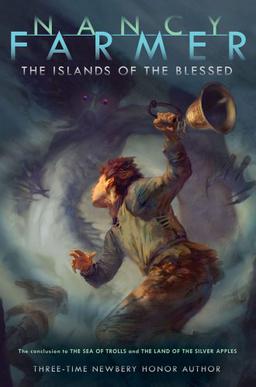
And so we begin April with an ending—the ending to The Sea of Trolls trilogy. The titular book of the trilogy is one of my favorite books of all time, and, after discovering that it easily held up upon reread as an adult, I heartily recommend it to everyone. The second book, The Land of the Silver Apples, I was disappointed to find was unable to stand out the shadow of its predecessor—will The Islands of the Blessed suffer the same fate?
Overview of The Islands of the Blessed
What is It?
“Foolish boy,” whispers the voice of the hogboon. “You force me to slay you.”
A tornado destroys the fields of Jack’s village, the winter ahead looks bleak, and a monster invades the forest outside of town. As if that isn’t enough, now there is a hogboon intent on Jack’s murder—and on marrying Thorgil. Jack and Thorgil aren’t completely helpless, though, and along with the Bard they have a mission of their own: to right the wrong of a death caused by Father Severus. Destination: Notland, a realm of the fin fold, and, unfortunately for the adventurers, Not Always There.
The Islands of the Blessed is the third book of the The Sea of Trolls trilogy. As with the previous novels, it is a middle grade historical novel centered on Jack, an apprentice bard who is dragged semi-reluctantly into adventure so that he can right a lot of wrongs. Also featuring prominently in this book is Thorgil, the Northman heart-daughter of Olaf One-Brow, whom fate appears just as interested in as Jack.
This is also the first book I’ve reviewed where I almost left the back-of-the-blurb out—while it’s literally accurate in that Jack encounters a hogboon that wants to kill him, etc, it’s very misleading as to what the book is about. The hogboon shows up just briefly—most of the book is focused on putting to rest a draugr that was once a mermaid, and all the complications that arise along the way toward that goal.
Who Wrote It?
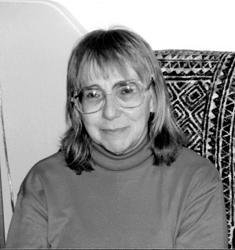
Nancy Farmer is a writer of fantasy and science fiction primarily targeted at children and young adults. I went into detail with my The Sea of Trolls review, but Nancy has written multiple impactful novels for young adults and children. Perhaps her best-known novel the sci-fi work The House of the Scorpion.
Content Warnings
As with the previous two novels, The Islands of the Blessed is a very friendly book for all ages. There’s a little more violence than in The Land of the Silver Apples, but nothing as potentially disturbing to children as early portions of The Sea of Trolls. I’d comfortably hand it to an eight-to-ten year-old who is a strong reader (although an eight-to-ten year-old might struggle with this book for other reasons, like not having sufficient life experience to really get the early teen protagonists).
Prior Reviewed Books
The Sea of Trolls: The Sea of Trolls is a middle grade historical fantasy novel that follows Jack, a Saxon boy who, along with his sister, gets enslaved by Northmen. What follows is a grand adventure wherein Jack makes the best use he can of his basic training as a bard (think more along the lines of a druid than a minstrel) to protect himself and his sister.
The Land of the Silver Apples: The Land of the Silver Apples is the sequel to The Sea of Trolls and primarily centers around Jack endeavoring to rescue his sister Lucy from elfheim. Throw in freed slave Pega, a bunch of oddly Christian hobgoblins, and some terrifying knuckers, and you’re in for an adventure with good variety.
The General Review (Mild Spoilers)
“You sound like one of those mewling Christians,” sneered the shield maiden…
“I wouldn’t dismiss Christians so readily, Thorgil Small-Brain,” the [Bard] said. “They may seem weak, and some of them are certainly rogues, but they have prevailed in situations that would slow the blood of the bravest hero.”
“They’re only fit to pull dung carts,” Thorgil said. “The future belongs to the strong.”
“That belief is why the Northmen are going to disappear.”
The Islands of the Blessed, pg 34
There’s a funny detail in The Land of the Silver Apples that shows up a handful of times, which in that book is a noodle incident. It’s this little story about a severe, and severely pious, monk named Severus that had some sort of run-in with a mermaid, which led to a cascade of other troubles. The children of the story assume some sort of romantic entanglement, made all the more amusing for anyone aware of Father Severus’… austere temperament, while the few adults in the know are quite firm it was something else entirely.
Well. You get the full story in The Islands of the Blessed. I’ll leave you to read the novel to learn the details, but the final result is a vengeful mermaid-draugr (the spirit of someone who drowned) that needs to be peaceably laid to rest—or, if needs be, forcibly put down. The arrival of said draugr kicks The Islands of the Blessed‘s plot into motion and serves as a primary driving force throughout.
Anyway. My experience with The Islands of the Blessed was somewhat the opposite of The Land of the Silver Apples. For the first few chapters I felt some distance between me and what was happening, but as I read I found myself sliding into things more and more, and, by the end of the book, I was deeply in love with it.
The Islands of the Blessed is an interesting book—and a weird book—for several reasons. It ties together elements from The Sea of Trolls and The Land of the Silver Apples, such as by bringing the Northmen back (beyond just Thorgil) and well as making Ethne a key character. It, unfortunately, largely leaves Pega out of the story, while building up background characters (Skakki, Olaf One-Brow’s son and inheritor, as one example; the Tanners as another) and introducing new characters (Schlaupe, the good half-troll). The book also features the fin folk heavily in chapters—which are very different from how mermaids are usually presented, as was the case with the elves in The Land of the Silver Apples—and gives a brief glimpse into Olaf’s afterlife, allowing him to return for a chapter or so. Many chapters have a strange, dreamlike quality to them—particularly the final chapter—while others are very present and to the point. In short, there’s a little bit of everything you could expect from the The Sea of Trolls trilogy, plus some new things besides—except for full-blooded trolls, or the titular sea. Those still don’t make a return.
Ultimately, The Islands of the Blessed is a book about life and joy. The whole series is, to an extent, but this book really brings it home, particularly in the arc of Thorgil. In The Sea of Trolls, Thorgil was an angry little orphaned girl who only wanted to be a warrior and to fall gloriously in battle so she could go to Valhalla. At the end of the book her ability to go berserk is taken from her, beginning her slow, arduous journey to become—well, I won’t spoil that. But let’s just say that seeing what Valhalla is actually like, for the women, anyway, made some big moves in showing Thorgil that living your life completely focused on a glorious death does not actually come with a very desirable reward.
There’s a balance, of course. Life and death are in constant tension, and sometimes killing is necessary to preserve and protect life; sometimes the willing sacrifice of one is necessary to save many others. I think The Islands of the Blessed has a really strong foundation built on this balance, and it flows through the entire book and every conflict Jack finds himself in.
I’m glad Jack’s—and Jill’s—story ends on such a strong note.
Wrapping Up
I did not understand my daughter’s longing before… I want something and I do not know what it is. The gold, the jewels, the wealth I have accumulated are nothing, and my life has been wasted in useless pleasure. It is a cruel thing, this bell, yet fair beyond reckoning.
The Islands of the Blessed, pg 367
Though the journey was turbulent at times, The Islands of the Blessed proved to be a moving capstone to a trilogy that, I’m convinced, was never originally envisioned as a trilogy—but I’m glad came to be. I found this book inspirational and would certainly recommend it.
Enjoyed this review? Consider subscribing below so you never miss an update! You can also follow me on X.
I’m also a indie author with two books of my own. If you enjoy science fiction, try The Failed Technomancer, or, for those who prefer fantasy, consider Inner Demon.
 Boo Ludlow
Leave a comment