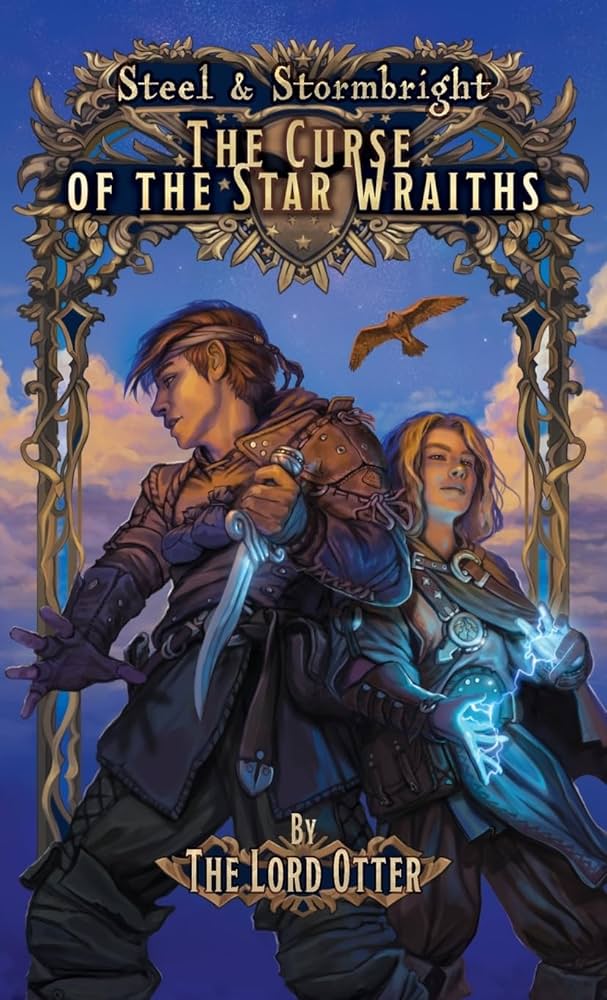
Gotta be honest, I’m not excited about this review. I only read books that look interesting to me (and then I’ll review anything I read—or attempt to), but sometimes, despite my best efforts, I’m going to end up reading something that just missed the mark in almost every way. You have been warned.
Overview of Curse of the Star Wraiths
What is It?
In a world where gods walk alongside mortals, and humanity is cowed into submission by the empire of Alcaron, two brothers find themselves in the wrong place at the wrong time.
Taken from their homes and subjected to terrors that would drive any man insane, Serithas and Zolan will have to learn just what it takes to be men, in a world that appears indifferent to their very existence.
Following their journey, our heroes shall find themselves pitted against a slew of unspeakable horrors. All the while they are being pursued by General Caerst, a woman whose reputation and malice knows no bounds.
Nowhere is safe. Instead, both will have to learn the true meaning of strength, resolve, and friendship. They will have to rise to the occasion, when all else would rather have them turning away in fear.
They will have to become STEEL and STORMBRIGHT.
Curse of the Star Wraiths is a short, punchy sword and sorcery novel following two brothers who really get put through the meatgrinder.
Who Wrote It?
“The Lord Otter” is the author of this book. He’s done a good job at keeping consistent with this author pseudonym and online persona—I have no idea who the real man behind the otter is. (Not that I’d reveal him; he clearly values his privacy deeply.) So I don’t have much to say other than he also has an X account, and he published Shadow of the Twin Moons late last year, the sequel to Curse of the Star Wraiths.
Content Warnings
Curse of the Star Wraiths has a strange approach to objectionable content. The book makes frequent, even casual references to all sorts of acts of evil inflicted on others, of physical and sexual natures, as well as acts of hedonism, and acts of brutal violence, but for the most part avoids any sort of meaningful description—such things are acknowledged to exist, and then the narrative usually rushes forward as if those things have as much weight as mentioning that the sky is blue or a dog was slobbery.
The General Review (No Spoilers)
Cards on the table: I didn’t finish Curse of the Star Wraiths. I got a little over a third of the book and just could not find the will to carry on.
To be fair, there were things I liked about Curse of the Star Wraiths. It’s a hard thing to define, but I believe this book was written with a lot of passion and enthusiasm. There’s also a lot of energy and movement to the prose and chapters in this book—while I think Curse of the Star Wraiths maybe moves too quickly, picking up the pace a little is still a skill that many fantasy novels lack, so credit where credit is due. I also loved the art in this book. I wish more novels, even those intended for older audiences, included more art within them.1
And now… for what didn’t work for me.
Here’s where the beginning of the end started for me, if I remember the exact spot correctly: chapter two. A sorcerer of sorts, Aedas, has a brief moment where he reflects that the Ilgrathians,2 a people he’s unwillingly allied with, had captured and enslaved him when he was much younger and forced him to watch his wife be raped and murdered. He then reflects that the Ilgrathians had tortured him so that he was completely broken, mind and spirit, and unable to even consider resisting the orders of his masters.
Two things here made me wonder if I was going to finish this novel. First was how remarkably casually Aedas’ wife’s fate was mentioned. I’m not necessarily referring to Aedas’ perspective, but the overall narrative’s perspective. Why was this detail included in the story? Perhaps the point was the numbness he appeared to feel, as he had no emotional reaction to this memory; rape had been mentioned casually several times before in this story, but this was the first time it felt like it was supposed to have narrative weight, and it didn’t.
On to the second thing—shortly after these thoughts, Aedas does commit a small rebellion against the Ilgrathians, contradicting the earlier explanation that he either can’t rebel against his masters or would need tremendous motivation to do so.
It’s bizarre. These moments happened extremely early on, when how the world works is being established, and it gave me a sense that histories of these characters bear little to no weight on what they became or what they are going to do. What happened once, in the past, is set dressing, nothing more. It also gave me the sense that extreme acts of evil didn’t matter in this world—in the sense that they didn’t affect the characters that experienced them.
The moment that finally killed Curse of the Star Wraiths for me—despite the fact that I did end up reading for a few chapters more—was the part of the story where the protagonists, Steel and Stormbright, are taken as slaves and thrown into a slave pit, where the weak died and the strong survived. The narrator states that in those pits they suffered deprivations, sleeplessness, were beaten, and even raped—and none of these things appeared to have any meaningful effect on the characters whatsoever. How they talk or act didn’t change. They didn’t have lingering injuries. They didn’t have any difficult emotional moments where they processed what happened to them. The narrator says it happens, then the narrative moves on as if it didn’t—so why bring it up at all?
Couple this with how frequently rape was mentioned (along with torture and various acts of hedonism),3 and I started to find things distastefully cavalier.
I kept finding more elements of the story that made me wonder why they were included. The first third or so of Curse of the Star Wraiths is almost like an origin story for the brothers—it describes how one became a sorcerer, how they were both enslaved, how (somehow) they learned to become weapon-proficient warriors in the slave pits, and how—again—Aedas acted against his masters to help these brothers escape the slave pits and become mercenaries. They briefly make allies, such as a disgraced Ilgrathian named Trilgar, who are ignominiously killed off without actually having much effect on the story, if any at all. None of this matters because none of it changed the brothers in any way. The only moment of meaning was the moment where the younger brother became a sorcerer; that moment was coupled with actual change in the character’s state, and was the reason the two brothers were later enslaved. Everything from that moment to them joining the mercenary band could have been skipped or explained in a paragraph and I don’t think I would have missed anything. The brothers are basically just a flat level of angry, and are flat in just about all other regards, the entire time.4
Again: Why spend so much time on how a character got to where (it appears) the story is meant to take off if the characters aren’t going to experience any growth or development during that time? Even my mention that the brothers somehow learned to become warriors while in the slave pits is dubious, as their father was a warrior and there is suggestion he trained them before they were enslaved, so perhaps the chapters of them in the slave pits serve even less of a purpose than I expected.
Perhaps one of the goals was to show just how awful the Ilgrathian people were. The problem is, saying that they are vile hedonists and then leaving it at that doesn’t give me any emotional connection to the situation at all—I don’t hate them the way I hate those damnable forest elves in The Hobbit (and that’s not even an example of a people you’re narratively supposed to hate). And that’s to say nothing of the fact that I don’t need dozens of pages to tell me (rather than show me) that I shouldn’t like the bad guys of a story.
I had other issues with this book, but everything else that comes to mind pales in comparison to these bigger issues.
As it currently stands, Curse of the Star Wraiths has nineteen reviews on Amazon and an overall star rating of 4.6 out of 5. Clearly other readers had a much better experience with this book than I did, but, unfortunately, I couldn’t even finish the book, and it’s a short read.
Is Rape Okay?
I’m going to try to keep this discussion short, because I think there’s overlap with some of the thoughts I have for the article on crudity and offense that I’m working on.
First off, obviously it’s objectively bad to rape—stating that to hopefully stave off shrieking from the internet harpies—but that’s not really what I’m trying to touch on with this question. Is rape a topic that’s “okay” for fiction? The answer to that is unequivocally yes.
In a vacuum, anyway. As a heavy topic, there are obviously more effective and less effective ways to handle this topic—thoughtful ways and distasteful ways—and your mileage is going to vary a lot based on your audience.
One reason I struggled with the frequent mention of rape in Curse of the Star Wraiths was because of how meaningless it was. And when I say meaningless, I mean meaningless—nothing suggested that it was a heavy, horrible thing that damaged people, and nothing suggested that the author was swinging the opposite direction into black comedy or some sort of satire5; the tone of the rape itself didn’t even fall anywhere in between, and the story didn’t give any insight into the characters and what effect it had on them. It just existed as a topic, mentioned but entirely disconnected from everything else.
To date myself a little bit, it actually felt very edgelord-y in a Shadow the Hedgehog with a gun sort of way. Or a Hot Topic kind of way. (Does Hot Topic still exist?)
But heavy topics don’t have to exist just to add fake weight or suffering to a story—and it bothers me when they are, clearly. They don’t belong in every story, but when present they can be used to explore characters and the depths of the human soul in fascinating ways (or to juxtapose against other topics) when handled well. I talked at length about this in my review on Deathbringer in relation to the character Kale, whom I found the most interesting character in the book. A major part of his story and development was that he was raped by the main villain, and you feel the weight of that experience on his soul. It deeply colors his character and his actions over the course of the story, and it makes his somewhat tepid actions against his aggressor much more heroic than they otherwise would have been.
Kristin McTiernan also wrote a pretty good essay on the topic of rape, specifically Hollywood’s shallow, trope-y representation of it. Kale, as a character, is a good example of one of McTiernan’s points that everyone responds to trauma differently—and some people aren’t traumatized by experiences that would ruin others. (Kale does not fall into that crowd, though.)
Another example that comes to my mind is from The Perks of Being a Wallflower, specifically the movie adaptation. There’s a scene in the first third or so of the movie where Charlie—the protagonist—talks to someone at a party about a good friend of his that had committed suicide. That’s a heavy topic; I’m not certain that ranking the seriousness of such topics is wise, but I know many people who care more about suicide (in general) than rape. Anyway: in the movie, it’s a small moment. It doesn’t come up again (to my memory; it’s been about a decade since I’ve seen it). But that one little revelation colors how you see Charlie, and how his new friends see him, for the rest of the film, revealing that the author didn’t bring this topic up casually, but to accomplish something—to deepen his character. And it worked!
Regardless of the story, there has to be meaning behind the creative use of heavy topics. There needs to be purpose. There needs to be intent, whether the topic is used dramatically or comedically. This also applies to a huge swath of decisions made in writing, conscious and unconscious—experienced readers can’t always clearly define why, but they can often tell when something was most likely inserted into a story just because, even though it doesn’t belong (at least in the story as it currently exists). Such things stick out like a gaudy clown painting hung on a wall in a lavish building with an art deco style.

And there are an unfortunate amount of clown paintings out there.
Wrapping Up
Casually referencing evil and depravity without having any depth to it only results in a thin veneer of… whatever the author is hoping to accomplish with it, I suppose. It creates a hazy illusion, like mirages of puddles of water pooled among sweltering desert dunes, but without any real substance. It naturally carries some offense and some distaste with it, but carries none of the deeper meaning that some authors are striving for when handling heavy topics.
As well, when more and more elements in a story stack together with the sense that they aren’t actually connected in any way, meaning is further sucked out of the narrative. Why do I care that a character suffers when it has no effect on that character, or any of the characters, whatsoever? Why do I care to learn a character’s backstory when the character’s arc is a flat line through those events? All stories are carefully crafted illusions that seek to build and connect meaning, but without those connections you end up with smoke without mirrors.
In short, Curse of the Star Wraiths just didn’t work for me—and I can’t recommend it.
Enjoyed this review? Consider subscribing below so you never miss an update! You can also follow me on X.
I’m an independent author myself. If you like some dark science fiction, check out The Failed Technomancer; for fans of fantasy, Inner Demon is what I’d recommend.
- It’s understandable why that doesn’t happen, though—art is expensive and takes a while, and after getting a cover figured out most authors—myself included—are just done with that side of things and want to move on. ↩︎
- As a side note: pictures and descriptions suggest the Ilgrathians as humans, but they speak and act as if they are not, and they refer to humans as “humans,” a type of thing most people don’t do when speaking of their same species. Could have used more clarity. ↩︎
- I was unable to find my review for the last explicitly sword and sorcery novel that I read, but it, too, was bizarrely casual about rape and other gross things of a sexual nature and left a very bad taste in my mouth. That book was far more explicit than this book, to be fair to Curse of the Star Wraiths—but is this standard fair for sword and sorcery? I hope not. A part of me is interested in one day picking up Conan and the Grey Mouser books, but some bad experiences with the genre are making me gun-shy. ↩︎
- And, no, this isn’t a Conan or Indiana Jones Enduring Hero archetype—the story didn’t justify the brothers being unchanging by highlighting how they changed the world and characters around them. Because they didn’t. ↩︎
- Because, yes, heavy topics—such as rape—can be effective pieces of comedy, but your mileage is going to really vary depending on your audience. ↩︎
 Boo Ludlow
Leave a comment