Welcome back! I hope the new year has been going well for you thus far.
Been a few weeks since I’ve done a normal blog post. It’s good to be back. I loved all the family, the good food, reflection, introspection, goal-setting, and so forth of the holidays, but in my mind those things derive most of their meaning from the doing that leads up to them and follows them. And, well, in some ways I’ve been living that. I’ve been writing roughly five days a week, some days exceeding my time goals and other days falling short. But have I lived up to my goal of exercising during the work week?… No, I’m 0/5 on that.
Anyway, it’s been a while, but another The Failed Technomancer chapter is live! Chapter 20, right here!
Bloggyness Review: Wonka
An unexpected gem that came out of last year was Wonka, featuring Timothée Chalamet, Keegan-Michael Key, and a few other actors I don’t know off the top of my head, although I know I’ve seen several in other productions that I liked.
Anyway, I went into the movie with the lowest of expectations. I find modern Hollywood to be preachy and boring—at least, anything mainstream—if not outright insulting to audience intelligence. So when someone offered to pay for my ticket, I didn’t turn down the offer, but I assumed I’d spend a good chunk two-hour runtime napping.
As you can tell, Wonka had an uphill battle to win me over. I spent the first twenty or thirty minutes of the movie analyzing everything that happened, wondering what message Hollywood was trying to beat me over the head with, and… found nothing. Well, that’s not true. I found myself having a good time. This movie surprised me in the first few seconds by being a musical (although, in retrospect, maybe I should have expected that—the other two Roald-Dahl-chocolate-factory-delightful-kid-torture movies feature a lot of diegetic song), and then continued to surprise me by being very imaginative and whimsical. I don’t believe that Wonka is based on any actual Roald Dahl properties, but it still managed to evoke very similar feelings within me of outrage at the callousness and stupidity of the world, while still directing most of my attention on feeling wonder and creativity. I had enough fun that I won’t bring up any of the nitpicks I had (they really don’t matter), and instead recommend the movie wholeheartedly.
Actually, I will bring up one silly complaint. I loved the Oompa Loompa character. He stole every single scene he was in, and I would have happily watched an entire movie of just him talking and sassing. It was very rude of the writers to create such a superb character and then withhold him for most of the runtime. (Played by Hugh Grant, I think? The lead male in that one Emma Thompson Jane Austen adaptation—Sense and Sensibility, I think.)
This movie did not reinvigorate my faith in any mainstream film production, but I will heartily recommend it.
Discussion: Theft of Fire
I have a confession to make: I loved Theft of Fire (Devon Eriksen). It’s a compelling, well-paced, character-driven sci-fi novel that gave me the strongest Firefly vibes that I’ve had since, well, Firefly. (Better than Serenity. Serenity was okay, but not as good as the TV series.) (As another aside, a lot of discourse I’ve seen around this book compares it favorably to Heinlein, a sci-fi author I must admit I have not read, so I can’t make that comparison.)
But I can’t recommend it, and I don’t plan on reading future books when they come out.

Well, I’ve got fairly strict tolerance for certain content in the books I read (and write). For example:
- I would say I have a fairly high tolerance for violence and certain types of blood and gore. (What that means is hard to define, I must admit. Saw is way too much for me. A handful of previews was enough to let me know I will never watch those movies. But The Walking Dead, at least what I’ve seen in the first season and random episodes from following seasons, is well within my tolerance levels. But I prefer my violence at roughly Lord of the Rings or Star Wars levels [first and prequel trilogies].)
- My tolerance for swearing is roughly middling. (I don’t like cursing. I’ll tolerate more than my wife and most of my family will, but if things start feeling too coarse I’m out.)
- And my tolerance for nudity and sex is very low. It’s much higher in books than visual media because I can control what I imagine (and skipping paragraphs or pages is easier than fast-forwarding when it comes to avoiding this stuff), but I still vastly prefer suggestion and implication over being overt and explicit. (That doesn’t mean I don’t think characters should never be naked or have sex, but it needs to be handled carefully to meet what I find appropriate. Brandon Sanderson does a pretty good job with it in his books. Chaucer’s introduction in A Knight’s Tale was very funny and well within my tolerances—bare butt ranges from funny to forgivable when used sparingly, but that doesn’t apply to other private parts.)
I bring this up to provide context when I say that there’s just too much raw swearing and explicit nudity/sexual content in Theft of Fire for me to genuinely recommend it, at least to anyone with the same preferences I have, and that really bums me out. It was a thrilling read, and it crafts a science-fiction, spacefaring future that is imperfect but still optimistic enough that I’d be genuinely thrilled to see mankind achieve it someday. And, as I mentioned before, it had many moments that gave me feelings very similar to when I watched Firefly for the first time.
To be even more clear on the content that is preventing me from continuing this series:
- For swearing, expect a minimum of one “F—” per page, although I would guess the average is much higher.
- For explicit nudity/sexuality, expect detailed and lingering descriptions of one woman’s body, sometimes in compromising situations that… are hard to put into context without going on way too long of a tangent. The short version is sometimes she’s insane and that doesn’t stop the main character from looking and imagining, although he never touches or acts.
Unfortunately, there are just too many roaches in this ice cream for me to eat around.
But, that doesn’t mean that this book isn’t a useful jumping-off point for several interesting topics that I want to briefly touch on here, and then let you share what you think in the comments.
—Vulgarity/Explicit Content
Adding vulgarity and explicit content to a story is a choice and a strategy—when done with purpose, anyway. When done really effectively, such content can greatly elevate a piece, but I find it more often drags a story down.
In Theft of Fire specifically, I go back and forth in one area where the author chose to employ this strategy, but I think the other area was just plain unnecessary.
For the former, the main character, Marcus, is a rough individual who has lived a hard life, works a lot of heavy labor, and swears a lot. While I don’t like the swearing, I think I can understand the author’s choice to use it and might even agree that it was the right choice, even if I wouldn’t have made that decision in one of my stories. After all, having spent a lot of time with people like Marcus, he just feels right. I didn’t like the swearing from the real-life people that I knew either, but I can’t deny that choosing to have Marcus curse strongly and harshly works unfortunately well to create that intended effect of realistic characterization.
On the other hand, the area where I think Theft of Fire makes a misstep, is with Marcus’ focus on another character’s (Miranda’s) body, along with some spicy dreams he has and some very descriptive language of certain body parts. If the goal is to show that Marcus is unwillingly growing increasingly physically attracted to Miranda, that goal can be accomplished without describing Miranda’s body in crass detail—indeed, Marcus’ regular focus in that area tells me all that I need to know about how crass he can be, and so the descriptions just start to feel exploitative or like wish fulfillment. So, in this area, I think Theft of Fire missed the mark.
(Also, I think the intent is to show a budding romance through the increasing physical attraction of these characters, which still didn’t work for me. While physical attraction is part of love, it is not the entirety of it.)
Other stories provide effective examples of crudity that elevated or dragged down. Do you remember The King’s Speech? The original version of that movie was rated R for swearing, and audience reaction was so bad that Hollywood—that nebulous entity that, to my knowledge, only ever re-edits to bring in more explicit content, not less—created an edit that was PG-13. Clearly that’s an example of swearing drastically dragging down a story, not lifting it up.
Schindler’s List, on the other hand, used nudity to greatly elevate its work, as the horrors of the Holocaust would not have had nearly as powerful an effect—as visceral a reaction—without showing the humiliating treatment that Jews received in the hands of the Nazis.
I have to provide just one more example where, I think, vulgarity elevated a moment, but was perhaps riding the line:
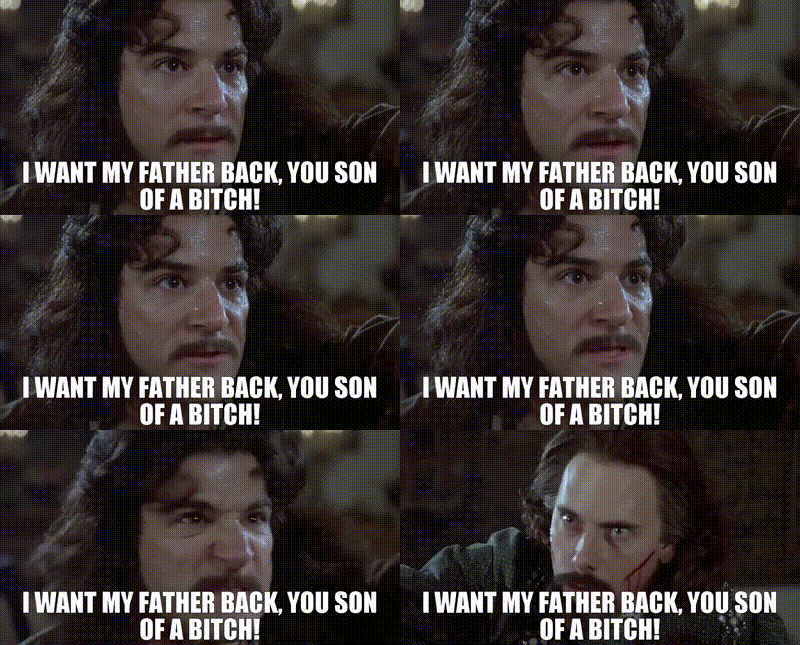
However, this famous, famous line only works because The Princess Bride is otherwise very, very clean—or, looked at another way, shows a lot of restraint. No one else swears, has crude conversations, or dresses inappropriately—all possible crudity and vulgarity is distilled into this single moment where one of the most deplorable men to ever be crafted in fiction meets his painful, painful end at the hands of a man in agonizing pain. If swearing showed up anywhere else in The Princess Bride, I just don’t think this moment would have landed.
Anyway, this is a difficult topic that I think I find no clear rules for, particularly since preferences and boundaries differ so greatly from individual to individual. (As much as I like the above example, I wouldn’t say that quote out loud under most circumstances.) I do wish, however, that most modern storycrafters would learn to lean away from explicitness and vulgarity rather than into it.
What do you think? What stories were ruined for you because of vulgarity or explicit content, and what stories unexpectedly made very effective use of it?
—Aggressively Flawed Characters
I hated Miranda for most of Theft of Fire. It wasn’t until the last quarter of the book, ish, that her many, many flaws and rough spots came together and made me start to root for her—after she’d overcome many of her initial infuriating traits, and after I’d learned part of the story behind who she was.
On the other hand, I found Marcus intensely relatable as a man who generally feels unappreciated, who’s got demons he’s trying to overcome, who struggles to connect with people, and who generally just wants to be left alone to do his thing. He’s selfish, crude, and often quite rude, but I easily connected with him as an extremely flawed character.
Theft of Fire does flawed characters well, and I say that even though I really didn’t like Miranda for most of the book, because she still remained compelling—or, at least, she remained a critical part of a compelling story. It’s a very difficult line to walk, however, and many stories that attempt the “unlikable/aggressively flawed” protagonist fail to give me a reason to hang on and root for the character(s). (Characters should have flaws, though. I am not advocating for Mary Sues.)
But when a flawed character is done well, it makes an undeniably incredible rush when that character completes a redemption arc. If that character completes a redemption arc. (I’m still bummed that Community never really got around to having Jeff mature in any real way, even when everyone else around him did to at least a little degree.)
—Rip Off, Don’t Remake
My final avenue of discussion came from Theft of Fire intersecting in my head with a video essay about video games called “Clones Aren’t Killing Gaming – They’re Saving It”:
The gist of the essay is this: rip off, don’t remake. (Apparently that used to be a guiding principle in Hollywood?) But there’s a difference between good ripping off and just creating a substandard copy, and that difference is defined by well-done iteration. Some of our most excellent creative endeavors exist because someone looked at a creative work someone else did and thought something along the lines of, “That, but with my own spin on it…”
It’s fairly common knowledge that Star Wars (good Star Wars, I’m thinking of the original trilogy) is basically just a Western in space. And Westerns made in the US heavily stole from Italian Westerns and Japanese samurai movies. Both of which stole from many stories that came before them, including myths and fairy tales. All of these things come from a shared set of evolving (and mutating) DNA that can be traced backwards, but feels very unique and distinctive in each individual work that bested the test of time. And, of course, good stories like the OG Star Wars didn’t rip off of just one thing, but multiple—Dune, too! We wouldn’t have these amazing stories if it weren’t for a long line of ripping off.
I don’t know if Theft of Fire ripped off of Firefly intentionally, but given the age of the author I’d be baffled if he hadn’t seen at least one episode of the TV series. If he didn’t, then clearly he ripped off of the same type of source material that ultimately produced Firefly, because there’s a lot of similar feelings between the two stories and universes.
Anyway, what I’m getting at in a roundabout way is that ripping off is good, and we need more good, old-fashioned, iterative ripping off. While I don’t think there’s an inherent problem with sequels or reboots—Max Mad: Fury Road is strong evidence that some reboots need to exist—I do think too much remaking just starts to make stories stale or fetid, particularly when a lot of remaking draws too directly from the original story without becoming its own thing.
Here is another example that came to my mind of the fruits of ripping off: I liked Eragon, and the fantasy roots connecting Eragon to Tolkien and other stories (Star Wars) are pretty obvious. But here’s a rip-off in Eragon that most people I’ve met don’t know: Christopher Paolini obviously was a fan of David Eddings and The Elenium, because the ra’zac are just Eddings’ “seekers” but beefed up to play a more major role in the story (and, frankly, be a whole lot scarier). I like the ra’zac, but they don’t stop me from enjoying The Elenium or its seekers, which I think is a sign of a good rip-off.
And one more: The Wheel of Time pretty blatantly retreads The Lord of the Rings ground early on before becoming its own thing, but good golly did The Wheel of Time do well at becoming its own thing while still respecting those roots. And, given the legions of Wheel of Time fans out there, we can guarantee a lot of future stories drawing on those books rather than directly drawing on Tolkien.
Finally, for all the examples of good ripping off I brought up, I want to bring up one bad example: Zac Snyder’s Rebel Moon. It rips off Star Wars, it rips off every story that draws its DNA back to Seven Samurai, and countless other stories besides, but by completely failing to do anything new with its ripping off it completely fails to be iterative, transformative, and as a result collapses under the weight of giants rather than stands on their shoulders.
Tell me, my friends… what rip-offs are your favorites?
Writing Updates
I’ll keep this on the quicker side this week. I am about 11,000 words into Hazel Halfwhisker! The story is off to a strong start and is promising to be an engaging adventure with a lot of heart and heroism at its core.
As well, this year I get to hungrily wait to hear from Writers of the Future and Baen Publishing over whether or not my other stories have won/been accepted. That probably won’t happen until February or March, but I’m excited now nonetheless.
Send-Off
I’ve asked you enough questions above, so feel free to respond to any of my ramblings inspired by Theft of Fire. Or tell me how much you love The Princess Bride and why you watch it every year. (Or read it. The book really is incredible, and one of the few examples of a book-and-movie pairing that are meaningfully different but exist as equals rather than the film clearly being inferior to the book, or the very rare film eclipsing the book.)


 Boo Ludlow
Leave a reply to 2024-01-22—Has-Been Motel – Boo Ludlow Books Cancel reply