Have you ever eaten a nanny? I bet you have. I’m not much of a fan of them, personally, but the rest of my family eats them all the time.
(For context, my little one calls bananas “nannies.” And she eats, pulverizes, and otherwise terrorizes a lot of nannies.)
The Failed Technomancer, chapter 27, is live! 64Bit and his friends must cross the mountains in an effort to find Id, a dark technomancer… with the added difficulty of personal tensions being on the high side.
Discussion: What’s the Value of “Vanilla” Fantasy?
Have you ever read the Eragon books? It’s been a decade or more for me since I finished Brisingr, but I still remember them fondly. I quite liked them, and reread the Roran parts of Eldest until the covers fell off my copy of the book; Paolini did a remarkable job considering that he started writing Eragon when he was fifteen and published when he was nineteen. It probably didn’t hurt that his parents were professional publishers with five or so years of experience under their belts by the time they put their full efforts behind publishing and marketing Eragon; that said, I don’t think the series would have turned into a phenomenon if the stories and characters weren’t good. I don’t even mind that clear and direct inspiration was taken from the original Star Wars trilogy; the general archetypes used by Star Wars were really strong and Eragon borrowed them well.
Anyway, I liked the Inheritance Cycle as a teen. So when I discovered that Paolini had published another book in that universe, Murtagh, I was very curious. I bought the book, started reading… and it’s been about a month and a half and I’m still not done. (I typically read through books much, much faster than this.)
The issue isn’t the book’s length. Given the time and motivation, I can read a Stormlight Archive book in a week, and retain what I read. I don’t think the issue is quality, either: this isn’t a review of Murtagh, and since I haven’t finished the book I don’t want to say whether I think it’s good, bad, or something else, but I do think Murtagh is competently written, at least as far as I’ve gotten into the book. (Maybe could use a stronger hook.) So when asked by friends and family why I’m struggling with finishing the book, the only answer I can come up with is this: “It’s too vanilla fantasy for me right now.”
But what does that even mean? And why would that ever be a bad thing, or at least something that makes a book less palatable?
When I think of “vanilla fantasy,” a lot of things Tolkienesque come to my mind. I think of humans, elves, dwarves, halflings, orcs, and goblins; I think of mighty warriors, cunning thieves, and wizards that wield magnificent magic (sometimes less often than you’d expect); I think of adventure, exploration, wonder, new worlds and lands; I think of fighting, strife, high ideals, imperfect heroes, and a quiet but deep understanding of the human soul. None of that is boring. None of that is uninteresting. Quite the opposite. It’s so good that Tolkien became the foundation for Western fantasy since… well, since Tolkien gave us the template. Countless excellent worlds and stories have been derived from it, as well as stories and adventures in tabletop role-playing games, comics, movies, television, and so forth, to the point where many people today have never read (or watched) Lord of the Rings, and yet are still very familiar with these elements.
“Tolkienesque” is not “vanilla fantasy,” though. Not inherently. Having elves or dwarves or orcs does not necessarily make a story vanilla fantasy either. At least, not in the way I approach the idea, which is more about the feelings a story evokes.
I want to defend Tolkien first, then return to directly talking about vanilla fantasy—but the two topics are related.
Sometimes, when a story is first published, it shakes the world by being completely unique and interesting, doing things no one else has done before, or doing familiar things in completely new ways. But then the years pass and that story becomes foundational to other stories that build on it or borrow from it in various ways; eventually there’s a generation of people who grew up on the new stories, the stories inspired by that first world-shaking story; then they go back and read that first story, and they feel bored or disappointed, because now the original feels unoriginal, uninspired, trope-y, done already, and other synonymous words and phrases. All foundational stories are at risk of this sort of miasma poisoning new readers.
Lord of the Rings, I think, is in a rare class of story that is impervious to this dereliction.
Lord of the Rings isn’t easy to read; a lot of people struggle with Tolkien’s prose, his verbose descriptions, and his songs and poetry. It’s a style that doesn’t vibe with a lot of modern readers well, particularly most readers who use the word “vibe.” But that hasn’t stopped Lord of the Rings from being an evergreen seller, with new fans every generation. The story is completely timeless. I don’t think it will ever matter how much of fantasy (Western or otherwise) is medieval, has wizards, has elves and dwarves and the rest, focuses on adventure and heroism, or otherwise shamelessly borrows from Tolkien. Lord of the Rings will always stand. (As a tangent, I think Dune is in the same sort of position, but for sci-fi.) It is not vanilla, despite being the inspiration that so much of vanilla fantasy draws from (directly, or indirectly through works that were directly inspired by Tolkien), perhaps by virtue of sheer quality, depth, and clarity of character.
So there you have it: Tolkien is awesome. Not a particularly daring statement, but a true one. And his stories are great examples of how very traditional fantasy elements (set by the OG notwithstanding) do not inherently make a story vanilla.
So what is vanilla fantasy?
Vanilla fantasy isn’t bad. Not intrinsically. In fact, a lot of vanilla fantasy is really high quality stuff. When I think of vanilla fantasy, I get a feeling that makes me think something along the lines of “This isn’t as fresh as it could be,” or “I’ve read/experienced this before”; one of the stories that comes to my mind is The Sword of Shannara, the first book of the first Shannara trilogy (author: Terry Brooks). To be clear, The Sword of Shannara is really good, and I would recommend it to anyone who likes fantasy. But when I try to revisit the book, I rarely can finish; at some point I get my fill of what I’ve experienced before and well and elsewhere, so I set the book down and look for something new.
I look for something new. I think, for me, that’s the difference between real vanilla fantasy and other fantasy—and it’s what lets me read a fantasy novel that doesn’t have anything Tolkienesque in it at all and still think, “This is vanilla fantasy.” Maybe that’s an answer I could have popped out several paragraphs earlier without having to praise Tolkien as much as I did, but I think just saying that vanilla fantasy isn’t… new, doesn’t feel fresh, isn’t enough because it doesn’t evoke the right feeling. Something being timeless, or something feeling fresh and interesting, allows it to sidestep being vanilla, but there has to be more to it than that. I need an example that isn’t a Tolkien titan.
Have you read The Elenium, or The Tamuli, by David Eddings? (Also books published forever ago—I’m only twenty-seven, yet I feel like a crotchety codger, only recognizing the value of books published ages past. I think part of that is because modern publishing has severely lost its way, but that’s a tangent for another time.) These trilogies books run the risk of being written off as vanilla fantasy (but I wouldn’t describe as Tolkienesque)—medieval-ish setting, magic, Greek-like gods running around on the planet and getting into shenanigans, trolls, and the like. But that accusation couldn’t be farther from the truth. Both of these trilogies are extremely funny and fresh, even today, and feature a really unique plot where the heroes have every advantage over the villains, with one or two exceptions: time, and sometimes knowledge. If it ever comes down to a fight, or other competition, the heroes will win, and do so easily and with style and humor, but the fact that the villains are so close to accomplishing their goal when the story starts provides the needed tension for the readers to be gripped anyway. I’ve never read another story like it, and while I must admit that I haven’t reread these books recently, I have full faith they would hold up just as well now as they ever have.
But let’s back up again. I said that vanilla fantasy wasn’t inherently bad. Yes, there do exist uninspired vanilla fantasy stories that are terrible, and I don’t often feel inspired to read vanilla fantasy, but there are also genuinely good stories in that “feeling,” Sword of Shannara and The Inheritance Cycle being examples in my library. But what does it matter that they are good if they are vanilla, and I’d rather go off and read something else, their quality be damned?
Comfort food.
And introductions to fantasy as a genre.
Sometimes, I just want to read a familiar story. For whatever reason, I’m not looking for the new, the bold, the challenging. I just want something fun and familiar. That’s when I come running with open arms to vanilla fantasy. It doesn’t happen to me often, but I knew people who knew every flavor of vanilla fantasy, from vanilla bean to french vanilla to the obscure stuff, and they still haven’t gotten enough of it. As well, vanilla fantasy is probably what I will go to first for my children when I introduce them to the genre. Eragon and Sword of Shannara are two examples of amazing introductory fantasy books that can hook someone on fantasy, spark their imagination, give them an amazing time, and are fairly easy to read. And if that new reader tastes this vanilla fantasy first, then they have a reasonable baseline to begin discovering his/her unique tastes and preferences from.
In short, I’m not usually a fan of vanilla fantasy, and I don’t know if I’m going to finish Murtagh, but I’m glad that fantasy comfort food and starter packs are out there. And we probably will never run out of them.

Side note from the author as I review this blog post before clicking “Publish”: Murtagh does keep getting better as it goes along. The beginning is a bit of a slow start, but it picks up.
Bloggyness Review: Orion and the Dark
Orion and the Dark is Dreamworks animation distributed by Netflix. In it, a boy named Orion overcomes his fear of the dark (and everything else) by spending a night traveling across the planet with a physical manifestation of darkness. Which manifestation, by the way, is helpfully and clearly named Dark.
Some spoilers incoming, including an overview of the plot laced with my thoughts.
The premise that Orion and the Dark is sold on is revealed to be misleading early on. The movie opens with Orion, getting to know him and the various fears that he deals with, seeing his life and family, and introduces the co-protagonist, Dark. Dark is tired of everyone being afraid of him, and, since Orion is one of the most fearful people that Dark has ever met, he figures if he can take Orion on an adventure and help Orion overcome his fears, people might have a change of heart about him. It’s a solid opening, and my wife and I were very invested.
Then this is all revealed to be made up. Very suddenly, the camera shifts to a girl saying that she knows this story isn’t real, that it’s a trick, that it won’t work, at the end of it she will still be afraid of the dark. An adult version of Orion walks on camera and chuckles, and asks if she wants to continue the story. There’s a little more to the conversation than that, but they do.
It’s at this point that Orion‘s mushy middle begins, and boy does it mushily follow bedtime story Orion and Dark with occasional cuts back to the real word. The premise of this movie might be about overcoming fears; it might be about appreciating night time and the darkness; it might be about the connection between a father and his daughter; the movie at this point stops being clear about what it wants to be or where it’s going. Things meander about as Orion and Dark interact with the other “night entities,” being Sleep, Sweet Dreams, Insomnia, Quiet… and Unexplained Noises. (Most of the representations of aspects of the night makes sense to me and relatively easily show their value in little clips, except for Unexplained Noises, who is just kinda… there the whole movie.) There are breaks while adult Orion and his daughter interact, which may or may not cause something that happened in the bedtime story to be changed. And, weirdly enough, a whole lot of things happen and are brought up to justify people’s fear and dislike of the dark, rather than show why Dark should be valued as much as Light. Strictly speaking, that’s fine… but there should be a back-and-forth. Instead, it’s nonstop “Darkness kinda sucks, actually, in all the ways that are meaningful, anyway.”
Maybe some strange creative decisions in this film could be explained by the fact that the story of Orion and Dark is technically a bedtime story being made up on the spot, but that doesn’t make everything interesting or make sense even in that context. This context could be used to explain why the Night Entities feel like plot devices rather than characters, but, again, explaining why things are the way they are doesn’t make them interesting or entertaining in the middle. Explaining why something is half-baked doesn’t finish baking it.
That’s not to say that there aren’t high points. As I mentioned before, the beginning of the film is really solid (and I’ll get to the ending in a little bit). The animation is really attractive, the character designs are excellent, the sound design (and music) is positively quirky, and the voice acting is top notch. My wife and I had plenty of moments in the middle of the film where we were having a great time, but it was surrounding but a lot of directionless filling.
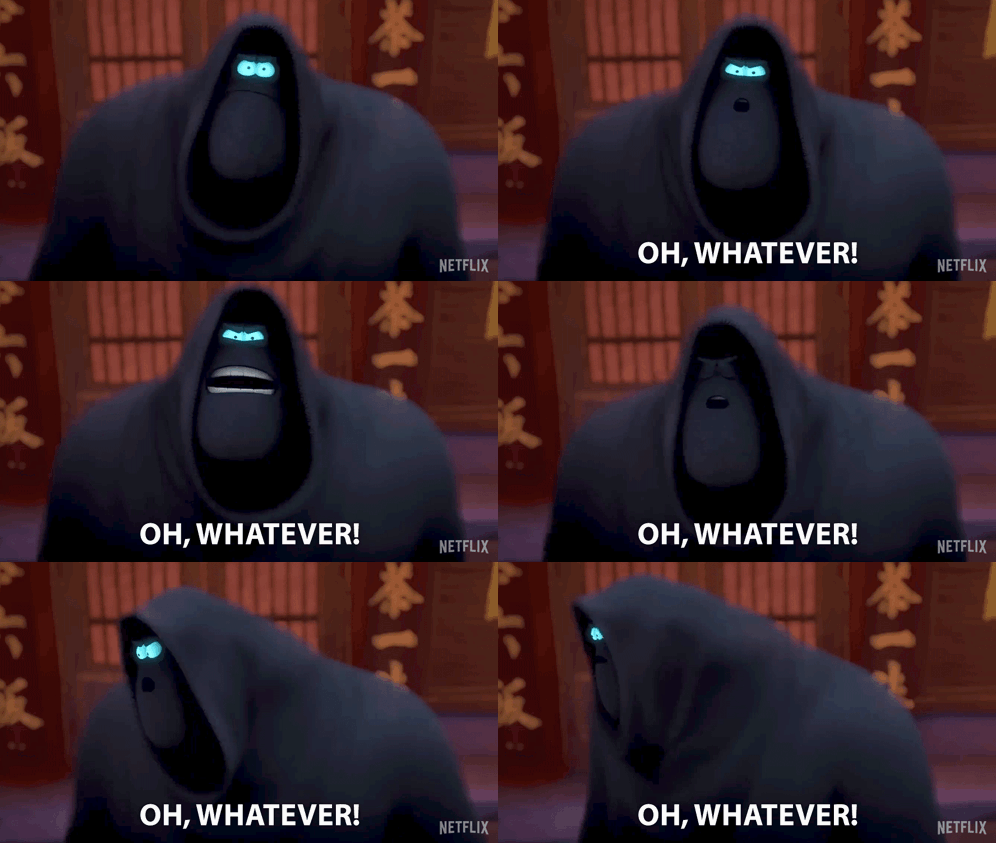
Then the end. Wow, the end. The ending went from extremely poignant and tear-summoning to utterly bizarre and mood-killing in about thirty seconds, and then it just keeps going. Almost film-killing. I won’t tell you all the details, but at the very end, when young Orion and his future daughter get dropped off at young Orion’s house (yeah, that happens, the future daughter joins the bedtime story as a character), just turn the movie off and skip the actual ending, because the actual ending is a lead weight around the rest of the movie’s neck.
I haven’t the foggiest clue what would have done to fix this movie. I mean, if I were the one writing the script, I would have dropped everything about adult Orion telling his daughter a bedtime story and treated everything between Orion and Dark as actual, canonical events within the movie’s universe. But the writer, Charlie Kaufman, clearly seemed very invested in the meta-story of parents telling bedtime stories to their kids, and then the kids getting involved, and the kids passing those stories on to their kids… cemented in the terrible ending when, completely out of nowhere, a time machine shows up, along with time monsters, and Charlie’s grandson, and there’s a laser gun… Very jarring. Anyway, the movie appeared really invested in having two parallel stories going on at once, and I for the life of me have no idea how to marry them in a better way.
Maybe if the movie took the Princess Bride approach and had the movie start with the dad and his daughter, so it was clearly a story from the beginning. I dunno.
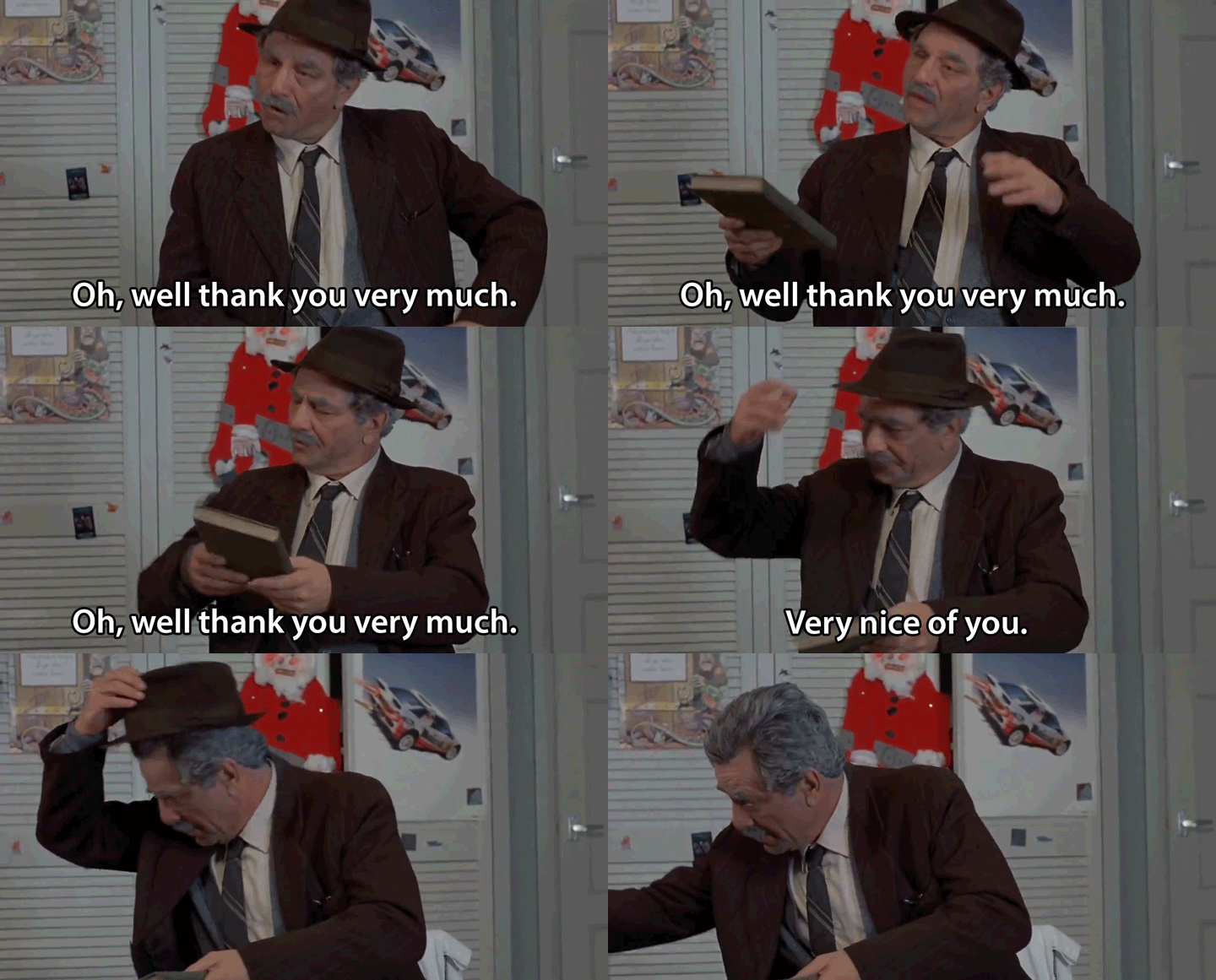
For your children, particularly younger ones, this is a fun, inoffensive film that will probably entertain them, and they won’t really care about the tonal or structural inconsistencies. Unfortunately, this movie is far from the next How to Train Your Dragon (the type of family-friendly animation that genuinely has the ability to entertain mom and dad as well as the kids).
Writing Updates
Hazel Halfwhisker is at… 35,000 words! Woohoo! That’s an increase of about 7,000 words! I was really pleased with a lot of productive writing time last week.
This week, I’m not sure how likely I am to hit a minimum of 5,000 words. Hopefully I get the time sometime this weekend (speaking as the guy writing this blog post on February 10th) to spend a few hours carefully plotting and planning; if so, I expect more big boosts in speed. If not, I may need to spend some normal writing time structuring the various interweaving elements of this story. (I’m usually a very discovery writer, but I have found that the more story elements I choose to work with the more I need to plot in advance.)
Speaking again as February 12th Boo, I did some amazing plotting this weekend. I’m not sure how much word count that will directly translate to this week, as I still need to organize my notes a bit more and put them in a more accessible format than the eldritch tome my notebook is; as well, it means I need to go to Part 1 of this book and make some revisions in preparation for future sections. But I’ll take slow and steady over rushed and heady.
Anyway, the Baen website still shows Inner Demon with the status “Manuscript Submitted,” and Writers of the Future still shows The Courage in a Small Heart as “Submitted” as well, so the wait continues on that front.
I don’t think I mentioned this last week, but The Precious Burden of Joy is posted in the “Other” section of Stuff to Read. This is a piece of a story that I started writing, then moved on from when I realized it wasn’t the right story for what I wanted to do with the World of Murid. It still ultimately proved useful in helping me develop some characters and more of the world, and Greentail and Parsnip play important roles in Hazel Halfwhisker. That said, consider this little snippet as something akin to peeking into an artist’s sketchbook—things will be fun, things will be weird, things will be poorly done, and it’s definitely incomplete, but it gives you an insight into the madness under the hood.
Send-Off
If you have anything you want me to discuss in future blog posts, let me know. But in the mean time… How do you define vanilla fantasy? Are you generally a fan, or do you prefer to chase the new and fresh? Is it a feeling to you, or closer to a sub-genre? Also, did you see Orion and the Dark? What were your thoughts? And, of course, if you look at The Precious Burden of Joy, I’d love to hear any thoughts you have!
Have an excellent week! And…


 Boo Ludlow
Leave a reply to keilanil Cancel reply