Hello, friends!
My baby can be a bit of a stinker sometimes. She’s not anti-touch, but she usually isn’t interested if you ever ask for a hug. That’s until it’s time to change her diaper or put her to bed, however—then she’s suddenly demanding hugs left and right, holding tight, doing everything she can to delay the inevitable.
Makes me want to put her down for naps far more often. I like her hugs.
The Failed Technomancer, chapter 31, is live! 64Bit and Wesley are having fun dissecting a rozie… will it reveal anything useful?
Discussions—Remakes, Reboots, and Differences in Mediums
Are you familiar with the BranDan podcast? Okay, it’s actually called Intentionally Blank, but I think of it as the BranDan podcast, or the Bran and Dandon podcast. They had an interesting discussion recently about why remakes/retreads tend to be controversial in movies, but not in other media. Here’s the video if you’re interested:
Here’s the gist of their discussion. If you go to the theater, nine-hundred and ninety-nine times out of a thousand you are going to see a “remake” (an existing play that you’ve likely seen before but that has been reimagined by a new directer, cast, and crew, with the same script as always). This is the norm for the industry. Redoing popular, existing plays tends to be much more culturally and financially successful in theater than running something new (although new plays sometimes get their time in the spotlight). But, this is hugely taboo in movies. For example, we already have, and love, the 1998 Mulan; it was sacrilege to make a new version of it. More recently relevant, we already have a cartoon version of Avatar: The Last Airbender; what’s the value of redoing it with live actors and enough CGI that it’s effectively a cartoon again?
Well, I had feedback to this discussion. I thought they were missing something critical their entire conversation: movies don’t change. But then they did end up bringing in this exact point in the last thirty seconds or so—oh well. I still want to say my piece.
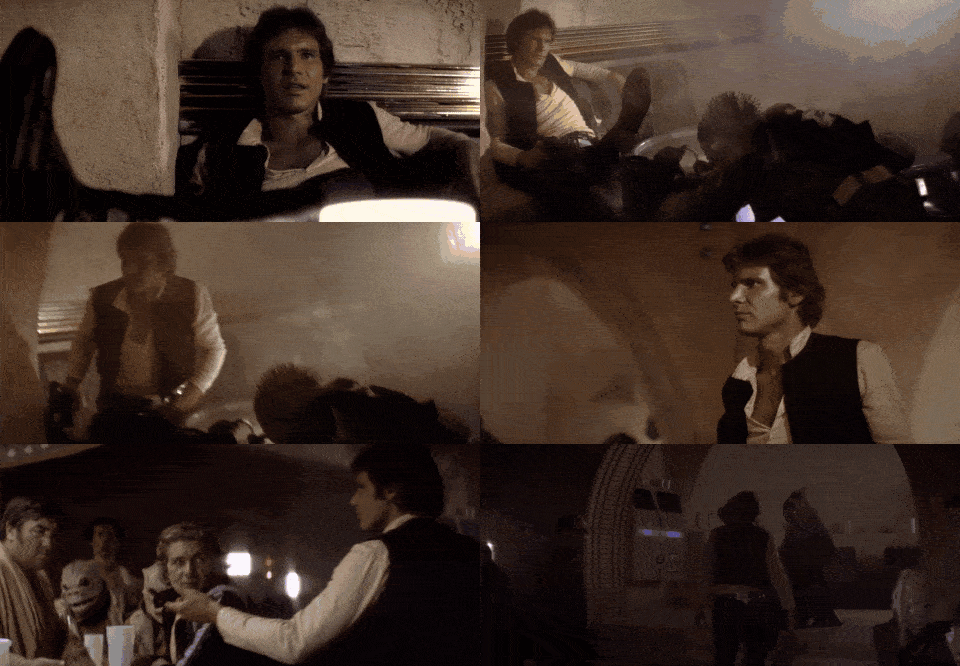
Here’s what I mean by “movies don’t change.” Provided you own a physical copy of a movie, and/or your movie hasn’t been Thanos-blipped out of existence by Warner Bros–Discovery, you can revisit that movie whenever you want, as often as you want (as long as there exists a functional and accessible machine for you to play that movie on), and the movie remains exactly the same every time. Not one frame of difference. You may have a unique experience with it by virtue of you being in a new stage of life, or otherwise having changed as a person, but the movie itself has not changed. This removes the need for a remake. It also makes it very easy to, fairly and unfairly, directly compare a remake to the original, and new often doesn’t hold a candle against nostalgia.
(There are also many people who claim that the mere existence of a remake, particularly a terrible one, “ruins” the original. I don’t agree with this, but what really matters is how much of your audience shares this perspective. If enough people are mad at you for making a bad remake and tarnishing the original, you’re going to find a lot less success than you may have otherwise, regardless.)
This isn’t an issue with theater, orchestras, opera, ballet, and all other live performances because you can only experience what you get in the moment. It’s there, then it’s gone forever. Even if you go back on a different night, with the same actors performing in the same location, you will not get an exactly identical performance. Even if each actor follows the script perfectly. Especially if any actors go off-script. Something, at least, will be or feel different. But over thousands of years of live performances, that’s become a feature rather than a flaw. People genuinely love seeing the exact same Shakespearian scripts reimagined in every possible direction, from the familiar to the utterly bizarre. It sometimes boggles the mind how equally effective completely different interpretations of a character can be; it can be equally interesting to see an interpretation that just doesn’t work and puzzle out why.
I think this holds true for just about any art form. Recordings can be returned to exactly as they are, while live performances only really exist in the moment.
Imagine if paintings were constantly remade. (Well, actually, copies of paintings were regularly, painstakingly remade historically, but not for the purpose of creating something new. We accomplish what the ancients were attempting by using the modern marvel known as the printer.) What would that even look like, if once you saw The Scream you never could again; instead, you’d have to find some other artist’s repainting of it? And books—remakes don’t really work for books, either. Even with some words or sentences changed here or there, would there be a point to reading a remade book? Eh…
(Probably the closest we’ll ever get to a remake with a book is a retelling of a familiar story, like the infinite fairy tale retellings on the market. But the semantic difference is there in the name—it’s not a remake, it’s a retelling, which scratches a different itch.)
That all said, I do hope that one day Dan comes into some sort of incredible fortune that allows him to fund his passion project: to take the original script for one of the Knight Rider movies and give it to a new director, cast, and crew to make their own completely re-envisioned version of the movie, just like what happens in stage plays. Would this be a success? Would Dan kick off a new trend in movie making? I dunno—but with someone else’s money, I think that sounds like an exciting experiment.
… Hopefully it doesn’t end up exactly like the CGI The Lion King, significantly worse in every way. Now that I think of it, that Disney remake is an example of the above idea going terribly wrong. On the other hand, Cinderella (while a little more re-envisioning than remake) holds up extremely well, even considering the beloved original. Disney’s record is spotty, to say the least.
As a final bit of feedback to Dan: I disagree that books are exactly the same each time we read them. I, at least, imagine things a little differently with each read, particularly if a lot if time has passed between reads, or if the knowledge that comes with having finished the book meaningfully changes the experience of rereading it.
Bloggyness Review—Crimson Sun
Crimson Sun, Colby Dunn’s debut novel and the first in a trilogy, is about Caleb Rambrant, a hero in trouble when his country is invaded by a hostile nation. Here’s the blurb that sold me on the book:
We have all read a story of the naive village boy who leaves home and rises up to learn the way of the sword, get the girl, save the world, and become a hero. But what if he had these things from the start? How will he act when one by one, all of it is taken from him as war seeps into his country?
Colby Dunn, https://colbydunn.com/crimsonsun/
Doesn’t that sound exciting? Intriguing is another word I’d use. Having not read a story like that before, I was excited and intrigued.
I will not be finishing this book. I got about a quarter, maybe a third of the way through, and just couldn’t push myself to keep reading. Crimson Sun‘s biggest failing, for me, was its editing. This book needed a line editor and a copy editor. Frequently, just as I was starting to get sucked into the rhythm of the book, some jolt would make me uncomfortable again. I felt like I was riding a horse that had just thrown a shoe, again and again and again.
There were other aspects of the book with strengths and weaknesses, but the frustrating prose just kept stopping me from getting into things. I had a feeling that the book wanted to feel very familiar at the beginning, then subvert my expectations with an exciting twist, but I couldn’t get into the book to reach that payoff, if I’m right that it was coming.
I felt like Crimson Sun had a ton of promise, and if a revised version of this book ever gets published, one that addresses my pain points, I’ll be excited to give it a second try. I did really want some comfort food epic fantasy with a twist; unfortunately, things just did not work out for me as-is.
Writing Updates
Hazel Halfwhisker is at almost 59,000 words! A smaller jump than last week’s word count, but still pretty good given that I wasn’t able to write Friday.
I’ve also got other news, specifically about The Courage in a Small Heart. It’s a mixed bag. I did not place in the Writers of the Future contest. However, I did receive the Silver Honorable Mention… again. (I’ve received it previously for other short stories.)
On the one hand, I’m pleased with myself. Writers of the Future is very competitive. A silver honorable mention is still really good, considering Writers of the Future self-reports thousands of submissions a quarter. On the other hand, I wish I knew what I needed to do to break this wall, as I’ve received Silver Honorable Mention before, and if I can’t win then I’d at least like to break into Gold once.
So, I’m trying not to complain. I would be lying if I said I wasn’t disappointed—I just want more honor!
On the bright side, this does mean that I can publish a version of The Courage in a Small Heart directly to this website sooner rather than later, and there will guaranteed be no issues with me using it as part of the future Hazel Halfwhisker Kickstarter. Woohoo!
Send-Off
Would you be interested in seeing movies remade in the same way that theater productions are “remade”? Or are you generally against remakes and prefer to see new cinema?


 Boo Ludlow
Leave a reply to Zachary James Cancel reply