Hello, friends!
So, stop me if you’ve heard this one… Two muffins were in an oven. One muffin turned to the other and said, “Hey, is it getting hot in here?” The other muffin responded, “Holy crap, a talking muffin!”
Anyway, that bit of standup there is how I nagged $5 off of the mug pictured below, both all part of my lead-in to a personal insight:
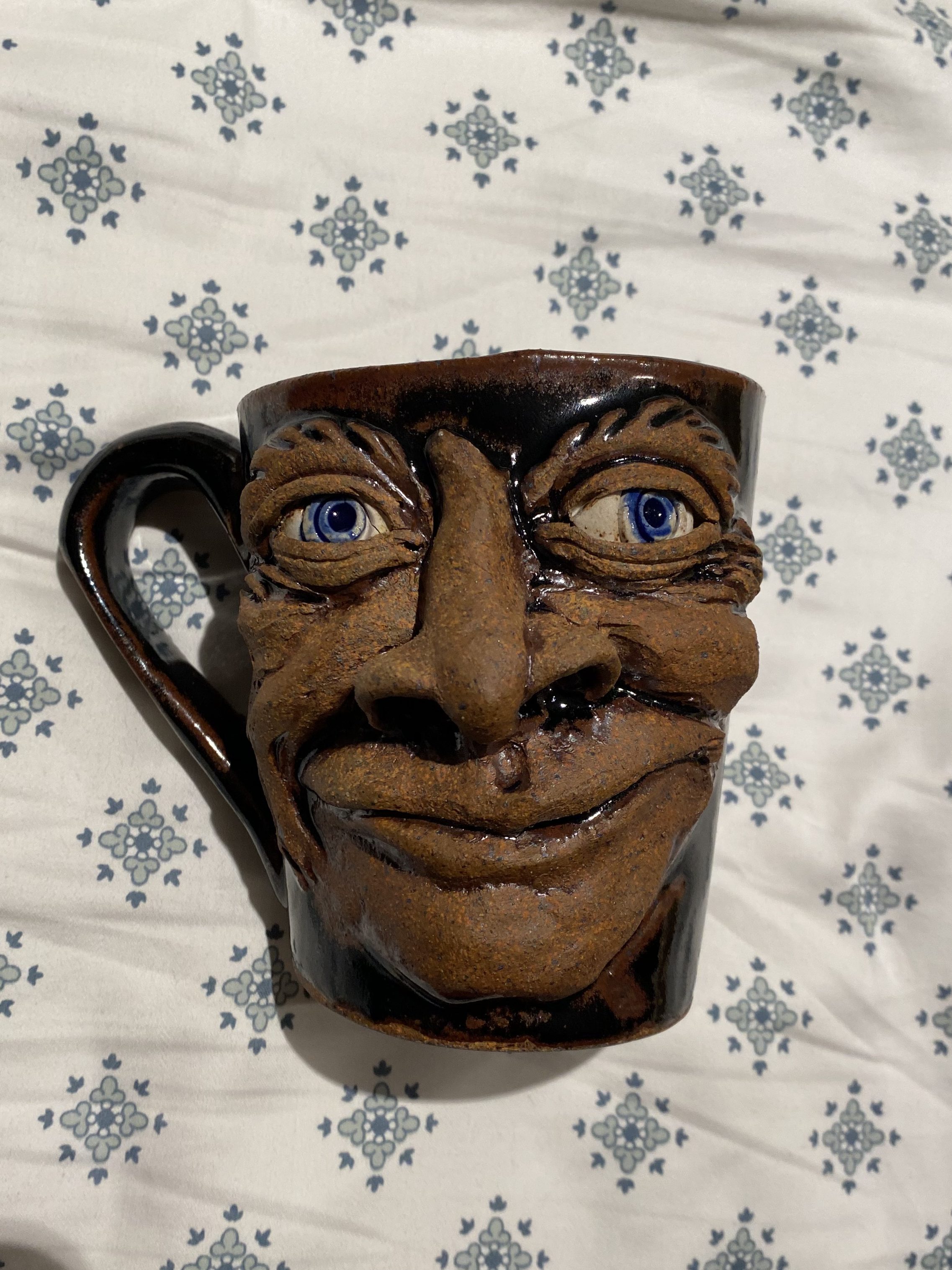
(Kinda looks like a muffin—similar color and texture.)
I love pottery! I made a fair amount in middle school and practiced over a few high school summers, when such classes were fairly accessible. I loved making, particularly, themed sets of cartoonish elephants and dragons, but I also dabbled in bowls and mugs. My teacher through almost all of this was a wonderful, loving, patient woman named Sue. She did not make the above mug—but she loved putting expressive human faces on odd things (particularly insects), so this mug, found at a local farmer’s market, warmed my heart and brought me back.
It’s interesting how quickly something unexpected can pull up strong, positive memories
Bloggyness Review—House of Leaves
House of Leaves (Mark Z. Danielewski) is a highly experimental fictional novel of layers. The first layer is The Navidson Record, a film documentary about the Navidson family and the horrors they experienced within a house that was larger on the inside than on the outside. The second layer is a work of academic criticism about The Navidson Record written by a man named Zampanò—the majority of House of Leaves is this “criticism,” which features a great deal of missing or damaged pages, as well as pages structured… unusually. Then, on top of that layer, is “Johnny Truant” (it is unlikely that is his actual name), a drugged-out nobody who discovered the notes of Zampanò’s unfinished work and decided to transcribe them into a mostly-complete product, adding frequent footnotes, asides, and personal stories (generally grossly crude and utterly irrelevant to the main narrative). Finally, on top of all of this, are more footnotes, as well as appendices, from an unnamed, unknown editor (or team of editors) who ostensibly revised and published this work after Johnny Truant submitted it to them and disappeared—it is unclear just how heavy or light a hand this editor exercised.
In short, the book intentionally sets itself up with many, many layers of uncertainty.
House of Leaves was sold to me on the first two layers alone—that I would be reading a fictional work of academic criticism about a nonexistent found footage horror documentary that claimed to be legit (in the vein of The Blair Witch Project, I suppose). It was completely out of my wheelhouse, it sounded weird, but I was intrigued enough to give it a try, particularly when I found a physical copy on a sale somewhere (the remastered, full-color edition, no less). This part of House of Leaves initially captivated me. I found the characters and the story captivating, and the obfuscating lens of receiving the story through a “critical analysis” heightened the intrigue for me—it was like noticing a vague, but haunting, detail in a blurry photo and becoming obsessed with finding out what it was, the photo becoming far more engrossing specifically for its blurriness than it may have ever have been if taken with crisp clarity. (Analogue horror leans on this aesthetic a fair amount, come to think of it, and this is a, sort of, horror novel. I’m not sure horror novels can be analogue horror, though. But that’s a tangent.)
That said, this obfuscation grew old for me pretty quickly, and I longed to just read the fascinating genre story that I saw as the true heart of the novel, without all the distractions. This feeling was exacerbated by the other layers mentioned above—in particular Johnny Truant’s asides, his general unreliability and crass lack of focus. Almost every one of his stories were directly irrelevant to both the “academic criticism” layer of the story and The Navidson Record itself, instead mostly focusing on graphic sexual escapades, violent encounters, and Mr. Truant’s rapidly deteriorating sanity. I did think the tone or theme of these asides was intended to be connected to the chapter they were inserted into, the point being that they ran parallel in a way, but it just did not work for me. I began skimming through these textual insertions very early on in House of Leaves. I didn’t even touch the appendices at the end of the book, because by the time I had consumed about 600 pages of this flailing insanity I was beyond ready to move on.
Ultimately, for me, House of Leaves was the novel equivalent of a lot of modern, public art: I came to look at it because I found something intriguing, but I ultimately decided the sum was far less than the whole of its parts.
There are reasons this book has a dedicated audience, composed of those tuned in to the layers of this novel that I actively despised, didn’t care about, or didn’t realize were critical to engage with. For example, apparently, when viewed as a satire of academic criticism, many find House of Leaves hilarious. Consider that the fictional author of this work, Zampanò, is completely blind, yet claims to be an expert on cinematography and other visual arts, hence his reason for writing this work in the first place. Consider also that, within the fictional world of House of Leaves itself, almost all of Zampanò’s citations are fabricated, and even the existence of The Navidson Record (the entire documentary the “academic criticism” is about) is highly suspect. Apparently dissecting these additional layers can make this book utterly engrossing when approached with the right literary background and mindset—according to other articles I read in an attempt to understand why anyone likes this novel as a whole. As for me, my experiences with literary criticism left with with a sour taste toward the insufferably self-important genre, but not in a way that made this novel strike my funny bone.
I also want to emphasize that what I saw as the central story in House of Leaves—The Navidson Record—is very interesting. Absorbing the entire story involved sifting through hundreds of pages and thousands of words that I ultimately wish I hadn’t had to read, but I was invested enough in the life of the Navidsons that I slogged through to the end to find out how things turned out. And, you know what, the ending was pretty good, and I think that had I read that story alone (without all other obfuscating layers) I would have been pretty satisfied and could have easily recommended it. Instead, I stumbled to the finish line exhausted, ready to move on to a story that wanted to be a story, that wanted to be read.
If you know what you’re getting into, and you still think the above sounds engaging, you might be in the crowd that loves House of Leaves. I think everyone else either won’t care or will actively dislike the book.
As an aside, despite ultimately not liking House of Leaves, I think Danielewski is a very talented author, and that this is a highly crafted work. Unfortunately, it proved to be evidence that moving out of your comfort zone is not always going to end with you discovering that you like new things.
Writing Updates
My word count for Hazel Halfwhisker over the last week is roughly 8,000 words. Meaning, over the course of the week I rewrote or revised about 8,000 words worth of book. There’s a fair amount more to go before I catch up to where I was, but I think this reset will make this section of the story much more sensible.
As for Inner Demon—

This one really hurt. I appreciate the professionalism of Baen’s team, and I understand that not everything makes the cut. While there’s that little worm of worry that maybe things would have worked if I had just given the book one more draft, I also know (or, have been told) that agents, editors, and publishers frequently pass on work of exceptional quality simply because it isn’t what they are looking for, whether that be for reasons of tone, theme, content, or something else. In short, I get it in my head, and there’s no hard feelings, but it will take a little bit to move past months of hoping and praying.
100–150 agent submissions and one direct publisher submission—that’s my stats on Inner Demon so far. I think I’m going to keep submitting it to agents, editors, and publishers until I finish the first draft of Hazel Halfwhisker. If nothing appears to be bearing fruit at that point, I’ll do the whole self-publishing shebang and start posting chapters on this website. Ebook, print copies, audiobook—the works, all myself.
At least I am the master of my fate, the captain of my soul.
Send-Off
Are you a fan of experimental novels? If so, what are some of your favorites, or ones that you’d recommend to people that already into the genre?

 Boo Ludlow
Leave a reply to 2025-03-07—Some Really Weird Fiction (Annihilation), AI Again – Boo Ludlow Books Cancel reply