Hello, friends!
This week… I wanna talk about me.
In part because I need to talk about my stuff in order to share it with people and show them why my writing is worth their time. In part because I need to learn how to do that effectively in the first place! So, consider this a practice swing, if you will.
Robot Cannibal Apocalypse—The Failed Technomancer
My debut, self-published novel is The Failed Technomancer, the very first book in the world of Robot Cannibal Apocalypse.
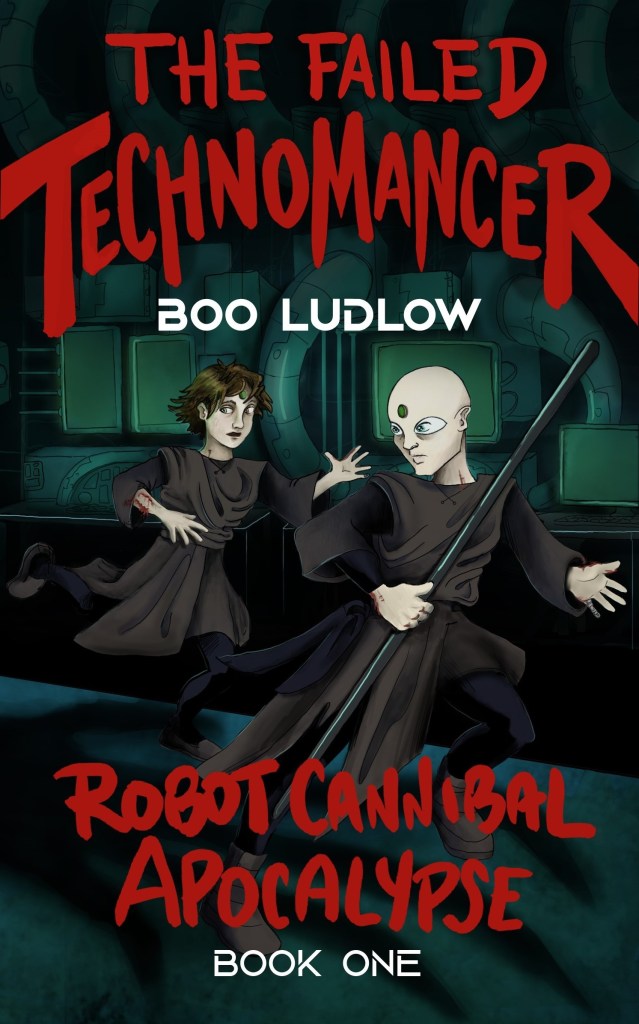
I think this book is fun. The main character, 64Bit, is introverted and a bit unlikable, but I think that makes it more satisfying when he gets put in his place. The world is interesting—similar to a post-apocalypse zombie situation, except all the zombies are insane cyborgs with a taste for human flesh. The book has moments of humor, moments of horror, and a lot of in between. (You can read it in its entirety here.)
The idea for The Failed Technomancer began with a conversation with my friend Zac, probably sometime around 2019—maybe 2020. We were discussing the zombie genre and how, at the time, it felt pretty played out. We wanted to figure out ways that we could make zombies feel fresh again. I don’t remember what Zac said that was the initial spark for this book, but it led to two ideas meshing in my mind: cyborgs and phantom limb syndrome.
Here’s the math I did. “Phantom limb syndrome” is something many people experience when they lose a limb: essentially, they feel aches or pains where their limb no longer is, sometimes to a debilitating level. Cyborgs are people who have had some (or most) of their bodies replaced with technology. Wouldn’t it make sense, then, for cyborgs to experience “phantom body syndrome”… perhaps feeling enough distress that they go mad? And become psychopathic cannibals? (That last part might require a sprinkling of fiction, but who knows?)
And thus, the rozies were born. (Robot + Zombie = Rozie.) People who had their brains removed from bodies of flesh and transferred into bodies of metal; people promised bodies that couldn’t get sick, bodies where all injuries were temporary (and painless), bodies that could be customized to look like anything. A utopian promise, to some, with mass production allowing billions of people to undergo the surgery before the negative effects kicked in widely—with disastrous consequences.
Other world building details came along as I worked things out. Technomancers, primarily, (my “space wizards”) answered a lot of important background questions: How can humans survive with nigh-unkillable killer cyborgs roaming around? How do these things keep getting made/damaged ones repaired? How did these things get invented in the first place, and how did technology advance quickly enough for apocalyptic levels of adoption before everything went to crap?
As my debut novel, I learned a lot from The Failed Technomancer. For one… I need to be a bit more careful with my names and branding. As much as I like the big, red, kinda-looks-like-blood letters screaming “Robot Cannibal Apocalypse,” I don’t think it sends the right message to the best readers for my book. One reviewer commented that he thought the book would be a comedy because it seemed so over the top—other people I shared the book with were put off by the dark colors and red text, but were surprised to find that the book wasn’t direct, hardcore fantasy horror once they started reading it. I also think that marketing the book as “dark fantasy” didn’t work… Blacktongue Thief is dark fantasy, and my book is nowhere near as grim and unforgiving. In short, I’ll have a lot of work to do when I (eventually) return to the trilogy and revamp the first book before writing any sequels.
Do your market research, kids.
Third Realm Universe—Inner Demon
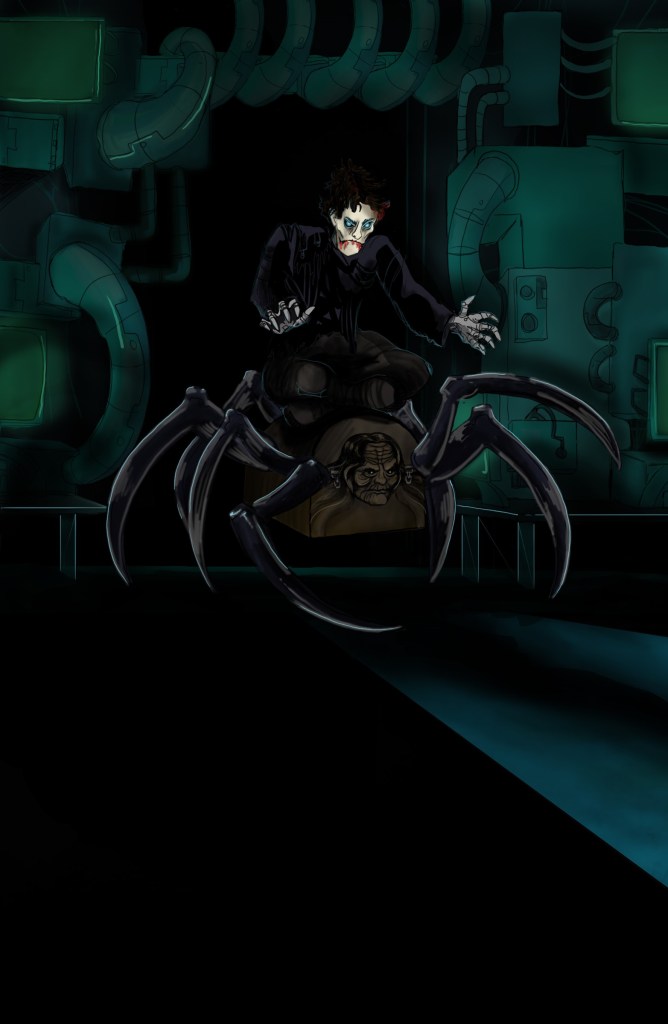
Inner Demon will be my second self-published book. The manuscript is completed and polished; I just need to format a PDF and epub, get cover art, and upload it to various websites for it to be officially published. Oh, and I also need to record the audiobook, do market research so I can do better with the cover and genre marketing than I did with The Failed Technomancer, and probably a half-dozen other things I have written down somewhere.

I’m waiting until I finish the first draft of Hazel Halfwhisker before I do all of this. (Perhaps some of Hazel Halfwhisker‘s length can be explained as my subconscious realizing the longer this book takes the longer it is before I have to engage with the business side of being an indie author.)
You can read the prologue and first chapter for Inner Demon here. Here’s my in-progress blurb:
Gnyphe (pronounced KNIFE) woke up in an alley several years ago with no memory of her past and the strange ability to use shadows as portals. She’s hunted for all that she lost since then, partially rebuilding her life along the way. But now a friend has been kidnapped, and Gnyphe’s suspecting it might be related to what happened to her—and that the price of her past might be her present.
(Learning how to write good blurbs is another skill I’m trying to develop, and it is hard.)
The journey to writing Inner Demon was much longer and more circuitous than Failed Technomancer. Inner Demon‘s deepest roots began with a game of Call of Cthulhu 7e that I played with some college friends. Call of Cthulhu is a very fun TTRPG, but aspects of 7e’s rules bugged me; as such, I decided to take what I liked most, tweak it to my tastes, and write my own TTRPG. I wanted a world to put my TTRPG in, which would help me make decisions on what content I’d need to include in the rules; lots of pre-existing ideas in my head gradually congealed to the Prison Island, an Australia-like land basically in a permanent, fantasy Wild West state. I tested the game with some friends, and one of them (I think Zac again) coined the word “Westpunk,” which stuck in my imagination firmly. I began to build out the world more, “discovering” the continent that was the ancestral home for these descendants of abandoned prisoners, figuring out a multiverse with a variety of dimensions, sketching out the world’s history, and so forth. I had a blast with it. (Also continued to iterate on the rules.)
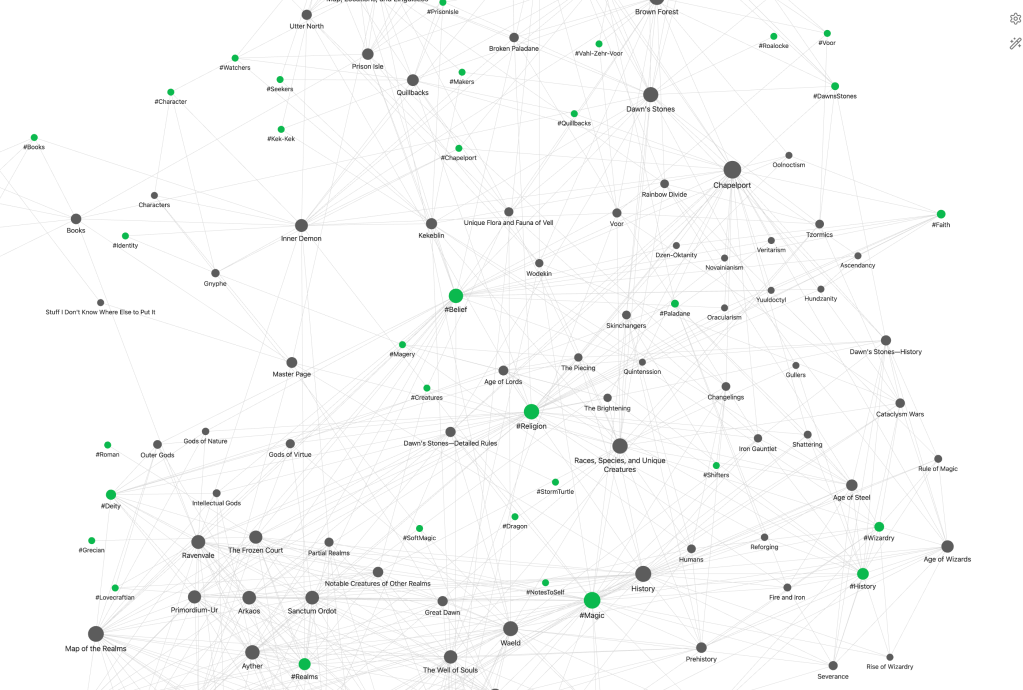
As this setting grew, it went far beyond its original fantasy Wild West roots, so I (reluctantly) dropped the name Westpunk in favor of Third Realm—which, while much more appropriate for the setting in its current form, isn’t as evocative, so I consider it a work in progress.
Anyway, I find cross-pollination to be really productive in my creative endeavors. I had this setting that I’d built out a lot, I didn’t have time to play TTRPGs much, and I had successfully applied for Brandon Sanderson’s writing workshop class, in which our one assignment was to (essentially) write a book in one semester. I decided to write The Ballad of Carthage Jones, set on the Prison Island that started everything.
That book kinda sucked. (It was my very first, totally completed novel, after all.)
The Ballad of Carthage Jones was an excellent learning experience, however. I learned how to finish a book. I learned many strengths and weaknesses that I had as an author. And I learned that I really liked this Third Realm world that I had developed, so I started plotting more story ideas.
But, before I wrote another Third Realm novel, I wanted to develop that robot-zombie-story idea I had. And you all know how that went, since I talked about it first, and I ended up publishing that book first.
When I returned to the Third Realm, I decided I wasn’t interested in redoing The Ballad of Carthage Jones—I felt that the story needed a total overhaul before I could turn it into anything worthwhile. Instead, I decided to write a story about a girl with the ability to use shadows as portals and with no memory of her past—Gnyphe. That seemed more compelling to me at the time, so I ran with it.
The process from idea to final draft for Inner Demon flowed pretty similarly to Failed Technomancer. Both books had a handful of drafts. Both books had big portions of the book completely rewritten—a lot of Act 2 for Failed Technomancer, most of the climax for Inner Demon. With both books I worked with LooseLeaf Editing and Publishing, giving me experience working with professional editors. And, just like with Failed Technomancer, soon Inner Demon will go through the cover drafting process, the formatting process, and the audiobook creation process—all (except for the cover art) done by me this time.
What did I learn from Inner Demon?
For one, I enjoy writing standalone novels set in interconnected universes quite a bit. I also think I learned a lot more working with my editors this time around than I did the first time. I learned a bit more about plotting, and a lot more about revision. And I probably have a lot more to learn, since this book isn’t over the finish line yet, and I’m running out of time if I want to self-publish it before the end of the year!
World of Murid—Courage in a Small Heart, Hazel Halfwhisker
Working with a professional editor takes time. Months of time. I’d send my novel off to my editor, then wait a month or more before getting it back, spend a month or so editing, return it to my editor, rinse and repeat. That meant I had a lot of time for writing during this process, time that couldn’t be spent on Inner Demon. So I needed to jump into a new project.
My first thought was to go back into the Third Realm well. That water was sweet and cool. I began writing a novel I called Grand Odyssey—and got stuck. I had a lot of fun with it. I think it, eventually, will be a genuinely good novel. But something about it was not working, no matter what I did. (A part of me wonders if I just wasn’t ready to write that book. Another part thinks I just couldn’t get the plot skeleton to sit right.)
I took a little break. I fiddled with some short stories, cleaned up some older ones. I read a lot of novels. I tried to figure out what I wanted to do next. I figured now was a good time for experimentation—but what to experiment with?
Watership Down broke my slump.
I don’t remember exactly what it was in Watership Down that got me—but, per the usual, it was the intersection of several ideas that inspired me, turned into the seed of something new. I loved how powerful the characters and world was in Watership Down, despite being about common and simple things—take the world we know and present it from the perspective of a tiny animal, and suddenly it’s vast and wondrous again. This was true for other stories I was loosely familiar with, such as Mouseguard and Redwall, and stories I was deeply familiar with, like Of Mice and Magic… And notice those three stories all featured mouse protagonists? Well, once I made that connection, I got sucked in deep.
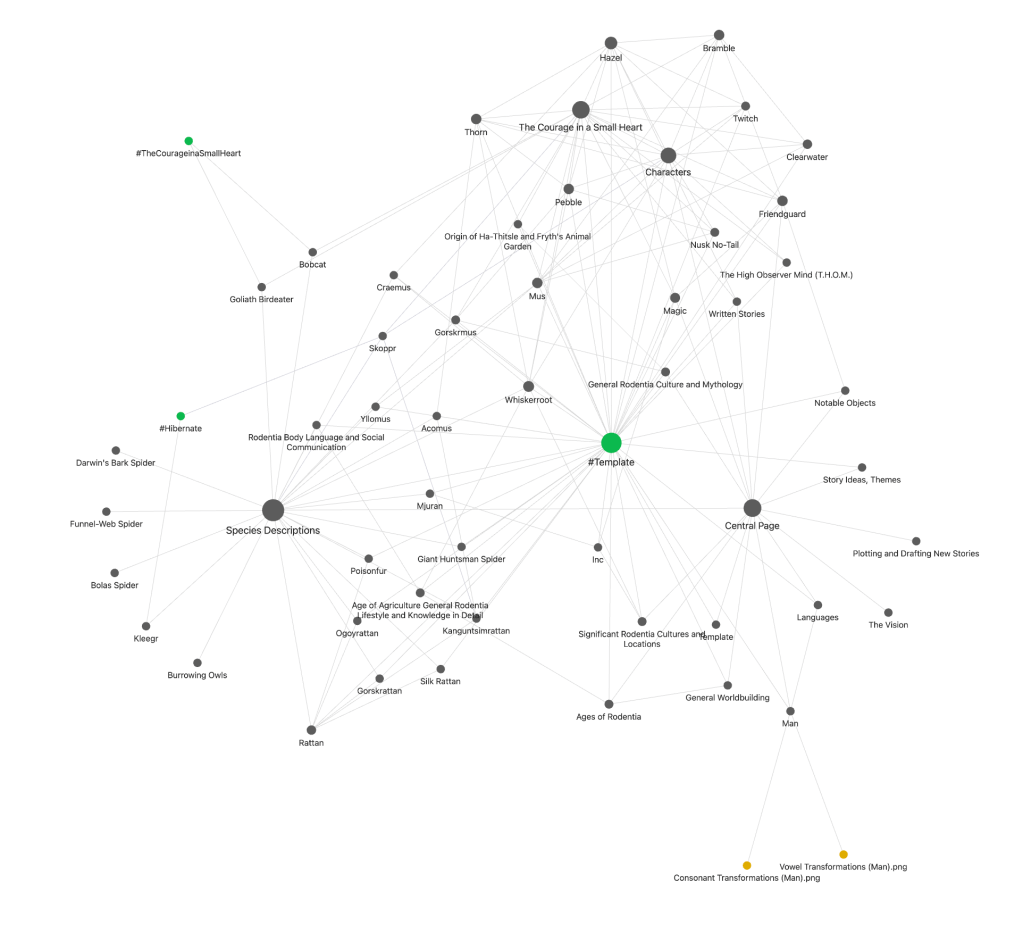
I didn’t want to choose between fantasy and science fiction, so I decided to do science fantasy—I already had worldbuilding ideas that fit that bill, anyway. I liked the fantasy trope of the “ancient race” that left behind powerful technologies, and I thought it would be interesting if that race were humans—post-apocalypse, then, with now-intelligent rodents (and lagomorphs, as a nod to Watership Down) rising from the rubble of civilization and claiming the world as their own. I also noticed that so many mouse stories featured mice with swords, for some reason. It’s an iconic weapon, I suppose. But pseudo-medieval settings are done to death, and Inner Demon is already late medieval/early Renaissance/Exploration; I decided to set the world, relative to the the mice, in a far earlier age, a developing agrarian society, with imperfect farming methods, with non-nomadic lifestyles not the default, with stone and tooth and bone weapons, and so forth. I also thought such low-tech peoples would be interesting when juxtaposed with with a fallen, high-tech civilization.
On and on, more things came together—then I stopped myself. I didn’t want to dive too deep before I knew if this world had legs for storytelling. So I decided to write a short story, The Courage in a Small Heart.
Oh yeah, this world had legs. Four legs. And a twitchy nose. And whiskers. I had so much fun. And I think the story turned out really well, too.
So I started writing The Precious Burden of Joy. And it crashed. A lot like Grand Odyssey had, in fact. Something just wasn’t working, but I couldn’t figure out what. (Part of it was the focus I chose—I want to write adventure, but The Precious Burden of Joy was looking to be painfully introspective, at least in my noets.) Unlike Grand Odyssey, I don’t think I will ever return to The Precious Burden of Joy—particularly since my next project, Hazel Halfwhisker, has been singing.
I’m roughly 152,000 words into Hazel Halfwhisker by the way, and still going strong. I think the story will end at 200,000 words. Definitely before 250,000.
So… that’s how I got here.
Wrap-Up
I really like writing. I really like creating. I really like building. I don’t think I will ever stop crafting stories, regardless of whether my career as an author goes anywhere—though I really hope it does! I’m going to keep plugging along, hoping that my stories can excite and uplift someone else the way so many stories have done exactly that to me. (And, once I have a little bit larger backlog, I’m going to start figuring out how to effectively advertise.)
Anyway. That’s my “about me” this week. Thanks for sticking around!

 Boo Ludlow
Leave a reply to 2024-10-07—Talk About Me 2, MILO – Boo Ludlow Books Cancel reply