Good morning, afternoon, or whenever you read this! It’s been… oh dear, it’s coming close to a month since I last posted anything. That simply won’t do!
And it also means this might be a bit of a long one.
Life has been crazy for me lately, so I haven’t gotten a lot of writing done, or updates, or anything of the sort. After living in my parents’ basement for a little over a year, my wife and I finally managed to move into our dream home—and boy howdy, that has been a process. A good process, and a dusty process, as it’s now time to unpack boxes that have been stored the entire time we’ve been between homes. Boxes which, I’m convinced, have developed some sort of cave-like-environment-dwelling life and began breeding in our absence. I don’t remember there being so many of them.
I almost want to take every box that I don’t remember and send it off to a thrift store, but my wife nixed that idea, as there are more than a few things she’s very excited to have back.
In addition, the baby is teething, the toddler is having some difficulty sleeping in a new and unfamiliar place, and my in-laws have moved to Peru to serve a service and proselyting mission. I believe there’s a saying for situations like this… When it rains it pours? (There’s no such thing as dealing with major life events one at a time!)
Inner Demon Updates
As I’ve mentioned before, all that’s left for Inner Demon (before I can publish it) is a cover, and I think that cover is coming along great. At least, the latest sketch that my cover artist sent me looks pretty good, and I especially love her interpretation of Tactan and Kraw:
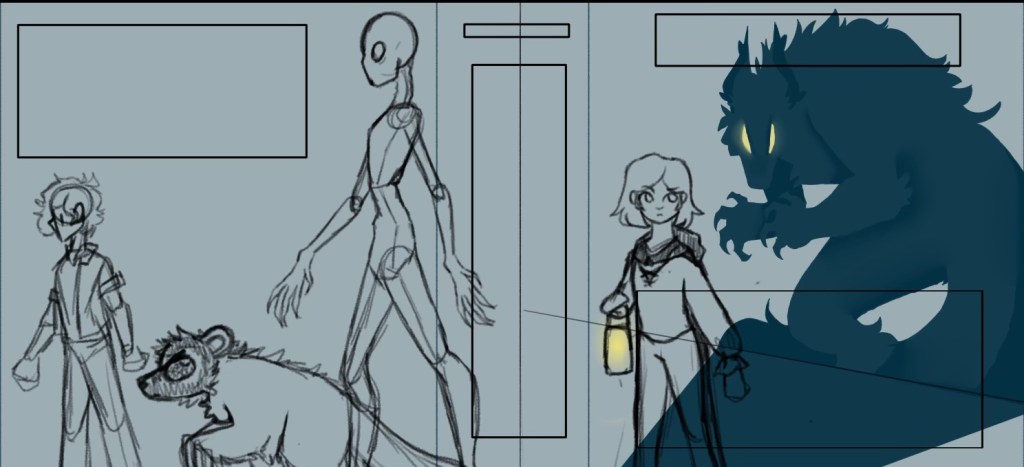
The artist’s name is Eve Ludlow—she married my brother, that’s why we share a last name—and you can find her art on Instagram (@evephoria77). She does a lot of gorgeous watercolor stuff.
Will I keep my goal of self-publishing this novel before the end of March? I’m feeling pretty confident about everything except for the audiobook—especially since I need to finish the first draft of Halfwhisker before I can start on Inner Demon‘s audiobook.
Doing everything yourself can save a lot of money, but it costs a lot of time…
Writing Updates—Halfwhisker
Halfwhisker is almost at 210,000 words. About ten thousand words is a lot less than I’d like to represent a month of labor with, but, as mentioned above, I had a lot on my plate. The first draft will almost certainly be finished before the end of February. Then I’ll take a break to work on other important projects (such as the graphic novel script for Courage in a Small Heart) and give myself distance from Halfwhisker, which should help me edit and revise it more effectively.
The word count is high enough that, unless I drastically cut this story down (which I don’t want to, as then it would no longer be the epic adventure I’m trying to tell), I most likely will do some shifting to break it into a duology or a trilogy, but I’ll also publish an omnibus version with some extra stuff in the back. But that’s long-term planning, as I need to finish this book first!
Narrative Ink Interview
It’s looking like a yearly interview in January with my friend Colton is becoming a tradition—we’ll see next year if this really gets cemented. If you have any interest in listening (there’s no visual this time), I’ve embedded the video below. We talk about a lot of things, ranging from life to my writing process and some thoughts on the state of the industry.
Bloggyness Reviews and Odd Comments
Larry Correia
My Larry Correia binge has nearly reached its conclusion! I’ve not read near all of his stuff, but I’ve read enough of it, and in a short enough time, that I want to slow down and sample some variety from other authors.
Also, there are really long wait times at my library for many of his novels, so I’m being forced to pace myself whether I want to or not.
Here are some rapid reviews:
- Destroyer of Worlds: Saga of the Forgotten Warrior is continued in this blood-pounding third installment. Stakes are raised as new technologies and magics are introduced, more villains infiltrate the budding society of rebel casteless, established factions battle for power, and Ashok proves to not be as entirely immune to change and growth as he thinks he is. I thought this was a solid addition to the series, although the name of the book gave me expectations that probably were a little far-fetched, which did affect my enjoyment of the book. Correia needs to tell whoever names his novels to calm down a bit.
- Monster Hunter Bloodlines: Bloodlines annoyed me. Not because it was a bad book. Actually, it was a very fine book, I would describe as a middling entry into the Monster Hunter International series, which still makes it very much worth the read. No, it annoyed me because I thought this book was the conclusion to MHI, but instead it turned into a part 1 of 2, and that part 2 still might not actually be The End. After talking with some other fans of MHI, it appears that the community understanding of this series is that Correia does have a story with a beginning and end in mind, and that story will be told (Pitt will meet his destiny, along with the other Chosen), but this series is also a bit of a play box for Correia. (Which is probably why three of the books in the main series are spin-offs that follow other characters, sometimes without Pitt even showing up in a bit role—and that’s not even mentioning the true spin-offs that aren’t listed as part of the main series.) While a constantly expanding MHI universe does appeal to me, I hope Correia will write the final book (or books) in this series soon, as I would appreciate a substantial conclusion to cap off an already excellent series; in addition, considering how many other series he has finished since he began MHI, I’m hoping Pitt and his friends aren’t getting neglected.
- The Grimnoir Chronicles: A completed trilogy starting with Hard Magic (which I reviewed in December), continued in Spellbound, and finished in Warbound. For me, these are the true hidden gems of the Correia collection. I loved this bizarre, fantastical, alternate 1930s reality where a secret society of wizards battles to keep the peace between magicals and non-magicals, while also protecting the planet from an extraterrestrial, lovecraftian threat. I would highly recommend these books. They must have been popular enough at one point, because they are in libraries, but perhaps that popularity trailed off, because I found no waitlist for these books—meaning you could probably borrow a copy today and see if you like it. (The final book in this trilogy was published in 2013, which could also explain the lack of buzz around the trilogy. Been over a decade since it wrapped up.)
- I also want to note that I had some big issues with Hard Magic, despite enjoying it, and I’m not saying the series is without flaws, but I do think the whole is greater than the sum of its parts; in fact, the series still ended up perhaps my favorite in the Correia catalogue, so hats off to that man.
In a bit of unexpected news, Larry Correia’s next novel will not be published by Baen Publishing. It will instead be published by new indie publisher Ark Press, which appears to be mostly staffed by people who formerly worked at Baen Publishing (either on the publishing or author side of things).
If you don’t follow Baen Publishing or Larry Correia, the above probably doesn’t mean anything to you, so let me try and summarize the important stuff. Baen Publishing, among other things, has always been notable for being the most apolitical of the larger publishers—which means it’s a publishing house that doesn’t persecute conservative authors just for existing and might actually publish their works, essentially. It’s also a publishing house that’s done really well for itself focusing on genre fiction that just entertains, rather than publishing fiction novels that are more interested in pushing some agenda. And Baen Publishing accepts direct manuscript submissions, not forcing aspiring writers to hunt down an agent first. In short, Baen Publishing feels like one of the few true descendants of a much better age of publishing.
Larry Correia, to my knowledge, has been Baen’s biggest breadwinner for going on a decade now. The two have made quite a bit of money working together (MHI doing a lot of the heavy lifting), and seen a lot of commercial and cultural success. On the outside, it appeared to be a partnership made in heaven.
But now Correia is moving on to another publisher, at least with his newest series. I have no idea how much he is planning on continuing working with Baen.
I don’t know why Correia made this decision—I can only speculate, or share what others have speculated. Some think Correia decided to move to a newer, nimbler publisher who was willing to adapt to the times (something Baen, supposedly, has been recalcitrant about, along with every other medium-to-super-large publisher). The fact that Ark Press will be composed of Baen’s best suggests to me that leadership and vision has been souring at Baen, and those who know how to succeed would rather start their own publisher than try to fix Baen. I don’t know, and I don’t know anyone who knows—but I am extremely excited for Ark Press and the potential it represents.
Also, Ark Press will publish a book a month from talented authors its first year, which at the bare minimum means a lot of good stuff to read if this venture proves to be successful. Here’s hoping, as a lot of genre fiction has been coopted or poorly treated in the hands of of mainstream publishers.
Here’s the x-post that announced everything:
Man on the Inside
Man on the Inside is a new Netflix series written by the brain behind The Good Place (Michael Schur), with Ted Danson taking the lead role. I watched this series expecting a comedy, and it certainly has its funny moments, but it ended up being very thoughtful and character-driven—more of a drama, maybe. In this instance, what I received was much better than what I thought I had been promised, and I was very satisfied.
I would highly recommend Man on the Inside. In short, it’s about an elderly man hired by a PI to live in an old folks community and investigate whether a staff member or resident stole a precious family heirloom from another resident. The series meditates on relationships, the nature of life and death, and other difficult topics without ever moralizing or preaching.
This series also made me think a lot of a book I read a few years ago, called Being Mortal (Atul Gawande). That book was written by a doctor and explores his experiences with cancer patients and how they (and their families) approach mortality—some fighting tooth and nail to hopefully extend their lives through increasingly uncomfortable treatments, others choosing to accept the inevitable. I would highly recommend reading that book around the same time you watch Man on the Inside—they complement each other well.
Harry Potter
My wife and I started rewatching the Harry Potter movies recently, and they are delightful. I think they’ve all aged really well.
In addition to just being good, these movies are hilarious to look back on as an adult, having watched them so long ago. The difference between Dumbledores is notable—I think both did excellent jobs for different reasons, but the first Dumbledore is so slow and… old-feeling, compared to the second, that it makes it feel like old Dumbledore hit an intense weight training routine (and took a lot of testosterone) between movies to become new Dumbledore.
(Yes, I know they switched Dumbledores because the first actor died.)
But the funniest thing to me, as an adult, is just how straight so many interactions between the adults and the kids are played, despite being inherently ridiculous. Take this scene from Sorcerer’s Stone:

Snape, a thirty-something adult, walks up to an eleven-year-old kid, completely unprompted, and mocks him in front of all of his classmates. After watching this scene, I turned to my wife and said, “That might just be the single pettiest thing I’ve ever seen in my life.” Then we both burst out laughing.
This is one of the awesome things about fiction, though—this scene still works. The books and movies still work, even with—or more likely because of—deeply (believably) flawed characters doing ridiculous things that most normal kids or adults wouldn’t do.
You know what? I’m not here to watch normal, boring people be normal and boring. I’m glad that Snape is such a petty man that he dedicated his life to being miserable after that one time in high school the girl he wanted to kiss decided to kiss another guy instead of him. Normal people would have found a different pretty girl to kiss, but not Snape. Instead, he became an incel.
And Finally, Brandon Sanderson
I’ve decided that I’m done with Brandon Sanderson. For the time being, I don’t plan on buying any of his new books, or reading them, or generally supporting his endeavors or what he produces.
I’m still going to enjoy the stuff of his that I already have, that I already know is good, and I hope that I will enjoy the (already purchased well before this point) Stormlight TTRPG when it comes out. I will still recommend his free teaching materials to anyone interested in becoming a better author of fiction, because he taught well (Devon Eriksen dedicated his first book to Sanderson because of how useful Sanderson’s writing classes are). I also think there’s a lot about his business model that new authors ought to learn from. In short, there’s a lot of good that Sanderson has done that ought not to be forgotten or thrown away, even if I think he’s on a bad path at the moment.
Sanderson has been giving me red flags for a little while, but I had a difficult time putting my finger on why until Wind and Truth came out. To put it bluntly, this book helped me realize that Sanderson appears care more about pushing a political/ideological agenda than he cares about writing a good story—particularly when it comes to good, consistent world building. This feels like a particularly bad betrayal coming from Sanderson when a huge part of what built his empire is exceptional world building.
Yes, this has to do with the LGBTQ stuff in Wind and Truth, but not the presence of gay characters in stories. Homosexuality (and gender dysphoria, etc) are not the same things as the LGBTQ+ political ideology. Bear with me here.
Back in 2011, Sanderson published his fantasy-cowboy hit Alloy of Law. In this book, the planet Scadriel had progressed to a point where it was roughly equivalent with late 1800s/early 1900s USA in terms of technology and industrialization, and clearly inspired by that time period’s culture—values, issues, and so forth.
This book also introduced Ranette. Ranette is lesbian. In the same way that a reader knows a character is straight without having to have it shoved in his face or paraded around and pointed at, anyone would be able to figure out how Ranette felt about other girls. And her character fit in with the world building. She kept her homosexuality hidden in public because she would have been ostracized (again, this story was modeled after early 1900s culture), but in private company she was as open about who she was as her grumpy, misanthropic self could be. By the end of the series, she even spends time openly with her wife.
In short, Ranette was a really solid, defined side character who fit in as one puzzle piece among many that contributed to the much bigger picture that is excellent, consistent world building. Nothing about her felt like a character added to a story to check a box or make a point; nothing about her felt like it didn’t belong in that story or world, despite her proclivities not being welcome in that world’s public society.
Now let’s look at Stormlight Archive. This is Sanderson’s epic fantasy series—presumably the work that he wants people to compare with works like Jordan’s Wheel of Time or Tolkien’s Lord of the Rings. These books, generally speaking, are dense. The world building is extremely deep and showcases a world and cultures that are, in many instances, utterly alien from our own—even more so than most fantasy series. And Sanderson does not slouch in teaching us about this world, how these people live, and what they value. Especially the Alethi.
Alethi culture is extremely rigid, meticulously structured, to the point where basic skills are accessible, or denied, to people based on sex. For example, men aren’t taught to read or write. And they are completely fine with this. In fact, when male Alethi characters encounter male characters that can read, they generally find this fact odd, or even bizarre. Women, on the other hand, are expected to keep their left hands (referred to as “safehands”) covered in public at all times as a custom of Alethi modesty; a woman exposing her left hand in public is roughly as improper as a woman exposing her breasts.
And the list just goes on. Men learn the art of warfare. Women become scholars. Men are builders and craftsmen. Women are painters and singers. Almost anything someone can do is given to a single sex as a proper, worthy activity, and doing something not assigned to your sex could get you ostracized or, at the bare minimum, seen as not right in the head.
Of course, courting follows its own set of strict social rules, one such rule being a chaperone system that even applies to older adults who have been previously married but are now single. (Looking at you, Dalinar and Navani.)
This rigid culture also affects activities that, for whatever reason, weren’t “categorized” while Alethi culture was forming. Many Alethis view uncategorized activities with distrust or dislike, at least in part because it isn’t known whether they are properly male or properly female activities.
I’m really hammering this point home to emphasize just how clearly Sanderson presents Alethi culture, and generally depicts cultures in Roshar, a stark contrast from most fantasy books which lean on a pseudo-medieval culture (perhaps so not much has to be explained). Almost all of what I’ve mentioned above you’ll know by the end of Way of Kings, and is emphasized or built on throughout Words of Radiance. Alethi culture has an extreme sex-based social dichotomy that is constantly reinforced. That is the world building of the Stormlight Archive. That is the perspective that characters operate from.
In the first two books, almost one million words worth of reading, not a single homosexual character is mentioned, nor hinted at. That doesn’t mean that homosexual characters can’t, or shouldn’t, exist in this world, but it does make it clear that such things would be well outside the norm—and the Alethi don’t treat norm-breaking with much open-mindedness, let alone patience or respect.
That’s probably why something felt wrong when, in Oathbringer chapter 35, it was strongly emphasized that one side character named Drehy was both gay, in a relationship with another man, and all of his friends knew and were aggressively supportive. Regardless of your feelings one way or another in the real world, in the world building of Stormlight Archive such feelings and relationships would be seen as aberrations—something that, like in Rannette’s case in Alloy of Law, might be allowed to do its own thing when hidden away or among outsiders, but would never be accepted within that world’s culture at large.
Drehy being gay alone called some attention to itself, but it could have been passed off as something other characters thought strange but were willing to overlook because of the unique and powerful bond shared by Bridge Four. That might have organically fit in this world. However, when Kaladin seemed confused about Drehy’s situation (apparently he was the only Bridge Four member to not know in advance), every other character in Bridge Four—despite having a lot of respect for Kaladin, and not responding remotely in this way to other topics—immediately dogpiled him for being, essentially, a bigot. Kaladin, also somewhat out of character, was immediately cowed into stating that Drehy wasn’t doing anything wrong. The entire interaction felt completely out of place—and weirdly modern. It was the sort of conversation you can see on the internet all the time, unfortunately, and came across as extremely preachy. Ideologically driven, even. But it was a relatively short scene, it and other scenes like it in Rhythm of War, so I brushed it off.
Then I read the following from Wind and Truth:
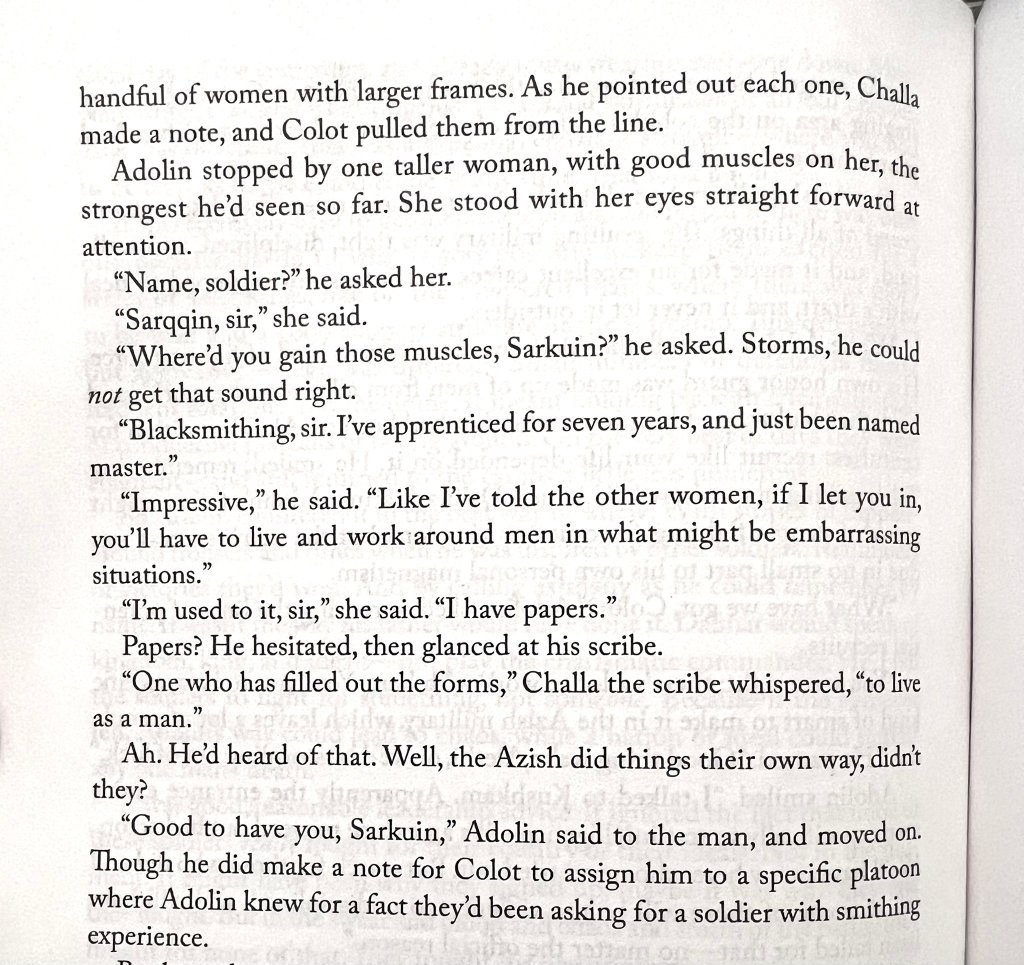
There’s a lot of issues with this beat. First of all, being trans is extremely modern. (Transgenderism, as it exists now, is the result of gender critical theory and Marxism colliding—very, very modern ideas.) It doesn’t help that Stormlight Archive often feels like it goes out of its way to be distinct from the modern world, with many key aspects of its world building being very against the modern real-world grain. (The sex-based dichotomy I mentioned earlier is a powerful example of that, particularly in a modern world that’s trying so futilely to erase the differences between sexes.)
Second of all, this scene shows a trans character completely out in the open, extremely public, without even a vague sense of discomfort from the characters around her. Again, as a reminder, she lives in a world where all shown cultures display some level of sex-based social dichotomy, some of which are extreme—such as the Alethi. In fact, that detail matters a lot, because not only is this character openly trans in front of her own people, she’s openly trans in front of Adolin, an Alethi! Adolin sometimes proves to be more open-minded than other Alethi, but much more often he serves as an example of an idealized Alethi. By that I don’t mean that Adolin is perfect, not at all, but many aspects of his character—how he thinks about the world, many of his positive traits (such as his honor), even many of his negative traits (such as his willingness to resort to limited skullduggery when necessary)—could be seen as an Alethi archetype, and one mostly positively representing the unique traits of the Alethi people. Adolin is, of course, his own character, but that doesn’t mean that him taking Sarqqin’s unique situation in stride so well is consistent with how he has been characterized.
Again, like with the Kaladin scene mentioned before, this sort of interaction just doesn’t make sense in Sanderson’s established world. If homosexuality (which features heavily in a sub-plot between a character named Renarin and a character named Rlain) and transgenderism were well-known and openly accepted, we would have had such things present in Way of Kings, not snuck into the series over a million words later. (Earlier presentation would have also given the series time to explain how such things could be openly accepted in a world with strong sex-based social dichotomies, particularly among the Alethi, whose dichotomies appear to be carefully designed to be complementary–meaning, a gay couple would lose access to half of the Alethi world by virtue of not having a member allowed to participate in it!) This late insertion, in addition to everything else on the same wavelength in Wind and Truth above and beyond what’s in any other Sanderson book, certainly makes it feel like Sanderson was hiding these things until his readers were already hooked and this arc of the series finished. That’s kind of underhanded and gross.
Now, Sanderson has spent some time defending himself from accusations and criticisms of how he’s written Wind and Truth, and other books. You can find some of that on his blog (particularly in the On Renarin and Rlain post) and in some of his posts on his X account. I recommend giving him some space to read these things in his own words.
As I understand it, Sanderson’s self-defense has two parts:
- Sanderson always planned on having gay characters in major positions in his books (including Stormlight Archive), and characters that are gay (or trans) were always planned to be that way.
- “My plan was for Renarin to be gay when I wrote Way of Kings Prime in 2002.” (Noted in the “On Renarin and Rlain” blog post.)
- Sanderson believes that writing gay/trans characters is a key part of him becoming more empathetic, in understanding his neighbor.
- “Why? Because my stories are the way I explore the world, and the way I understand the people in it. And this is the way that I attempt to achieve one of my primary goals in life, that of learning to be more empathetic.” (Noted in the “On Renarin and Rlain” blog post.)
I can’t argue Sanderson’s second point. If he seeks and learns empathy by writing, as he words it, the “other,” then good on him. I also wouldn’t want to argue Sanderson’s second point, at least not against it. I agree with him that the existence of gay characters in a story shouldn’t be controversial. (It also shouldn’t be expected or required, despite what other Sanderson quotes have suggested.) But I would note that how such characters are handled—as with any group—can be controversial. To my knowledge, how he handled Rannette was never controversial. How he is handling many characters, including Sarqqin and Renarin, is.
As for Sanderson’s first point, it has glaring holes in it. Sanderson is the world building guy. And he’s had decades to hone his craft. So… why is his world building off in the novel that should be his greatest yet? It’s not because he’s a bad writer. Taste is subjective, but you don’t have to enjoy Sanderson’s books to recognize that he writes very well. The explanation has to be something else.
Could Sanderson just have written a bad book? Even great authors don’t write at the top of their game every novel. Sometimes stinkers sneak out. It’s possible that, unfortunately, Sanderson just happened to screw up one of the most important novels he’d ever write.
Is Sanderson just letting his standards of quality decline? Even the greats can become too comfortable with success and start to produce work that’s worse than their first successes, made back before all the fame and glory. Maybe this is possible. Descriptions of Sanderson’s in-house editing team certainly suggest that Sanderson has a George Lucas problem (no one willing to say no to him).
Is Sanderson just mistaken—or lying—about having planned Renarin to be gay as early as 2002? Maybe. But I think that’s very unlikely. While he hasn’t provided the receipts—copies of his Stormlight Archive notes—to prove it, he did explicitly mention in his somewhat infamous Dumbledore Essay, “If I were going to put a gay person into one of my books–and I do intend to do so at some point…” In my opinion, this dramatically weakens any argument that Sanderson is mistaken or lying. (But it does strengthen the argument that some of Sanderson’s gay characters exist to check a box, if his intention was just to get a gay character into a book.)
Is it true that Sanderson always planned this, but perhaps his original plans were a lot more subtle, more in line with the world building of Stormlight Archives, but he broke with subtlety and got preachy? Perhaps he did this out of pressure from an overwhelmingly leftist publishing industry, or perhaps he did this because he himself has become ideologically driven?
Well, I mentioned earlier that I decided to stop supporting Brandon Sanderson’s new books (and other works) because I felt like he was letting ideological messaging take precedence over good writing. So, it’s obvious that this is how I’ve put together the pieces of the puzzle that I have. But I don’t know.
And I’m not convinced that Sanderson knows. In 2007, in the Dumbledore Essay (linked earlier), Sanderson wrote this:
Let me just say this: If asked to do so, I would vote against legislation that would offer tax incentives or an official stamp of approval to gay marriage. The simple reason is that my vote would feel–to me–like an endorsement of homosexuality. My conscience, then, would not allow me to vote in that way, as I feel it would be a betrayal of myself and the things I uphold.
Then, in 2023, in a Q&A short blog on his website, Sanderson wrote this:
My current stance is one of unequivocable support for LGBTQ+ rights. I support gay marriage. I support trans rights, the rights of non-binary people, and I support the rights of trans people to affirm their own identity with love and support. I support anti-discrimination legislation, and have voted consistently along these lines for the last fifteen years. [Emphasis added.]
Now, that timeline works out—2007 is about fifteen years prior to 2023—assuming Sanderson changed his opinions and voting habits roughly the same year he wrote the Dumbledore essay. To me that seems like a very rapid turnaround relative to how firm I read Sanderson’s opinions in the Dumbledore Essay (and the differences between the two essays suggests that Sanderson has become fairly ideologically radicalized in that time), but I’m not Sanderson. I’m not in his head. I don’t know. And I think any further speculation would get into conspiracy theorizing, which I don’t want to do.
Here’s the long and short of it. Stories have no obligation whatsoever to include real-world sensibilities or ideologies within them. In fact, many of the best stories are so good because they are very different from the world we live in, while still remaining relatable and containing universal values (such as heroism or virtue). Thus, I will immediately reject a story or author who I sense is prioritizing ideology over story, or using a story primarily as a vehicle to promote ideology. (Doing so inevitably produces bad writing, so I wouldn’t want to read said story anyway.) Brandon Sanderson appears to have toyed with prioritizing ideology over good storytelling in two of his Stormlight Archive novels, and then committed to that action in Wind and Truth, which I cannot abide. Thus, for the time being, I will not read anything new he produces, at least until it appears Sanderson has decided to prioritize good writing again.
And that’s all I have to say about all of that, from my own writing projects to authors I’m no longer following.

 Boo Ludlow
Leave a reply to 2025-09-02—Cosmere TTRPG – Boo Ludlow Cancel reply