
We’re back, baby! The Lost Colony, the sequel to Chloe’s Kingdom (by Gregory Michael), has been out for a few weeks. At the time of writing it’s sitting at five stars on Amazon and Goodreads, which is really good, despite the low total number of reviews.1 Speaking more anecdotally, I’ve only seen praise for the book online; all put together, The Lost Colony is clearly being received well. Good job, Gregory Michael, it appears your hard work is paying off!
But what do I think?
First, a rewind, since I reviewed Chloe’s Kingdom a while back. I loved that novel,2 and I immediately turned around to share it with my wife—and she loved it, too. I praised the characters, the pacing, the tone, the world; I had a few minor quibbles with the story here and there, but that was it. I eagerly awaited the next installment in this series (to-be trilogy?); after all, Chloe’s Kingdom ends with the Kingdom (the colony spaceship home of surviving humanity) nearly socially destroyed, Chloe and her friends completely outmaneuvered by the wicked Jubilee Callisto, and the beloved-by-literally-everyone Penny kidnapped by said villain and trapped with her in a tiny spaceship out in deep space. It was a monster of a cliffhanger that demanded resolution.
In short, Chloe’s Kingdom had set a really high bar for Gregory Michael’s sequel.
And, to be honest, I bonked against that bar. Not badly, though. I still enjoyed The Lost Colony, and I opened up with all of this praise for both books because I think they deserve the praise, and because I still plan on reading the sequel to this novel, and because I think The Lost Colony is a solid read. It’s well-made, and I recommend it to anyone who enjoyed Chloe’s Kingdom. It just didn’t click with me the same way Chloe’s Kingdom did.
So, what’s up with the book? What happens in it?
The Lost Colony picks up more-or-less directly after Chloe’s Kingdom ends. There are some important differences between the books that I will go into soon, but a lot of what really worked for Chloe’s Kingdom is still present, either taken in interesting new directions or left as is (because if it ain’t broke, don’t fix it). Chloe, Mardi, Mojito, and other engaging characters are still at the forefront; the Kingdom (and the strange world it contains) is still an interesting setting with secrets to unravel; the plot still burns quickly; and the book itself is still written with Gregory Michael’s signature bite-sized chapters. (They are a lot like miniature cookies: you end up eating way more total volume of cookie than you normally would because they are small and having just one more is such an easy commitment.)

The biggest difference between the two books, that I first noticed, was that The Lost Colony is grim. The first book had a very light, upbeat tone with enough serious moments to maintain substance and weight; The Lost Colony almost completely reverses that tone, being mostly a serious, downbeat read, often very heavy, with lighter moments scattered about like a breadcrumb trail. Here’s an example: the first scene in which Mojito appears in this novel. Upon reading that silly raccoon’s name, I was very excited to be reunited with him, but then Mojito slinked slowly in from stage right, suspicious of the environment around him, still bearing injuries from the beating he took at the end of Chloe’s Kingdom… and my spirits dropped. He was no longer some fun, comic relief that served a practical purpose here and there. He was a living, painful reminder of the gaping wound that Jubilee Callisto’s actions had left on nearly every character, and the Kingdom itself.
There’s more where that came from. Chloe is hooked on painkillers and not herself. Most every character is filled with grief or regret over what happened, and fear for Penny. The Kingdom has been transformed into a despotic state pretending to be a democracy. Frequently I found myself thinking, “Is this entire book just the Dark Night of the Soul?”3
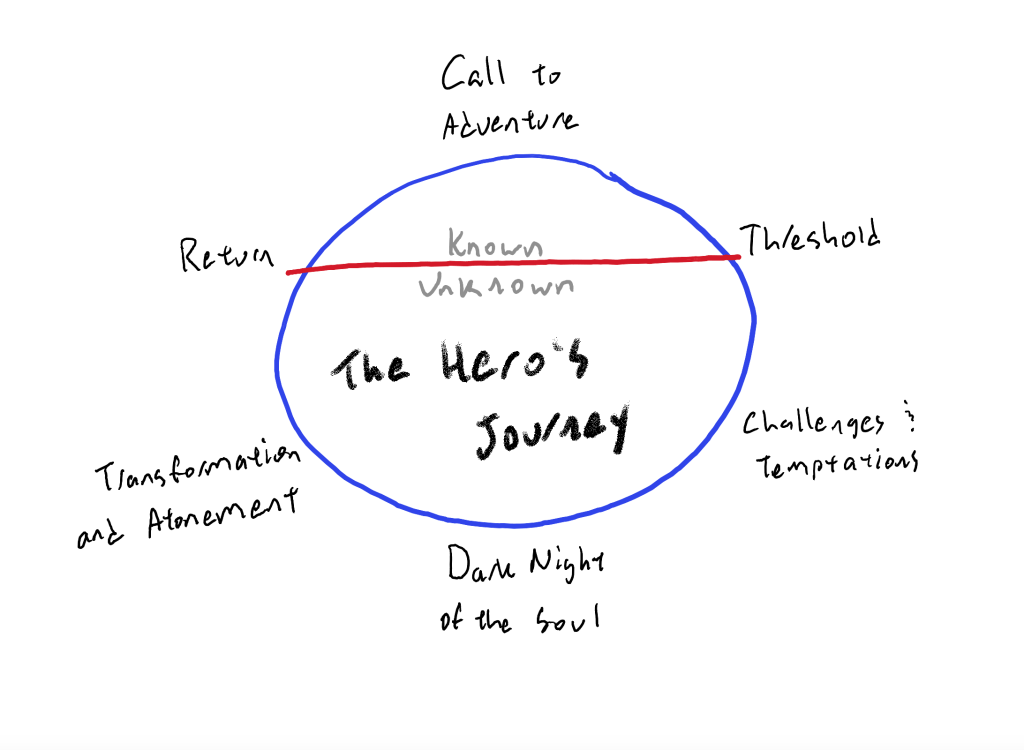
(I want to note this tone change isn’t a bad thing; given how Chloe’s Kingdom ended, it would be bizarre if this book started off sunshine and roses. That said, your mileage may vary. My wife really struggled with the depressing miasma that had settled over many of the characters.)
The cast is quite a bit bigger, too. We have all the same viewpoints as the first novel—including two Mojito viewpoint chapters, real treats—in addition to characters like Sid, Millie, and Morgan. (These characters played secondary-but-important roles in Chloe’s Kingdom, so I already knew who they were—but the amount of focus they received in this book still surprised me a little. Their elevated presence works, though.)
Another notable difference between Chloe’s Kingdom and The Lost Colony is that the former has a very focused story, while the latter is split into two. This isn’t to say that all characters are always focused on the same thing at the same time in Chloe’s Kingdom, but everyone was in the Kingdom and there was always an overarching end goal that kept things tied together and pointed in the same direction; all other viewpoint character goals were subordinate, building toward that greater purpose. In The Lost Colony, on the other hand, there are two separate locations that the characters are split between, without much interaction back and forth: within the kingdom and without the kingdom. Both areas feel very different and involve different overall character focuses.
As a final note, on the smaller side, The Lost Colony features a lot more sci-fi tech than Chloe’s Kingdom did. Cyborg-like enhancements to prosthetic limbs, crossbow bolts with EMP tips, and some surprises that I won’t mention here—there’s a lot more advanced and unique technology aboard the Kingdom than I had expected following the first novel!
This is probably the best spot for me to transition into what actually happens in Chloe’s Kingdom, so spoiler warning ahead as I summarize the plot. If you want to stop here, know that I recommend the novel to everyone who enjoyed Chloe’s Kingdom. It’s a very different experience compared to the first novel, but if you like variety then that’s only a good thing.
Since there’s very little interaction between the two storylines happening in The Lost Colony, I’ll describe each separately, starting with the in-Kingdom events.
Most of what happens in The Lost Colony happens within the Kingdom. Chloe is hooked on painkillers; Mardi is stricken with grief and regret; Mojito is injured and sad. The only semi-happy member of the original crew is Dutch, who is now jacked and deeply in love with spacewalks.

Each member of the original crew is very afraid of what might be happening to Penny and is deeply committed to trying to get her back. They are joined by Morgan, Millie, and Sid, who also want to do anything they can to save Penny.
Just like in the last book, everyone loves Penny, making her a consistent central motivation.
So, it’s time to prepare for another heist. Since the Kingdom’s new authoritarian government is uninterested in even attempting to save Penny, it’s up to Chloe and her friends to steal an asteroid gatherer and have several of them fly off in hot pursuit. However, such efforts would be meaningless without first figuring out where they are going, so they need to steal the coordinates to the Lost Colony from the admiral’s office. They manage to pull this off reasonably well, with few surprises—one such being Mardi getting left behind by Chloe for his own good, much to his dismay—until the Kingdom takes full remote control of the asteroid gatherer, stopping their heist (and rescue mission) dead in its tracks.
Then, to everyone’s surprise, they are allowed to continue on anyway. Dutch’s parents, the leaders of the new government, decide to give Dutch what he wants, their reasoning being that he’ll never stop trying to escape, so might as well get it over with.
At this point Chloe, Dutch, and Morgan head off toward the Lost Colony and are no longer part of the in-Kingdom part of the story. The people left behind—Mardi, Millie, and Sid—have to deal with the fact that they are now wanted criminals and that the new government is itching to execute at least one of them (preferably Mardi) to make an example. The new government becomes increasingly authoritarian to get what it wants, shutting down the Honeycombs, sending in armed guards, attempting mass starvation, and more, eventually succeeding in arresting Mardi and putting him up for a sham trial prior to execution.
The book then ends with Chloe, Dutch, and Morgan returning… along with a few others. Their return is timely enough to save Mardi and put a few things to right—after all, Jubilee can now stand for many of the crimes being pinned on Mardi—but the shadow of what was discovered at the Lost Colony still looms deeply over everything. (More on that later.)
Really early on in reading these sections of the book, I wished that I had read Chloe’s Kingdom more recently. I think a lot of my questions wouldn’t have come up, or would have been more easily answered. For example, I remember Dutch being semi-emaciated in Chloe’s Kingdom; he starts eating well and working out a little before the end of that book, but his muscled description in this book gave me the sense that months had passed. I don’t think that was actually the case—otherwise Chloe and Mojito would have had time to be completely healed from their injuries, and Penny would have starved to death in space—but this sense of time weirdness continued with me throughout the book.
I had other questions that affected my enjoyment. A big one: Why was the Kingdom sharing coordinates with the Lost Colony but forbidding contact? I wanted an answer, but The Lost Colony mostly brought up questions, presumably to be answered in the sequel.
Another: In light of what’s revealed at the Lost Colony, why did Dutch’s parents allow him and his friends allowed to leave? When faced with an existential threat, I don’t agree with the logic, “They are going to escape to our shared doom eventually. Might as well let it happen.”4
Some of these questions intrigued me and pulled me forward, some frustrated me.
That all said, this was my favorite part of the book. I really like Mardi as a character, and all the characters were consistently put in difficult situations that forced them to be really active. I really like the setting of the Kingdom. Seeing how an oppressed people might resist an authoritarian government while trapped on a colony ship with it, surrounded by the uncaring black void, was really interesting. We even got some more details about how the Kingdom actually works and manages to be self-sustaining (which we basically knew already, but we got to see more stuff in-action). In short, lots of good, engaging stuff happened.
And now, on to the out-of-Kingdom events.
Penny, Jubilee, Sheriff Gibbs, and Luna begin The Lost Colony aboard the Black Hole, a powerful warship that Jubilee had previous ordered to be secretly custom-built. Almost half of the book is spent here,5 with Penny resisting navigating the ship toward the Lost Colony and Jubilee playing power games to get what she wants. Once the crew arrives at the Lost Colony, they are immediately taken into custody by eerie people that appear to be human, but really don’t feel it. These humans, for whatever reason, seem to care about only two things:
- That the no-contact agreement was breached.
- How much heatium the colony of the Kingdom has accumulated.
Heatium is, for the record, an exceptionally rare and useful metal (that I believe is only found in space), which notably appears to be particularly useful in weaponry. (In fact, the Black Hole is primarily made of heatium, at least its outer casing.) It isn’t explicitly stated, but you’re given every reason to believe that the Lost Colony acquiring more heatium—or learning just how little the Kingdom actually possesses—would be very bad for this remnant of humanity.
It doesn’t take long for Penny and the others to realize something terrifying: no humans live on the Lost Colony. Only replicants do (if they can be said to live); Penny and the others had long thought these monsters were annihilated by the destruction of mankind’s ancient home planet, or at least left trapped on the little blue marble. Not so, unfortunately, and the crew of the Black Hole are entirely at the mercy of the replicants.
Penny and the others remain imprisoned until Chloe and her crew arrive on the asteroid gatherer, essentially kick down the door, and storm the Lost Colony in a somewhat-improvised rescue. Following this, with replicant ships hot on their tail, Penny, Chloe, and the others flee back to the Kingdom and relative, temporary safety.
This was the weaker half of the book for me, where I felt the disconnect between plot threads the most. I just didn’t find it all that interesting. World-shaping revelations happen in this half of the novel, but Penny and the others rarely had much to do, and it rarely felt that they had much agency; half of the novel is spent sitting in a space ship, then the other half in prison, roughly.
Now, obviously things happen in these chapters—largely internal things, but there is some external conflict. At one point Jubilee threatens to space Luna (Sheriff Gibbs’ dog) if Penny won’t obey her, so Penny complies and calculates the course to the Lost Colony. Later, Gibbs has a change of heart and tries to overpower Jubilee so he and Penny can turn the ship around, but Jubilee predicts this and viciously tases Gibbs in the neck, putting him out of commission and, after some time, killing him. And, of course, there’s the arrest at the Lost Colony, shortly preceding the revelation that Jubilee was so horribly wrong with all of her predictions.
I didn’t click with Jubilee’s arc in this book—which was most of the out-of-Kingdom’s drive. Her motivation is pretty straightforward: she was born from an artificial womb and from artificially combined DNA, which has left her with an existential crisis. She wants family, specifically blood family—the family-like connections she’s made in the Kingdom aren’t enough for her. Her insecurity runs so deep that she questions whether she has a soul, or is even truly human. This is all really interesting stuff. Good, tough sci-fi questions. What I don’t get is her fixation on the idea that, despite being born from an artificial womb and cobbled-together DNA, she’s going to find blood relatives in the Lost Colony—and that, somehow, everything will be put aright by this. Somehow all the blood on her hands will be washed away if… I don’t know. If she discovers her knowledge of being artificially created and born was a lie, I suppose, and that she has a real mother on this other colony ship. Or that she discovers “siblings” created from the same process? Jubilee doesn’t think through these possibilities; she’s focused on wanting to find a blood relative, and her logical threat is tenuous at best.
The only conclusion that I can come to is that Jubilee is entirely insane. After all, she actively avoids questioning her own crazy conclusions too much. I think this idea is supported by how quickly Jubilee changes her mind after reaching the Lost Colony. Despite spending years building up her conspiracy, despite betraying and/or murdering everyone previously close to her, the moment she realizes that there are no living humans aboard the colony ship she rapidly comes to deeply regret everything she has done, and her new goal becomes the same as everyone else’s: save Penny (the girl she was willing to threaten with murder not much earlier). In fact, she becomes committed enough to this goal to throw herself in front of a hail of bullets to save Penny’s life—a sort of but not actually deathbed repentance.6 I found that moment very bizarre.
Jubilee just didn’t work for me. She didn’t for a moment stick to her insane goals of finding blood relatives (upon reaching the Lost Colony); she didn’t wonder if there were human slaves kept aboard the ship, or if the replicants were really cyborgs and, if that were the case, their human parts shared DNA with her. She didn’t mentally justify why she might find “blood relatives” on the Lost Colony when there has been no communication or physical contact between the two ships for generations. She just immediately dropped the issue that she’d built her life around and moved on.
Time also felt extremely weird in the space sections of The Lost Colony. Especially at the beginning. While the Kingdom parts of the book felt like weeks (or more) had passed between the end of Chloe’s Kingdom and the beginning of The Lost Colony, the space parts felt like they happened immediately after, leaving me unsure which was right. As well, later on, how much time it took to fly between the Kingdom and the Lost Colony felt inconsistent; to be fair, this was explained in-book by the colony ships closing in on each other or drifting apart, so my sense of time weirdness might just be a remnant of my former time-related criticisms, but it felt off nonetheless.
(You’ll note at this point that, searching the book and my memory, I found answers or, more often, implications or suggestions of answers to many of my questions. As such, I’m not sure my confusion was justified, but I felt it, so I’m bringing it up. Perhaps I should have taken a nap before reading.)
Finally, the rescue of Penny and Jubilee felt a little too… convenient. Specifically two items. First, Dutch is able to steal a data chip from a replicant, plug it into his human technology slip, and it works perfectly well, giving him just enough access to the replicant’s ship for the rescue to happen. (They get captured anyway, and later Chloe repeats this feat.) It seemed odd to me that these two technologies that had existed separately for hundreds of years were perfectly compatible. Second, the only barrier stopping Dutch from using this chip is a PIN code… which the replicants had printed on the inside of their face masks, for some reason. Why would a computer have issues remembering the PIN code for its colony ship access, much less need it written down in real space? Also, if these replicants are part of a hive mind, as is suggested, why would each need an individual command chip anyway?
In short, the space sections felt a little rough for me. That doesn’t mean they weren’t without their high points. The reveal of the replicants was eerie, and its implications for the people of the Kingdom dire. This reveal also made me wonder how much else we’ve been told about old Earth that wasn’t true, and whether or not that will be relevant in the next book. I also really liked the two Mojito chapters, and I found Mojito’s rescue of his humans, despite the raccoon not having a clue what was actually going on, extremely well done and believable.

To zoom out, The Lost Colony was a mixed bag for me. Chloe’s Kingdom was sold on its sci-fi heist, and the series is called Stellar Heist, but the “heist” in this book didn’t feel like an upgrade from the last book, nor did it get enough focus to feel more heist-y than thefts in non-heist novels. The upbeat tone that I had previously loved had been traded for a grimmer atmosphere, which had its pros and cons. Several characters had little agency over the course of the book, and the ones that had the most agency didn’t interact with the Lost Colony much (if at all). Overall, The Lost Colony felt very transitional, preparing for what I imagine will be an extremely explosive conclusion in the third (and, if I’m correct), final Stellar Heist book—which I predict, as long as this series sticks to its guns on the heists, will end with Chloe and her friends having to infiltrate the replicant colony ship, perhaps a reverse heist with them needing to plant a killswitch code into the replicant colony’s central computer. In short, there’s some good, critical setup for a grand conclusion (which often is the case in middle entries in a trilogy), but I wasn’t as enthused by the overall set-up process as I would have liked.
I had fun. Penny is lovable. Chloe is creative. Dutch is driven and increasingly capable. Mardi… well, he’s loveably Mardi, and I think that will make sense for anyone who has read both books. Sid, Millie, and Morgan made pretty good new additions to the cast of viewpoint characters. Everyone except for me is giving the book five out of five stars; I’d give it three and a half. Good, genuinely worth reading, but not reaching the same heights as Chloe’s Kingdom.
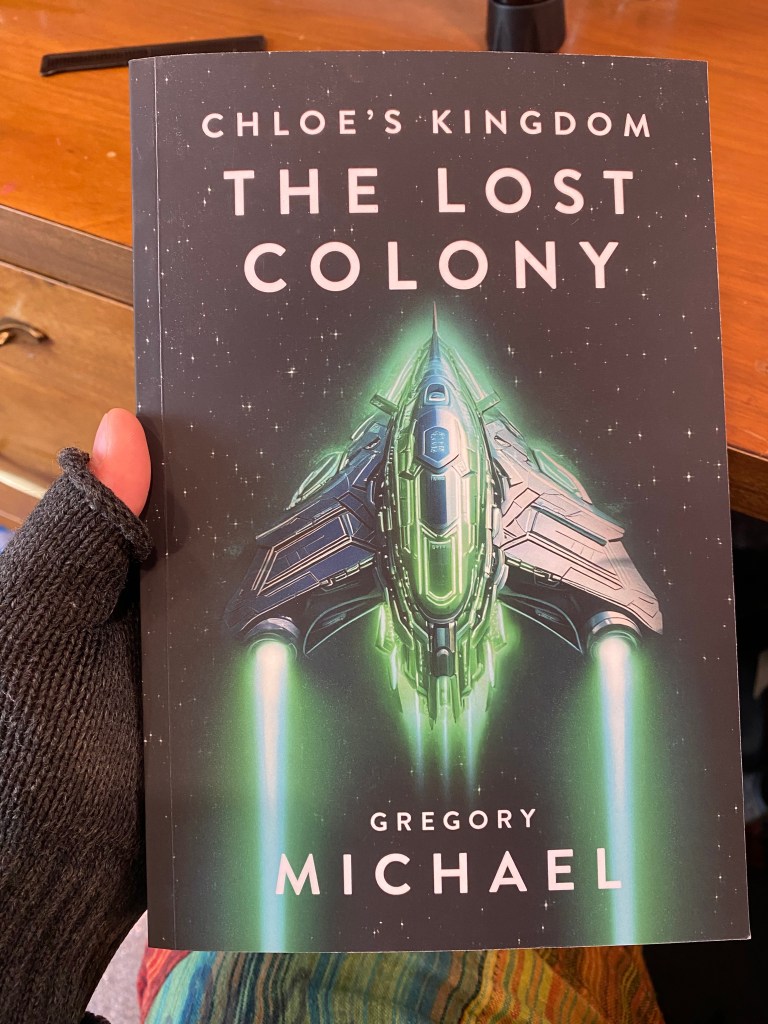
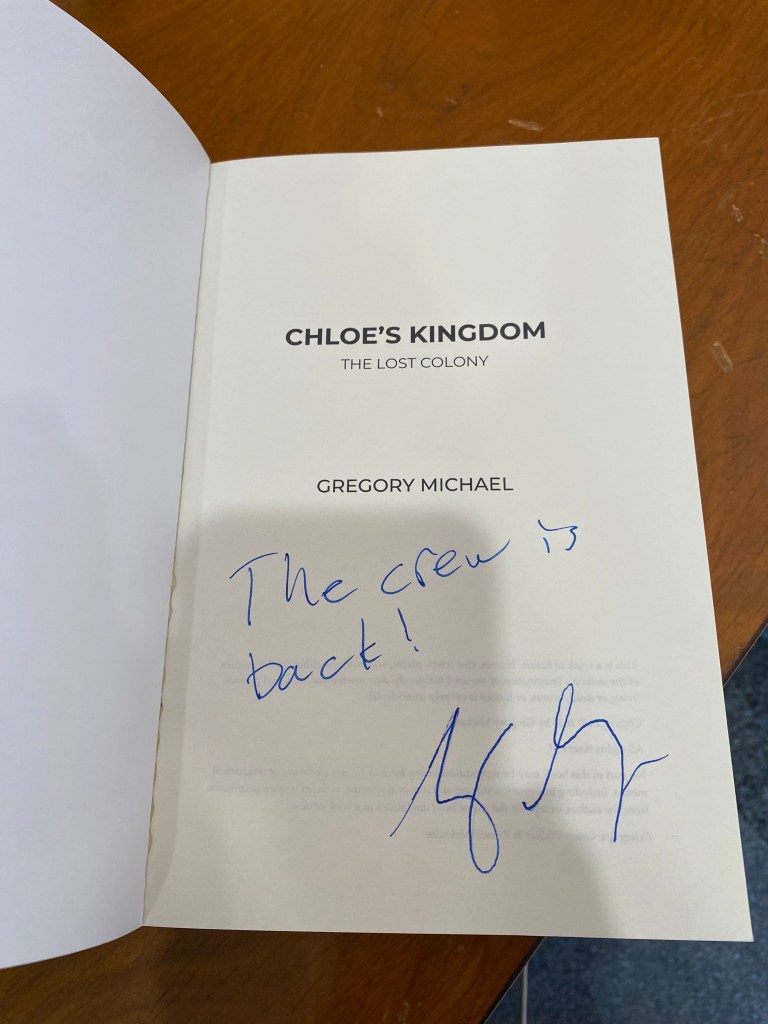
By the way, a massive thank-you to Gregory Michael. He invited me to be part of announcing The Lost Colony, which I was more than happy to do. He sent me a signed copy of the book. We’ve talked a decent amount online, and he very kindly accepted my author to read part 1 of Halfwhisker‘s current draft. He’s an awesome guy and I’m grateful that I get to be a footnote in his author journey.7 This review was difficult to write; I liked Chloe’s Kingdom so much that I started reading The Lost Colony perhaps too much expecting more of the same, but this book was willing to take big risks that paid off for other readers more than it did for me, and I think a willingness to take risks is admirable. I hope that this review is well-received, because I really do think honesty—but not rudeness—is the best policy, and that’s what I tried to do. To speak to you directly, Greg: I’m rooting for you, man. I’m excited for the conclusion to Stellar Heist, and the dark atmosphere in this book makes me very curious what you’re going to do with that space zombie idea you mentioned toying with.
And, above all else, my understanding is that your goal is to make good YA because there’s not enough of it, and you did succeed in doing exactly that. Gateway books that draw people into reading are so important…
And now. A tangential topic. In my review of Chloe’s Kingdom I included a section called “Gregory Michael Versus the Woke,” discussing Michael’s really intelligent and subtle use of gay characters in Chloe’s Kingdom (making that an aspect of a character’s personality instead of their personality). In short, I was really impressed (with Chloe particularly), and I hoped that more books would take a page out of this one, considering LGBTQ+8 is getting forcibly injected into everything these days.
How did that hold up in The Lost Colony?
Acceptably. Chloe’s gayness is pretty much a non-factor in this book, which makes sense given how little time she spends around Penny. Instead, Millie and Morgan take the rainbow spotlight, being a touchy-feely lesbian couple. It’s a lot more blatant than in the previous book, and in another book by another author I might have been put off, but I knew Michael wasn’t preaching and that this was a natural evolution of how the characters had been set up in the previous book. It got a pass from me, though I wished that Millie and Morgan had been written a bit more subtle about their affection for each other.9
I will state that, well, to use my own words:
Chloe’s Kingdom would be a weaker story without Chloe being gay—which is a good thing. The story begins with Chloe willing to sacrifice nearly everything to get her life back, but it ends with her willing to sacrifice everything to rescue Penny—despite being highly jealous of Penny’s and Dutch’s attraction to each other. Sure, maybe a similar story with comparable-though-meaningfully-different emotionality would be possible if Chloe was solely really good friends with Penny, but after reading what Gregory Michael pulled off, I wouldn’t want him to rewrite the story that way.
I didn’t feel the same way about Morgan and Millie in The Lost Colony. Being lesbian was just an aspect of their characterization; take it away or change one of their genders and the story would not have been substantially changed. Is it an issue? No. And, you could argue, it’s an even more pure expression of what I wrote about in my review of Chloe’s Kingdom: their feelings exist, are part of their characters, but aren’t fully their characters, and don’t need to be deep plot points.10 (Imagine a book where literally every described aspect of a character’s appearance or personality had to be a deep plot point!) In addition, it mostly only came up when the two were together, and it usually isn’t in your face. It’s not subtle, but there’s still a level of restraint most modern writers need to learn from.
- Twelve between the two sites. This is an indie novel that’s only been out for a month or so; those are good numbers, so far as I’m aware. ↩︎
- Considering YA isn’t my preferred genre, that’s notable, in my opinion. ↩︎
- The below image is a version of the Hero’s Journey; the Dark Night of the Soul (sometimes called “The Abyss”) is where the hero goes through his hardest tribulations, coming out the other side ready to rise above it and change. ↩︎
- The answer could be that Dutch’s parents don’t fully understand the threat that the Lost Colony represents, or recognize that Jubilee breaking no-contact means that they are doomed anyway. There are answers, and reasonable ones. ↩︎
- Page 143 out of 356 is when this crew is undoubtedly aboard the Lost Colony, so 40.16% of the book by page count. ↩︎
- And I’m not a fan of deathbed repentance. They work for other people, but not for me. (Jubilee doesn’t actually die, though, so she may yet get a chance to actually, truly atone for the evil she’s committed; to emphasize, this is not a true deathbed repentance.) ↩︎
- I do really like footnotes, after all. ↩︎
- The “+” stands for “pedophile.” ↩︎
- More than anything, it was the relationship archetype I didn’t like—straight or gay, couples that are a little too touchy or flirty can be cringy as well, even without kissing and such, in the real world and in imagined ones. This archetype is a writing tool that works for a specific purpose, and maybe Michael’s intent was to have Millie and Morgan be a little too much for outsiders; whatever the case, I wasn’t a fan. ↩︎
- Millie’s and Morgan’s sexuality is a larger percentage of their characterization than Chloe’s had been with her. ↩︎

 Boo Ludlow
Leave a reply to 2025-12-15—The 2025 Blog in Review – Boo Ludlow Cancel reply