
Coromon is a modern take on the classic monster-taming genre. Tame Coromon and explore a vast world filled with thrilling turn-based battles, brain-twisting puzzles, and a mysterious threat to the world awaiting defeat. Nobody said being a Battle Researcher was easy!
Coromon Steam Page Description
Coromon is a monster-taming RPG where you take on the role of a Battle Researcher and explore the vast continent of Velua, a land filled to the brim with monsters called Coromon. The game wears its Pokemon inspiration on its sleeve, for better or for worse—with it intentionally positioning itself as a spiritual successor of sorts (yes, for something as well-known and beloved as Pokemon), that inspiration will either leave the game eternally on the back foot or make it the underdog and people’s champion, depending on how you view it.
Strap in. This is a long one.
Some Disclaimers
My first disclaimer before I continue: I have not finished Coromon. I have three save files on my SteamDeck. I really want to finish the game. I’ve tried just pushing through the problems I have with the game. Thus far, the end result has always been the same: Coromon loses me right when I least want it to.1
And yet I keep thinking about it.
My second disclaimer: As I mentioned, Coromon is unapologetically inspired by Pokemon (particularly in the Nintendo DS era, such as Platinum and White/Black). It’s a spiritual successor for people who feel like they aged out of the franchise they grew up with, but still want more. Given this detail, I don’t think it’s possible to review Coromon and not frequently compare it to Pokemon.2 It’s hard to say whether or not that is a fair comparison. After all, The Pokemon Company is the owner of the single most financially successful franchise of all time and has tremendous resources to spend on every game it makes3; TRAGsoft is an indie game studio with very limited resources. But, since Coromon is very consciously acting in Pokemon‘s space and very consciously breaking from various Pokemon traditions while leaning into (or improving) others, it appears TRAGsoft chose that comparison for themselves, so I’m going to roll with it. If you choose to be David and take on a Goliath, it’s not up to you whether or not the God of Israel will guide your stone.
My third, and final, disclaimer: In this review you’re going to read a fair amount of, essentially, “Coromon didn’t do this as well as Pokemon/should have been closer to its inspiration” and “Coromon didn’t go far enough from Pokemon.” I don’t consider these critiques paradoxical or unfair, as sometimes it appears Coromon is trying to mimic Pokemon and at other times it appears to be trying to innovate.
Wow… That’s a lot of ground-setting. Let’s just get started with the short and long reviews.
The Short Review
The short review: Are you a fan of Pokemon, Digimon, Cassette Beasts, or other games in the monster-taming genre? Coromon is worth your time. You may or may not become a superfan, but I think, at the bare minimum, you will have an enjoyable experience.
Do you hate Pokemon and that general game loop of catching monsters, training them up, and battling hundreds of trainers across a few dozen hours of game time? This is probably not the game that will change your mind. (It really leans into that archetypal game loop.) That said, Coromon is significantly more competitively-minded and strategically-oriented than Pokemon ever was. If the “casual” nature of a single-player game of Pokemon is what turned you off of the genre, then Coromon might actually have a chance of luring you back.
Now for the long review.
The Long Review

Coromon begins with your character traveling to the Lux Solis campus to begin a career as a Battle Researcher. This essentially means that you will be trained in Coromon battling and then sent out to the field to seek out and battle wild Coromon to learn more about them—kind of like if Jane Goodall tranquilized chimps and taught her captured ones to suplex wild ones and used that as the basis of her primatology research.
After getting set up with a starter research kit (and a Coromon pal), your character is invited to a special task force researching Titans—powerful elemental entities that may be the source of the various mystical elements that create Coromon.4 Not long after you take to the field, you discover that literal aliens from another planet are seeking to corrupt these Titans and, through them, your world, with a mysterious element that causes all creatures it infuses with to become extremely powerful and extremely violent. At that point it’s off to the races with you seeking to collect the essences of each Titan before the aliens can, traveling through themed sections of the continent that emphasize specific Coromon types.
And I don’t know how that story ends.
For me, my ventures into the world of Coromon began magical—particularly my first. The game was so pretty. The sound design ranged from acceptable to really good. I liked the monster designs and generally like the changes to the mechanics. But then the game got slow and grindy, an experience that just kept building up, leaving me frustrated rather than enthused with the new things Coromon had to offer. I eventually learned that I had picked some slow-growing ‘mons to start the game with, which apparently don’t really bloom until later levels, so I started a new save file with a mix of ‘mons that peak early and that need to be nurtured for a while. Nope. Once again, I started out having fun, but at about the desert area I had completely lost interest. I tried again… No dice.
So I spent a lot of time combing through various elements of the game to figure out why… and here’s what I came up with, the good, the bad, and the ugly.
The General Game Loop
First, to provide overall context, Coromon has a gameplay loop pretty familiar to anyone who has played Pokemon, or other games in this genre. You go out in the wild. You use your monster to fight wild monsters, or teams of monsters trained by other battle researchers, in turn-based combat where one monster is on the field at a time. You capture monsters, train them up, they evolve into new forms when they meet the right conditions—etc, etc.
There’s a story, and in parts of the game you put away battling for puzzles, but the vast majority of the gameplay experience comes in the battles—which means if you love every battle, you’ll love the game. If the battles start getting old for you, the side content won’t be enough to buoy up the overall experience—at least, that was the case for me.
Monster Designs
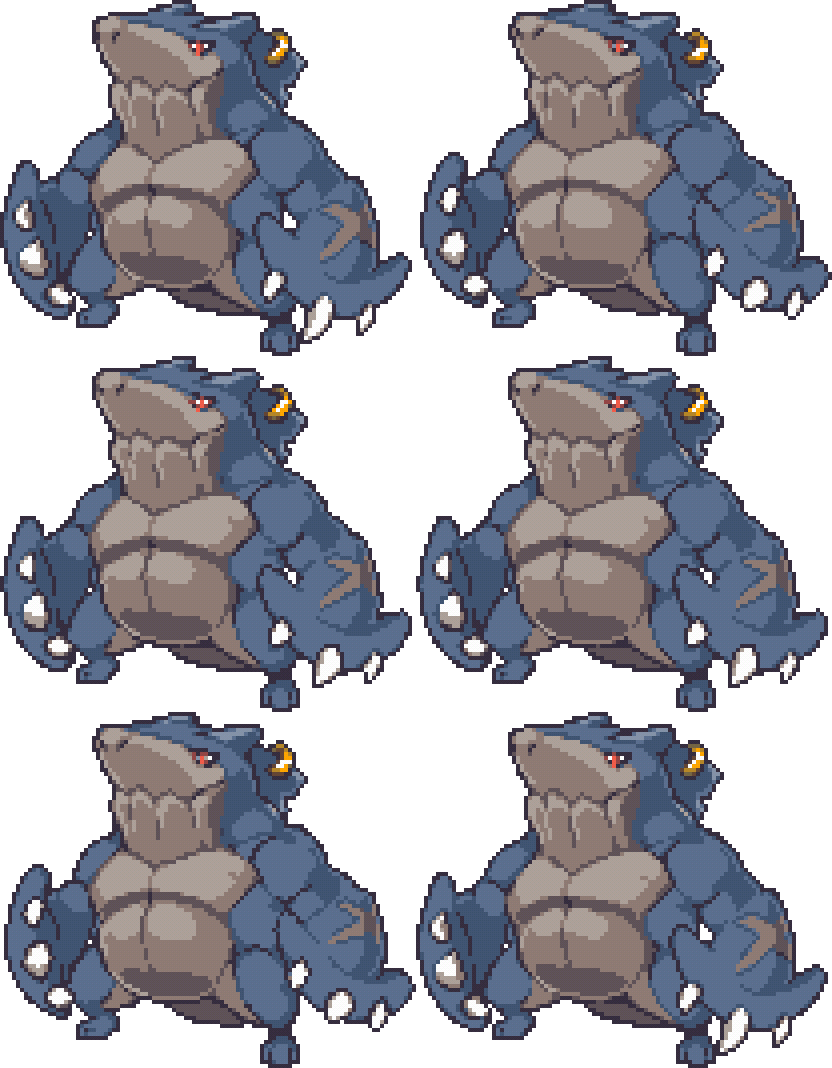
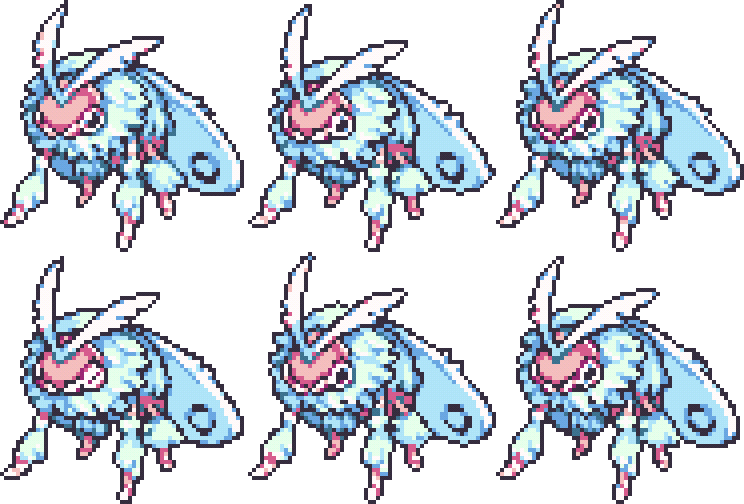
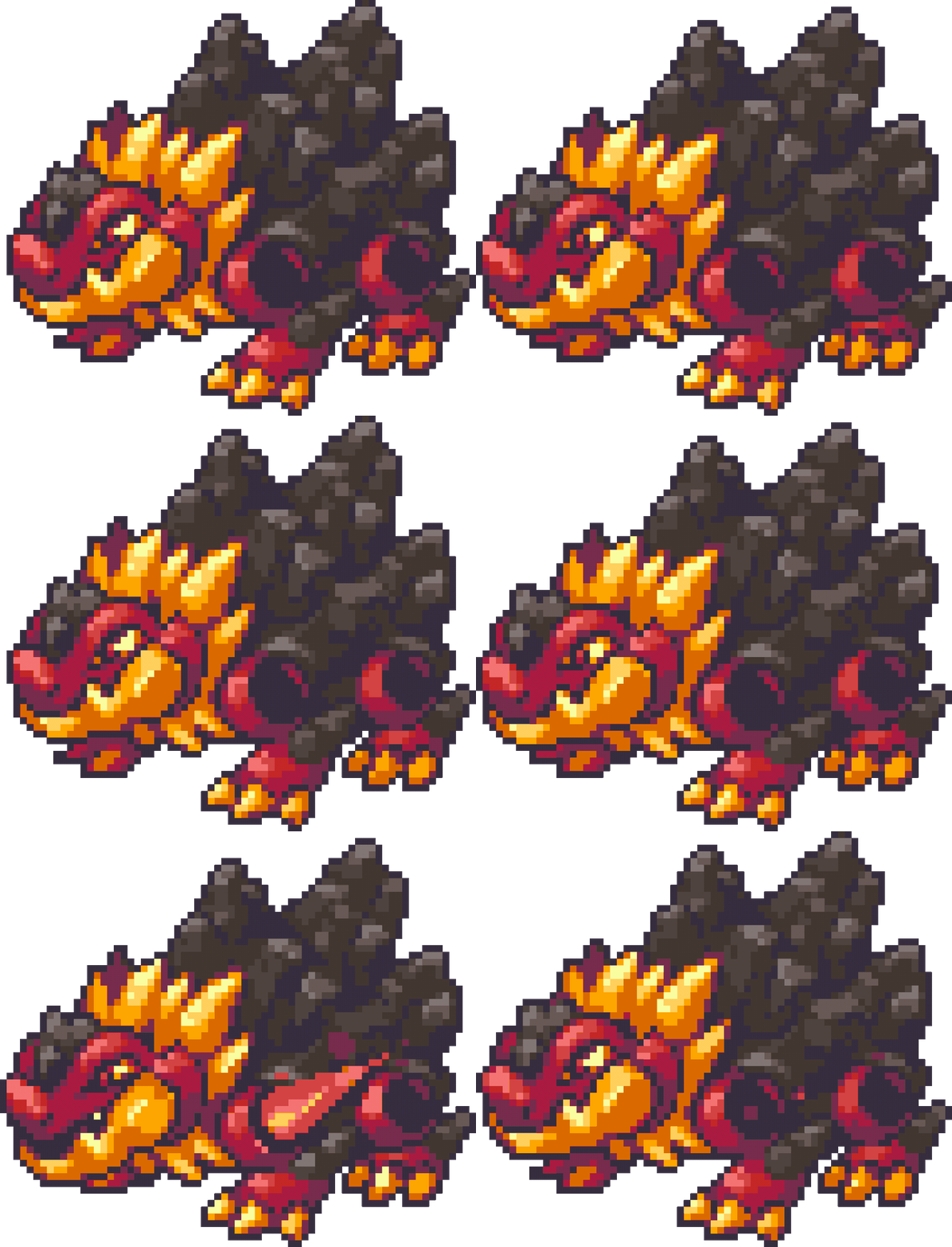
But let’s really start with something great. The monster designs in Coromon are amazing. This is one of the strongest elements of the game, if not the strongest. Even the monsters that I personally am not a big fan of are still interestingly designed and animated in such a relatively lifelike way, pixels and all, so that I have to at least appreciate them. It’s very much following in the footsteps of Pokemon‘s moving pixel art era, but better—and, I should note, artistically distinct. I don’t think anyone is ever going to look at a Coromon monster and mistake it for a Pokemon monster.
Look at how awesome these monsters are! Below are the three final evolutions of the starter ‘mons and one of the first-area ‘mons:

Now here’s a random pixel Coromon compared to a modern 3D Pokemon:

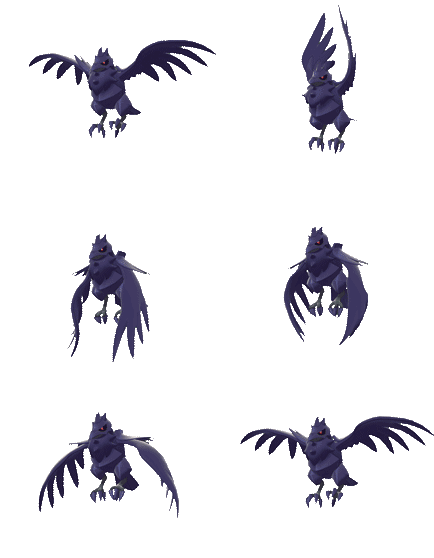
I must admit, outside of actually playing with these monsters in-game, I don’t think the difference between the above models has the same impact. All I can say is that seeing and battling in-game looked and felt way better with Coromon‘s moving pixel monsters than any 3D Pokemon game I’ve played.
This is all just the tip of the iceberg, though. Coromon also nails its monster variety across the roster, with big monsters, tiny monsters, cute monsters, scary monsters, bizarre monsters, and everything in between. The bugs, especially, impress me, with a plethora of amazing designs.
Of course, I’m not a personal fan of every design, but I don’t think there’s a single miss in the roster, even in the more straightforward monsters.
Names and Cries
The names and cries for those monsters aren’t stellar in Coromon, though. Most of the time it feels too much like it’s aping Pokemon but not doing as good as a job. (Not that Pokemon has universally good monster names. I think the only monster taming game I’ve played with a potentially flawless name game was Cassette Beasts.) It doesn’t detract from the overall experience, but I none of the monster names just stuck with me the way monster names have in other games.
So, the designs of the monsters are easily amazing. But what you get to do with the monsters matters most, otherwise just collecting them will rapidly feel pointless. And what you primarily do with Coromon is battle. Let’s break down various game elements directly related to battling, then wrap up with a few other game elements.
Types
Coromon uses a Type system for its monsters, similar to Pokemon, but which felt shallower. It’s also quite a bit simpler than Pokemon‘s system; this was probably done in the name of balance, but it made the combat less interesting to me.

There’s two ways in which Coromon‘s Type chart felt shallow to me. First, nothing was immune to anything else. This is a feature of Pokemon that isn’t repeated in most RPGs, but that I think felt lacking in a game very directly inspired by Pokemon. Second, Coromon has far fewer interactions between types, and less variety in interactions. By this I mean each Type, on average, is super effective and not very effective against fewer Types than in Pokemon, resulting in most attacks landing neutrally.5 I didn’t find this very engaging.
That said, Coromon‘s slightly smaller type chart, and significantly smaller number of interactions, is far easier to memorize than Pokemon‘s sprawling list, so some may find Coromon‘s Type chart to feel manageable rather than shallow. To each their own.
I also wasn’t a fan of how Coromon‘s typing was applied across its monsters. All monsters only get a single Type—that’s it. No interesting cross-combinations and all the strategic potential that could come with that.
That all said, Coromon does something completely unique with its Type chart, a something that I’m on the fence about: about half of its Types solely exist on moves and can’t exist as a monster’s Type. These Types still interact offensively and defensively with Types that Coromon can have, though. This element felt weird at first, and even after getting used to it I think it’s is a lateral move from a traditional Type chart, but not all attempts at innovation are going to be lightning in a bottle. In short, perhaps TRAGsoft could do something that feels inspired with this, but it needs iteration.
Finally, with regards to Types, for me the interactions between types were even less logically coherent than in Pokemon. This is NOT to say that Pokemon has a perfectly, logically consistent Type chart, just that, when I forget how a Type interaction works in Pokemon and am too lazy to look it up, I’m way more likely to be successful at reasoning my way to a correct combination in Pokemon than in Coromon. For example, water can disrupt electricity in the real world (water doesn’t conduct electricity well without a certain range of salinity); it makes no sense that Water, as a Type, is weak when attacking Electric (as in Coromon), rather than neutral (as in Pokemon) or strong. Again—this doesn’t really matter, but does increase mental load as you’re learning the game since things aren’t very intuitive.
Power Points Versus Energy
On to other battling elements. Pokemon uses a “power point” system: every move a Pokemon knows can be used a certain number of times, then the Pokemon has to rest before the move can be used again. This system is used to balance stronger moves against weaker moves by giving stronger moves fewer power points. Coromon uses an energy system: every moves draws from a shared pool of energy, and once that energy is gone the Coromon has to rest (which, unlike in Pokemon, can be done mid-battle—although mid-battle rest only partially restores energy and doesn’t restore any Hit Points). I found this system exciting in concept. In practice, it felt like a lateral move, except for in specific battles where I found my opponent to be unkillable because it was impossible for him to run out of energy and he kept increasing his defensive stats and healing himself. Those moments led me to believe energy was weaker mechanically than power points, even if the energy system was otherwise implemented extremely well in Coromon.
Moves
As for the moves that use energy as fuel, there were a handful that appeared to be direct parallels with Pokemon‘s, but to a certain extent that is unavoidable—not having a single move that evokes Tackle, for instance, is impractical. I did sometimes think that the wordplay to differentiate moves with obvious echoes was silly, or created awkward wording, at times—such as calling a move “Fast Strike” instead of “Quick Attack” when they are essentially identical—but there’s no need for Coromon to have its moves mirror Pokemon‘s names when the moves are functionally identical, and in fact there are probably good legal reasons as well to not do that.
What I really liked about Coromon‘s moves was how you could freely add or remove a known move from a Coromon’s moveset. This allowed for a significant amount of experimentation that simply can’t be done in Pokemon. (In later levels, when you have many moves at your disposal, anyway.)
Randomness
Coromon intentionally prioritizes a competitive audience over a casual audience—as a result, the game intentionally de-emphasizes various randomized game elements that, in a more casual game like Pokemon, create a lot of variance. For example, Coromon has fewer moves with a X% chance to have secondary effects; often a move or ability with a secondary effect is guaranteed to activate after X uses instead.
In fact, Coromon goes a step further in this area by having an optional game mode that completely eliminates variance. Those few moves with an X% chance to activate a secondary effect? Instead, they automatically activate after a certain number of uses, just like other moves with that mechanic.
This feature makes combat significantly more predictable—you know exactly when you will crit, exactly when your monsters’ abilities will activate, exactly how many times you have to use a move before its secondary abilities activate, etc.
And I don’t like it.
Don’t get me wrong, for people who want a more chess-like experience in their battling, this emphasis is probably golden. And I’ve absolutely been burned by Pokemon‘s variance before, both winning and losing games totally undeserved. Still… for me, this Coromon mechanic made the game feel less dynamic. With no chance of ever getting surprised, many battles felt predetermined, at least when playing against a computer. Against a human opponent… Well, I wouldn’t know.
I guess I’m just a casual.
Abilities(+)
Moving on from game features directly tied to combat, let’s talk monster abilities. I generally found the unique abilities available to various monster species to be interesting and thematic, even the ones that pretty clearly felt like clones of Pokemon abilities (but often toned down). But that’s all lateral movement.
Here’s where Coromon was inspired. It’s going to sound simple, but in practice, in-game, it’s amazing. Abilities+. In short, if your monster could evolve but you choose to keep it from evolving, you get somewhat compensated with a stronger version of that monster’s ability.
For example, one monster has an ability that causes enemies that hit it with a physical move to take a little damage. With its Ability+, you could potentially cause physical attacks to deal half of the attacking creature’s health in recoil damage.
That was an extreme example, and probably the only unbalanced one that I found, but it is absolutely nuts how cool some of the “plus” abilities are, and it genuinely made me stop and wonder if I’d rather have a fully-evolved monster or a partially-evolved monster, at times. That’s never happened to me in Pokemon.

Grinding
But you can’t access new abilities without evolving your monsters, and you can’t evolve your monsters without leveling them up, and you can’t level them up without grinding… right?
Right?
To be frank, I hate grinding. I’m not sure I’ve encountered a single RPG that has managed to make grinding fun. Most of the time you end fight tens and tens of underpowered monsters to gain a little experience, wasting a ton of real-world time, just to continue with the story. There’s nothing exciting or rewarding about that.
And Coromon, unfortunately, can be pretty bad with regards to grinding. The game developers appeared to be aware of this, as before every Titan fight I was able to find an item that temporarily increased the amount of experience I got from battles, which shortened the grind—but the grind still existed, and it was very frustrating for a guy with little play time.
But it’s not just farming small battles to gain a few levels—the average fights, whether against other Battle Researchers or against wild Coromon—can be such a pain. Coromon‘s focus on being “competitive” lends itself well to thrilling battles against notable bosses, but, for me at least, it often means you have to spend a lot of meaningful resources in every battle you have between towns, and, with no convenient way to heal your monsters, it’s easy to get ground down after two or three battles, forcing you to run back home, heal up, and then run back to where you originally were, dodging wild monsters the whole way. That’s a lot of backtracking that felt unnecessary.
Coromon is pretty clearly designed with the intent of battling one person, resting, and battling another person, so battling multiple people in a row with no healing in between (even of just energy) can be a frustrating experience.6 This also makes raising up new monsters a huge pain, which made it harder for me to experiment with different monsters that I found on my journey.
To be fair to Coromon, though, this is a genre issue, and Coromon‘s stab at fixing this issue isn’t necessarily worse than Pokemon‘s solution of having most in-between battles be completely effortless. I’m not sure there is a clean solution.
(Although, once again, Cassette Beast‘s solution of having your character level up and having all captured monsters match your character’s level does the job pretty well. It saves you from grinding to level up newly-caught monsters, anyway.)
Potential System
And now… the potential system. In my opinion, Coromon‘s biggest swing… and miss. Which is a bummer, because the TRAGsoft really highlights this system in advertisements as one of their biggest improvements on the genre—and, to be fair, it is in some ways.
To first understand how potential works in Coromon, you first need to understand what a “shiny” is. In many monster taming games, there’s a random chance that a monster you encounter uses a different color palette than normal—such monsters are considered “shiny.” In Pokemon, every Pokemon has one Shiny variant with a very low chance to spawn.

But wait, there’s more—and I swear this is all relevant, so stay with me here. How strong or weak a monster is in certain areas is usually referred to as its stats—a higher Attack stat deals more damage with the same attack than a lower Attack stat. Simple stuff. In Pokemon, there are three indirectly related systems that allow you to customize your monster’s stats to a degree: IVs, EVs, and Natures. These systems, and how they affect your Pokemon’s stats, are usually extremely opaque in-game. As well, shinies and stat customization are entirely separate systems from each other (in Pokemon).
In Coromon, these systems all got melded together into the potential system.
All of your monsters have a Potential score. Higher scores mean that your monster gains more Potential every level and, once your Potential reaches a certain threshold, you gain three bonus points to invest into any stat of your choice—then your Potential resets and you start building it up again to earn more bonus stats. It’s way simpler than in Pokemon, way more transparent, and way more accessible. For people who understand the effects of every stat point they invest, it vastly increases the ease of access to the competitive side of Coromon, particularly compared to Pokemon, and for more casual players it simply lets you feel good about dumping everything into one stat for big numbers.
But since every Coromon’s Potential is different, some Coromon have lower Potential than others—and therefore lower stats overall. Unlike in Pokemon, where a monster of a given species will always have the same total amount of stats overall, putting them on a level playing field.
I don’t like grinding through the wild, trying to find a monster with high Potential so I don’t feel like I’m being saddled with a weak monster. It’s frustrating.
And for some reason this game’s Shiny system is tied directly to its Potential system. If you find a Coromon with high enough Potential, it’s Shiny. And if you find one with maximum Potential, it has yet another color palette.
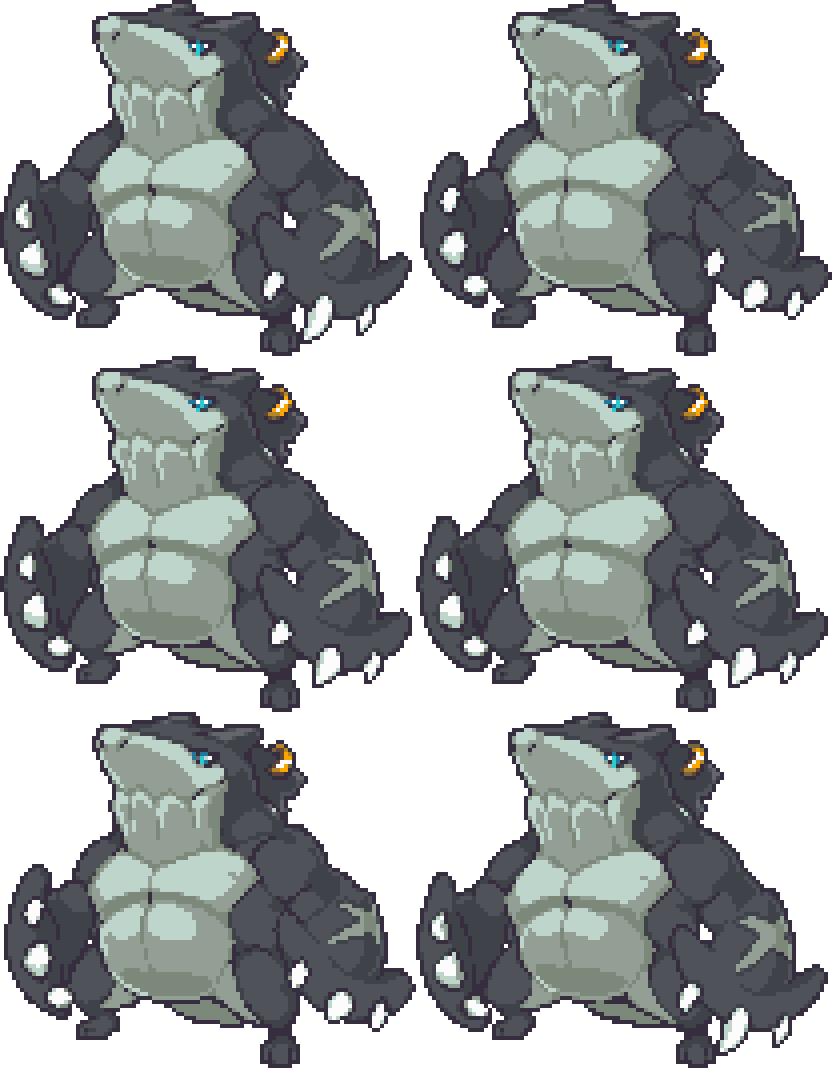
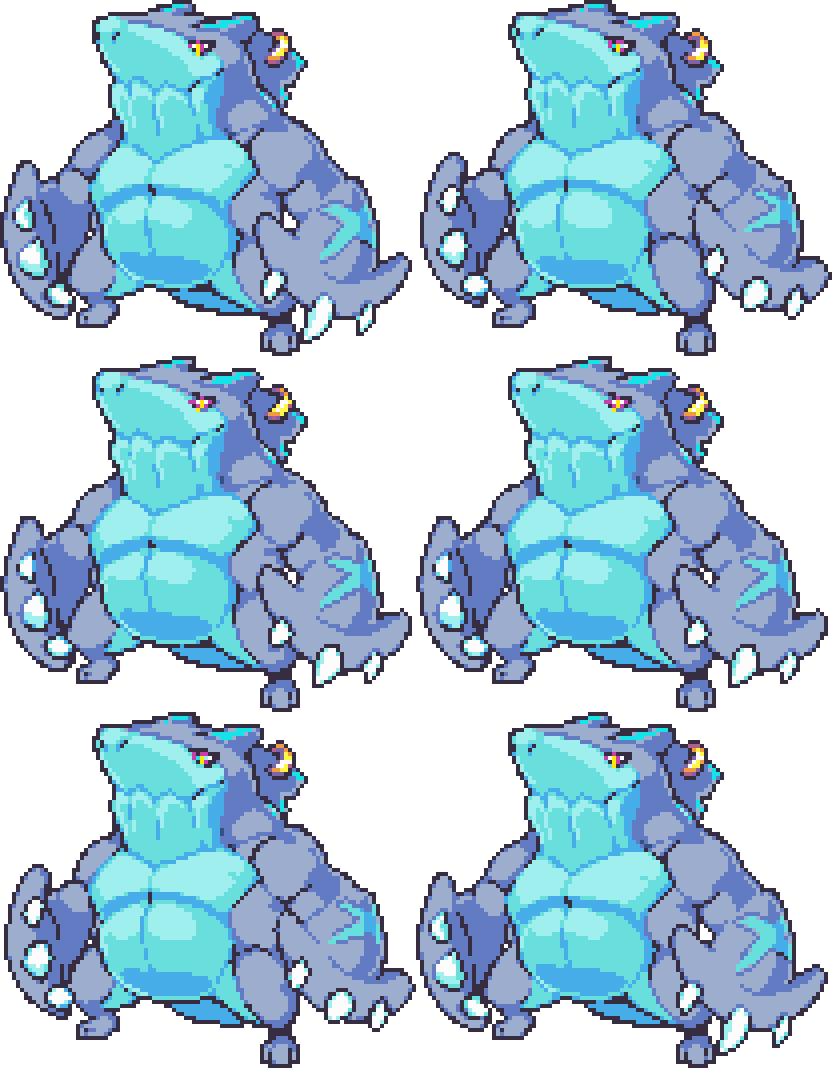
The intent of tying the Shiny system with monster stats was to reward players who found rarer monsters to also have those monsters be stronger, but in practice it just meant I felt like I was missing out if I didn’t spend hours seeking out those rare monsters. they went from cool trophies for people with that kind of time to feeling obligated.
As well, for people who find increased enjoyment in hunting for monsters with specific color palettes and getting the strongest monster possible, it’s really disappointing when the color palette for the monster you want is only available for a weaker version of that monster.
Finally, combining stat customization with Shinies also feels redundant in the sense that Coromon also makes use of an in-game Skin system you can use to change how your monster looks. You can just buy the below skins with in-game currency that you get by playing the game, rather than walking through the same patch of grass for hours hoping one randomly spawns.
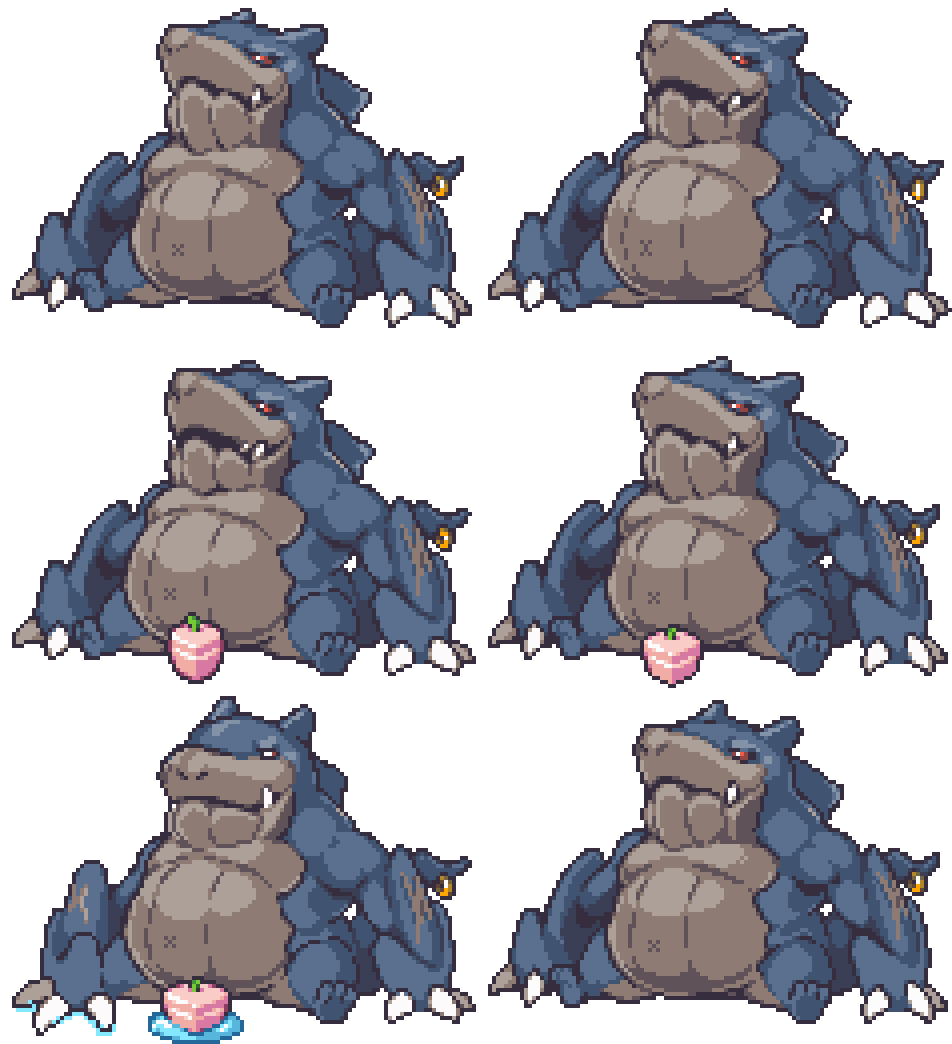
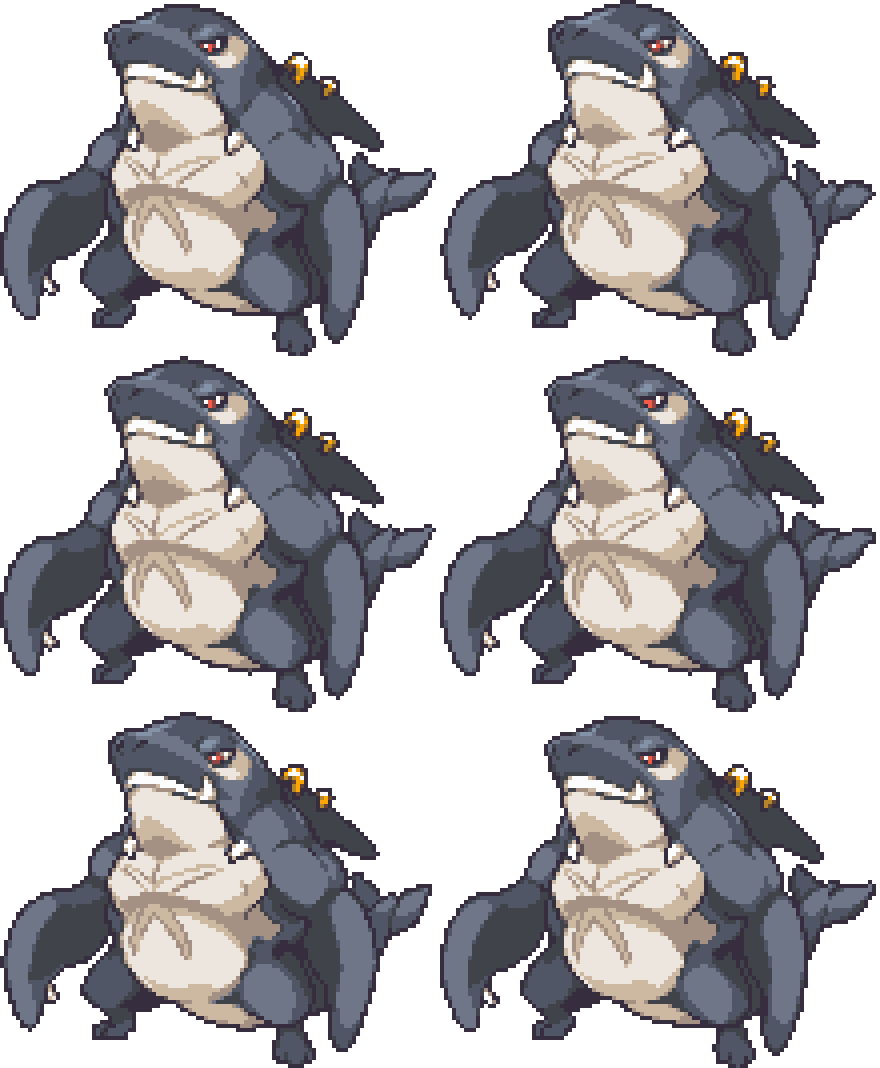
In short, while I like each of the above ideas in a vacuum (particularly the concepts behind them), the weird mixture of systems ends up bringing all of them down for me.
Casual Versus Competitive
Finally—finally!—the biggest struggle, for me, in Coromon. The casual versus competitive struggle, and what this game wants to be.
Pokemon is pretty unapologetically a casual game. Yes, the Pokemon Company hosts competitive tournaments where adults and young adults can compete to become that year’s Pokemon Champion, but that’s almost completely unrelated to the main game. (For example, competition was cancelled during the COVID plandemic and no one noticed except for the few thousand people who attend these tournaments.) Most of Pokemon‘s obscure, frustrating systems can be forgiven because they contribute toward an intended vibe in a casual game and, by being obscure and unintuitive, they succeed in that. It’s weird, it doesn’t make sense (possibly intentionally), but it works—until you start approaching the game competitively, but that’s your choice.
Coromon, on the other hand, advertises itself as competitive Pokemon, but it doesn’t go far enough.
Coromon removes a lot of variance common in the genre, but it still includes moves with random effects that can throw a game. (Fewer than in Pokemon, but still.) Coromon has the extremely competitive and convenient feature of being able to swap your moves out whenever you want, but it costs a lot of in-game money and in-game time to swap out abilities or change how you invested your Potential—arguably even more important features, competitively. Coromon lasers in on 6v6 combat, where two teams face off in a no-holds brawl, but most of the game doesn’t actually focus on that kind of fighting and instead drains your resources from fight to fight without convenient rest or recovery in between—it’s like the single player gameplay is teaching you to approach Coromon as a game about resource management. Coromon vastly improves the process of customizing the stats of your monsters, but at the cost of most monsters being directly weaker than other monsters of the same species!
It’s just… I don’t know. Maybe if Coromon included a battle simulator as part of the base game, none of this would matter as much.7 Like in Pokemon, you could deal with the quirks of the game in single player and have fun, or not. But the game doesn’t have a battle simulator. Instead, the game cares so much about being competitive that the aftergame almost entirely consists of preparing teams to battle other players with. It’s baffling to me how many competitive features are frustrating to use when this is the focus of the game.
Wrapping Up
So why can’t I stop thinking about Coromon? Why am I seriously considering purchasing Coromon: Rogue Planet when it eventually comes out? Get out of my head! GET OUT OF MY HEAD!

TRAGsoft is on to something. Of that, I’m completely convinced. Despite all of my frustrations with Coromon, it still lives rent-free in my head. And Coromon, as far as I can tell, still has a fairly healthy fanbase that’s excited for the next game—which is way more than other competitively-focused monster tamers can say (notably TemTem).
Maybe Rogue Planet will fix the problems I have with Coromon, and it will become my favorite monster tamer, even more beloved than Cassette Beasts. Or maybe the rumored Coromon 2 will. Or maybe TRAGsoft is happy with where the game is, and happy with its current audience, and won’t change things that much.
I dunno, man. I dunno.
I just know that I’ve never had a harder time figuring out how to close out a rant-review. Despite all of the frustrations I’ve expressed with this game… maybe I’ll go boot it up and try a new save file one more time, see if that game mode that randomly reassigns every Coromon’s Type does the trick…
- The game almost exclusively has “Positive” and “Very Positive” reviews on Steam, which is worth noting. Despite my struggles with it, a lot of other people quite like it. ↩︎
- Even its name, Coromon, intentionally evokes Pokemon vibes, despite not actually meaning anything. (Pokemon means “Pocket Monster.” Coromon… is just made up.) ↩︎
- Even though it doesn’t. ↩︎
- Coromon‘s Titans fill the same general role that Gym Leaders do in Pokemon, only they serve as a single, massively powerful boss rather than a team of powerful monsters. ↩︎
- Pokemon has an average of eight interactions per type—that means roughly four strengths and four weaknesses. Coromon averages three. ↩︎
- Or it’s a skill issue and I need to get good. ↩︎
- Competitive battling in Pokemon would be miserable without the conveniences of Pokemon Showdown. ↩︎

 Boo Ludlow
Leave a reply to 2025-09-01—September Newsletter – Boo Ludlow Cancel reply