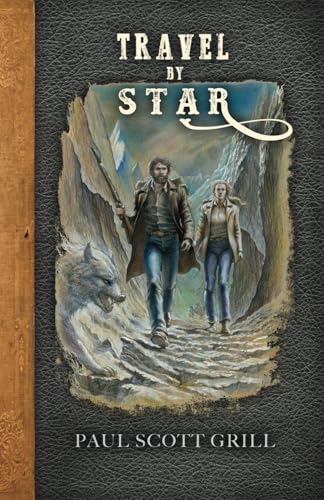
Just in case this is a dealbreaker for anyone, I have to state this as plainly as I can: at no point in Travel by Star (by Paul Scott Grill) does a tiny pink blob hop on a five-pointed glowing stellar object and ride it to another location—or, in other words, travel by star.1

This review for Travel by Star was extremely difficult to write. Mostly that’s because I didn’t end up liking the book, despite going into it because of high recommendations and being extremely excited for it—but also because it feels pretty rude to leave a critical review for an indie author’s debut novel. Just breaking out is hard enough as it is, and I’m no stranger to how personally crushing and demotivating a disappointing review can be.2
There’s an entirely separate conversation we could have about the nature and responsibility of reviews: I strive to be honest but uplifting, even in my critical reviews, and despite being a very small fish in a very deep ocean I don’t want to run the risk of being the review that hurts an author’s chances at wider success, at least when, despite the flaws I found in a book, I thought the author deserved another chance. Expecting a home run the first time someone goes to bat is just unreasonable.
Of course, authors peddling slop full well deserve all the harsh criticism they should get—but this is not one of those instances.
In short, when I see something I thought didn’t reach its full potential, I hope that I can be part of an upward arc, rather than a brick wall. That’s why I’m reviewing Travel by Star. While I had many issues with the book, I did have several things that I really liked. As well, this book has really worked for many other people, some of whose reviews I’ll share in the footnote.3 By writing this review, maybe I’ll help this book find more of its intended audience; I also hope my critical comments will be useful to the author when preparing his next venture for an even wider audience, should he ever read this.4
The Back-of-the-book Blurb
Travel of the Ruelands has sworn he will never make another run through the wilds. He has fought his share of desperate fights out there, and come nearer to death than any man should. But when Nichole Littlestar, a woman bearing unspoken burdens and impossible hopes, asks him to guide her to the almost mythical city of Archewood, he finds himself drawn into the most dangerous venture of his entire life.
The two companions must now make a journey they could never have prepared for, fighting monsters ahead and demons behind. And hard at their heels is a terrible hunter intent on killing the last faith of a darkening world…
The Review Proper
There’s a common theme I’ve noticed in Travel by Star reviews: it’s really hard to define what this book is, cleanly. It’s big. It contains a lot of elements of many different genres, but doesn’t cleanly slot into any of them. It’s ambitious. And it’s faith-based.
In short, it’s going to take a while to unpack.
Paul Scott Grill, to my knowledge, describes his own book as a fantasy western. I’d describe it as a faith-based flintlock adventure fantasy wearing a grimdark skin—but it’s decidedly not grimdark.5 So I’m going to use those general categories to organize this review.
— Adventure —
Let’s start with the adventure description. If you’ve read a fantasy adventure novel before (The Hobbit comes to mind), particularly one with a hero’s journey, you will be familiar with the overall movement of this novel. The book introduces Travel and Nichole Littlestar6 (the protagonists) early on, teaches us a little bit about them, and then sends them off on an adventure with a specific destination as their end-goal. They experience trials along the way, make friends, deal with enemies, and change as people.
Two elements largely drive the forward momentum of Travel by Star (both the literal outward adventure and the metaphorical inward adventure). The first is a need to get to a mythical city named Archewood, which was destroyed years ago. Specifically, Nichole has had vivid dreams of Archewood and, along with these dreams, feels a spiritual call to visit where the city once was; there’s some ambiguity early on whether or not the city still physically exists, but there’s a clear answer to that question well before the end of the book. Getting Nichole there alive is a major goal for Travel and Nichole both.
The second is the inward movement of the characters. Both Travel and Nichole have long histories that are mostly hinted at in this book, with strong suggestion that both have lives fraught with folly and regret. Travel, in particular, is weighed down by his misdeeds; he initially is reluctant to help Nichole find Archewood because he doesn’t believe the city exists, but as he grows his resistance changes to be because he doesn’t believe he is worthy of Archewood. Nichole’s resistance to traveling to Archewood in the first place is resolved before the book starts and largely is addressed in her slowly revealed history, but she, too, has made regular poor life choices and is now finally shouldering a burden she doesn’t understand but feels that she must take on, or the consequences will be dire.
And, perhaps of course, traveling the hero’s journey together brings Travel’s and Nichole’s hearts closer together over time.
As far as the world itself is concerned, I really loved what was revealed over the course of the book’s adventure. It’s a very well-constructed iceberg—meaning, I only saw what was above the water, but it led me to believe (and imagine) a massive body of history, events, and locations beneath the water. I’ll go into more specifics later, but, suffice to say, this world does not lack in the epic fantasy world building department.
That said, I found the personal journeys of the characters themselves less interesting. Travel and Nichole both felt compelling to me initially, as what I learned about them made their mysteries all the more compelling, but as the chapters added up I found myself very disappointed at the drip feed of knowledge about them—and what some of that knowledge ended up being.
Let’s look at Nichole as an example. Early on in the book you learn that she is on the run from something—she’s not really sure what, but it wants her dead. You also learn that she’s known of a “calling” of sorts to find the city of Archewood for nearly her entire life, but she spent most of her life running away from that calling, either rustling horses or living as the side-chick of an ice-boat captain. Those stories have the potential to be interesting, but most of that information is heavily backloaded into the book—long after I’d reached the point that I was tired of flashbacks or chapters that didn’t directly follow the main characters and their current adventure—or is briefly reference or just alluded to. Not every part of a character’s backstory needs tons of detail, of course, but I don’t think I ever got to the point where I knew and understood Nichole, so something was lacking for me.
Even worse—and this applies to both Nichole and Travel—information about their histories is rarely very relevant to what is going on or how the characters interact with each other. In one scene Travel admits a deep regret to Nichole, a time when he offered a woman protection as she travelled between cities in exchange for sex. (The details of the arrangement weren’t explicitly stated, but heavily implied.) Travel seems remorseful for the actions of his past self, but Nichole doesn’t respond at all—whether to affirm that he’s changed or to recoil from him and later have to reconcile the differences between past and present Travel. This happens several times—another instance is when Travel learns that Nichole is an octant. Octants are very rare people, almost exclusively male, with literal angelic heritage and the ability to manipulate a specific element; because they are rare, octants are very valuable to certain villains of this world. Travel more-or-less shrugs this revelation off, having figured something along those lines out himself and reasoning that it doesn’t ultimately change much.
Perhaps these characters could be interpreted as intensely stoic, but to me it read like there was a lack of connection between them. One of the results of that lack of connection was the late-stage romance feeling quite two-dimensional to me—there’s a male character, there’s a female character, they are on an adventure together, so they must fall in love. Right?
I dunno.
All of this would have been stronger if the book put more focus into Travel and Nichole. Unfortunately, the book early on takes big detours to follow other characters and significantly build them up, and I think that distracted focus really hurt my ability to connect with the book’s protagonists. And it’s not that there’s anything wrong with multi-viewpoint stories—I love multi-viewpoint stories. But in this story, something was missing that made me not feel like I was getting enough of Travel and Nichole in their chapters, and that made me want to get back to them in other viewpoint chapters so that, hopefully, I could see them fleshed out as much as other, less-central characters, like Drannach or Hatchet.7
— Flintlock Fantasy with a Grimdark Skin —
Let’s get back to those genre descriptions and how they apply to Travel by Star. I would describe this as a “flintlock fantasy” that’s “wearing a grimdark skin.” What does that mean?
It means that the world of Travel by Star is ridiculously cool in a kind of depressing way, a way that would be fully grimdark in the hands of another author, but isn’t in Paul Grill Scott’s hands. (He writes this world with far too much hope for true grimdark fantasy.)
Flintlock fantasy is a sub-genre of fantasy that takes the usual, expected fantasy setting—pseudo-medieval—and ages it forward into somewhere from the 1500s to 1800s, often with an emphasis on the impact guns would have in such a setting.8 Monsters, magic, and the like are still present, of course, being fantasy. Compared to the real world, the world of Travel by Star falls on the far latter end of that time period, with there being guns with actual bullets in shells, as well as railroads, early electricity, and the like.
So the level of technology is roughly equivalent to that of a Western, but there are werewolves all over the place. And zombie-like monsters called the Crin. And ancient, nigh-unkillable, dinosaur-like monsters. And dragons. Demonic spirits. And a skyscraper-sized spear that was stabbed into the planet and left there. And there are even whimsical elements, like an intelligent dog capable of speech, a cranky (but pious) rabbit, and horses descended from literal horse-angels. That’s where the fantasy comes in.
The grimdark skin that covers this world is created in its tone and focus. In this world, war between nation-states has not-so-distantly ravaged this world, destroying major city centers and trade routes. In the aftermath, many monsters roam the lands, as well as bandits and other criminals, all wearing away at the remaining villages and other communities as surely as a rushing river grinds a boulder down to a pebble. Most people are low on hope and pushed to do desperate things to survive, and few communities have any semblance of order or peace. Even most individuals are broken, with the majority encountered over the course of the book having their fair share of regrets for things they’d once done.
Let’s not forget that many of the monsters mentioned were men and women, but who have succumbed to the darkness of this world. The werewolves that stalk the land, for example, were transformed by grief and despair into violent, nigh-unkillable monsters. Let’s also not forget that the land itself is dying, with many places becoming desertous over time, and others poisoned by demonic spirits or influence.
In short, almost literally everything is in a bad place—but also a creatively magical place—and there’s a lot of evidence it’s only going to get worse.
It’s all really cool and creative stuff. It’s a very strong, broken start from which Paul Scott Grill could go in the direction of fixing this world, but there’s still enough left to lose that he absolutely could have made things much worse if he wanted to—and, to be clear, either direction could work very well. Grill went the former route, sort of, which is why I can’t truly call Travel by Star grimdark. Despite all evidence to the contrary, the world starts improving the moment Nichole accepts her calling to find Archewood. As well, characters aren’t narratively punished for doing what’s right; Travel’s and Nichole’s pasts rarely, if ever, catch up with them to haunt them outside of their dreams; these would be required fixtures if Grill’s intent were a grimdark story. Despite all of the latent misery and despair in this world, there’s a clear upward movement in the world’s trajectory.
Anyway. For me, the world was easily the strongest part of Travel by Star—I simultaneously wanted way more of it but also knew that Paul Scott Grill’s light hand in revealing it was part of what made it so fascinating. There’s a lot of room for co-creation between author and reader in this book!
— Faith-Based —
And now. Finally. Travel by Star is a faith-based book.
I’m not sure I’m using the term “faith-based” in the same way that other people might, as the vast majority of my “faith-based” genre fiction reading comes in the form of CS Lewis—whose body of work many reviews directly compare Travel by Star to. So, for me, “faith-based,” in the context of genre fiction, is what CS Lewis accomplished with The Chronicles of Narnia: a fictional novel that has recognizable allusions or allegory to matters of faith, that clearly has the values and virtues of a specific faith tradition woven into it, but that can be read and appreciated on its own, whether or not the reader shares that faith or is even aware of it.
Travel by Star comes from the Christian faith tradition—the big reason some reviews have compared it to the works of CS Lewis, I think. A lot of the book wrestles with the fallen nature of Man, on redemption, on how falls from faith or grace can destroy wider communities and whether or not such things can be restored. For much of the book I was convinced that the city of Archewood was representative of Heaven, or perhaps that it was a failed attempt at a city-of-Enoch situation, or even some sort of metaphor for Jerusalem.
Well. The end of the book pretty directly removes all metaphor and theorizing out of what’s going on, as Jesus Christ literally shows up as a character in the book, gives Travel a vision of His crucifixion, raises Nichole from the dead, and directly confirms that the world of Travel by Star exists as an additional world covered by the blood of Christ’s atonement. It is the most Christian deus ex machina I’ve ever read outside of the Bible.
When Aslan of Narnia is pretty obviously Jesus Christ, and CS Lewis himself plays with ideas of multiple worlds being covered by Christ’s atonement, and even has Christ sacrifice Himself on each world in some fashion (as happens in Travel by Star),9 it’s really hard for me to figure out why Travel by Star just doesn’t work for me in this area. But I think I can wring it out with this quote:
Archewood had never been just a City, or a Book, or a Tree. Before it was anything else, it was this Man. It had always been Him. [Jesus Christ]
Travel by Star, Chapter 63, Page 612
I am not aware of a moment in The Chronicles of Narnia where I’m told how I’m supposed to understand the series’ metaphors. Granted, it has been a long time since I’ve read those books, so I could be missing moments where CS Lewis pulls back the curtains and exposes the wizard; if they exist, they have not remained in my memory. But Travel by Star has moments like the above where it tells me exactly how I’m supposed to understand everything. And that doesn’t feel like fantasy or storytelling to me. It feels like a sermon. And I don’t read sermons for entertainment. And I get kinda cranky when I feel like the story I’m reading turned into a sermon partway through.
This approach specifically worked for some people, I have to note. For example:
Grill’s answer to Aslan is actually somewhat of a challenge to Lewis’ approach and far more sophisticated in its theology than most ‘Christian’ fantasy dreams of…
Apparently I fall very firmly into the CS Lewis camp. Unless I enter a story explicitly aware that Jesus is going to be a fictionally represented character within the story (such as with The Chosen), I want the Christ-character in the story to err on the symbolic side. That’s just me, I suppose.
Also, referencing another Michael F Kane post, it’s possible I’m in the minority of people who feel the ability to ponder about this book’s questions was taken from me, as Kane himself is the person whose recommendation led to me reading the book, and he has no issues with having interpretations of Archewood outside of what the text explicitly says it is:
Archewood as a symbol for an idealized past and hope for a promised future was, I think, the single best conceived part of Travel by Star.
I’m not sure what was conscious and what was discovered over the course, but for me it was the idea that hit deepest.
That all said, I want to clarify that nothing in Travel by Star is disrespectful, nor does Paul Grill Scott do anything “wrong,” per say. I thought his interpretation of Jesus to be very interesting and thoughtful—in some ways it made me think hard of the Jesus who cleansed the temple, using a whip and divinely righteous anger in the process. That’s a real side of Jesus present in the scripture, but not one that gets much attention, as a faker, softer, fluffier Jesus is what usually gets represented in mainstream conversations. For me, Grill’s directness in removing many possible unknowns, in converting many symbols into unambiguous references, did not work within the context of a fantasy novel that I believed existed first to entertain (while still being suffused with heart and meaning), that’s all.
(I should also probably note that I’m much more of a Tolkien than Lewis fan—The Lord of the Rings books are absolutely Christian through and through, but there’s still healthy and reasonable debate over what the Ring represents, Sauron, elves, etc. If anything [directly], of course… Tolkien understood the value of a story being a story first and foremost.)
Wrapping Up
Reading through reviews for Travel by Star, I wish I had the deeply moving or transformative experience that others have described for themselves. I wish that, at the end of this novel, I had the distinct sense that I’d read a flawed masterpiece. I wish this book, described as a uniquely American fantasy, grabbed me by my bootstraps and manifested my destiny.
But I’m just not in that boat.
There were too many parts of Travel by Star that dragged for me. I had too many moments where I felt like I wasn’t getting enough of what was most important in the story, while getting way too much of what wasn’t—I often felt the latter in the Drannach and Hatchet chapters. I was able to forgive typos and grammatical errors at first (indie novels deserve that), but after I ran into enough lines where half the sentence was missing I began to get frustrated with the lack of line editing and copy editing.
In short, I can’t unequivocally recommend Travel by Star.
But the book still had me hooked in certain areas. This incredibly ambitious work still had me excited in parts. I’m not turned off to giving Paul Scott Grill a second chance—and he is actively working on a sequel to this book, so I may end up checking it out.
Travel by Star is unequivocally a work of passion and faith. It’s clearly a book written by a man who has a lot of thoughts about Christian virtues, beliefs, and values, about Jesus Christ Himself, and he’s excited to share them. It’s also a book that has found a specific audience.
And I’m happy for them. Because not every book has to be for me, and that’s okay.
- I had way too much fun riffing off of this in the original rough blog post. After all, Christian Kirbo already exists in internet meme culture; combine that with the unintentional connection made by Travel by Star‘s name and there’s a lot of room for tangents. Could have been a peanut butter and chocolate combination. ↩︎
- Niko at Niko’s Book Reviews was kind enough to review The Failed Technomancer; I was very disappointed when I learned that he got halfway through and the book lost him, but I really appreciated his honesty and his willingness to talk about the book anyway. Thanks, Niko! ↩︎
- Michael F Kane: “Travel By Star is a truly wonderful Fantasy Western with roots laid in the deep soil of the classics. Strap in folks. This is one you’ll probably want to read.”
Samuel Moore: “Travel by Star… is a little hard to describe but truly easy to recommend. It has shapes all throughout, molded by love and hope, of Lothlorien, of the Stone Table, of L’Amour, of myth, of tall tales. It tells of clear good and evil, and a few characters struggling between.”
Elijah the Middleborne: “The world vividly brought to life by Grill’s excellent prose is one full of beauty and decay, wrath and love, grit and tenderness. It’s utterly unique, and I admit to being a bit confused by allowing my preconceptions of fantasy get in the way of the world Grill was writing.
You will find subtle and not-so-subtle references to Grill’s influences and inspirations, but what he’s written isn’t derivative.”
And then the Amazon Customer Reviews are 90% 5-star, 10% 4-star. ↩︎ - I hope so. Grill and I follow each other on X and, while I don’t know him personally and have never encountered him in the flesh, he appears to be a faithful, down-to-earth guy with strong opinions of how the world is and ought to be. ↩︎
- “Hopedark” might be a more accurate niche genre name, but I’m not familiar enough with the genre to feel comfortable with using that name casually. (I’m only barely familiar enough with flintlock fantasy to feel like I can aptly use that genre name.) ↩︎
- I imagine the book is called Travel by Star because of the protagonist names, Travel and (Nichole) Littlestar? ↩︎
- Drannach and Hatchet are important to the story in the sense that they get a lot of “screen time,” and their roles are critical, but I felt like they got too many chapters each, and I don’t have much to say about them outside of this footnote. The story is about Travel and Nichole, after all, and that’s where most of what happens happens, not with these two.
Drannach is an unapologetically evil, somewhat two-dimensional villain—I say somewhat because he does have a tragic backstory, and a lot of time is spent in his head letting us know how he thinks, but his choice to relentlessly pursue vengeance and war reduces him to a shadow of what he could have been. Perhaps, in line with the faith-based elements of this book, that’s an intentional choice to show the effects of hate and sin, but I didn’t find it made a very compelling character to read for chapters and chapters (despite the cool, engaging world building revealed in his chapters). The best comparison I can think of is Sauron in The Lord of the Rings. He/It is unapologetically evil and drives a lot of the obstacles the heroes face, but we never really need a chapter from Sauron’s perspective.
As for Hatchet, he’s Nichole’s adoptive father, and essentially plays a mentor role, having trained her (and, to an extent, Travel) up before sending her out on adventure. He then follows after to try and help her, and dies, as most good mentors should. (In story.) ↩︎ - Powder Mages (trilogy, Brian McClellan) is a good example of the genre. And I just so happened to have reviewed these books already, funny enough… Promise of Blood, The Crimson Campaign, and The Autumn Republic. Spoiler alert: they were really good. ↩︎
- More detail: In both Travel by Star and The Lion, The Witch, and The Wardrobe, Jesus Christ is slain to atone for the sins of the world(s). In the latter, it happens in the form of Aslan, stabbed in the heart by the White Witch. In the former, it happens in the form of an unnamed man who gets crucified by political and religious leaders of the city of Archewood. ↩︎

 Boo Ludlow
Leave a reply to 2025-09-01—September Newsletter – Boo Ludlow Cancel reply