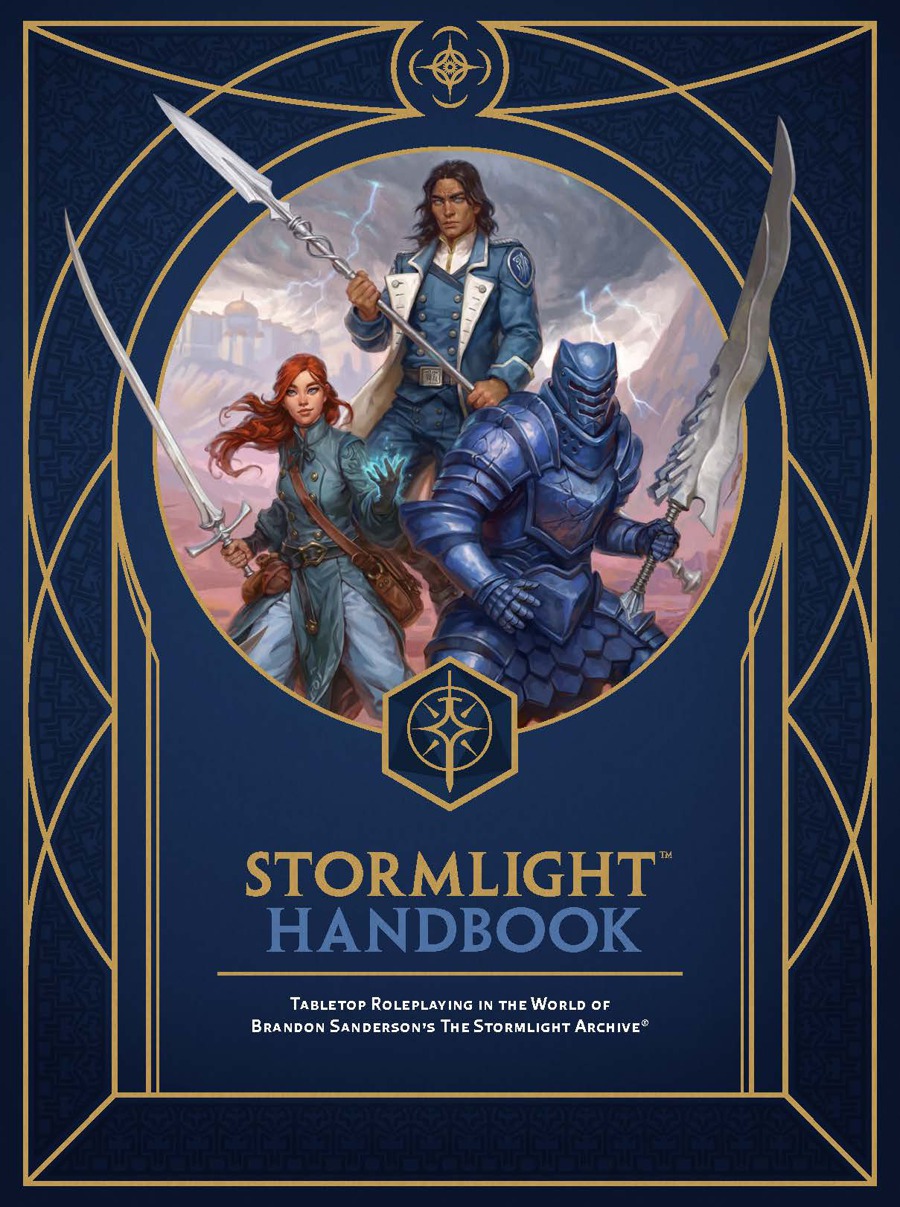
A while ago I announced a break with Brandon Sanderson (in this post), with a lot of explanations why. I’m sure he’s completely broken up about it and sobs himself to sleep, but the steadily increasing admixture of alphabet soup1 in his stories (damaging the overall quality of the meal) couldn’t be ignored. I figured leaving the restaurant sooner rather than later was a good plan if I wanted to avoid food poisoning.
Well. To continue this metaphor, I’d already made some future orders (before the above occurred) that couldn’t be cancelled, so I’m getting this dish whether I like it or not. I might as well talk about it. I do like TTRPGs, after all.
Cosmere TTRPG Overview
Not long after Sanderson’s record-breaking Secret Projects Kickstarter, another project with Sanderson’s name came to life: the Cosmere Roleplaying Game.
Originally advertised as just a TTRPG for Sanderson’s Stormlight setting, on the day of release the game was revealed to actually be massive in scope, beginning with the Stormlight setting but eventually growing to cover all of of the Cosmere—hence the name—assuming fan support continued for the game, of course. This Kickstarter was specifically for rules, setting guides, and a campaign for both Stormlight and Mistborn, with the promises of glimpses into future projects. The company behind this custom-made game: Brotherwise Games, who has licensed Sanderson products multiple times before. The minds actually crafting the game? Largely a multitude of individuals who migrated from Fantasy Flight Games, none of which I personally recognized, but who had apparently found some success with their Star Wars TTRPG.
The Cosmere Roleplaying Game was a bombshell not just for its secret identity and expansive scope, however. This Kickstarter also broke records, becoming one of the highest-funded Kickstarters of all time (in the tabletop role-playing games category, anyway). In addition, everything in the game was confirmed to be canonical to Sanderson’s worlds, meaning fans not interested in the game itself still felt compelled to buy the game to learn new things about the Cosmere that might not be in Sanderson’s novels yet. (Or to read through the game adventure published alongside the rules and try to experience it as if it were another novel.)
I can’t speak for how many non-Sanderson fans were interested in the game for the game itself—at the time, I was a Sanderson fan interested much more in the game than the potential for new lore—but the descriptions of the rules themselves weren’t as enthralling as everything else surrounding the game. The game was promised to be very familiar to fans of Dungeons and Dragons 5e, a set of rules I was getting bored of at the time, so I was in the crowd that wasn’t initially enthralled by the promises of what the end product would look like as a game—but back then I was a Sanderson superfan, and I had heard very good things about Fantasy Flight Games’ take on Star Wars (though I hadn’t played it), so I decided to take the leap and buy the game anyway. After all, some of the things we were promised—freeform character creation, skill-based magic systems, and the like—did sound like compelling improvements to the DnD 5e framework as it existed.
The PDFs for the Cosmere Roleplaying Game—specifically, the Stormlight setting—were released a month or two ago, and they are what I’m basing this review off of. I previously reviewed the beta rules that came out very shortly after the Kickstarter (you can read that here), and, be warned, an unfortunate number of my criticisms carry over to the final draft.2
I do need to note that I have not played the Cosmere Roleplaying Game. All of my comments and observations here are entirely based on just reading the rules.
The Elephant in the Room
Unfortunately, the Cosmere Roleplaying Game suffers from the same alphabet soup issues that Sanderson’s novels are increasingly suffering from—Wind and Truth being the straw that broke this camel’s back.
To start, if the Cosmere Roleplaying Game is truly fully canonical to the Cosmere, sex and gender are confirmed to not meaningfully exist in the Cosmere—or, in other words, sex as an inherent, immutable part of someone’s identity just doesn’t exist. Binary or definable sex and genders, anyway. This is made clear on page 125 of the Stormlight Handbook:
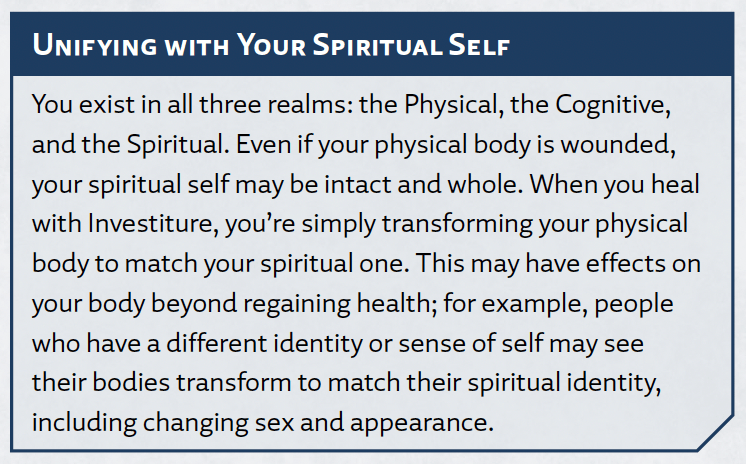
[When you heal yourself with magic, this] may have effects on your body beyond regaining health. For example, people who have a different identity or sense of self may see their bodies transform to match their spiritual identity, including changing sex and appearance.3
I can’t even say that any of this is hard to find in the rulebook. While the Cosmere Roleplaying Game doesn’t wear its sexual politics on its sleeve as brazenly as, for example, Thirsty Sword Lesbians—yes, that is a game that, unfortunately, exists—whenever these guidebooks make a reference to sex or gender, they almost without exception use terms such as “all genders,” or they add inserts like the above to specifically focus on the idea that people can be wrong in their own body. What’s more, the game rules specifically encourage making your character’s sexual identity an important part of character creation (page 29), and to discuss with your play group how you want to integrate sexual identity, changing sexual identity, romantic and sexual relationships, or asexuality into “your story” (page 364). None of this belongs as a base assumption in a roleplaying game, especially not one marketed toward Sanderson’s audience (which includes children as young as twelve).
What’s most depressing is how casually and (it could be said) subtly these harmful ideas are presented in the Cosmere Roleplaying Game. Pronoun clarifications are added in parentheses. The fact that sex and gender are frequently brought up makes it clear the game designers assume sex and sexuality should be a central topic of the game experience. The writers of this game appear to really and truly believe that either sex and gender don’t exist (or that they don’t matter), have fully internalized those harmful lies, and write every part of the game according to that world view, even with fictional cultures where such ideas just don’t fit.
This isn’t just an issue in the Stormlight Handbook. The Stormlight World Guide also includes, as an example, a section on sex and sexuality for every major culture and people in Roshar, making sure to be as “inclusive” as possible even when describing cultures that are very rigid in their understanding of sexual nature and prescription of gender roles (such as the Alethi).
In another game, all of this might be a non-issue for the buyer. To use the aforementioned Thirsty Sword Lesbians as an example… You know what you are getting when you buy that game based on the name alone, and only a specific crowd is going to be interested in it in the first place. After all, one of the strengths of fiction is that it can explore themes and ideas that aren’t accurate to objective reality, and for the people who want to explore sexual identity as central to everything… well, that idea is a bit reductive, but they aren’t lacking in material to choose from. But all of this becomes an enormous issue in a setting like Stormlight that, at least initially, was about more than very modern political ideologies.
So the Cosmere Roleplaying Game brings may issues to the table by dabbling in sexual politics. I already mentioned some very real moral and ethical issues, such as adult themes and content being very present (and subversive, though not pornographic) in a game meant to be accessible to children. In addition, these elements are also world-breaking as far as the fiction is concerned, as I’ve described in my aforementioned Sanderson post.4 Finally, these elements are extremely destructive as far as the game aspect of the Cosmere Roleplaying Game is concerned, as any direct injection of real-world politics or ideologies into a game meant for general audiences just makes for weaker, less interesting, or even actively repelling gameplay experience (and signals that the game isn’t really meant for general audiences)—after all, outside of very niche groups who will roleplay sexual encounters whether they are baked into the game or not, sex and sexuality doesn’t naturally come up in most tabletop role-playing games.5
It’s all just so gross.
Two Elephants?!?!?!?

Oh, you thought I was done? No, unfortunately, but perhaps predictably. After all, alphabet soup politics rarely ends with sexual identity—that weird umbrella almost always drags along with it diatribes on disability, colonialism, trauma, mental health, and so forth, all of which is present in the Cosmere Roleplaying Game.
The Stormlight Handbook is very consistently sprinkled throughout with preachy little messages, often relating to the aforementioned topics. Let’s use slavery as an example:
Although human slavery is banned in Kharbranth, this basic right doesn’t extend to singers.
Stormlight Handbook, page 40.
Taken in isolation, the above statement doesn’t appear to be too obnoxious. Yes, it’s unnecessary to state that not being enslaved is a basic right, or that slavery is bad; everyone knows that, and mentioning that slavery exists without condemning it in the same breath isn’t going to suddenly cause the reader to go, “You know what, I’m going to go enslave someone.” But, just like with the Cosmere Roleplaying Game‘s clear stance on sexual identity and the nature of human sexes, the frequency with which slavery is brought up, with the little preachy moments attached to it, rapidly becomes burdensome and has the effect of nagging the reader of the rulebook for—well, I’m not sure what purpose, as I assume most people (if not everyone) who read The Stormlight Handbook don’t own slaves, never have, and understand that slavery is evil.6
In addition to frequent small statements throughout the books, the Stormlight Handbook includes multiple sections of unnecessary moralizing beginning on page 363. These sections are careful to remind you that slavery is bad, racism is bad, other forms of bigotry is bad, etc, and all but explicitly says, “Hey, these various topics all feature in one way or another in the Stormlight setting, but you really should just cut them out entirely, because you might commit a real-world wrongthink in your fantasy game.”
In addition, it’s so difficult to know how to write about these topics because the Cosmere Roleplaying Game is so wildly internally inconsistent. The book regularly discusses sexual nature, slavery, bigotry, and colonialism, and then all but tells you that these topics are super sensitive and maybe shouldn’t be included in your games; the book talks about how characters with mental illnesses or physical disabilitiesshould be respected (even going so far as to recommend researching real-world people with such conditions before playing them in-game—page 2987) while also gamifying disabilities/illnesses (page 297); in short, in so very many ways the Cosmere Roleplaying Game really badly wants to have its cake and eat it, too by including offensive material and then trying to be as bland and milquetoast as possible.
In all of this, I have to wonder what the people making and playing this game really want. If you are so triggered by, as an example, classism that you can’t tolerate its existence in a fantasy world… Why are you making a game featuring that as an element, or why did you buy a game with that as a setting element? Perhaps a non-Sanderson fan, and someone unfamiliar with TTRPGs, could be forgiven for assuming potentially offensive content won’t be present in a role-playing game, but if that’s the case why would they be buying a Sanderson TTRPG in the first place?
This is part of why I think the inclusion of a “Safety Tools” section of the rulebook (page 360) shows a failing of one sort or another on the part of the team making the Cosmere Roleplaying Game. They don’t trust their players to handle themselves like mature adults, so they need to tell them how to act like their version of adults; they aren’t confident enough in Sanderson’s handling of his own world, and their handling of Sanderson’s world in their licensed game, to let it exist without guardrails or censorship; and yet they are going to shine a spotlight on many of these controversial elements as well, most notably the ones being shouted the loudest in the current political spotlight.
Pick a lane, guys.
I am going to state one thing that surprised me, though, considering the giant mess that I just discussed: freechairs. Or, as it read to me, a “combat wheelchair,” which has long been an extremely contentious topic in the TTRPG space.
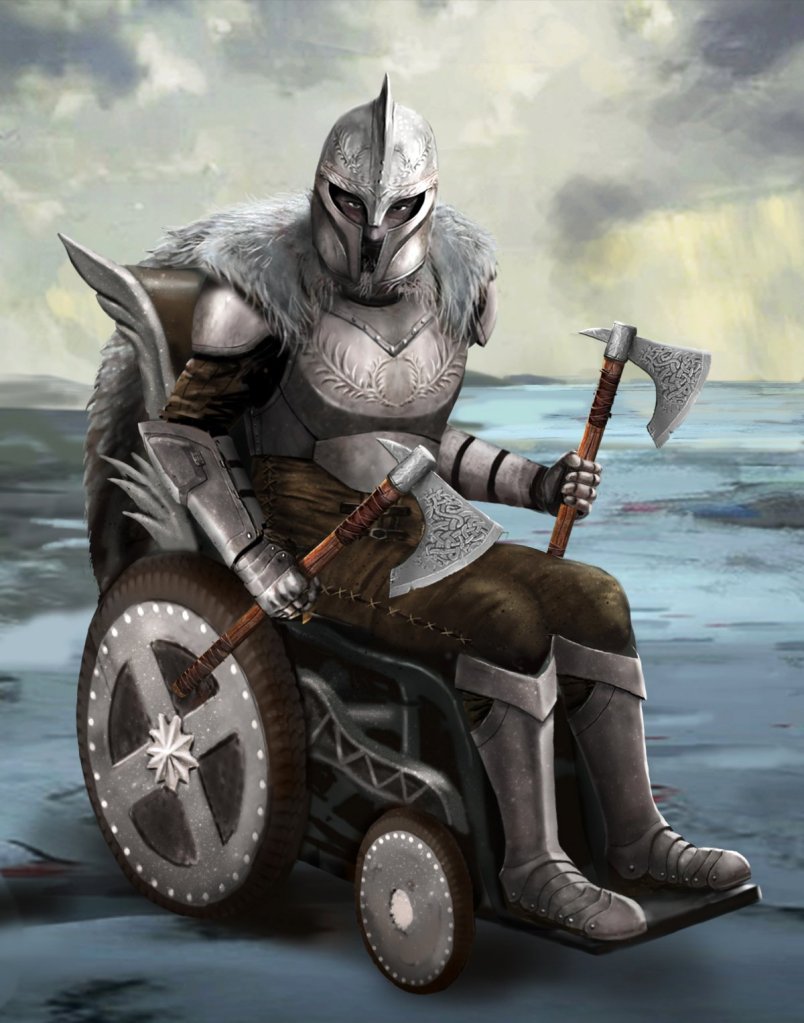
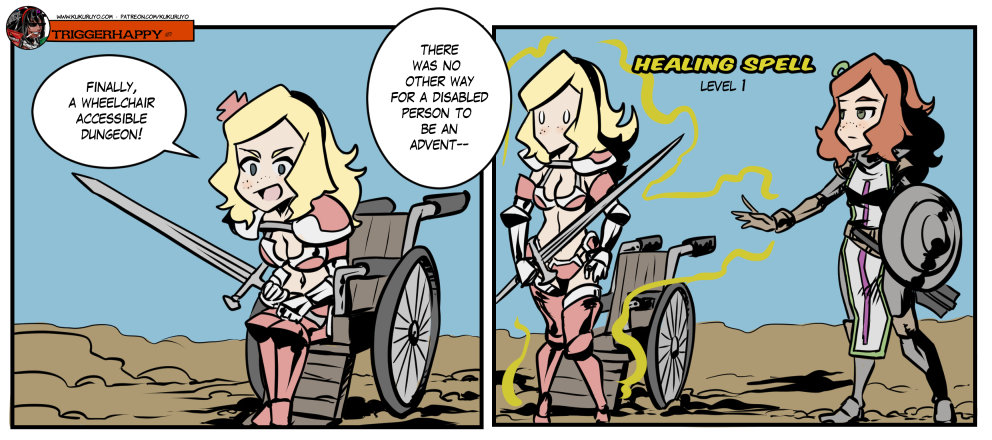
Yep. Freechairs/”combat wheelchairs” exist in the Stormlight Handbook. And, surprisingly, I don’t hate them. There are aspects of their integration into the game that make me roll my eyes—for example, making them the sole magic item with unlimited uses—but the Stormlight setting is one with a very high degree of magic-as-science, making it fairly reasonable for “freechairs” to be widely available to players. It still romanticizes disability a bit, and brings into question what the point is of a player intentionally creating a character with a disability just to handwave it away, but to each their own, I suppose.8
The way I read the freechairs, they only provide horizontal mobility, and the fact that they levitate (in a very limited manner) means that they would provide some limited ability to handle rough terrain, something normal wheeled chairs would struggle with; they aren’t half as bad as the “combat wheelchair” peddled by activists, which is so objectively powerful that even characters with fully functioning legs would choose using them over the alternative of not.
And, probably most importantly, freechairs already have precedent in Sanderson’s books themselves, wherein they felt natural in the Stormlight setting, so there’s nothing that feels egregious, preachy, or forced about them.
Of course, this is paired with the “gamify but don’t gamify but actually do gameify” approach to disability and mental illness that the Cosmere Roleplaying Game takes, so your mileage may vary.
Finishing With the Elephants
Everything that I’ve mentioned previously is going to be a dealbreaker for someone, and for good reasons. I don’t think the argument that “It’s fiction, let them do what they want” holds water when the implementation of the above elements breaks the game’s own world, risks making moment-to-moment gameplay worse, and is inconsistent with what the Stormlight setting has historically been, among other things.
Some will take advantage of the natural liberty of a TTRPG (when played physically, anyway) and ignore such elements in the games they run while still using the core rules and mechanics of this game; more power to them. If you’re among that number, now you have a better idea of what you are getting into. As for the ones that would rather just not deal with it and play something else, that’s an equally valid approach.9 I’m still going to move on from discussing these grosser aspects of Brotherwise Games’ design and move on to discussing actual rules and mechanics, so if you want to head of now, feel free.
That all said, I must admit, I really like the actual core mechanics of the game, despite the ugly drapery.
Cosmere Roleplaying Game Rules in a Nutshell
Brotherwise Games weren’t lying when they initially announced that the Cosmere Roleplaying Game was going to feel very familiar to players of Dungeons and Dragons Fifth Edition, as far as core mechanics go, while also bringing its own spin on things. This, originally, disappointed me, but having actually read the rules I now am quite impressed with the mechanics that Brotherwise Games has cooked up. In many ways, this game is exactly what I wish Wizards of the Coast’s most recent revision to Dungeons and Dragons had been. It does away with so many sacred cows of modern Dungeons and Dragons–likes, while making meaningful additions of its own and ensuring that every change and addition feels like it belongs.
Where do I begin? First, I’m going to assume that anyone reading this is familiar with Dungeons and Dragons, so I won’t explain the most basic rules mechanics, such as how to use a d20 to resolve tests and challenges.
The Cosmere Roleplaying Game retains the classic structure of six ability scores as the foundation of your character (referred to as “attributes” in this game). However, the scores themselves have different names than in many other games, and are grouped into three sets: Physical attributes (Strength, Speed), Cognitive attributes (Intellect, Willpower), and Spiritual attributes (Awareness, Presence). Every score is represented by a single number that is added to die rolls related to that attribute, making the resolution of die rolls quick and intuitive.
These attributes feel much more thought out than in most games, with each directly contributing toward other key character traits. As an example, your Speed score determines how far your character can travel in a single turn; Willpower determines the size of your Recovery Die (used for healing and restoring resources); Strength affects how much you can carry, as well as your total hit points; and so forth. On paper, this system does an excellent job at meaningfully differentiating each stat and making it difficult to decide which one to specialize in, if anything—and since meaningful choices are a good thing, that’s excellent design!
In addition, each set of attributes comes with its own Defense score (Physical, Cognitive, and Spiritual). These scores are used pretty much any time a character resists something, including social influences, which streamlines challenge resolution.
Beyond that, each character is built using a variety of different traits and abilities, which I won’t go into in detail here because there is simply too much. Skills are straightforward, in that the number of ranks you invest in a skill directly translates to the bonus that skill grants to related rolls (in addition to your attribute bonus); all characters use the same basic path of progression (meaning they gain Hit Points, skills, and Talents at the same rate), removing the multiclassing issues of other games; there’s a nice blend of detailed rules, such as those revolving around combat and Talents, and squishier rules, such as those revolving around Expertises, allowing the game to feel like it has a robust and manageable toolset without becoming unwieldy. In short, I was impressed by most of what I read.
Speaking of Talents, classes do not exist in this game. Instead, character options are largely presented as Talents that characters can learn as they level up. All Talents are grouped into themed paths—such as “Hunter,” “Soldier,” or “Scholar”—and Talents have to be taken in order in a path, but beyond that there’s no penalty to mixing and matching paths to your heart’s desire. In my mind, this creates the best of both worlds; players who want to spend time tinkering with different talents for the “best” combinations will have plenty of material to work with, while players who want the simpler experience of just playing a pre-existing set of themed abilities can just stick with one Talent path. Per other reviews I’ve read, your character should be able to meaningfully contribute and feel powerful either way. Everyone wins!
Magic is handled very differently from how Dungeons and Dragons handles it. In the Cosmere Roleplaying Game, players gain new skills that allow them to perform magical feats. Increasing your ranks in those skills gives you access to more powerful abilities—spending Talents can accomplish this, too—and stronger abilities require the expenditure of a resource known as Investiture, meaning players can infinitely use weaker abilities but have reasonable access to potentially game-breaking ones. It’s flexible, doesn’t appear particularly fiddly, and is very freeing.
Finally, at least as far as I’ll mention here, the Cosmere Roleplaying Game has actual social mechanics! Coming from a tradition of Dungeons and Dragons games, as well as spinoffs, I cannot tell you how refreshing it is for social mechanic rules to exist, let alone appear to be fully useable. I don’t consider them to be amazing, and they are a little lighter of a sketch than I would prefer, but at least they exist.
And more! It’s really disappointing how badly Brotherwise Games fumbled the aforementioned elephants in this game, because the actual core mechanics of the Cosmere Roleplaying Game read as deeply thought-out, well-tested, and compelling. I have no doubt that, had I access to these exact core rules in college, I would have spend hours and hours and hours playing this game with my friends.
Oh! And there’s one thing that I just had to save for last on this topic before moving on: the Plot Die.
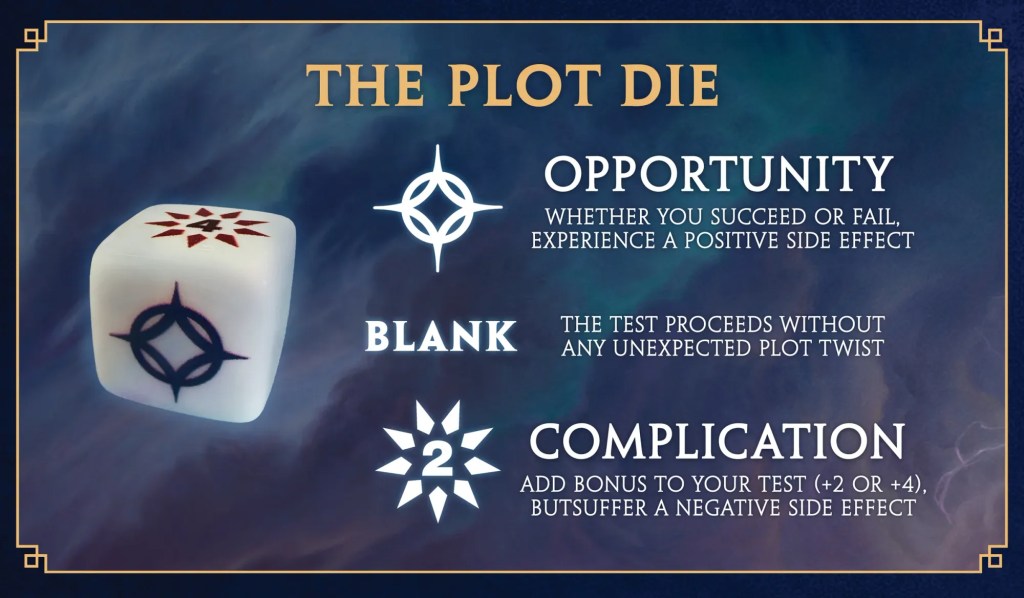
The Plot Die is another aspect of this game’s core rules that I really didn’t like in concept when I first learned about it, but have grown to be really excited about as I read—in fact, I think I’m going to steal the Plot Die as-is from the Cosmere Roleplaying Game and use it in my Shadowdark games.
Here’s how the Plot Die works. At times the Game Master, the person running the game, may feel compelled to ask a player to “raise the stakes”—which means, roll the Plot Die in addition to any other dice being rolled. (The game recommends doing this on roughly 1/3 of rolls, but to go by gut and not actually attempt to do that literally). On a blank role, no “plot twists” happen. On an Opportunity, a positive side effect occurs, regardless of whether or not the player rolling the die succeeds; on a Complication, a negative side effect occurs. Players and the Game Master are encouraged to quickly collaborate on what the positive or negative effect should be, but the Game Master has the final say. It’s quick, it’s collaborative, it’s easy to implement, it feels like a mechanic that can easily add a little zest to any game. I like it, conceptually.
Cosmere Roleplaying Game Presentation
I can’t comment on the physical books until I receive them later this year, but, if they match the ebooks at all, this game’s rulebooks are going to be lovely bits of eye candy for many people’s shelves.
For the most part, I liked the layout and organization of the rulebooks. I was also impressed by the text-to-art ratio—there is a meaningful amount of mostly solid art in the books, but there is a lot of text as well, lending the game to feel like you are really getting your money’s worth (at least, if you are like me and care about rules over pictures). The font is easy to read and the general coloring is pleasing to the eyes. I found the organization and delivery of information to mostly be really clean and intuitive, although some things felt oddly placed—for example, it felt odd to me how late in the book the rules on Combats are placed when the book begins with lots of descriptions of character abilities that you can’t understand the full context of without understanding how combat (or social encounters, etc) work in-game.
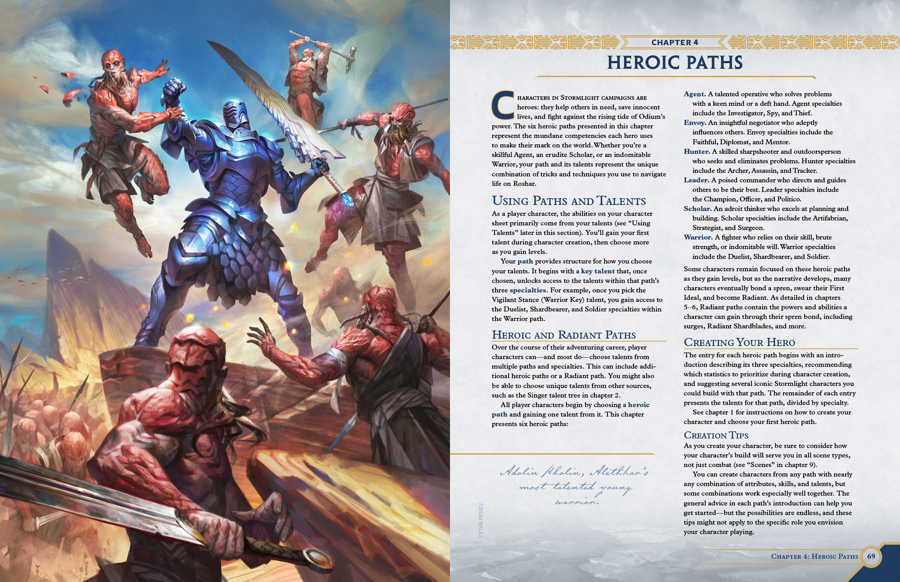
Back on the topic of art, there’s no accounting for personal taste, but I had a very mixed experience. Don’t get me wrong, all of the art is colorful and I think it’s clear the artists put a lot of effort into each piece. There are a lot of pieces like the below that are just gorgeous:
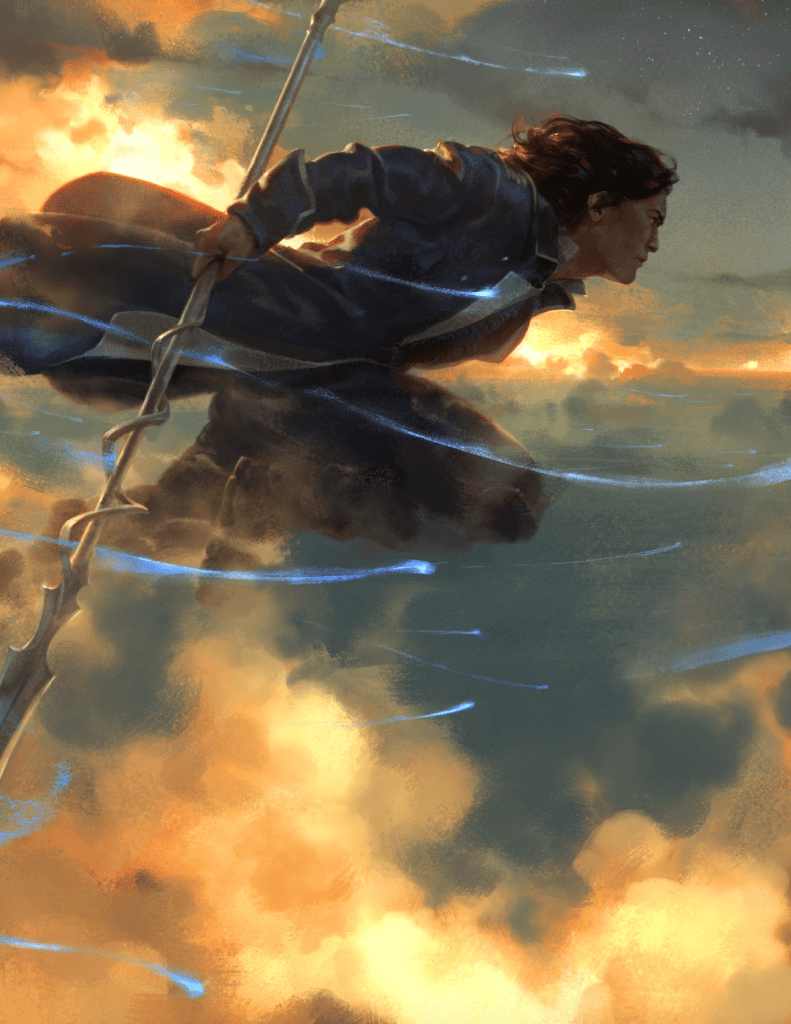
But there are also a whole lot of pieces, like the below, that, to me, feel oddly sterile, without energy:
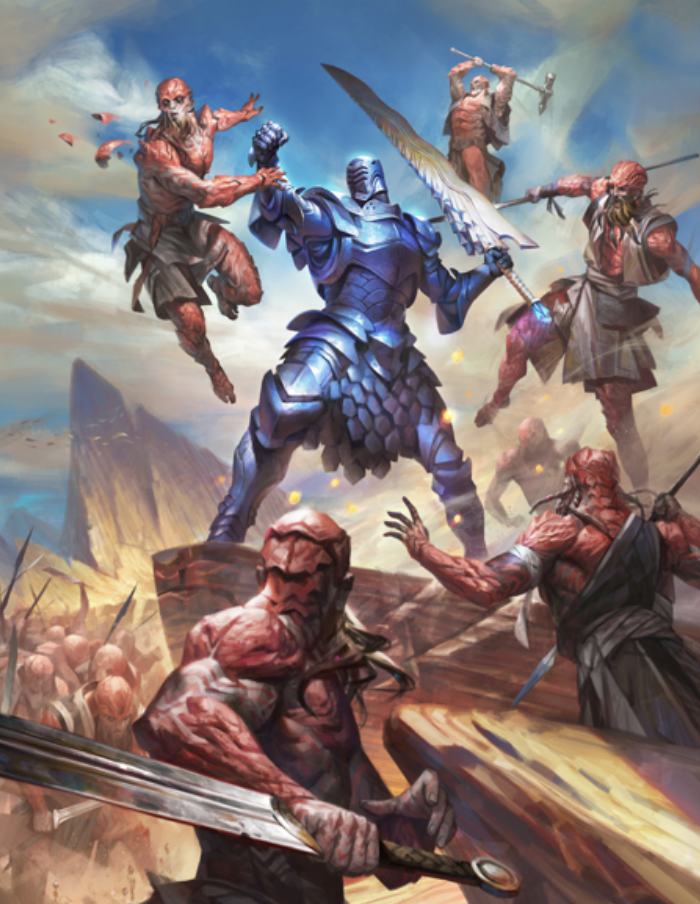
Having never formally studied art, I’m not sure I have the words to describe exactly what I mean, but if you see it with me then you’ll understand; if you like all this art and can’t understand why I’d be criticizing it, I’m happy you’re happy.
Cosmere Roleplaying Game Intended Experience
The Cosmere Roleplaying Game spends a lot of words—a lot of words—saying that the players of this game are collaborative storytellers. The Game Master has a story prepared and the players get to go through it, but also get to be a part of shaping it and making major decisions within it.
It’s the sort of thing that I think will resonate really well with people who love Critical Role or Dimension 20, but that will quickly prove to be flat when put into practice—at least, if done too literally.
In my experience, there’s a clash of fundamentals going on here. Tabletop role-playing games are games. Games can have intended narratives (and, indeed, many great ones do), but the real, best stories that come out of most games tends to naturally unfold based on player actions. (This is also called emergent storytelling.) I couldn’t tell you the overarching plot of most adventures that I’ve played over my life, but I could share with you dozens of little events and incidents that will forever be seared into my brain. On the other hand, games where the Game Master clearly had a specific story to tell and was going to ensure it got told no matter what were generally miserable experiences.
I’m not really confident that Brotherwise Games is specifically trying to encourage Critical Role–style gameplay with the Cosmere Roleplaying Game, though. I think they are just using language that will be familiar to most of their audience, which makes sense. But since that language comes with certain assumptions, it may make starting and learning how to play a tabletop roleplaying game game rough for some groups.
I also don’t think this is helped by the fact that, in my opinion, Sanderson’s worlds don’t actually make great material for tabletop role-playing games. They are all designed with epic and very carefully, specifically plotted stories in mind—and they perform excellently in that area—but not the freeform spontaneity that marks a good role-playing game. Yes, yes—ultimately, a TTRPG is what you make of it, meaning you can adapt the experience to how you have fun. I just think that means Sanderson’s worlds are going to take a lot more adaptation than other settings, with the result of a lot more work on the part of the Game Master than if his group had decided to play a different game.
My Final Thoughts
My grandma used to have the following poster on her wall, and I saw it whenever I went to steal a snack from her kitchen:

I absolutely have praise for the Cosmere Roleplaying Game. I think its core mechanics are awesome, and under other circumstances I would be excited to play the game based on those alone. The game’s presentation and feel is also largely a win, but that’s not usually what decides for me whether or not I’m going to play a game.
The cockroaches ruin the experience for me—or, rather, the elephants I mentioned at the beginning. Elephantine cockroaches. Anyway, I’m not interested in supporting a game, or company, that promotes destructive ideologies, whether sexual or political. I don’t care whether the company genuinely supports those things or is just floating in a political current, it’s bad either way.
I won’t want to have to eat around the bad parts to get to the good parts: I want all good parts!
What makes this all a bigger bummer for me is that I have no faith Brotherwise Games is going to change or do better next time. I don’t believe that these huge problems exist solely because this company is licensing Brandon Sanderson’s Cosmere; I think the company is going to include these elements no matter what they produce. Brotherwise Games announced they plan on using the core rules for the Cosmere Roleplaying Game to produce a non-licensed game called Plotweaver, which will release rulebooks for three “generic” settings: Fantasy, Modern, and Science Fiction. Under other circumstances, these would be instant buys for me, because I like the core mechanics that much, I’m a bit of a collector, and I want to see these rules applied to other settings; unfortunately, I just don’t trust Brotherwise Games to keep their products free of preaching and activism.
Hopefully I’m proven wrong to some degree when the Mistborn Handbook releases next year. I’m not holding my breath.
I can’t recommend the Cosmere Roleplaying Game. It appears to be another symptom of Sanderson’s overall decline as far as worldbuilding and storytelling is concerned, despite polished elements to the actual rules of the game.
Enjoyed this? Consider subscribing! Or go check out one of my novels, The Failed Technomancer and Inner Demon.
- For those not in the know… this is a reference to LGBTQ+, that bizarre and often paradoxical grab-bag of Marxism, mental illnesses, and sexual identities made central (or sole) personality trait. ↩︎
- It’s almost like they didn’t read my disorganized blog post and take my comments to heart or something. Weird. ↩︎
- This also has hilariously open-ended results that could fundamentally break the Cosmere at some point—and also horrible implications. No one’s spirit has an immutable nature, or at least no aspects of their spirit are eternal constants; how you perceive yourself actively changes your spirit, and then magic can “heal” your body to match that perception. That would suggest that this goes far enough that people with horrible, disgusting views of themselves—perhaps because of guilt, or maybe mental illness—would transform into such loathsome creatures when “healed.” One the funnier side of the spectrum, someone who genuinely managed to believe he was a dragon would transform into one when “healed.”
This is all essentially conformed in The Lost Metal when one of the characters—I wish I could remember her name—stamped her soul to reshape it and became an extremely powerful wizard instantly. I just wish that idea hadn’t been brought into harmful areas. ↩︎ - In short, Sanderson crafted a very unique and consistent fantasy world with strict sex and gender rules, then proceeded to break that world by injecting very modern sexual identity politics (with very modern vocabulary and writing styles) and acting as if that wouldn’t create any friction whatsoever.
Along these lines, here’s an amusing critique I’ve seen floating around the internet about this shift in Sanderson’s art: He’s been spending way too much time on Reddit, and treating that tiny, loud, echochambered audience as if it were the silent majority. ↩︎ - This trope of in-game sexual activity is very present in media about TTRPGs. For example, the “horny bard” archetype is common and, I’ll admit, at times amusing—go watch Dorkness Rising for an excellent example of that archetype done well. (Don’t watch Critical Role’s Legend of Vox Machina for an example of that archetype turned into porn.) And yet, these sorts of characters are rarely present in the games themselves, as the players who try to play such characters usually rapidly find how awkward such encounters are with their fellow players, or are told by the rest of the table to knock it off. ↩︎
- Maybe Sanderson’s works are significantly more popular with slavers and human traffickers than basic logic would suggest. ↩︎
- This is one of the most bafflingly terrible pieces of advice I’ve ever read for a TTRPG. Literally all that matters is the people you’re playing the game with; if you want to be silly and exaggerated, as long as everyone is having fun at the table, go for it. Attempting hyper-realism in representing mental illness or physical disability brings unnecessary homework into what’s supposed to be a relaxing experience, and—as is evidenced in Sanderson’s own work, most notably Szeth’s essentially miraculous mental health recovery in Wind and Truth—most likely going to result in entirely different kinds of poor, offensive “representation.”
As a side note, this page also mentions that some people with disabilities can’t be healed with magic if their disability is part of their internal sense of identity because “they’re already whole” (page 298). It all comes across as abled people heavily romanticizing being disabled, for some reason—I’ve never met a disabled person in my life who wouldn’t choose to be totally healed, actually made whole, if given the opportunity. (The only exception might be some of the Deaf people I’ve met. Deaf people are very proud, and protective, of the Deaf community and culture. Many of them view things like cochlear implants as essentially an existential threat to Deafness.) ↩︎ - I once played a half-human, half-drow character in a Pathfinder game who had a magical cloak that, while worn, made his drow parentage appear to be standard elf parentage. (For those not in the know, drow are elves that are generally depicted as universally evil, similar orcs.) In hindsight, this was a pretty silly decision, although at the time I was hoping the Game Master would use that element of my character’s nature to heighten the drama of the game by forcing a reveal at some point. It never ended up happening. ↩︎
- I recommend giving Shadowdark a try. If you don’t already have a game or system you’re attached to. Or, heck, even then. Shadowdark is just that good. ↩︎

 Boo Ludlow
Leave a reply to 2025-10-06—October Newsletter – Boo Ludlow Cancel reply