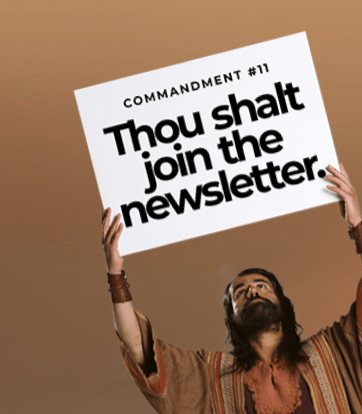
One of the more bizarre TV pilots I’ve discovered on YouTube—and that, perhaps, specifically because of how hard it tries to be familiar. Today, I’m talking about The Promised Land.
The Promised Land — Pilot
The Promised Land Overview
What Is It?
On their way from Egypt to the promised land, Moses and his family struggle to manage the hardest part of their nation’s journey: the people.
The Promised Land is a “workplace mockumentary” with the gimmick being that the people of Israel are the subjects of the documentary as they wander the wilderness with Moses—so the “workplace” is the desert (and significant Biblical locations). (And the cameras… are held by time-travelers? I’m probably overthinking this show.)
I am not an expert on The Office—Michael Scott makes me cringe too much, so I haven’t seen most of the series—but The Promised Land feels a lot like someone really liked The Office, really liked the Bible, and decided to mash the two together to see what happens.
The description of The Promised Land on its own website also mentions Parks and Recreation as inspiration.
Who Made It?
Mitch Hudson is credited as the writer and director of The Promised Land. On the About the Show page of The Promised Land‘s website, he’s noted for having “written and directed a feature film and several award-winning short films, earning recognition at festivals nationwide.” However, the only specific name mentioned in his bio is The Chosen,1 for which he served as assistant director. His IMDb profile provides the names of those other projects, for those interested.
Richie Johns is credited as the producer. His bio doesn’t mention any previous projects, but it does mention “his directorial debut… Still Hope, a powerful feature film inspired by true stories of human trafficking survivors [to be released in 2026].” As with Mitch, Richie’s IMDb profile has a few more details for those interested, but he’s still very much at the beginning of his career and there’s only a handful of projects listed.
In other words, The Promised Land is a big, ambitious swing being done by two young filmmakers looking to make people laugh and share there faith, and probably hopeful to make a splash.
Content Warnings?
Occasionally cringy humor.
Also, I suppose people who are extreme purists about how Biblical figures and events must be represented might be bothered by some of the… interpretations that The Promised Land makes—but let’s be real, such people are not the intended audience anyway.
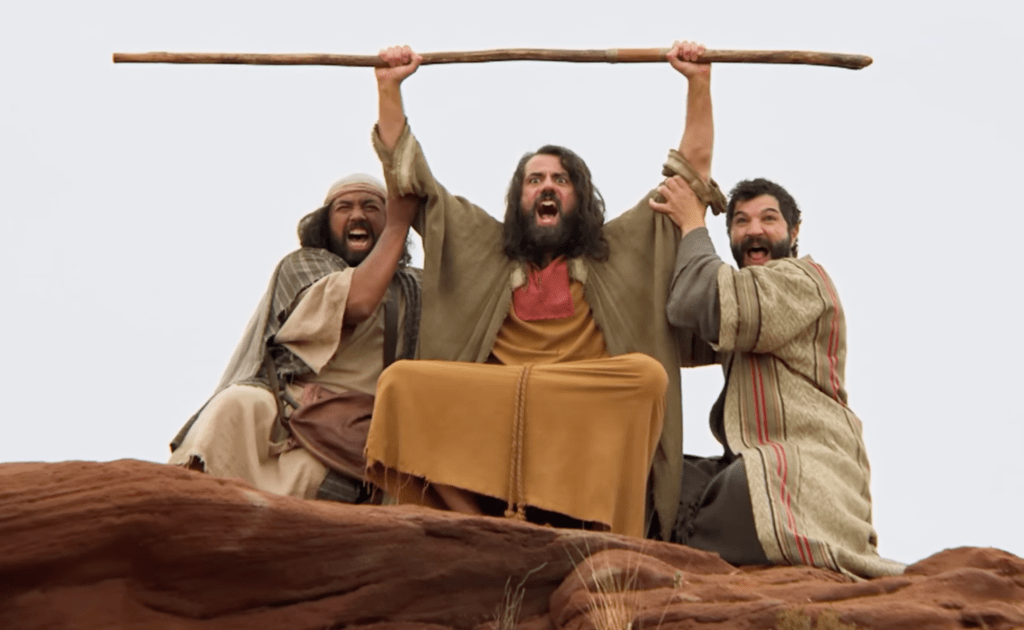
But no, there’s no swearing, there’s no nudity, there’s not even any real violence. There’s some implication of violence off-screen at moments, but it’s done for laughs, not to be gritty or rough. For example, the Pilot references a Biblical moment where the Israelites are at war and God promises they will win as long as Moses can hold his staff in the air for the duration of the battle—which proves to be a lot more difficult a task than first expected as the hours add up—but you only hear “violence sounds” in the background. All the focus is on Moses.
There are some jokes about Biblical practices, such as circumcision, that might come across as gross or bizarre to those who don’t understand the historical or cultural context.
A Brief Review
The Promised Land is one of the weirdest things I’ve ever watched in my life. I’m on the fence about a lot of creative decisions it presented.
But it still made me chuckle, so I kind of like it.
I’ve mentioned The Office and Parks and Recreation already, but the shortest and fastest review I can give is this: if you liked those two shows, and if you aren’t allergic to the Old Testament, then The Promised Land is worth giving a try. If you tend to bounce off of that style of humor and storytelling, I don’t think there’s much else here to capture your interest.
Also… I can’t be the only person who looks at Moses and sees Michael Scott in the late 13th century. Right? Does anyone else see it? I feel crazy…
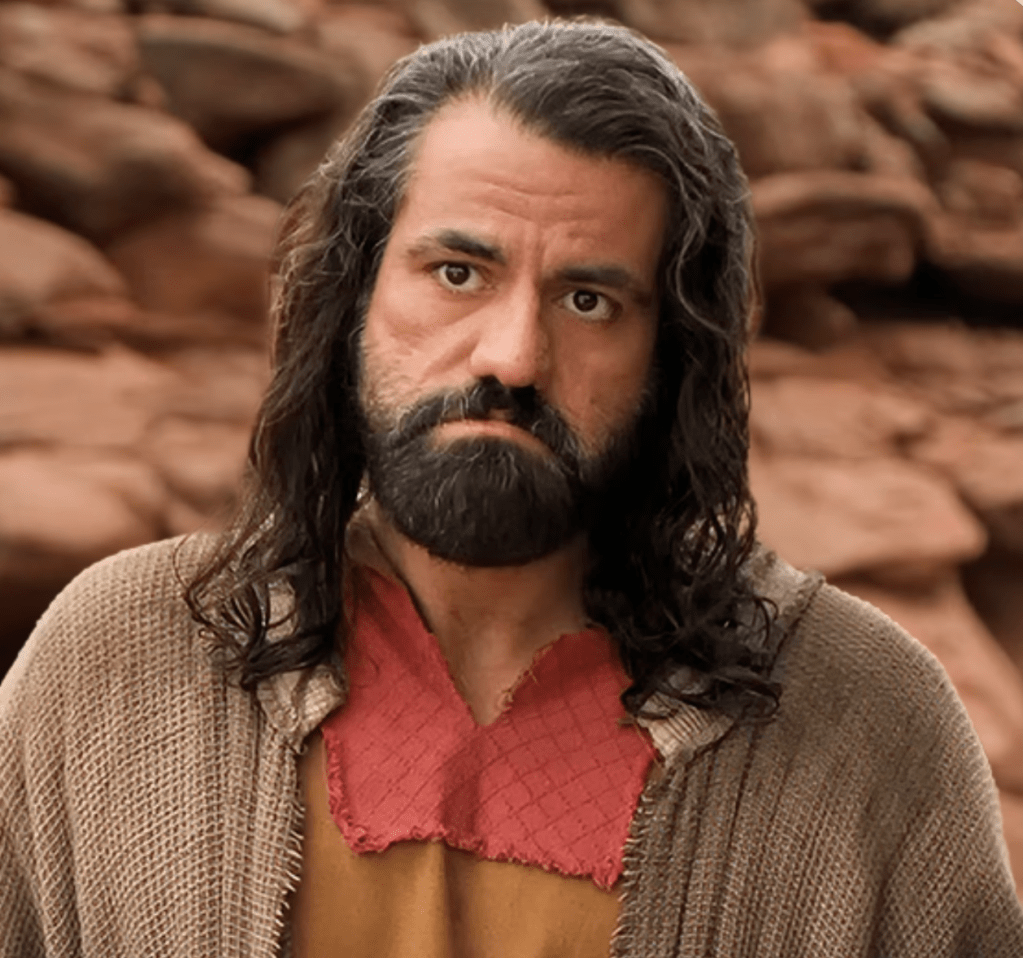

They don’t even look that similar, but there’s just something…
Anyway. For those less familiar with the aforementioned TV shows, you might need a little bit more to get a picture of what I’m talking about, so here it is.
The Promised Land opens with Aaron in a one-on-one interview with a cameraman. He openly acknowledges the existence of cameras, despite ostensibly being a man from the late 13th century; this is kind of a make-or-break moment. If you can suspend your disbelief here, you’ll probably make it through the rest of the episode just fine.2
The rest of the episode largely focuses on Moses as he acts as leader of the people of Israel and judges their day-to-day squabbles—which takes up the entire day, essentially every day, and puts a significant amount of stress on his shoulders. He’s visited by his father-in-law, Jethro, who is unimpressed by Moses’ leadership style and, by the end of the episode, recommends that he learn to delegate.
Other plot threads involve the rest of the central cast: Miriam, who feels underutilized and under-appreciated, and who feels socially threatened by Moses’ impossibly optimistic wife, Zipporah; Joshua, who idolizes Moses (but Moses doesn’t even really remember his name—perhaps an attempted Michael-and-Dwight sort of relationship; Aaron, who maybe is too much of a people-pleaser; Korah who believes he should be in charge; and the single best character of the episode, Chisisi, an Egyptian solder who survived the Red Sea but ended up on the wrong side of the water, who is doing everything he can to blend in as a regular, everyday Hebrew because he’s afraid he’ll get killed if he’s ever found out.
I loved Chisisi. He felt the freshest and most interesting of everyone on-screen and his conflict felt the most pressing and important to me—he believes it’s a matter of life and death, after all.
It’s a colorful and varied cast; almost all of the episode’s movement revolves around each character being extremely quirky or flawed, how events naturally transpire from them rubbing against each other and against the needy, sometimes incompetent tribes of Israel. It’s much more character-motivated than plot-motivated.
There’s a lot of awkward and cringe-inducing humor. But there are also moments of heart and kindness that may tug at your heartstrings. It’s a show that tries to poke fun at the human condition while also cherishing the genuinely beautiful moments.
For anyone concerned, you do not need to be a Biblical scholar to appreciate the show. Some of the Biblical references do cut pretty deep—if I hadn’t seriously studied the Bible for a while, there are a handful of jokes that would have been incomprehensible rather than funny—but you don’t need to understand those jokes to still understand what’s going on.
The Dangers of Portrayal
But why? Why make a “workplace mockumentary” about… Exodus?
The Promised Land‘s website describes the show’s rationale better than I could, and I think understanding that rationale will significantly improve most people’s experience when watching. I’ll attempt to summarize, however: it’s common to take historical figures (particularly from cherished faith traditions) and make them larger than life in our heads and our hearts—but the Bible was pretty clear that Moses was human and had many flaws, to say nothing of the deeply imperfect people he led. Sometimes recognizing the humanity and flaws of such people, without tearing them down or ignoring their accomplishments, is a good thing.
In other words, trying to encapsulate the whole of someone, the bad and the good, can be even more uplifting than idealization. And, hopefully, such representations may give us more hope for our imperfect selves.
If God could lead a nation with a shepherd on the run, a reluctant spokesman, and a sarcastic sister, maybe there’s hope for the rest of us too.
~The Promised Land “Rationale” web page
This can be extremely difficult to represent on-screen and get right, however. Just look at Jesus in The Chosen as an example—many Christians have been vocally offended at one point or another by how The Chosen chose to represent their Savior. Some people even got mad that Jesus was presented as a little bit funny. Not a jokester or a comedian, but someone who could be silly or lighten the mood with an odd comment or observation when the situation called for it—a trait I would consider fairly innocuous, but apparently not to everyone!
Among Christians, at least, Moses isn’t nearly as beloved or revered as Jesus Christ—but he also has the benefit of not literally being God (and not literally being the only perfect man to ever walk the earth), meaning writers have a lot more room to explore what Moses as a character could be while remaining respectful and within the realm of believability for most audience members.
And yet, for whatever reason, believing The Promised Land‘s Moses was harder for me than believing The Chosen‘s Jesus.
I should be clear, the Bible doesn’t hide Moses’ imperfections: he stuttered, he doubted, he panicked, he nearly quit. He once killed an Egyptian guard in anger for punishing a Hebrew slave, debatably an act of murder. When God commanded Moses to pray to draw water forth from a rock, Moses instead struck it with his staff, an act of disobedience (or, perhaps, exuberantly imperfect obedience) that got Moses forbidden from entering the Promised Land. Moses has a longer list of recorded flaws and mistakes than any other prophet I’m aware of.
But all that isn’t the Moses I grew up with. Yes, I read the Bible stories. I watched VeggieTales. But this is my Moses:
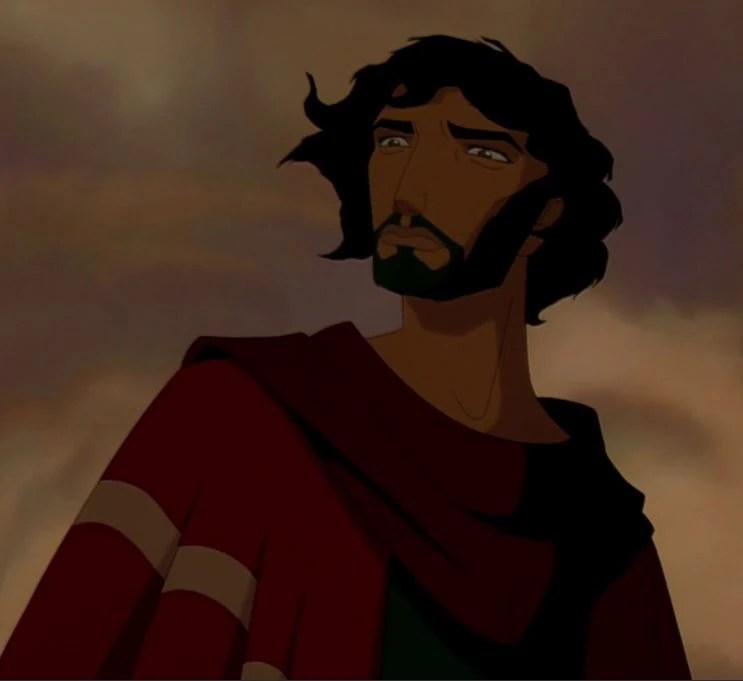

My Moses (from Prince of Egypt) idealizes the man a bit, smoothing away some of his rough edges (or making them fun) while emphasizing his heroic traits perhaps a bit more than existed in reality. It ignores some of his weaknesses, such as his stutter, and portrays some of Moses’ “controversial” moments in an unarguably positive light (killing the Egyptian). But that said, despite not being totally accurate, I don’t think the movie is necessarily unrealistic; many things within Prince of Egypt are within the realm of possibility while, yes, strongly leaning toward positive interpretations.
Perhaps as a result of this, I just did not like the Michael Scott–esque Moses of The Promised Land. He felt a bit disrespectful by virtue of being… imperfect. Even worse, accurately imperfect, but within a fictionalized framework!
I bring all this up not to dog on The Promised Land, or to try to compare it to The Chosen to say which is better or worse—it’s very much comparing apples and avocados—but to point out that your mileage is going to vary a lot with how well you can set aside sacred cows, as it were. With characters like Miriam or Zipporah, I don’t have nearly as strong an image of them in my head, so their quirks and foibles didn’t rub at me wrong—beyond them being intentionally built to have unlikable characteristics, that is. But Moses? I didn’t realize what Moses was in my head until I saw him represented… wrong.
For me, this isn’t helped by the fact that the very genre of The Promised Land leans into that discomfort, as the whole point of a workplace mockumentary is to watch imperfect, quirky people get thrown together like rocks in a tumbler. If any character doesn’t have at least one meaningful trait that makes him unlikable to some audience members, then said character isn’t pulling his weight!

I don’t think there’s a “one answer” on how to get such representations of real people right, because, at least as far as reception is concerned, all that matters is the audience. Some stories consciously bend the literal facts of reality quite a bit but still manage to, in my opinion, retain the spirit of things (The Prince of Egypt); others try very hard to be, as it were, “Biblically plausible” (The Chosen), but that far from guarantees every possible audience is going to agree with what’s plausible and what isn’t.
And then there’s The Promised Land, with parts of it landing in the uncanny valley of character representation and fictionalization, at least for me.
Summing it Up
Like so much television that I’ve reviewed of late, The Promised Land can be watched for free on YouTube, meaning giving it a try is a really minor commitment with little to lose. If anything I shared earlier sounds promising, it’s probably worth hitting up.
As for me, I thought it was amusing; I never laughed out loud, but my nose has several good, strong exhalations and I was entertained. My wife wasn’t impressed; my brother thought it was just as funny as The Office. That’s a pretty wide range of responses, in my anecdotal experience.
I guess what counts as the promised land is different for different people…
Enjoyed this? Consider subscribing below!
I haven’t written any workplace documentaries, but I do have two self-published novels available nearly everywhere, both of which are available in audio for those with ears to hear but not eyes to see. If you like post-apocalyptic science fiction, try The Failed Technomancer; if you like a fantasy adventures with strange monsters and found families, check out Inner Demon.
- And, let’s be real, that should be surprising to no one. Though wildly different in so many ways, The Chosen and The Promised Land still share a lot of DNA, including Biblical roots, faith-based professionals driving the shows forward, similar visual design, deep scriptural cuts—and a really obnoxious way of pronouncing their Rs. ↩︎
- If this show were surreal and absurd rather than trying to stay grounded and down-to-earth, suggesting that Aaron (and the others acknowledging the cameras) were crazy, and that the “cameramen” were just people carrying around rocks tied to sticks, could have been pretty funny. But that’s a wildly different direction than this show wanted to go, probably for good reason. ↩︎

 Boo Ludlow
Leave a comment