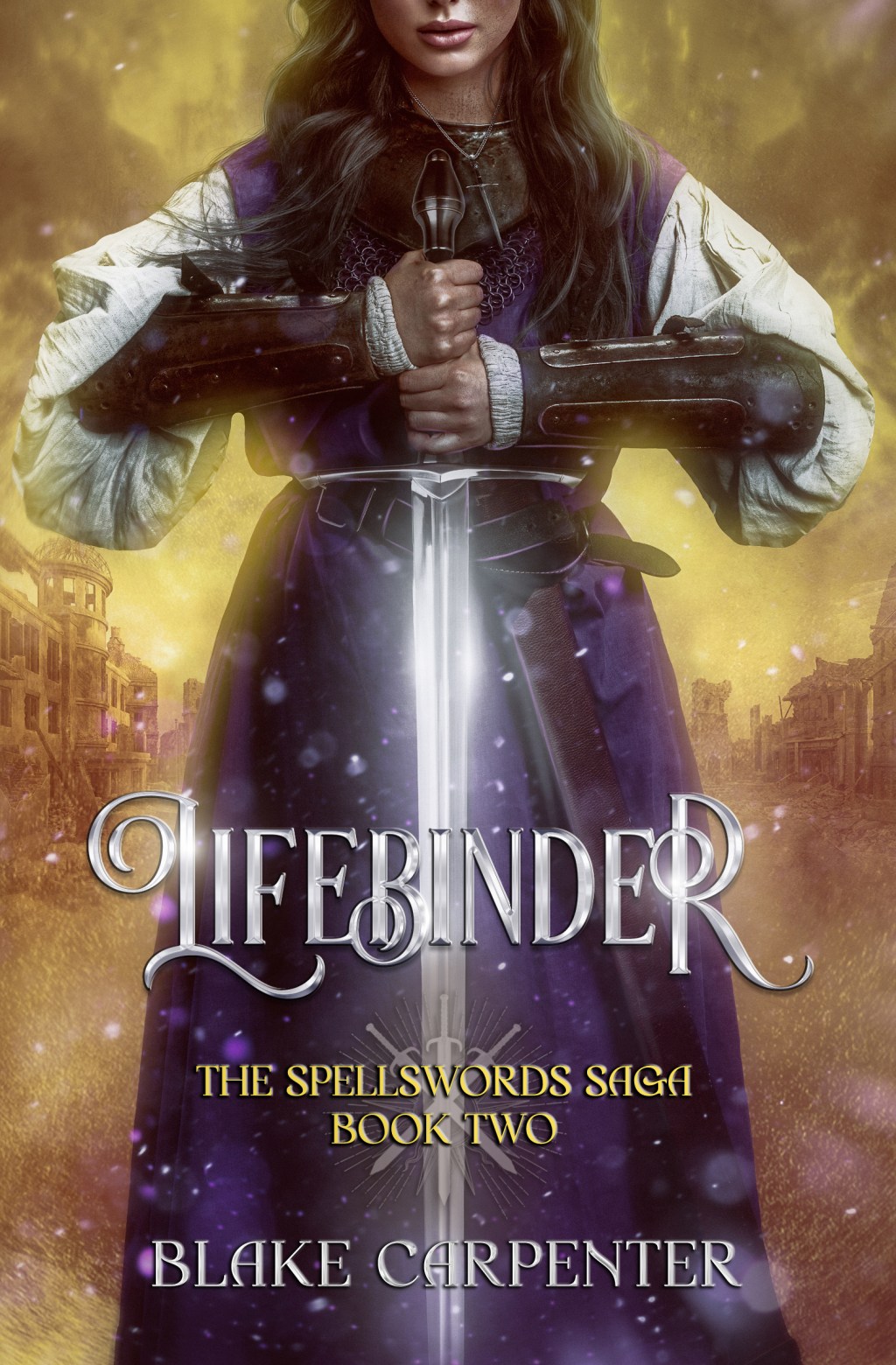
As promised, back for round two—Blake Carpenter’s Lifebinder, sequel to Deathbringer! If you liked the first book—or if you’re generally interested in finding a new series that promises epic fantasy outside of the usual pseudo-medieval trappings—read on.
Overview of Lifebinder
What is It?
Inga Alenir is in peril. The Deathbringer has been reclaimed, and the black sword’s magic is the only thing keeping her alive. Meanwhile, new armies are gathering as old allies make ready to go to war once more. New enemies are tracking Inga from across Agareth, intent on ending her life before she endangers their plans. As she struggles to evade bands of assassins, a threat even more dangerous, and centuries-old, is searching for her.
But some hope remains: Inga learns of the Lifebinder, whose magic is so powerful it can bring the dead back to life. So begins the next stage of her journey—the truth of her family’s downfall is waiting to be revealed, and Inga’s choices will decide not only her own fate, but the fate of everyone on the continent.
Lifebinder is a continuation of Inga Alenir’s story as first told in Deathbringer, Book One of The Spellsword Saga. Its story of adventure, heartache, victory and loss, and asks the question of how to live after revenge has already been won.
Lifebinder takes the relatively self-contained foundation laid out in Deathbringer and expands it into the beginnings of an epic story (a saga, if you will) spanning continents and featuring warring factions and a rapidly expanding cast of characters. Firmly in the realm of fantasy, the story features a heavy amount of magic—although no wizards or sorcerers, since all magic comes from one of two sources, the first being epic spellswords (passed down in long-lasting, but not unkillable, matriarchal dynasties), and the second being “spell-steel”.
The latter, spell-steel, has an important background impact on The Spellsword Saga‘s setting that I’m not sure of the genre word for. There are early cars and airships, trains, “bright-steel” lamps that feel a bit like electric lamps, and other bits of technology recognizable in the modern world, but powered by the magic of this one—as well, guns appear to use gunpowder (revolvers also exist, I think, which suggests the existence of bullets and bullet casings), and many people still carry around swords. Is there a genre term for all of those trappings? Gaslamp fantasy? Arcanepunk? Flintlock fantasy? It’s a fun general setting blueprint and Carpenter makes good use of it, regardless of whatever someone better at marketing than I would call it.
Who Wrote It?
Blake Carpenter wrote Lifebinder; he also wrote Deathbringer, previously reviewed, and The Way of Mortals, which I plan on reading before too long. I described his exploits in more detail in my Deathbringer review, so go check that out if you want to learn more about him. He is active on X; I don’t know that he has any sort of website, but he does have a LinkTree.
Oh, and the man still, at the time of this writing, represents himself online using Tracer Bullet, revealing him to be a man of culture and taste.
Content Warnings
Once again, some swearing, which largely feels very organic (in the sense that it’s used during moments of high or specific emotion, rather than liberally enough to suggest that the author has a limited vocabulary). Nothing so severe as F—, but, to my memory, there’s B— and lesser words.1
This book does not feature any of the innuendo or other limited sexual content of Deathbringer. The most sexual scene that I can think of is a moment where a married couple wakes up in bed together and the wife tells her husband that she’s pregnant and they get really excited. Real steamy stuff, mmm hmmm.
Prior Reviewed Books
Deathbringer: The first book in The Spellsword Saga, although it was self-contained enough that it felt like a stand-alone. Deathbringer is a fantasy vengeance story about a woman widowed on her wedding day seeking to kill her husband’s murderer—and reclaim a magical sword that’s hers by birthright.
The General Review (No Spoilers for Lifebinder)
As a sequel novel, and not a series conclusion, the most important question to first ask is this: Is Lifebinder a strong continuation of what Deathbringer began?
Objectively, I think the answer is yes. It builds on a lot of what was good in Deathbringer; it also raises the stakes and increases the scope.
That said, as far as my subjective reading experience is concerned, it was a mixed bag.
I want to start with what was difficult for me before moving on to what worked for me. First things first, I had a much harder time getting into Inga’s and Kale’s heads and emotional states in this book than in the last book. Let’s break that down.
At the end of Deathbringer, Kale was freed from the Avards and had the choice to return to his sister’s family or follow Inga. Inga, on the other hand, had learned about Kale’s abusive past with Yenda the Younger (as well as largely buried their hatchet), slain all female members of the Avard clan, reclaimed Deathbringer, and finally allowed herself to process the grief she felt over Pyotr’s death, which, crucially, included letting him go. (This happened with her mother as well.) There was absolutely room for more stories to sprout from there, but a lot of problems in Inga’s life were also resolved, and the book ended with Inga planning on leaving the city and heading back toward home—or, what was left of it. As such, I felt a bit of whiplash when Lifebinder opened up with Inga still in Whitehall, having spent several months bumming off of Jaska Isrodel, rebuffing Ruslan Avard’s frequent requests that she finally leave the city, and spending most of her time getting blackout drunk.
In hindsight, I think this move of Carpenter’s makes sense, although I struggled with Lifebinder‘s early chapters. Inga doesn’t have a home to return to—it was burned down by Yenda Avard, everyone (and everything) living there killed. I had assumed that she would seek a new life in the neighboring homestead owned by Mistress Darya, but that wasn’t really home—and maybe it was too close to the physical location of painful memories—so I can understand why Inga wouldn’t have been very motivated to leave once blanketed in the comfort of Jaska’s mansion. I can also understand why Inga, even having largely resolved her emotional turmoil over Pyotr’s death in the previous book, was still struggling somewhat with her ghosts and her emptiness. All that pain and absence doesn’t go away just because she achieved her vengeance and found some degree of emotional resolution—in fact, that was part of the point of the end of Deathbringer.
I think the reason this was difficult for me was because it felt contrary to the momentum at the end of Deathbringer. I was excited to see Inga leave Whitehall and have new adventures elsewhere, and that appeared to be her plan. That technically happens, eventually, but the transition was a little rough for this reader.
I also struggled with Kale throughout this book. I spent a lot of time praising how interesting of a character I had found him in Deathbringer, but in Lifebinder I wasn’t nearly as engaged, and it’s hard to say why. I want to blame it on Kale feeling softer and less confident in this book, but, let’s be real, he was barely holding himself together in Deathbringer (despite putting on a strong face), and he was far from the toughest guy around.
Kale takes for himself a bit more agency in this book, much more actively (and independently) seeking to support Inga than before, but he also had several moments that made me pause and say, “Wow, that was really stupid of you,” most notable near the end of the novel, so no spoilers here—the point is, I hadn’t interpreted Kale to be a bit dense in Deathbringer, nor did I sense his brain frazzled in the moments that he made these poor decisions, so it felt odd.
Finally, on the emotional side of things—the romance between Kale and Inga is continued in this book, and it felt just a bit strained for me. I think it’s because a lot of their romantic development appears to have been put on a simmer during the months that Kale kept Inga from pickling herself alive, leaving what developments that do happen to happen quite suddenly—and in the very little time these two actually spend together. I accepted all that more easily from Kale, but for whatever reason Inga’s side didn’t work as well for me—despite how often Deathbringer and Lifebinder focused on how Kale’s eyes make Inga think of Pyotr. If anything, that should have made it harder for Inga to fall for Kale, when she thinks of Pyotr each time she looks at him. But, to keep spoilers light, there’s still a lot to explore in future books, so it’s not like I expect this element of their stories to be without struggle or growth as the series goes on.
As for the next batch of things I struggled a bit with, Inga is an extremely reactionary character—a lot of things happen to her, and then she makes a big response, but I didn’t really feel her as much as an engine in this story.
To be fair, almost everything that happens in this book kicks off with Inga deciding that she needs to hunt for the fabled Lifebinder—hence the title of the book—so she is at least part of the spark that sets off everything to follow. But the rest of the book flows like Inga is caught in a wild, unpredictable current, carried here and there by other characters and doing her best to stay above it all. Again, she does still make meaningful, impactful decisions, but something about how the following events unfolded left me feeling like things were just happening, rather than having some sort of through-line that drew me along.
On my final bit of criticism, Deathbringer ended, in its epilogue, with a holy order of knights being alerted to the danger that Inga poses to their church and, it appeared to me, preparing to send out an elite squad to either arrest her or put her down—this time for good. That’s not really continued in Lifebinder, at least not as directly as I felt had been promised—several holy knights still play a key role in Lifebinder, to be clear. I think this is a similar situation to my whiplash with Inga still being in Whitehall at the beginning of the book: it appeared to me that Deathbringer had set some pretty clear expectations as to where things were going in its sequel, so when that didn’t happen (and when I didn’t find what was given as engaging as what I thought I had been promised) I was taken out of the book until I realigned my expectations.
So, uh… What worked for me? (That isn’t too much of a spoiler, anyway.)
I still find the world of Agareth interesting. I’m curious to learn more about the rest of the spellswords and their powers—and the epilogue of Lifebinder has me very curious about Clan Chale’s future plans. I’m also very curious about an almost blink-and-you-miss-it detail that occurs while Inga is traveling through the Veil.
I think Inga and Kale are still interesting, and I still want to see them explore the tangled emotions between them.
I’m also very curious to discover all of the shakers and movers in The Spellsword Saga. As one example, Golova does, in fact, make a return appearance in Lifebinder, and it’s nothing like I imagined it would be—far more interesting, far more impactful, in fact. Many more clans with their own spellswords show up in Lifebinder as well, or are at least discussed in far more detail than had happened in Deathbringer, and all of this promises an even more epic scope in the upcoming Bloodlust.
In short, at the time of writing I’m mostly driven by setting, promise, setup, and my deep enjoyment of Deathbringer, but there were still some things unique to Lifebinder that grabbed my attention.
The Story in Detail (Spoilers)
Lifebinder begins several months after the events of Deathbringer. Much to my surprise, Inga is holed up in Jaska Isrodel’s house, spending most of her days getting drunk and generally trying to numb the pain of existence while Kale takes care of her. Turns out her plans to leave Whitehall never happened and, despite having some resolution to her loss of Pyotr in the first book, she’s still wallowing in misery. As I discussed in my spoiler-free review: this all was a bit jarring to me, but in hindsight it makes logical sense.
Inga’s ennui is interrupted by an attempted assassination—while going on a walk with Kale and getting some sunshine, green-clad guards attempt to shoot her in the head. Inga survives thanks to Deathbringer—both the sword’s regenerative powers and its ability to animate the dead—and, thanks to injuries received, also learns that she is still, technically speaking, dead. She can act under her own volition, she’s self-aware and capable of thought (unlike the bodies she animates), but her heart still no longer beats, despite her having reclaimed Deathbringer, and her blood lies black and still in her veins. She would have fully died if she had not reclaimed Deathbringer from Yenda the Younger, but it appears that Deathbringer doesn’t actually have the power to fully restore her to life, at least not fully, but merely to sustain her existence and repair some injuries along the way.
The attempted assassination creates a lot of problems and ultimately results in Inga (finally, as far as Ruslan Avard is concerned) deciding to leave Whitehall. Her goal: to find Lifebinder, a spellsword with the power to turn back death in a variety of ways. Her obstacle: Lifebinder disappeared decades ago during the war her grandmother, Mad Katarina, started, and no one has the slightest inkling where it went. Without any other leads to go on, Inga decides to travel to her destroyed homeland, Denadal, to see if her grandmother had hidden Lifebinder there.
Kale, of course, insists on traveling with Inga, and Kale’s family offers an airship to get them much of the way there—to a city called Tresca. This offer also, fortunately for Inga, gets her out of Whitehall before the Empress shows up, and Inga has every reason to believe the Empress only has a dangerous interest in her.
The beginning of Lifebinder felt even faster than the opening of Deathbringer, so at this point I was just holding on for the ride.
On the way to Tresca, Inga has a brief encounter with another spellsword bearer named Khatei, her sword imbued with powerful magic themed around shadows—including, but not limited to, being able to travel across the continent by using shadows as portals, alone or in company. Khatei gives Inga a warning, then leaves.
Khatei is Inga’s first encounter with the wider world and its interest in her (by virtue of Deathbringer), if we don’t count the Avards. (The Empress doesn’t count because she doesn’t meet Inga in person.) She’s an interesting one; as is probably appropriate for her shadowy theme, it’s unclear whose side she is on, if anyone’s, but she does give Inga reason to be distrusting of most other factions in the empire (not that Inga had any reason to be particularly trusting already). She also helps with opening up the world for the reader quite a bit, as well as to inspire mystery.
At Tresca, Inga only stays briefly; shortly after arriving, she’s attacked by more green-cloaked spies and an exciting return, the Watcherwoman. In Deathbringer we knew her, briefly, as Golova; it turns out she is a bearer of a spellsword as well, nearly immortal by virtue of her sword’s power over time, and her goal is to take both of the spellswords in Inga’s possession, Deathbringer and Frostbite (claimed from the Avards). Though Inga is terribly outmatched by Golova’s swordswomanship, she’s rescued when Khatei grabs her through some shadows and pulls her across the continent to the Holy City of Sitania—sans Frostbite, since Kale was carrying the sword at the time—where she is allowed to speak for herself in front of a congregation of the ruling Matriarchs of the empire.
It’s here that I’m going to take a quick break and mention other events going on at the same time, or that will happen before too long in the story, that are not directly centered around Inga. There are a lot of characters and events in this book, and I won’t be able to touch on all of them.
First off, Sophie. Sophie is the bearer of Lifebringer—we, as readers, learn of her existence, and the location of the sword, long before Inga ever does. Sophie is, for all practical purposes, a slave to Matriarch Frasier, a bearer of another magical sword and the woman who ordered Inga’s assassination in Whitehall and Tresca. Sophie travels with Matriarch Frasier and uses the sword’s power to grant youth to her master every day; beyond that, Matriarch Frasier sees Sophie as little more than a nuisance.
Sophie shows up here and there throughout Lifebinder—I ultimately didn’t find her interesting. I didn’t think I needed insight into Matriarch Frasier through these chapters—she wasn’t particularly complicated, and mostly she focused on how much she hated Inga (and Inga already has a long line of haters). Knowing where Lifebinder was in advance left me feeling that Inga’s intended trip to Denadal was pointless—it wasn’t, but it still colored the reading experience—as I knew Inga’s “princess” was in another castle at the time. And, finally, Sophie experiences minuscule character growth during her chapters; I was hopeful that her growth would turn into an interesting development along the lines of her turning on Matriarch Frasier and then using Lifebinder to grant youth to herself—but that never happened. In Inga’s final conflict with the Matriarch, Sophie is killed offscreen and her sword is given to one of Inga’s companions. Poor girl gets done dirty.
Next, Ruslan. Ruslan gets very few viewpoints in Lifebinder, and what viewpoints he get most importantly serve to prop up further conflict, as he chooses to ally himself with the Frasiers in an upcoming rebellion against the empire. His chapters are kind of interesting, but mostly are promises of things to come.
Finally, Boros and Lenmana. At the end of Deathbringer, in the epilogue, a holy order of knights is alerted to Inga’s existence and, so it appeared to me at the time, readied to hunt her down and either arrest her or kill her. Not so, it turns out! No, these knights operate much more slowly, with Boros, as a leader in their order, carefully picking one other knight to assist him, that knight ultimately being Lenmana because:
- She’s female.
- She has a daughter.
- She’s loyal to the church.
All of this is important because the knights aren’t actually set on whether or not Inga needs to die, but they want to have someone ready to become Deathbringer’s bearer should such a thing be necessary.
Very little actually happens in these chapters. Boros and Lenmana don’t go anywhere; they make plans, they get briefed, and eventually they use Khatei to bring Inga directly to Sitania, the center of the church. After that they escort her to Denadal and generally follow her around, but I’m getting ahead of myself.
Inga is brought to Sitania by Khatei; before Khatei teleports away using her shadow magic, Inga promises a favor to the shadowy woman in exchange for her rescuing Kale (and Frostbite) from the Watcherwoman. Rather than bringing Kale to herself, Inga requests that Kale be delivered to his family. This leads to another side event that I’ll get into later.
This far in the book, a whole lot has happened, but I didn’t feel like much progress had occurred—I knew Inga wanted to go to Denadal in the hopes of finding Lifebinder, but she’s been waylaid from heading there twice now and (thank’s to Sophie’s chapters) I already “know” she’s not going to find Lifebinder there. Meanwhile, Kale has been sent away, and other additional viewpoint chapters are doing more to set up the next book, Bloodlust, than further the events of Lifebinder (such as Jaska’s meeting with the Empress, which happened shortly after Inga fled Whitehall). I was hoping events would soon feel like they had a bit more bite. That largely happens.
Inga presents herself before the gathered body of ruling matriarchs of Agareth, helpfully gathered in Sitania by Matriarch Frasier with the intent of bragging about how she had killed Inga in Tresca—she is quite surprised when Inga walks into the room. Some amusing politicking occurs, which ends with Inga being essentially absolved of all blame by this universe’s equivalent of the pope—the Holy Mother—and told she can travel to Denadal safely, with Boros and Lenmana to accompany her. Inga knows this is a load of bunk and that Frasier will attempt to kill her as soon as they are out of the shadow of Sitania—but that’s a problem for another day, as Inga makes it really clear to everyone there that she just really wants to be left alone, that she doesn’t have any plans past arriving at Denadal—and also that she had the power to kill everyone in Sitania if she wanted to, but she won’t, because she’s not her mad, homicidal grandmother. (It’s a cool moment.) Inga then collects Lenmana and Boros and heads off toward Denadal, initially by train and then by horseback.
Meanwhile, after getting rescued by her, Kale makes some bargains with Khatei, trading secrets for travel. She first takes him to Darya, the steadwoman who briefly took Inga in and cared for her at the beginning of Deathbringer, and Kale gives Darya Frostbite. Darya accepts, becoming the sword’s new bearer—and confirming that no man will ever bear a spellsword. A currently existing sword, anyway. Until this moment I had been really hopeful that perhaps the sword would choose to bind itself to Kale, but, alas, it was not to be. Then Kale and Darya travel by Khatei to… Denadal.
It was previously shown that Khatei can travel directly to specific people, not just to locations. After getting dropped off Kale realizes this, that he should have asked to be taken directly to Inga, but it’s too late now. Instead, he and Darya have to hide and survive in the ruins of Denadal for a time, which are crawling with Frasier forces. Things go… fine… until, while in hiding, Kale and Darya spot Matriarch Frasier walking by. Instead of staying silent, Kale decides to whisper to Darya at that exact moment, “That’s Matriarch Frasier”—which alerts the matriarch to his presence. This moment… felt so unbelievably dense of Kale. Fortunately, his moment of brainlessness passes quickly, he abandons his hiding place so that Darya can stay undetected, and he covers up by pretending that he’s making an assassination attempt. He loses the fight and becomes a damsel in distress, captured by Matriarch Frasier.
It’s at this point that Inga arrives at Denadal—and Kale’s screaming under torture rapidly leads Inga both to Darya and to Kale, leading to the book’s climax and most critical confrontation, Inga’s battle with Matriarch Frasier.
I was not a very big fan of this fight. As I mentioned before, I think Lifebinder did Sophie dirty by killing her offscreen here—after investing multiple chapters into her, it would have been nice for her death to carry at least a little more oomph.2 It also wasn’t helped by the fact that it felt like Matriarch Frasier and Inga were being deliberately stupid:
- On Frasier’s side, she’s spent decades of her life using Lifebinder to reverse her age to that of a young, healthy woman. I have every reason to believe she knows when she must “heal” herself, and the risks she’s taking if she delays that “healing” even a little bit. Perhaps her willingness to throw herself recklessly into a fight with Inga, despite the fact that she starts to rapidly age right before Inga’s eyes not long into said fight, was meant to showcase the depths of her insanity; I thought that it was a move that didn’t make much sense on a character as interested in self-preservation as her.
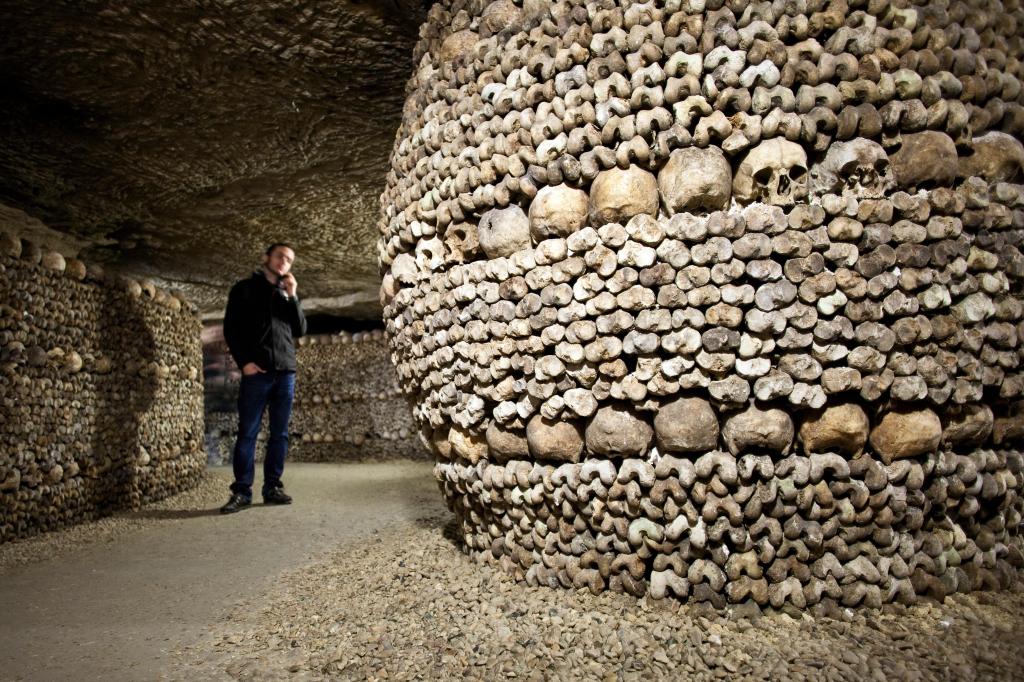
- On Inga’s side, when she first enters Denadal the first thing she notices is the absolute wealth of the dead beneath the city—more dead people are buried in this one location than anywhere else she has ever been in her life; the remnants of the dead are so plentiful that Denadal’s fortress, where her ancestors had lived, was decorated with bones. (You know, like the Parisian catacombs.) Instead of summoning an army of the undead to assist her in saving Kale’s life, she summons a handful (which are relatively easily dispatched) and goes charging headlong into a fight she’s entirely unprepared for.
In addition to feeling as if certain characters were acting a little out of character, I think Inga’s fight with Matriarch Frasier ran into another issue: if magic is going to be used to resolve major conflicts, I need to understand the magic well enough for that to feel satisfying, and I don’t. Not really, at least not beyond the idea that each sword is world-shakingly powerful in some way—but shouldn’t that mean overcoming the magic of each sword should be incredibly difficult?
I understand the magic of Deathbringer well enough, I suppose. That sword animates (and commands) the dead, including artificially sustaining the life of its bearer; the corpses Deathbringer animates are nearly unstoppable, have to be hacked to pieces before they are rendered inert; and the sword’s power waxes and wanes with lunar cycles. But Greenward, Matriarch Frasier’s sword? It appears to have the power to create, grow, and control plants freely, which left me wondering why Inga even remotely stood a chance against Frasier; why didn’t she summon a ludicrous amount of vines to wrap Inga up, render her immobile, and then execute her? That happened to many of Inga’s undead solders. Alternatively, why didn’t Frasier create a plant wall between herself and Inga to give herself a moment to escape when it became clear the fight was going against her? Does she even have that ability?
Credit where credit is due, Inga’s fight with Frasier ends in spectacular fashion: with Frasier separated from her sword and held over a pit full of animated bones, moments away from being dragged down to what feels like hell—and then her own granddaughter gives the go-ahead for her execution. Absolutely metal.

After Matriarch Frasier is killed, her granddaughter escapes with her spellsword via Khatei, who calls in her favor with Inga to prevent Inga from killing them both. Katei proves her fickleness, though, by leaving Lifebinder in Inga’s hands, despite the fact that Frasier’s dranddaughter had claimed it. Inga then gives Lifebinder to Lenmana, who binds herself to it, adding a new swordbearer to Inga’s limited list of allies and resources.
Then Inga goes outside, where she finds that a few descendants of the previous inhabitants of Denadal had returned, anxious to begin rebuilding their homeland now that Inga is back. Inga has little to promise them—she has no resources, after all, beyond herself and her sword. She also has other priorities. She knows Jaska is off to play diplomat for the Empress, but since Inga has every reason that the clan Jaska is going to visit, clan Chale, is dead set on war anyway—not to mention clan Frasier is still hellbent on plunging the continent into conflict—she basically tells the returning Denadains to take care of themselves as she animates every single dead body beneath Denadal in preparation to march for war.3
(Or so it seams. Since I was completely wrong about what the endings of Deathbringer actually promised for its sequel, perhaps Bloodlust will open with Inga having changed her mind, instead using her undead army to rebuild Denadal before doing anything else. It could happen!)
Once again, the epilogue managed to excite me, and I hope I’m right about the direction it suggests Bloodlust will be headed: Clan Chale appears to have made some major breakthroughs in creating new spellswords, and the Watcherwoman is planning on allying with the Frasiers, as well as the other rebellious clans intent on taking down the empire. Whatever happens, there’s going to be a lot of blood in Bloodlust—which, given its name, is pretty appropriate.
As I started with, Lifebinder was a pretty mixed bag for me. I found its opening a little jarring, I had mixed levels of entertainment throughout, and it almost lost me at the end, before getting me excited with the last few pages of the main book and in the epilogue—I’m hopeful I find Bloodlust to be more consistent when it comes out.
Other Details
As I mentioned in my spoiler-free review, a lot happens in Lifebinder, but I was often left feeling like there wasn’t a strong through-line tying events together. Some little details that contributed to this feeling didn’t really fit into my above review, so I’ll put them here.
There’s a handful of times where what Inga needs—whether she knows it or not—is just given to her. This happens in dreams, with a mysterious bearer who can control access to the Veil gives Inga a lot of information for unknown reasons, as well as connects her with a bearer whose sword grants her a constant (and debilitating) flow of knowledge. Inga doesn’t learn a lot, but she does learn that she shouldn’t use the magic of Lifebinder to heal herself—her being technically dead is the only thing that makes her immune to the time-warping magic of the Watcherwoman, as death is outside the limits of time. Characters just being given things is rarely satisfying; couple this with Inga learning that she more-or-less needs to abandon her quest, and I was left wondering why Inga had left her alcohol cocoon in the first place.
I don’t know what Carpenter has plotted out, although I loosely remember him mentioning on X that he’s a discovery writer—if that memory is correct, he probably didn’t have an outline he was following when he wrote these scenes, but I wish Inga had done something to earn this knowledge in some way. Perhaps it would have worked to have Inga be briefly healed, get attacked by the Watcherwoman, escape, and then figure out for herself why her being dead is the best state for her to be in (for the time being). It’s not my book, I don’t know, I’m just spitballing.
Tangents: Force Doctrine
This tangent is a blending of two things: my comments on the matriarchal society that Carpenter has built in his books, as well as something called force doctrine.4
Previously, I had commented that I found Carpenter’s depiction of a successful matriarchal society to be the best of which I’m aware. By that I meant I found it much more interesting and much more believable than others—after all, women and men still act like, and feel like, women and men in the world of Agareth, despite some minimum necessary changes born of women more frequently taking roles of leadership and control. (There’s nothing quite so lazy as creating a matriarchal society and, in effect, making every woman in it a man with a uterus and every man in it a woman with testicles—but that’s the easy road that other authors take.) Despite this being the best example of a matriarchal society (in fiction) that I’m aware of, I still had questions as to how such a culture would come to be in the first place—unless the men of Agareth, since the beginning of mankind’s existence in that world, were far more agreeable on average than the men of our world, it would take some truly unique circumstances for women to not only take most leadership roles but also hold them throughout the centuries and millennia, such that most men don’t even question their second-class place in the world.
Well. Perhaps Carpenter has a different answer, to be revealed in a future book, but this aspect of Agareth’s setting finally clicked in my head, finally made total sense, in Lifebinder, and the answer is a simple one: the spellswords. Duh.
I doubt that Carpenter was intentionally conjuring up force doctrine as he was building his world and writing his books, but the spellswords are a massive gamechanger that firmly put women on the most powerful end of force doctrine. After all, Lifebinder makes it clear that only women can be bearers of spellswords—this makes the force imbalance between the sexes extremely centralized upon the few female bearers, but this imbalance is so vast that it makes total sense that women would seize positions of control and authority and maintain them throughout the generations, ultimately building a culture and social order that upholds and enforces this hierarchy.
If this is intentional, I think this is a sign of really adept writing on Carpenter’s part. Yes, not every aspect of a fictional world that differs from our own requires justification or explanation, but a really good one can make such worlds significantly more compelling and, as happens in The Spellsword Saga, serve as a foundation upon which setting, character, and even plot can be strongly built.
If this isn’t intentional, I think it’s further evidence that good authors of fiction can serendipitously reflect deep truths about reality as part of doing their craft really well. Another example of this could be Alan Moore and Watchmen—the hateful communist that he is, Moore wrote Rorschach with the intent that this man who believed in good and evil and punished criminals should somehow be hated by Moore’s audience, but instead Rorschach became a beloved hero. Yes, Rorschach, in an objective analysis, is a much grayer character than I’ve summarized here, but I think the general point still remains.5
Ultimately, Agareth is a great example of how really well-done fiction can weirdly well adhere to objective truth (as best as we understand it) while still presenting all sorts of impossibilities. The Spellsword Saga doesn’t exist as merely a thought experiment on what a world could look like if women somehow held a monopoly of force over men, but such a thought experiment does exist within Agareth, and has been fleshed out really interestingly.
Wrapping Up
Lifebinder didn’t work as well for me as most other readers (judging by the largely positive reviews on sites like Amazon, Goodreads, and X). That said, I liked Deathbringer a lot, and there are still things going on in The Spellsword Saga that interest me enough to want to keep reading—but I think Bloodlust will be the make-or-break. If that book grips me the way that Deathbringer did, I’m all in. If I find myself with as mixed engagement as I had with Lifebinder, I’ll probably move on to another series. We’ll see!
Enjoyed this review? Consider subscribing below so you never miss an update! You can also follow me on X.
If you want to try out another fantasy novel, consider my book Inner Demon, which features a girl with amnesia who can use shadows and portals—and has a good friend in need of rescue. Alternatively, if science fiction is more your speed (particularly of the post-apocalyptic, robots-are-eating-people variety), I think you’ll enjoy The Failed Technomancer.
- Three perhaps useful clarifications here in understanding how I handle content warnings:
First, I think context and use affects whether or not swearing belongs in a book (or, at least, whether it is used effectively and with purpose). To be brief, I think restraint can lead to some beautifully effective cursing (particularly when used naturalistically), but many modern authors apply swearing in the same manner that an alcoholic applies alcohol.
Second, for me, I generally think of swearing in three categories. First are words like “damn” and “hell,” which barely register to me (and most people, in my experience), but I still wouldn’t use them at church. Second are words like S— or B—h, which I don’t use (or allow in my house), but, to my observation, are used commonly enough by a large enough body of everyday people so as to have a middling level of weight. Third are words like F—, which I might tolerate in the right artistic contexts, though I strongly dislike such language and pretty much always prefer it to take no part in a story—but, more importantly, I think most people recognize such words as being very strong and very crude, probably the strongest and crudest words in our language.
Third, I read Lifebinder in ebook form, which I find miserable for searching through to find things, so all of this is according to my memory, supplemented with little or no reopening of the book. If there are swear words stronger than I mentioned in this review, they didn’t stick with me, for whatever reason. ↩︎ - That said, Sophie’s presence also proved me wrong (when I thought Inga traveling to Denadal to find Lifebinder—when I, the reader, already knew it was elsewhere—would be pointless.) ↩︎
- The amount of dead beneath Denadal suggests that the ground level is going to be reduced by a few feet after every skeleton in the area finishes clawing its way into the moonlight. ↩︎
- I first learned about force doctrine through a man named Andrew Wilson and clips of the Whatever podcast. (Deeply authoritative source, I know). I don’t agree with everything Andrew says (on this or any other topic), but there are aspects of force doctrine that I think are self-evidential: for example, the idea that might doesn’t make right, but it does make rights real. Or, in other words, whether or not something is in truth a right only has bearing on reality if someone chooses to enforce or protect that right; in the face of opposition, such enforcement or protection requires not just force but possession of the greatest force (i.e. capacity for violence). After all, if a greater force decides such a right shouldn’t be acknowledged or respected and is willing to effectively use its bigger stick, in practice the “right” in question disappears.
In relevance to The Spellsword Saga, there’s a hotly debated corollary to force doctrine that men have a monopoly of force over women, so women’s rights only exist because some men choose to restrain other men from harming women. Debating either viewpoint isn’t my purpose here; the world of Agareth interestingly keeps regular women just as physically weak, relative to men, but still puts females as a sex above men in terms of power dynamics because of the spellswords, interestingly complicating how force doctrine can be interpreted (and complicating how cultures, societies, and so forth naturally develop, assuming this aspect of force doctrine accurately describes how people function in the real world). ↩︎ - I also want to clarify that I don’t think Carpenter is like Moore at all, in that Carpenter is, so far as I can tell, a stand-up guy and not a hateful communist, not actively disdainful toward swaths of this audience, doesn’t seek to put down truth and goodness in his writing, etc. ↩︎

 Boo Ludlow
Leave a reply to 2026-02-02—February Newsletter – Boo Ludlow Cancel reply