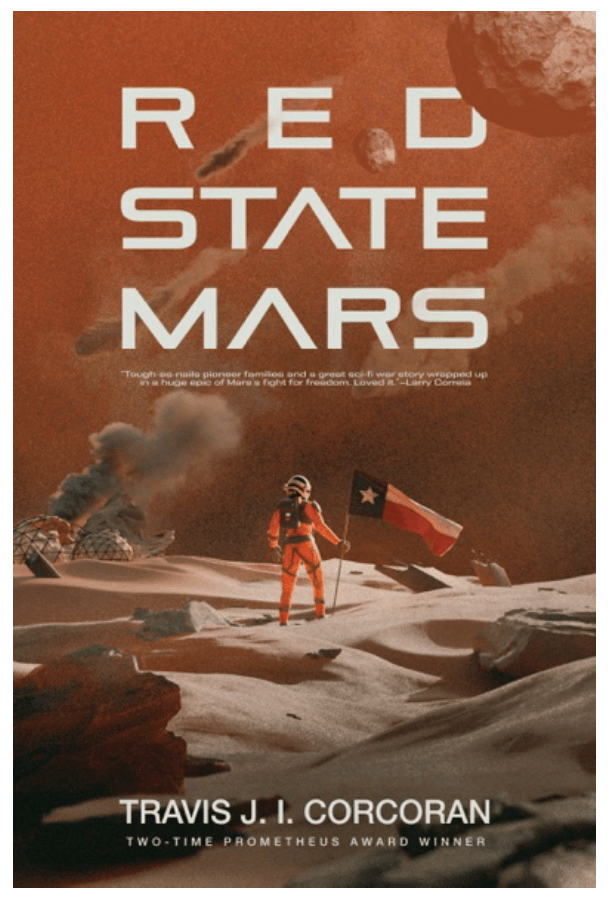
Tough-as-nails pioneer families and a great sci-fi war story wrapped up in a huge epic of Mars’s fight for freedom. Loved it.
Larry Correia
Imagine my surprise when Ark Press sent me over a survey asking if I had any interest in ARC copies of their upcoming novels. Free books, most likely in one of my favorite genres, or in an adjacent genre? How could I say no?
I doubt I was targeted for any reason other than being a backer to the American Paladin Kickstarter, though. I’m a minnow in the pond that is the internet, and almost all of my views, at least according to my site analytics, are on my reviews for things like Space King and various Glitch productions, Knights of Guinevere being the standout.
Anyway, that there’s my disclosure—I read Red State Mars as an ARC book. I wasn’t paid for this, nor was I coached in any way, so I still consider this review to be as unbiased as any of my reviews are. And, thankfully, I liked it, and I would generally recommend it—but read on to learn more about why!
(Also—sorry for the extremely blurry cover photo. I was sent a bizarrely small image of the cover, so that’s the best I can do.)
Overview of Name
What is It?
A sweeping epic of Mars’s fight for freedom—an unforgettable saga of war, family, and civilization on the red frontier.
For generations, the Newcastles, Mackenzies, Atkinses, Hyltons, and Hollinses have endured the hard red soil of Mars—surviving by individual grit, intense family loyalty, and free market trade. Scarred by World War III and Earth’s long, violent aftermath, they built farms, raised domes, forged alliances, and carried old grudges to a new world. Together, Martians have forged a frontier society that is complex, ornery, and rooted in the freedom of Texas soil from which many of the clans sprang.
Trade with the nearby Chinese enclaves brought prosperity for a time. But as Bejing’s reach lengthens, trade becomes tribute—and tribute becomes force.
When Chinese armored columns grind across Karl’s Ramp and convoys are torn apart in the Chaos, Mars is plunged into war. Robinson City’s dome falls in fire and blood. The Burrows holds out under siege until supply convoys break through beneath burning skies. At Lowell and Meltwater, city shields collapse and the red Martian soil melts and flows like blood as the Martian plains are seared with plasma fire.
The clans face an empire pressing down from above and rivalries tearing them apart from within. Senators brawl in council halls, mobs surge through the streets, and old feuds erupt—even on the football field. Out of devastation, a fragile coalition is born: uneasy, volatile, but fierce enough to strike back. Freightliners become fortresses. Drones become weapons. Family honor hardens into resistance.
From isolated domes to the vast Martian plains to the black sky above, war sparks into revolution and a desperate struggle to forge a nation on an alien world men now call home.
A vast chronicle of war, settler clans, and civilizations, of families too proud to yield, too divided to trust, and too determined to be ruled.
Military science fiction, grounded (and hard) sci-fi, colonial sci-fi, and a family saga all woven into one—Red State Mars juggles a lot of things, and I largely found that it kept every ball in the air. This is a story of how a bunch of American (to be more specific, Texan) settlers of Mars ended up plunging into war against Chinese settlers, who were eager trade allies until Beijing decided it was time to bring their distant colonies firmly under their direct control. The pacing is good, the set pieces amazing (and creative), and there’s a good amount of variety in beats of action, emotion, and politics.
Who Wrote It?
Travis J I Concoran wrote Red State Mars. I have never heard of him before this, so here’s his author blurb in the book itself:
Travis J I Concoran’s debut novel, The Powers of the Earth, and its follow-up, Causes of Separation, won the Prometheus Award1 for best novel two years running. Concoran is also the author of Red State Mars for Ark Press. He’s since published many other science fiction novels, and is also the author of the hugely popular homesteading manual Escaping the City. Concoran resides with his wife and dogs on a 56-acre farm in New Hampshire, where he writes code, raises goats and pigs, and tinkers with cantankerous machinery, while also serving as a Republican member of the New Hampshire House of Representatives.
If you want to find Concoran elsewhere, he has a presence on X and he has an Amazon store page.
Content Warnings
Swearing, and a lot of it. F—, and everything else, is used frequently.
I would largely describe this book’s swearing as “realistic,” so it didn’t bother me in the same way athat nother story’s swearing might; nonetheless, it will be an immediate turn-off for anyone sensitive to strong language.
By “realistic,” here’s what I mean. There’s a large clan of highly religious folk in this novel—the Hyltons—and they rarely swear, if ever. Children, generally speaking, are well-reared and thus largely keep their mouths clean. But the Atkins clan? Almost every other word is a curse word. The soldiers in general? Blue might be their favorite color, and they like it when it streaks. And so forth. These patterns feel well-mapped to how real-world people operate, and who would believably show up in the various scenarios this novel presents. If you’ve spent much time around said archetypes of people, it’s the kind of language that, while coarse, might just fade into the background of your mind.
As for other content that’s commonly found to be objectionable, there’s nothing worth noting. No sex or nudity, no glorifying violence or depravity, no glorifying drug use or abuse, no explicit torture, etc.
The Review
I have never read a family saga novel before Red State Mars (unless Orson Scott Card’s The Worthing Saga counts), so I spent the first few chapters of the book entertained, but confused. Names were being thrown at me left and right, and very large groups of people were being treated like a single mass character. It was a lot to keep track of, and it left me with some mixed feelings, initially.
Well, it turns out, that’s exactly how many family saga stories are supposed to work—the protagonists are more the group (or groups) than any one person, although there are individuals representative of each group who serve key narrative roles, and the story frequently “zooms in” on these characters. Once I got used to the “hand-off” moments—moments where, often, an older character ceases to get as much focus, with a younger character taking his place as representative of the next state of the family’s development, this unique aspect of the book really clicked. I’d be curious to give more books of this sort a try.2
But the moment that really had me hooked was early on in the book, during a trade negotiation between the Martians and the Chinese. For decades, the Martians3 and the Chinese4 got along great through open trade, but during one trade run the Martians notice something is off. A new guy is in charge at the Chinese outpost, someone who essentially demands subservience from the Martians and who declares all previous trade illegitimate, requiring the Martians to entirely repay decades of trade. The unreasonability of this request aside, it’s also an impossible one to comply with, and so tensions rapidly build until there’s a shootout, marking the first direct, armed conflict between the Martians and the Chinese.
I really can’t emphasize it enough: I was on the edge of my seat that entire scene.
And, fortunately, Red State Mars isn’t a one-trick pony, as it had many, many other moments that grabbed me and would not let go, most notably a handful of set pieces that wonderfully illustrated how smart and scrappy the Martians are, particularly when pushed into a corner. As fun as it would be to describe these set pieces, I’ll restrain myself, as I think it’s worth it to experience them entirely fresh.
I found many other elements of the book engaging as well. The grounded science fiction was very interesting, particularly in moments where the perspective shifted to be that of a drone, or a ship computer, or one of this novel’s many AI semi-characters. (There were also moments where the sci-fi was over-explained and my eyes started glazing over, but those were few and far between.) The depiction of different groups as people was extremely well-done—especially for the Chinese, actually. I cannot tell you how well Concoran made me hate the Chinese aggressors in this book, while still feeling deep pity for the civilians who just wanted to escape from tyranny.
Red State Mars isn’t a perfect book. There’s a lot of political infighting between the Martians; while I largely found these scenes as engaging as the rest of the book, some of them dragged on a bit long and didn’t feel like they led anywhere, other than to show that the Martians weren’t very well united at all. I also found the willingness of some Martians to bow to the Chinese utterly baffling, and not in an interesting way. Once the Chinese start executing your people and blowing up your cities, I can understand how accepting the “compromise” of the war ending and you paying a small tribute to the Chinese government might sound like a better alternative than all-out war, solely in terms of minimizing the short-term death count—but no one can be stupid enough to recognize this won’t ultimately end with your children or grandchildren under total submission to authoritarian Chinese control, right?5
All right, that’s probably me raging against a toxically pacifistic mindset, one that Concoran believably and effectively portrayed, rather than a weakness in Red State Mars. Just because I didn’t like an element in a book (an element that served as a legitimate source of narrative conflict) doesn’t mean it was a weakness.
But here’s a real weakness: after so many amazing military moments, and some political ones, the climax of Red State Mars is the war just… ending. After one of the coolest, most successful gambits by the Martians yet, with Martian and Chinese soldiers lined up and ready for a final, brutal struggle, some political maneuvering back on Earth results in China losing the will to continue the war, causing them to cede land and resources to the Martians and enter into a state that feels like a cold war. I got the sense that Concoran was trying to be realistic to real-world conflict, which rarely, if ever, ends with a satisfying final battle in which evil is entirely eradicated, but that doesn’t necessarily make for a satisfying ending to a novel—rather, a lukewarm one.
I probably wouldn’t be bothered by this conclusion if I knew that the story of Red State Mars would be continued in a sequel—as I did not believe for a moment that the CCP equivalent in this novel would fully commit to peace, as least not forever—but this book is intended to be stand-alone, so far as I am aware, so I was left feeling a little unresolved.
Wrapping Up
Here’s the most important thing, though: I enjoyed Red State Mars, and I am actively excited about the potential for more books in this universe. I’m also curious to check out other things that Concoran has written. As such, I think it’s fair to say that the whole is greater than the sum of its parts, meaning I can wholeheartedly recommend Red State Mars.
Enjoyed this review? Consider subscribing below so you never miss an update! You can also follow me on X. I’m hard at work on the final stretch of Halfwhisker, and you’re not going to want to miss it when this book goes live.
Sci-fi fans should consider checking out my debut novel, The Failed Technomancer. Dark, post-apocalyptic science fantasy, featuring a protagonist who is expected to save his home village, but is entirely incapable of doing so. If you prefer fantasy, try Inner Demon, a found family fantasy novel about an amnesiac girl who has a kidnapped friend in need of rescuing.
- Perhaps putting this commentary here is slightly rude—it’s not intended to be that way—but I have to ask: does anyone care about awards? I can’t think of one time that I’ve read a book because it, or its author, won an award.
Same with movies. Same with video games. I just care if I’ll like it, and since I mostly view awards as popularity contests I don’t see how any of them would be a real indicator of what I’m looking for in a book. ↩︎ - Concoran has a chapter at the end of this book where he discusses where his inspirations came from, and there he states he’s interested in writing a prequel, also a family saga, and I’ll be keeping my eye out for that. ↩︎
- Composed of Texans ex patria and their children, who were born on Mars and view themselves as wholly Martian. ↩︎
- The equivalent, but with China as their homeland; notably, many of the Chinese on Mars were trying to escape from Beijing’s authoritarian governance, only to find that tyranny’s grasp stretches as far as the red planet. ↩︎
- “I prefer peace. But if trouble must come, let it come in my time, so that my children can live in peace.” ~Thomas Paine
The “peacekeepers” apparently never read their Thomas Paine. ↩︎


Leave a comment