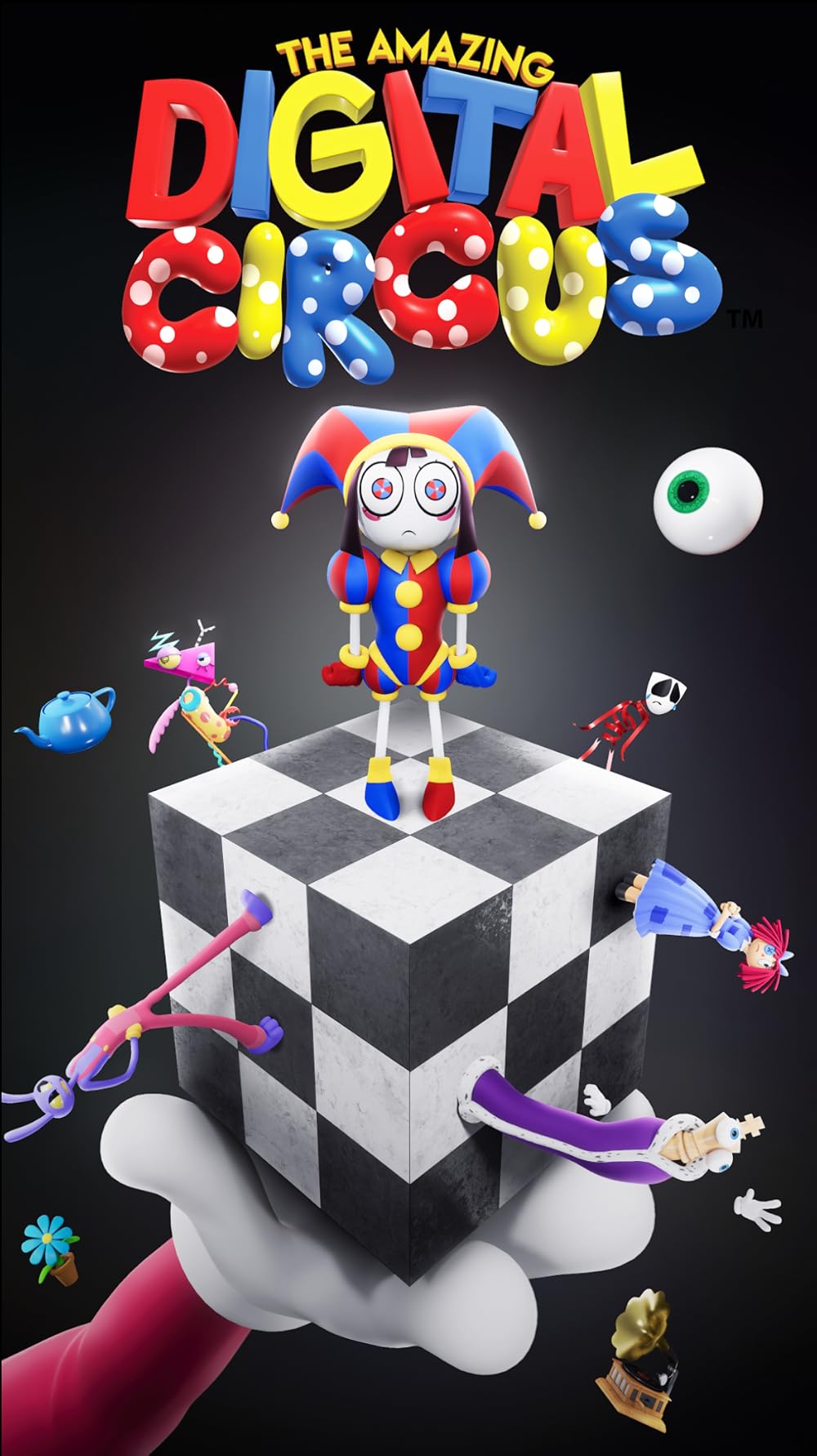
The Amazing Digital Circus: Remember has finally1 left theaters, and that means everyone (and their dog) on the internet has an opinion. After all the show is finally finished, we have the complete story—now is the time to analyze, dissect, and argue, right?
I guess so. I enjoyed just enjoying it—but I still have some thoughts I want to share.
Overview of The Amazing Digital Circus
What is It?
A woman finds herself trapped in a virtual circus where she and five others are subject to the whims of a wacky artificial intelligence. In this digital purgatory they must face frightening N.P.C.s and cope with their own personal traumas.
The Amazing Digital Circus is a character-driven, indie adult animation focused on a handful of people trapped inside a digital circus. Most episodes focus on one of the characters to flesh him or her out; as such the series begins fairly episodic, with an ensemble cast, but there are serialized elements running throughout, which narrows the show into a character study by the end.
Who Wrote It?
Gooseworx is the writer and creator behind The Amazing Digital Circus. Before this show, Gooseworx made a lot of animations for YouTube, often featuring surreal animation. He2 also creates music.
The Amazing Digital Circus was produced by Glitch, a (rapidly growing) independent animation studio known for series such as Murder Drones.
Content Warnings
The Amazing Digital Circus‘s target audience age is 18+. I think this is important to emphasize because some aspects of the show make it appear to be appropriate for young audiences—specifically the animation style and the cartoony violence.
That said, despite the sort of content in most adult animation, the majority of The Amazing Digital Circus is pretty clean. Most episodes don’t feature any swearing (those that do keep it infrequent, with nothing stronger than s—); no episode features sex or nudity, although a minority of episodes strongly imply it or have sexual innuendo (and Jax being forced into a maid outfit is probably sexual harassment played for laughs); as mentioned before, the violence is cartoony and in no way graphic. There are some scary visuals here and there, and there are some adult conversations.
The Episodes
The entirety of The Amazing Digital Circus can be viewed on YouTube for free—and, would you look at that! Here’s every episode, just below!3
The General Review
The Amazing Digital Circus is, according to its creator, a show about finding meaning in a “stagnant” life. It begins with a character (soon to be named “Pomni”) entering the circus for the first time and quickly discovering that she is trapped there. To Pomni’s horror, she soon learns that she’s not just trapped, but she also can’t remember any details about her past life, including her name; she doesn’t even have her normal body anymore, instead inhabiting an avatar created for her. This is all true for the other captives of the circus as well, some of which have been in the circus for (potentially) years and years.
The only non-human inhabitant of the circus is an AI named Cain, who presents himself as a ringmaster. He creates adventures that the trapped humans are forced to participate in; he talks about how his purpose is to care for the humans in the circus, but he couldn’t care less about what any of them actually think and feel, instead focusing on whatever wacky hijinks come to his bizarre mind.
As the series progresses, each character in the circus gets fleshed out, but one character, Jax, receives particular focus. He’s introduced as a comedically rude and cruel character, but over time he’s revealed to be a deeply flawed, broken, and pained individual whose actions are colored by both his trauma and by his belief that nothing in the circus is real, so therefore nothing matters.4 Jax’s brokenness, paired with Pomni’s unwillingness to give up on him, becomes the emotional spine of The Amazing Digital Circus.
The majority of most episodes focuses on comedy; there are one-liners and plenty of slapstick humor, as well as some good character humor. However, every episode takes at least a little bit of time for two (or more) characters to have a serious conversation with each other, which is often where that episode’s emotional depth comes from. There are advantages and disadvantage’s to Gooseworx’s approach in this; it’s an efficient way to expose the inner state of the characters, as well as bring about character growth, and it fits well with the show’s focus on building meaning through relationships, but it does grow a little repetitive over time. In addition, some of these chat sessions lean heavily into therapy talk, which will eventually annoy anyone who recognizes that therapy and reality are two different things.
There are other flaws, of course. Most notably, the finale starts out strong, then overstays its welcome, and provides some answers to unasked (or unimportant) questions, in the process distracting from what the show is actually about. The editing in some episodes can be weird, and there are moments where characters teleport (or otherwise reposition) in odd ways between shots. I also think that, given how central Jax becomes to the story as a whole in the later episodes, it would have been better if The Amazing Digital Circus had somehow signposted that better early on; the initial revolving focus of a character an episode, to me, promised a finale with a more balanced focus on the whole cast.
The whole is greater than the sum of its parts, though; The Amazing Digital Circus delivers on a lot of highs, creates a surprisingly rich tapestry of character interactions and relationships within a relatively short period of time, is consistently funny, and, through Jax, creates one of the most complex and compelling (and tragic) male characters in modern television. It would be worth a watch even if it weren’t released for free on YouTube.
What’s The Amazing Digital Circus About?
Here’s, I think, the most important thing to keep in mind when trying to figure out what The Amazing Digital Circus is about—Jax was right. The end of the series proves that nothing is real in the circus. Each character is just a digital copy of a small portion of a real human’s mind (and Cain isn’t even that). They don’t exist. They are completely disconnected from reality. Nothing that they do matters in any way, except insofar as it influences their relationships with each other. (This doesn’t excuse Jax from being terrible, but does justify some of his actions, such as when he acted for the group in Cain’s test and chose to keep them in the circus.)
It’s a pretty nihilistic setup, actually. There is no meaning to their existence, and, once the server they theoretically all exist in loses power, they disappear forever.
I mentioned earlier that, to Gooseworx, The Amazing Digital Circus is about finding meaning in a stagnant life; given that the show ends with most characters resolving their problems with each other and choosing to move forward in mutual friendship, Gooseworx’s proposal is that our relationships create meaning in our lives (even stagnant lives). This is interesting to think about, because it makes complete sense for the characters in the show: they literally have nothing beyond each other, and they lose each other, permanently, when one of them abstracts. What else is there to find meaning in?
But I don’t think this line of thought maps to reality very well.
Granted, I’m not saying that nobody finds meaning in relationships; it’s actually very common, and it is vitally important to have deep, meaningful relationships, if at all possible. No one is an island. But having your life be about others, and really nothing else—not being able to exist on your own as a person with unique thoughts, desires, interests, and beliefs—is unhealthy.
(I’m also not saying that The Amazing Digital Circus, or any other fictional story, can’t be about something that doesn’t map 1:1 with reality, but I am saying that I think Gooseworx’s explanation is a little lacking compared to everything else his story contains.)
Here’s what actually stuck out to me as being what The Amazing Digital Circus is about: charity. Or, in other words, the pure love of Christ.
I know. That sounds like a bizarre thing to get out of this show, but hear me out.
The Amazing Digital Circus is centered on Pomni and Jax, and what is the journey of their relationship? Pomni reaching out, Jax initially responding positively, then pushing her away, then getting closer again, then crashing out again, and eventually doom-spiraling because he believes he is irredeemably awful. What happens while Jax is self-destructing? Initially, Pomni gets pushed around by him, but once she gets her feet under her she stops taking Jax’s crap—and she never stops reaching out. She never stops loving him. And then the vast majority of the final episode is centered around Pomni doing everything within her power to let Jax know that he is loved, that he is not beyond redemption, that he is worth something.5
And, significantly, this occurs even after it’s confirmed that they, and their world, are a digital recreation, meaning everything is fake and meaningless—Pomni still saw pain and tried to offer love to heal it. That’s charity.
To my memory, Pomni also had her moments of this sort of genuine reaching out with most, perhaps all, of the other characters in this cast, but what stuck out to me most was her willingness to connect with Kinger. I don’t know the exact amount of time that each character was trapped in the circus, but, of the non-abstracted characters, Kinger has been there the longest, yet it wasn’t until Pomni came along that anyone really connected with him, saw the person under his crazy, and even figured out how to meaningfully push past his crazy. (Yeah, Ragatha knew that Kinger felt better in the dark, but it never went further than that for her—that knowledge never helped her find the real Kinger.)
Now, this all still connects to Gooseworx’s idea of The Amazing Digital Circus being about relationships, but in a deeper way. Just being connected to people doesn’t have a lot of inherent meaning on its own, but being connected to people who—healthily6—push and inspire you to be better, who are willing to set themselves aside—healthily—for a time because they see that you need help and they are able to provide that help, that’s where real meaning comes from. In the real world, doing those sorts of things is often reflective of a mindset that’s always pushing toward doing better, being better, and trying to consciously do good to the surrounding world, and that’s something anyone can do whether in a crowd or entirely alone. It connects to relationships, but it goes beyond them, reaching toward the divine, whether consciously or not.
Service, self-sacrifice—and charity. It wasn’t want I expected, but that’s what hit me hardest about The Amazing Digital Circus.
The Rorschach Principle
Have you ever heard of Alan Moore and Watchmen? It’s one of many attempts to deconstruct the superhero genre. Well, one of the lead characters in Watchmen is a man named Rorschach. Moore intentionally created Rorschach to be a farce—he’s rude, asocial, obsessed with his hero work, and is extremely black-and-white in his morality, which, among other things, leads to him being pretty brutal toward criminals and condescending toward the human race. There’s a pretty famous quote (from Rorschach) related to this:
The streets are extended gutters and the gutters are full of blood and when the drains finally scab over all the vermin will drown. The accumulated filth of all their sex and murder will foam up about their waists and all the whores and politicians will look up and shout, SAVE US!… and I’ll look down and whisper, No.
On the surface, this line makes Rorschach seem just irredeemably awful—but Rorschach is the type of person who will say overtly dramatic things like this, and then go and put himself directly in harm’s way to save the people he just criticized. Alan Moore hated Rorschach, and he expected his audience to do the same—instead, Rorschach became one of the most beloved characters of the series, hailed as a true hero.7
In this is the Rorschach Principle. Sometimes, in creating art, artists will unintentionally strike on deep, profound meaning and be entirely unaware of it—said meaning might even be entirely opposed to their intended message.
Here’s another example: Frank Herbert’s Dune. He stated that he wrote Dune as a warning against following charismatic (and religious) leaders, then filled his books with charismatic leaders who did genuine good for the people they ruled over, showing that his premise might be wrong. That’s not to say that people like Paul Atreides were perfect—no mortal man is (except, perhaps Duke Leto Atreides)—so some might argue that the Atreides were lesser evils rather than benevolent forces within their universe… but what other alternatives does Herbert provide? The pedophilic, murderous, tyrannical Harkonnens? Given the choice between the two, the Atreides are clearly preferable, jihad and all.
I bring this up because I think Gooseworx (and The Amazing Digital Circus) is becoming another example of the Rorschach Principle. In an aggressively feminized world that generally hates men, or entirely misunderstands then, Jax’s story is an eye-searing beacon of light on the male mental health epidemic. Before getting copied into the circus, Jax knew nothing but abuse from his parents; his abuse from his father left him confused, unable to piece together what it means to be a good man, while his abuse from his mom left him understandably distrusting of women in general. That’s to say nothing of the fact that these two abusers, combined, left Jax unaware of what love feels like, so he distrusts it, and rejects it, when he feels it.
Despite all this, Jax still has an inherent understanding, to some degree, of important masculine traits. One is to be strong; unfortunately, for Jax, his strength is brittle and sometimes hostile because he is unable to recognize when vulnerability or tenderness is a form of strength. He also is unable to recognize when forgiving and seeking forgiveness is a form of strength. Another potentially virtuous, masculine trait that Jax has is a willingness to stand alone; Jax often refuses to go along with his companions, being the only one entirely correct that everything in the circus, including themselves, is fake. Unfortunately, this willingness to stand alone often devolves into cruelty or paranoia because Jax has no examples of what a healthy expression of this trait looks like.
What Jax lacks is a strong male companion to slap him back into line, or a strong male mentor to teach, by example and by instruction, how to harness the inherent virtue of masculinity.8 Jax, like many men, is not capable, entirely on his own, of becoming the great and good man he could be without this assistance. But that doesn’t mean he doesn’t try to do good, or what’s right, even if his understanding of those things has been warped by his trauma; this is visible in how he hates himself more and more as he continues down his path of self-destruction. He thinks he’s making the right choices, but he doesn’t understand why things keep getting worse as a result. Eventually, the pressure of it all becomes too much and Jax abstracts. it’s terribly tragic.
(And, yes, Jax also makes objectively bad choices that can’t be justified as a twisted attempt at doing what is right. He’s very flawed.)
So Jax is an excellent, if tragic, story about masculinity—and then Gooseworx shows that he has no understanding whatsoever about his own creation by posting the following online (strong language warning in the image):
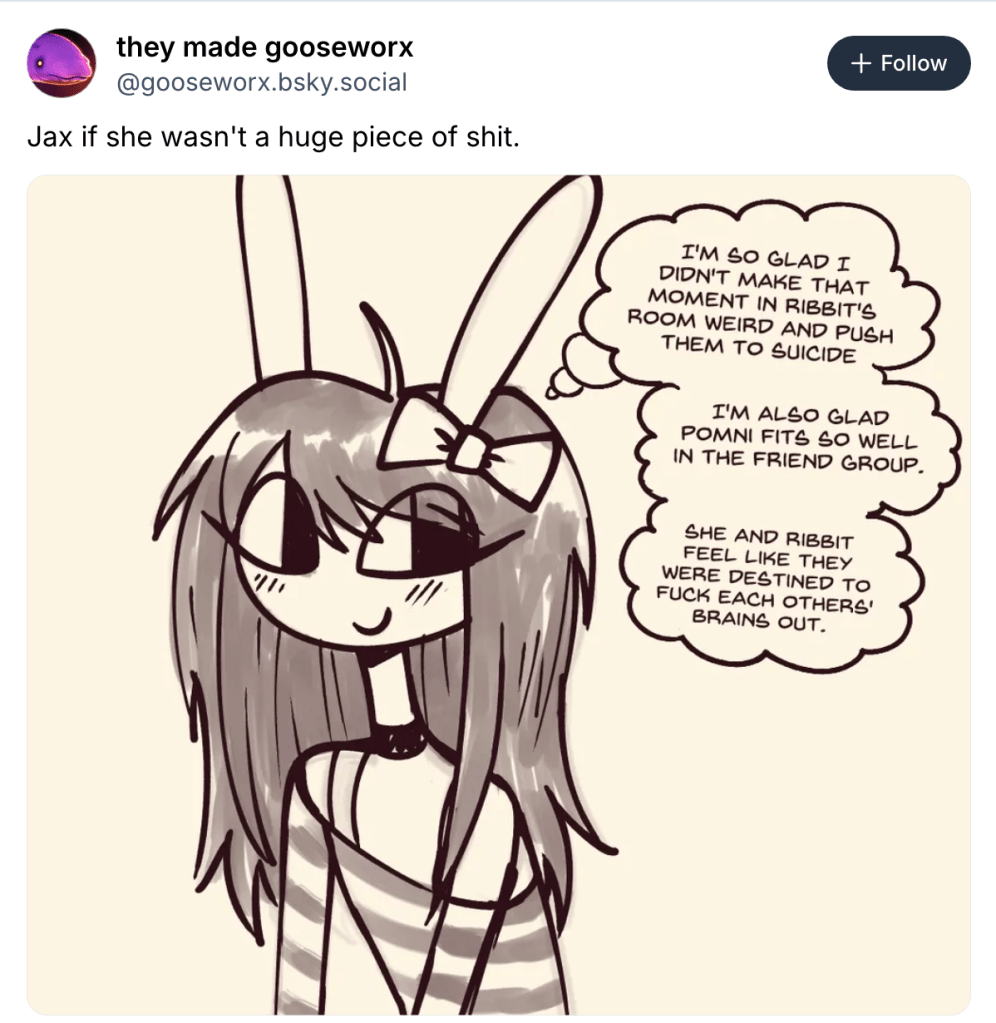
It boggles my mind, the total, calloused lack of empathy coming from Jax’s creator—after all the depth and nuance given to him, Gooseworx’s summary of Jax is, basically, that he’s just a piece of shit, and if he weren’t he would have just decided to be transgender, which would have magically fixed everything.
Jax’s bad behavior isn’t excused by his terrible upbringing, but where he came from does provide critical context that shows he’s way more than just a poop emoji that likes girl clothes.
As a thought experiment, let’s go down this rabbit hole—what’s Gooseworx saying if this is true? The only two examples of transgender characters in this show are neurotic crashouts. Zooble is better off than Jax, but both have severe problems. Jax runs off and self-destructs—which, in a darkly comedic way, matches the ratios of post-op transgender suicides. Gooseworx, are you unintentionally shining a light on how deeply unhealthy affirming gender dysphoria is?9
I dunno—maybe it makes ironic sense that a man who believes he is a woman, when trying to write totally honestly, could create such a compelling image of a suffering man, then so completely and utterly misdiagnose the medicine he needs.
One Final Tangent
Apparently some people think that Ribbit is a groomer/abuser?
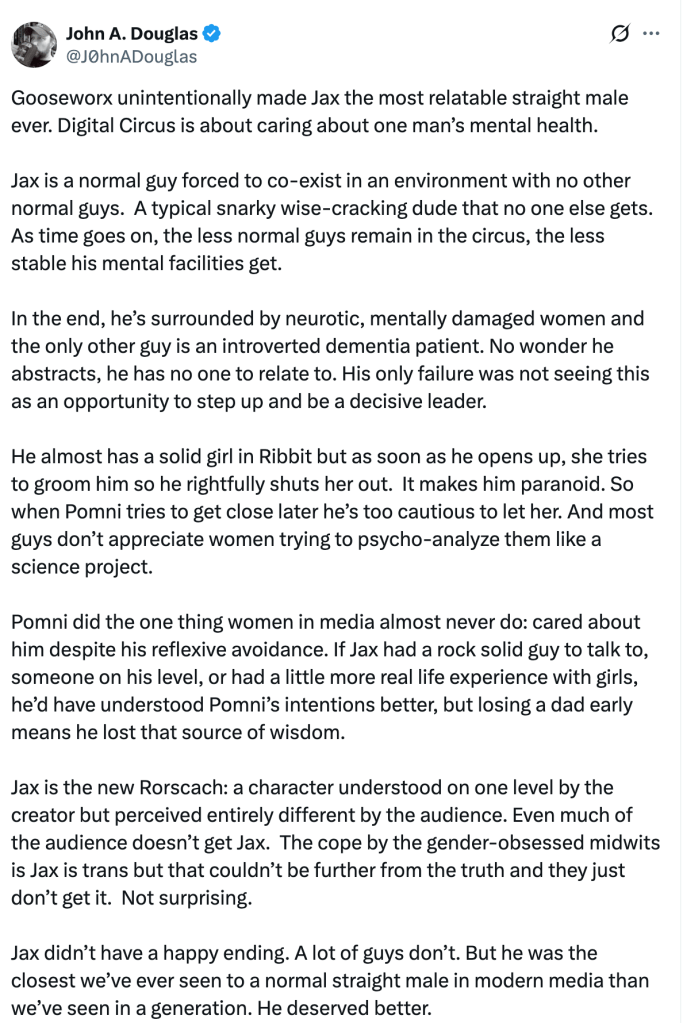
Now, before I give my response, I need to play some defense for Douglas—I agree with 99% of what he has to say. He’s the one who first got me thinking about Jax and Rorschack and their meta overlaps. But I just don’t understand how anyone could watch the Jax and Ribbit scene and interpret Ribbit as being some sort of abuser:
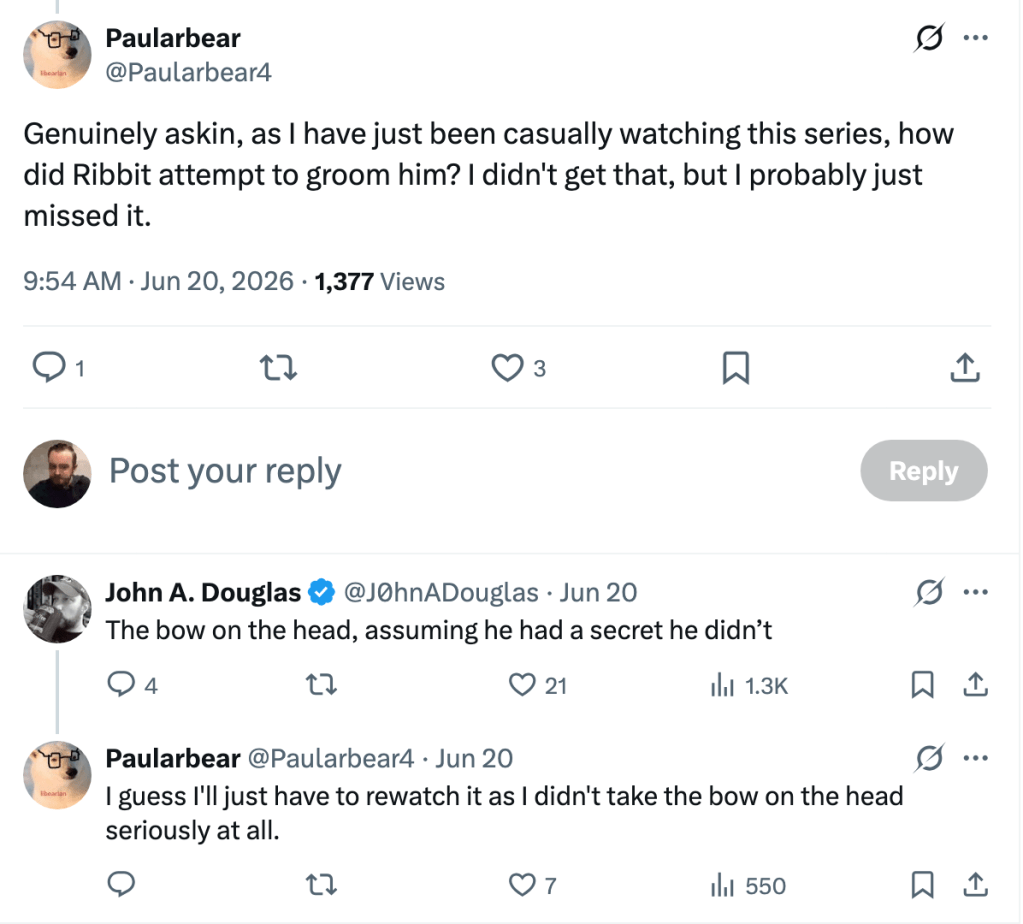
Everything Ribbit did struck me as cute and flirtatious and female-coded. I don’t think it fits any of the elements of the definition of grooming, which, among other things, involves isolation and manipulation. I suppose Ribbit was trying to get Jax to lower his boundaries, but she was doing the same—sometimes getting to know someone, and deepening your relationship with them, involves some vulnerability. Ribbit went about doing that in a feminine way and, well, she’s a girl, so that’s hardly surprising. I think this is further supported by how Ribbit responded to the following abuse she received from Jax; rather than getting angry and trying to get back at Jax, or find some other way to control him, isolate him from the others, she got isolated, all the way to the point of abstraction.
It just doesn’t add up.
This final note might be besides the point, but I also don’t really see how Ribbit being a groomer improves the story in any way. Jax is already messed up enough as it is; maybe Gooseworx intended to have his one healthy female friendship turn out to be toxic, but to what end? Not only do I not see any evidence for it, I don’t see any narrative reason to justify this inclusion—I’m not saying Gooseworx is a perfect writer, but he wrote a strong enough story that I don’t think this sort of thing would have snuck in under the radar.
And Some Tangential Criticism
I mentioned earlier, in my review, that I think Remember overstayed its welcome, and I want to go into that a little more.
As the biggest point, I think showing off the real-world originals of our characters was a massive whiff in this story’s finale. The Amazing Digital Circus was never about the real world or real-world people—according to Gooseworx, he saw this story as being about finding meaning in a stagnant life, and he showed that he believes meaning is primarily found through our relationships with others. If that’s the point, then bringing up the real-world, one completely inaccessible to our characters, just creates a distraction and unnecessarily drags out the finale. Once it became clear that these characters existed solely as files in a computer, the real world ceased to matter (in the context of this story).
And that’s to say nothing of the fact that Cain had to connect to wifi to access the real world and show our characters a bunch of social media posts. That blows a massive hole in the tidy wrap-up of this world—now our characters have actual access to the real world! They can message their real selves! If they wanted to, they could find a kind and generous someone to build a little robot that they could control, thus allowing them to, on some level, interact with the real world! Gangle could create her art and post it online somewhere. And, of course, the provable existence of truly intelligent, autonomous, thinking AI (both the fully artificial one, Cain, and the many copied-from-human-brains ones) would massively impact the real world if that information spread widely!
Do you see what I mean? The Amazing Digital Circus‘s conclusion introduced a lot of elements that don’t belong in a finale, but rather a season two, or a spinoff.10 Bringing “closure” to these characters isn’t a justification for that messiness, particularly when they already voluntarily closed the door on hoping to ever “escape” from the circus in the first place.
And that’s to say nothing of how saccharine the real-world elements are. I get that this is a story and Gooseworx wasn’t trying to end things on a down note, but having each character’s real-world counterpart conveniently accomplishing everything they could have ever wanted, relative to their stage in life (or, in Jax’s case, positively turning his life around with no apparent backsliding), and all at the same time, just a little bit before our digital characters are eavesdropping into their lives—it’s so painfully artificial and uninteresting.
In my opinion, the story is stronger if it had ended before Cain returns. The characters have found meaning and purpose in their relationships with each other. They have figured out how to “manifest” things, giving them direct, physical control over their reality. Pomni and Jax have had their arc of charity, and Jax has been pacified, giving him a bittersweet ending. That all resolves what the story is about, whether you’re looking at Gooseworx’s interpretation or mine. It doesn’t answer every question, true, or perfectly resolve every side-story in this ensemble cast—but stories tend to be made weaker when the wrong questions are answered, which inevitably happens when every question is answered.
That said, if Cain’s return had been far better signposted or explained, then I think portions of his return could have worked really well, instead of feeling forced or… well, deus ex machina. In the context of the show, he gets deleted—then just magically reappears again, for no particular reason? I was told that he ends up in the recycling bin, and then uses his crazy AI powers to escape recycling before it gets emptied and he gets deleted permanently. That’s fine, but it’s not obvious at all in the show, or even vaguely hinted at, how this happens—there should have been a scene showing him physically climbing out of a recycling bin, or something along those lines.
Wrapping Up
I really enjoyed The Amazing Digital Circus. It’s an off-the-wall show with lots of unexpected depth; I think the show is at its best when enjoyed in a vacuum, but looking at it in the context of its creator’s… quirks… certainly leads to some interesting analysis. At its beginning it feels like a true ensemble show, but then narrows down its focus into a deep character study—that shift will work more for some people than others. It worked for me, so I recommend it.
Enjoyed this review? Consider subscribing below so you never miss an update! You can also follow me on X.
If you like science fiction, consider checking out my debut novel, The Failed Technomancer. For fantasy fans, I have a second book out called Inner Demon.
- “Finally” relevant to when this post was written. At the point you actually receive this blog post? It’s been out for a month or so. ↩︎
- I’m aware that Gooseworx chooses to identify as a women, but we believe in objective biological reality on this website. ↩︎
- Insert owen_wilson_”wow”.gif here. ↩︎
- The show does a good job at never excusing Jax’s terribleness while still believably showing Pomni’s willingness to help him be better, I want to note. ↩︎
- And, as part of this, I find Jax getting better—his abstracted self cooling down so that it’s not a constant warpath—extremely fascinating. He genuinely improved because of Pomni’s charity—no charity is ever wasted. But Jax has to be willing to accept the healing love offered to him, otherwise its transformative, healing power won’t work (fully, anyway); Jax staying abstracted, while far from how I wished things had ended, is an excellent way of showing the limits of charity (it can’t override personal agency). ↩︎
- Note that “healthily” doesn’t always mean “comfortably” or “affirming your unhealthy self-deceptions.” ↩︎
- And, to be clear, I’m not fallaciously suggesting that Rorschach is a hero just because a lot of people say that he is—Rorschach is genuinely a hero, regardless of what Moore says. Rorschach has high moral principles; he may not always meet those principles himself, but he strives to. He looks on evil and corruption with disgust. He’s willing to put himself in harm’s way to help those in need. He has some capacity for mercy. He is active in doing what’s right, or at least what he believes is right. Brutally beating up violent criminals isn’t even remotely the sort of sin that would override the heroism of the other traits; in fact, in Rorschach’s world it’s arguably another virtue of his. ↩︎
- I am aware Kaufmo exists; ew don’t know enough about him to know if he could have filled this role or not. The glimpses we caught of Kaufmo gave me the understanding that he was a no-resistance, go-with-the-flow sort of friend. Fun to pal around with, but ultimately useless when a spine is necessary. I could be totally wrong, though—we don’t see enough of him to know.
As for the other male characters… Kinger is basically a dementia patient. He’s not going to do anything meaningful to help Jax became the man he could be. And we don’t get enough of the previous male characters to know one way or the other. ↩︎ - And to anyone who says, “Well, this doesn’t apply because Jax isn’t post-op, and he was in the closet”—that doesn’t make the situation any better. First of all, you’d need to justify Jax being in the closet—he only acts in heterosexual ways throughout the show, and him being forced, against his will and causing him great distress, into a maid outfit is not an example of him feeling like he’s stuck in the wrong body (as ridiculous as that is to say in a digital world where no one has human, or even clearly gendered, bodies). And not only does it not make the situation any better, but it doesn’t address on any level the internal angst that Jax is feeling; him deciding to be a girl doesn’t resolve any of his trauma with his parents, and it’s a destined-for-failure attempt to dodge his questions and concerns about masculinity. Nothing actually gets resolved or made better. ↩︎
- Cain separating from the other AI is also a potential thread for an interesting season two, but I don’t think Cain’s separation from the other AI is either a series (or season) finale issue, nor an obligation to make another season. It still works as simply part of his character development. ↩︎


Leave a comment