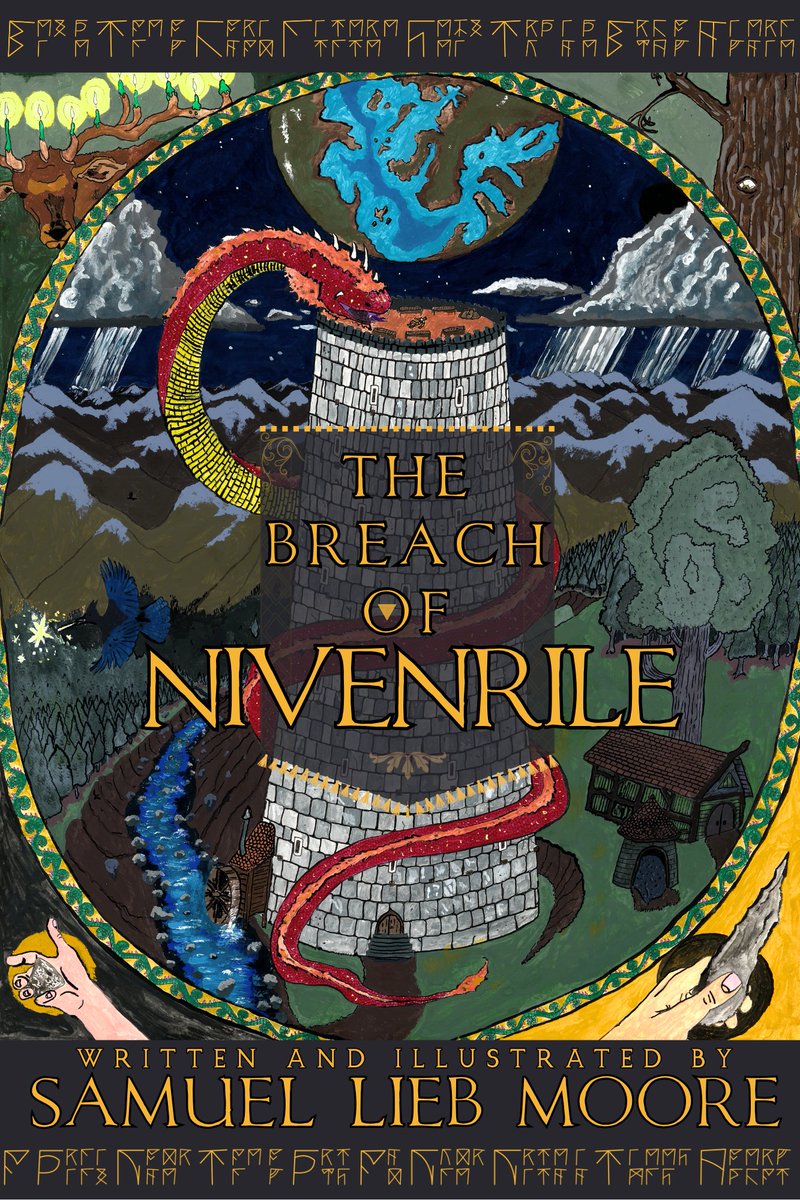
Another indie novel! And one that I sorta knew was coming for some time, as its author, Samuel Moore, connected with me on X a while back. I don’t know him well, but he seems a fine chap!
The Breach of Nivenrile was published on November 7th, so I’m a little late to the party, but not by much. Full disclosure, I was gifted a digital copy of the book by Moore and he explicitly requested a review, but that’s the end of it—no request that I give it a specific kind of review, or even where I review it, none of thast.
Oh! It’s also worth noting that The Breach of Nivenrile is Moore’s debut novel—and, for a debut novel, it makes a very strong showing!
Overview of The Breach of Nivenrile
What is It?
Conraid Littletree wanders the woodlands of Nivenrile as a lonely wordrunner, finding it easier to run than go home and face sorrow. That is, until he stumbles upon a startling sight that shakes his sense of safety.
The steadfast Bulwark, a wall standing 500 years strong and 150 feet tall, has guarded the peaceful land from woes. But now uncouth threats are creeping into Nivenrile, from spying eyes and a stalking huntress to smoke that lingers in the wind where it ought not to.
Conraid’s discovery sets him on a stealthy pathmaking task, given by the king himself, to seek out the root of the woes: whispers of a breach in the Bulwark.
With ragtag fellows—a froggish nore, a homesick atheling, a stoneworking umberknight, and a defensive shieldthane—Conraid soon finds the mission is more than mending a broken wall. Over sheer heights and through dark underways, they unearth threats to Nivenrile more invasive and insidious than they imagined.
Drawn into a fight for the land he loves, Conraid’s limits are tested, from otherworldly foes to reckoning with the sorrow he keeps outrunning. Among his unlikely fellows, he must unearth the strength to withstand what is coming, find the worth in gifts he has long thought small, and seek a path he need not tread alone.
The Breach of Nivenrile is an epic adventure fantasy in a Tolkienesque vein. The book features a significant amount of art created by the author and is entirely written in Anglish—which is a form of English which endeavors to solely use vocabulary with Anglo-Saxon roots, and thus eschew English vocabulary derived from the languages of England’s invaders (such as the French), or other borrowed words. (It’s far more comfortably readable than you might expect when reading that description—it’s basically English with a lot of words that feel archaic, but usually make quick sense in context.)
Who Wrote It?
Writing in the hopecraft of Lewis and Tolkien.
Tree nerd.
Anglish learner.
Fledgling, self-taught philologist.
SDG.~S L Moore’s X Bio
Website: https://www.samuelliebmoore.com/

Samuel Lieb Moore is an indie author, with The Breach of Nivenrile as his debut novel; I’m not aware of anything about him beyond what he’s put on his socials and website, and that very friendly smile and fine beard in his author headshot. He’s self-described as a “tree nerd, self-taught philologist, and writer of hopecraft—the purposeful fostering of hope through the arts.” He lists Tolkien and Lewis as significant influences, and I’ll say right here that very much comes through in his writing (particularly the former).
Content Warnings
There is some violence and are moments of fear, but I’d hand The Breach of Nivenrile to anyone who was a mature enough reader to handle the book’s unique vocabulary.
The Quick Take
Did I Like It: Yes.
Would I Recommend It?: Yes.
Why?: I really don’t like comparing things to Tolkien. No one can live up to that legacy, and individual experiences with Tolkien are so wildly varied. Even if I say, “Ok, ignore the behemoth that Lord of the Rings is today, with all the good and bad baggage that comes with it—pretend you read The Fellowship of the Ring just yesterday,” there’s so much to get out of The Fellowship of the Ring—and so much that stops people from finishing—that I don’t think what I mean is going to come across as intended.
So, it’s with some trepidation that I say this, because I feel I must: The Breach of Nivenrile feels Tolkienesque. The echoes and inspirations are fairly clear. The Anglish gives it a flavor no other book has. It’s not the best book I read this year, but it’s a good one, and it will give you an experience no other book that I’m aware of will.
The General Review
Have you ever read a book that’s just not like any other you’ve ever read before—well, it is, then it surprises you, but remains familiar nonetheless? Said book doesn’t need to be on the extreme ends of what you’ve experienced—best or worst—but just something that, once finished, you suspect you’re never going to really experience again?
That was The Breach of Nivenrile for me.
Okay that’s it, that’s the review. That was easy.
…
No, of course I’m kidding. But it is tempting to keep things that short and sweet because I’m having a hard time figuring out what I want to say about The Breach of Nivenrile—what worked for me, what didn’t work. It’s a very pretty piece of hand-crafted work clearly made with a lot of love by Moore, and it comes with a lot of quirks.
Let’s start with the big thing: The Breach of Nivenrile is written in Anglish.1 This sounds like a much bigger deal than it ended up being, and I’ve seen more than a few pre-reviews for this book with a message along these lines: “At first I wasn’t sure about the unusual language, but once I got into the rhythm of things it really flowed and I liked how unique it made this book.” As for me, I found The Breach of Nivenrile far easier to read than the King James Bible and many texts of old (and older) English that I had to analyze in college.
That did not mean I never needed to look up an Anglish dictionary, however. Fortunately, Moore had the insight to include a short one at the front of his book and a longer one at the back; this was very difficult to make use of in ebook form, and for that reason alone I think The Breach of Nivenrile is best enjoyed with a physical copy.
Now, on to the actual story. Conraid Littletree is the primary protagonist of this novel. He is a young adult who has essentially been orphaned—his mother died when he was five, and several years before the start of the novel his father went off in a ship and was never seen, or heard from, again. Since then Conraid has made his living as a wordrunner—Anglish for “messenger.”
Two events kick off Conraid’s adventure. First, while returning home from a wordrunning job, Conraid discovers a tree with a human eye in its trunk. Looking at the thing sickens him, so he flees. Second, he gets hired for a wordrunning job to deliver something to Good Owaine, king of Nivenrile, and there the king tasks him with a special mission to investiage if the Bulwark, a magical wall that protects Nivenrile from the outside world, has been damaged—and then to deliver Tirkee, son of the king of Prill and ward to Owaine, to his homeland of Prill. A young, unknown man, why was Conraid selected for this task, of all people?
Well, Conraid is not truly, entirely unknown, for he has a gift that is called a “waywrit”; it basically means he is almost magically good with directions and memorizing geography. This talent makes him a uniquely speedy, and accurate, pathfinder, which is exactly what the king needs, as time (and secrecy) is of the essence.
These starting portions of The Breach of Nivenrile are especially Tolkienesque. They are a little slow-paced and give you lots of time to absorb the world and characters, and to feel the deep unrest within Conraid’s young heart. Also like The Lord of the Rings, there’s a good deal of walking, and the uniting of Conraid’s fellowship—well, it’s not referred to as a fellowship, and it doesn’t happen in the exact same manner, but there are still two smaller folk who aren’t great at warfare (Conraid among their number), there’s a wise and capable wizard, there’s a friendly warrior, and there’s a gruff warrior, and I just kept thinking of The Fellowship of the Ring.
It’s after this point that things gradually begin to diverge, however. This fellowship has a Boromir-type—and I’m referring to the movie Boromir, who isn’t quite as noble as the novel. Anyway, the Boromir-type of The Breach of Nivenrile is a thane named Knace, and I find him the single most interestingg character in the story. Despite being a thane, his homeland and castle are defunct and his name is very lowly, both owing to the actions of an ancestor of his. This puts a chip on his shoulder, and some antagonism against seemingly the entire world; this combined with his deep loathing of magic quickly puts him at odds with the rest of the fellowship. They continue to reach out to him, and there are moments where Knace appears to be softening up and changing his mind—then Knace hardens up again, and eventually he abandons the fellowship entirely, firmly on the trajectory of a villainous arc.
I’ve spoiled too much, so I shan’t say more, but Knace isn’t the only part of this book where I was convinced things were going one way, then they went another. And, to give Moore some credit here, I don’t think he was attempting to subvert expectations or do anything of the sort; I think he was just telling his story, and these were the best directions for his story to go.
I was largely entertained by The Breach of Nivenrile‘s adventure. At times I felt there could have been a little more showing and a little less telling with the characters, but I generally enjoyed them, and it was fun seeing the development and maturation of characters like Tirkee (Good Owaine’s ward). The world also managed to accomplish being familiar-yet-unique, which is hard to pull off, and the magic was both more common than I expected and still wonderful and meaningfully limited nonetheless.
I have three primary complaints about The Breach of Nivenrile, and I’ll put them in what I think is most to least important.
First, there is a hidden primary villain in this novel, a great and terrible thing which I will not spoil. Conraid and his companions meet this villain at perhaps the three-fourths mark of the novel, and I was not pleased at all with this initial encounter. Imagine, if you will, if in The Hobbit there were a scene where Bilbo and the dwarves found themselves in Smaug’s presence with nowhere to hide, nowhere to run, no means to defend themselves—just completely caught dead to rights—and with Smaug’s full attention and full awareness that they are threats to that great wyrm, or at least intend to be. What would Smaug do? Eat them? Blast them with dragon-fire? Slam his tail down on them until they turned into jelly? Whatever the case, Smaug would have dealt with them swiftly and mortally, and anything else would have felt like the main characters were wearing completely unreasonable plot armor.
Well, a similar situation happens in The Breach of Nivenrile, but the characters prove to have dreadful plot armor. They encounter the vile villain. They should die in that exact moment. Instead, the villain tells them, “This is an unfair fight. Go and gather your armies; when we are more equal, then I will fight you.”
It’s just not satisfying, and it’s also not believable for a villain that has been using subterfuge to accomplish its ends for quick some time now. Perhaps for an anti-villain, but this is no anti-villain.
Second, there’s a B-plot of sorts throughout The Breach of Nivenrile where a witch is hunting Conraid’s fellowship with the intent of assassinating them. The witch does have a single very meaningful moment of threat where she casts a spell that almost kills our heroes; most of the time, though, she’s a non-factor. She just watches initially, and before too long a good witch curses her so that she may not use any weapons against our heroes, significantly hindering her ability to harm them. Later this bad witch is captured and sent to the good witches, who heal her heart such that she decides to join the cause of the Nivenrilers—and so much of this, particularly near the end of the novel, occurs very far away from the main plot, including the actual climax and resolution of the novel. I’m not sayin her struggle out of the pain and darkness of her childhood into healing and a sort of repentance wasn’t interesting, but I don’t think it was woven as tightly into the rest of the story as it needed to be to not stand out a bit.
Third, the end of the book dragged a bit for my taste. The road to defeating the revealed-primary-antagonist of this novel was a bit slow—or perhaps I didn’t feel much tension because of my first complaint—as was the resolution afterward, and the two put together left me very ready to move on by the time I got to The End, despite an otherwise satisfying conclusion.
(I will say, Conraid’s final confrontation with said villain was quite thrilling—easily the most exciting battle of the book.)
As a last note for The Breach of Nivenrile, this book is the first in a series—I don’t know how long the series is planned to be, as my quick search of Moore’s website didn’t tell me, but in my mind something doesn’t count as a series until it has five or six books in it, minimum. Time will tell if Moore is of a similar mindset. Anyway, despite that, The Breach of Nivenrile felt satisfying as a stand-alone novel. There are absolutely loose threads at the end of the book that could lead to some very interesting events in future sequels, but they in no way diminished my sense that I had read a complete, uncompromised story.
Wrapping Up
The Breach of Nivenrile was fun. It’s not a perfect book, but it’s in many ways a totally unique book, while also having a lot that will be familiar to fans of Tolkien.
Enjoyed this review? Consider subscribing below so you never miss an update! You can also follow me on X.
If you enjoyed this, great news, I’m an indie author as well! Check out my published novels, The Failed Technomancer and Inner Demon, available nearly everywhere (digitally).
- To define Anglish again: a hypothetical reconstruction of English as the language might appear using only Anglo-Saxon words (and how they may have evolved over time), with no borrowed words from other languages (like French). Some versions of Anglish are effectively invented languages unparsable to modern English speakers, while others are just modern English with a few words swapped out. ↩︎


Leave a Reply