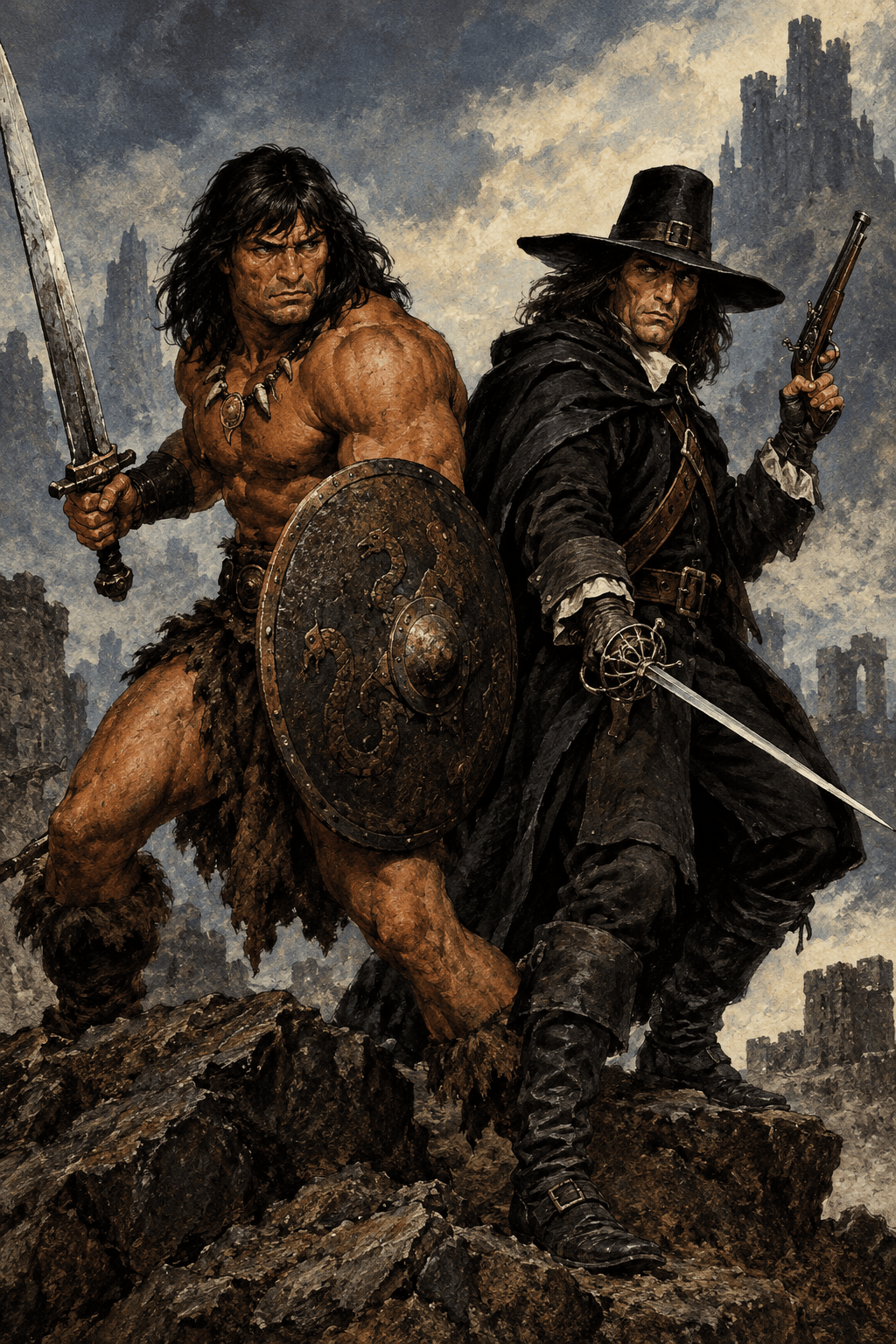
Sword-and-sorcery1 is a genre of fantasy that I’m not particularly familiar with, in part because it’s not very popular nowadays. As I understand it, the genre had its heyday back in the era of the pulp magazine, then started to die out as more epic genres took the center stage. But I keep giving it a try, because I want to like it. Conceptually, I think lower-stakes, lower-scope, but still heroic, adventurous, and magical fantasy sounds like an instant home run, but my two primary experiences with the genre thus far have been far from auspicious.
My first formal entry into the genre was The Reluctant Swordsman, and I hated it. I’m not normally the type to bang on about treatment of women in stories—I think fantasy should be allowed to be fantasy, and that includes sometimes doing things that don’t align with real-world sensibilities—but that book portrayed disgusting things that I don’t think should be defended under any context.
But that was just one book, and I didn’t want to judge the whole genre by it, so I tried again. For my second entry, there was an indie novel going around, The Curse of the Star Wraiths, which seemed to have potential—but I ended up not liking it either. Fortunately, not for reasons of offensive content, but primarily because the novel seemed really underbaked. So that was another miss.
So I decided to go back. Way back. Back to, arguably, the origin of swords and sorcerers,2 being Conan the Cimmerian, a character originally created by Robert E Howard. And, after reading some Conan stories, I discovered Solomon Kane, also by Howard. Did these stories eclipse their descendants?… Read on and find out!
Overview of Conan Stories and The Savage Tales of Solomon Kane
What is It?
Conan Stories
A collection of short stories featuring Robert E Howard’s enduring character, Conan the Cimmerian, presented in order of publication.
The Savage Tales of Solomon Kane
He was . . . a strange blending of Puritan and Cavalier, with a touch of the ancient philosopher, and more than a touch of the pagan. . . . A hunger in his soul drove him on and on, an urge to right all wrongs, protect all weaker things. . . . Wayward and restless as the wind, he was consistent in only one respect—he was true to his ideals of justice and right. Such was Solomon Kane.
Conan Stories and The Savage Tales of Solomon Kane are short story anthologies of the earliest stories of these two characters. They are very much early sword-and-sorcery, featuring mystical lands, wicked villains, and contained plots where the hero’s goals are often as simple as exploration, treasure hunting, or seeking after a damsel in distress. Fighting and problem-solving are the two most common obstacles in these stories.
Who Wrote It?
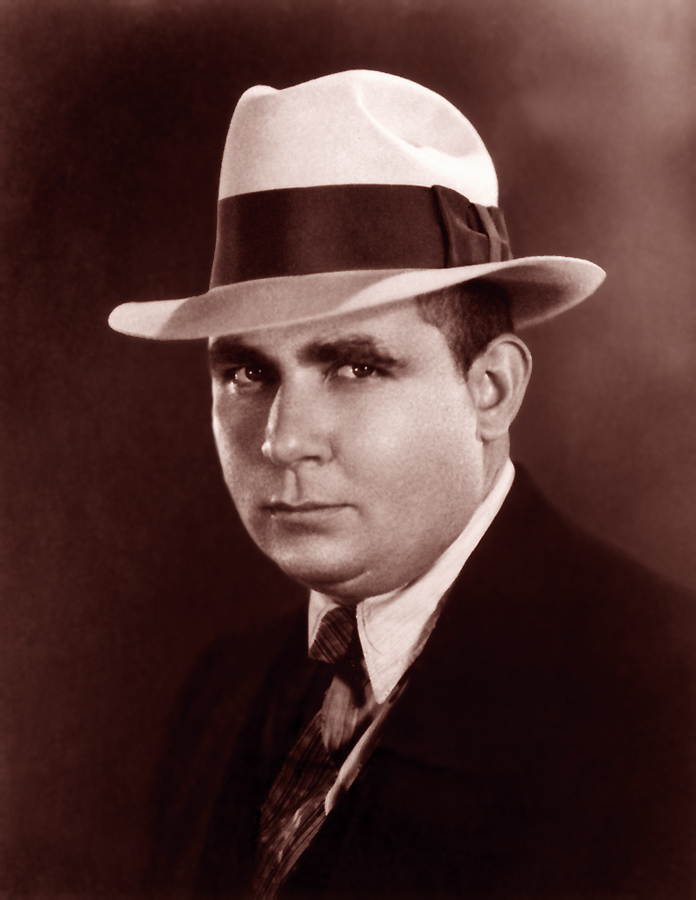
Robert E Howard is regarded as the father of the sword-and-sorcery genre. Though his lifespan was short (he committed suicide at the age of thirty), he was a prolific author of short stories. His legacy includes the absolutely titanic, evergreen Conan the Cimmerian (more commonly known as the Barbarian), whose tale has been told and retold for nearly a century now; the Hyborian Age, being the world of Conan; and powerful, though not as famous, characters such as Solomon Kane and Kull the Conqueror. Howard also wrote poetry, snippets of which can be found in many of his short stories.
Content Warnings
Several Conan stories feature suggestive depictions of women in compromising situations, including one where a female character spends almost the entire adventure nude. To my memory, this nudity is never graphically described, although there are instances where circumstance alone doesn’t require much description to make things very uncomfortable—such as a scene where a woman is nearly raped.
There is one Solomon Kane story, to my memory, in which the damsel in distress (and a villainous) spend portions of the story in states of undress. As a Puritan, Kane does not focus on these details in the same way that Conan, an unapologetic womanizer, often does.
Regarding the above, I would not describe the sexual content of Howard’s stories (what I read, anyway) as pornographic, but it certainly walks a line and I’m sure many readers will be uncomfortable with these parts of these stories. As for me, some of these stories I would be comfortable with handing to my future children in their teenage years (even with some of their more lurid elements), while others I think should remain with solely mature readers. It varies widely from story to story.
In addition, violence is very common in both Conan’s and Solomon’s stories. Both are often forced to fight their way out of dangerous situations; though heightened, thrilling, and sometimes detailed, I would not describe Howard’s violence as graphic or particularly objectionable.
Finally, these short stories were written in the 1920s and 30s. Depictions of women and, especially in Solomon Kane’s stories, black people (and traditional African culture) are very much of their time. This is not a moral issue, except to those who insist on judging the past by modern standards, but it may be shocking to readers who are only familiar with contemporary fiction and contemporary perspectives on culture and race. I bring this up to prepare such people, but not to discourage them from reading.
The Quick Take
Did I Like It: Yes.
Would I Recommend It?: Yes.
Why?: The majority of the works of Conan and Solomon Kane, at least what Robert E Howard wrote, has fallen into public domain and is thus completely free.3 These stories are foundational to a lot of modern fantasy. Combine these facts with the fact that I was sufficiently entertained while reading, and there’s not many good reasons not to give these stories a try.
The General Review
How do I review two separate short story anthologies about two separate characters? Well, the connecting link in both anthologies are their titular characters, Solomon Kane and Conan—so, let’s start there.
And let’s start specifically with Solomon Kane, as his quote below is both a great distillation of his character (when in context) and what got me interested in reading Robert E Howard’s work in the first place.
Men shall die for this.
~Solomon Kane, Red Shadows
Here’s that all-critical context: Solomon Kane is a wandering Puritan gunslinger and duelist. One day, while wandering through France, he discovers an injured little girl, abandoned and dying on the side of the road. There’s nothing Kane can do to save the girl—her wound is mortal. But he does his best to comfort her, and in so doing he learns that she and her family were attacked by bandits. The above quote is Solomon Kane’s firm statement of what happens next. I don’t read it as a promise or as a threat, but as an affirmation of justice that Solomon Kane feels duty-bound to carry out, even if the ultimate cost to deliver that justice may be his life.
Solomon Kane then delivers justice. Men do die. But Solomon Kane doesn’t.
Most Solomon Kane stories that I read followed this template pretty loyally. Solomon Kane is traveling strange lands, seeking to right a wrong he already knows about or that he stumbles into; in either case, he, without reservation, commits his whole soul into ensuring that justice is delivered, often by bullet or the point of his rapier.4
In this, Solomon Kane’s stories can get pretty repetitive. The vast majority of the variety that he offers comes in the unique locales in which he delivers justice, or in the unique villains of the week.5 Every once in a while I saw a promise of unique or interesting ideas being explored, but often such things were touched on once and then abandoned, or were just hinted at but never built upon. An example of the former is a story in which Solomon Kane is able to injure a ghost with his bare hands by virtue of his righteous fury, an interesting story element that’s never picked up in a future story; an example of the latter is Kane’s Puritanism, which doesn’t seem to matter in every Solomon Kane story that I read. You’d think that the strong religious convictions of a Puritan would lead to some sort of conflict when Kane is forced by circumstance to ally himself with a voodoo witch doctor—but no, no it doesn’t, beyond Kane very briefly wondering if he’s consigning his soul to hell and deciding to get on with what must be done anyway. (Very rip and tear of you, Mr. Kane.)
I often got the sense that Howard wasn’t quite sure he knew what he wanted to do with Solomon Kane. He had a far more popular character in Conan who also adventured a lot, some adventures of which were comparable to Kane’s adventures; perhaps the shadow that Conan cast made it difficult to see what made Kane special. The Savage Tales of Solomon Kane have a lot of story fragments in them, some of which suggest that Solomon Kane could have developed into far more more than he ended up being—but, alas, Robert Howard’s suicide ensured that Kane would never get any further development. By him, at least.
Still, I overall enjoyed reading Solomon Kane’s stories, and I think our modern story environment makes him uniquely compelling. Kane is a man with an innate—if not explicitly defined—sense of right and wrong who earnestly seeks justice no matter what. In a world full of poisonous gray morality, he’s a shining light that, yes, objective truth exists and that, yes, there is some sort of noble virtue in sacrificing everything to do what’s right because it is right, and needing no greater reason.
Now, on to Conan. Similar to Kane, I think the character of Conan can be fairly distilled using of his own quotes:
I live, I burn with life, I love, I slay, and am content.
~Conan the Cimmerian, Queen of the Black Coast
Literally every Conan the Cimmerian story is this quote. Conan has something he wants, or he wanders into somewhere and ends up embroiled in some sort of adventure. Often there’s a beautiful girl (but not always, and never the same one). Conan acts in his usual larger-than-life way, proves to be exceedingly keen (with a barbaric simplicity and clarity to how he views things), often a bunch of heads roll, and the story generally ends with Conan claiming some sort of treasure, which may or may not be said girl (or include said girl).
This repetition works so much better in Conan’s stories than Solomon Kane’s.
Yes, it’s not uncommon for me to read a Conan the Cimmerian story and get a little bit of deja vu, but that was never a problem. The Hyborian Age6 (the world of Conan) is richly detailed, interesting just about everywhere, and Conan rarely visits the same place twice. Even if the plot frequently rhymes, enough of the set dressing, characters, and stakes change every episode to keep things fresh, to keep curiosity afloat, and I don’t remember ever finding myself bored. If anything, the plot repetition is the bit of familiar that keeps you attached to Conan and his adventures, allowing the everything else to be as weird and inventive as Howard feels like in any given story.
Conan himself is part of that rhyming beat, of course. Conan doesn’t change, but he doesn’t need to—Conan changing isn’t what’s interesting about a Conan story. What’s interesting is seeing the world get bent and warped around his unstoppable influence.
Conan still adapts to new circumstance, of course. Many stories suggest at the lifelong adventures and learning (through practical experience) of Conan, much of which happens behind the scenes. His early stories typically feature him as a wandering adventurer or mercenary, and over time he takes on gradually grander roles, such as a protector for colonists on just beyond the edge of civilization, the captain of a royal guard, a pirate king, a general, and so forth. The picture that forms is that of an incredibly intelligent and capable man who is interested in experiencing everything he can that life offers, but is too restless to stay in one location too long.
There’s a reason Conan’s stories have inspired men and boys for decades at this point. Most men will never burn as brightly as Conan, but almost any man can find aspects of Conan that are worth dreaming about. There is great and there is terrible in Conan, and men like Conan, and often the exact same trait can change from great to terrible with a small shift of situation.
What are Conan and Solomon About?
Entertainment. These books exist to entertain, that is what they are about, and that’s a good thing.
Now, that’s not to say that the characters in these stories don’t have identities and beliefs from which deeper messages could be drawn, nor is that to say that the worlds of Conan and Solomon Kane don’t have consistent themes that are explored and returned on—they absolutely do. But they also don’t make the mistake a lot of modern stories do in forgetting what fiction is for: to entertain. Having incredible depth in addition to being entertaining can often elevate a story significantly, give it incredible lasting power, but, if you are an aspiring author, don’t make the mistake of putting the cart before the horse.7
Anyway, one of the more common themes woven through Conan’s stories is that civilization isn’t really all that civilized, and that sometimes barbaric people better follow the supposed ideals of civilization than civilized people. This theme is often paired with another theme, that civilization creates artificial environments which rarely survive incursions from the primitive world (sometimes portrayed as the “real” world).
Barbarism is the natural state of mankind.
~Conan the Cimmerian, Beyond the Black River
What’s interesting is that Conan often, but not always, stands on the side of civilization, despite being a barbarian—at least, when the two come in direct conflict. My read of this tension in Conan’s stories is essentially a rejection of extremes—extreme “civilization” ends up either suffocating itself, or becoming just as destructive as barbarism (but using different methods); extreme barbarism has obvious downsides I probably don’t need to describe.
That said, I think this exploration of the tension between civilization and barbarism is much more interestingly explored on a micro scale—specifically, in masculinity. Conan’s barbaric power (and willingness and capacity for violence), coupled with his ability to exert tremendous self-restraint when the situation calls, allows him to accomplish things no other man can. Most of the other men that Conan encounters fall more greatly to one extreme or the other than he does, and they are almost universally lesser than he; yet, the influence of Conan allows some of these men to become more barbaric (or even more civilized), and the end result is that these men, by exploring their dual natures, become greater than they were before.
For Conan, this expansion has simple ends, explained in the previous section—he wants the simple pleasures of mortal life, and little more. But those he encounters rarely are content with such limited horizons.
To be clear, Conan is not an exploration of virtuous masculinity, but simply masculinity in a generally neutral sense. Masculine drives and desires, when bridled, create civilization, and when unbridled these things create barbarism—and in both cases this happens simply because that is what men do. Men explore, men fight, men build.8 Give them higher reasons to act as men and they will invent, defend, and create; give them base reasons, deny them healthy expressions of masculinity, or otherwise encourage them to give in to natural evils, and they will take, destroy, and corrupt.
As I said, I wouldn’t put Conan in either extreme—he falls somewhere in the middle. Conan explores a lot. Conan fights a lot. Conan builds some, although he doesn’t tend to stick around to see what happens with what he built.
Solomon Kane, on the other hand—I ended up drawing a lot less out of his stories than Conan’s. I initially found Kane’s drive to explore and to set wrongs aright extremely compelling and extremely fascinating—it was the reason I started reading Robert Howard’s stories to begin with! But in multiple short stories Howard, as the narrator, pretty explicitly states that there is no method behind Kane’s madness. He is compelled to do what he does; he has no defined moral code, set of ideals, or divine mandate that sets him on the path that he’s on. In many ways this makes him even simpler than Conan—although, to be fair, Conan’s outward appearance of two-dimensionality is quickly disproven in his own stories. Kane, I found, had an outward appearance of deep dimensionality that collapsed as I continued reading, and thus I found him less interesting as time went on, at least compared to my initial experiences with him. But I’m sure there’s someone out there who finds Kane’s wild, instinctive justice far deeper and more profound than a strictly defined moral code, and I’m curious what such a person would have to say about Solomon Kane.
This isn’t all to say that Kane is lacking in his compelling moments, quotes, and actions, but such things tend to remain alone, rather than fitting into a greater whole—which, perhaps, could be the reason Solomon Kane never found the same level of popularity as Conan the Cimmerian.
Or perhaps Puritan gunslinger duelists who literally wrestle devils into submission just aren’t as interesting as womanizing, ultra-masculine, ultra-competent barbarians. You tell me.
Wrapping Up
The sword-and-sorcery genre has been redeemed for me! Yes, there were imperfections to be found in these short story anthologies—particularly Solomon Kane’s—but, having gone to the origin, I understand why this genre still exists today, despite not possessing the popularity of its youth.
And on Conan and Kane specifically—these characters and worlds are evergreen. It’s unfortunate that Robert Howard didn’t live to see some of the incredible influence of his work, but, regardless, his stories and characters have outlasted the majority of the stories written and published since he first put pen to paper, and I suspect they will continue doing so for a long time.
Conan’s for everyone. Solomon Kane is for everyone.
Enjoyed this review? Consider subscribing below so you never miss an update! You can also follow me on X.
I’m an indie author with two books published so far, The Failed Technomancer and Inner Demon. I think I’d recommend the latter over the former to fans of Conan and Solomon Kane—it’s not a sword-and-sorcery novel, but it is a fantasy story with more constrained stakes than your average fantasy novel.
- “Sword-and-sorcery is a subgenre of fantasy literature and media defined by fast-paced, action-oriented adventures featuring sword-wielding, rugged heroes in personal, lower-stakes conflicts.” Thanks, Wikipedia! ↩︎
- “Arguably” is a key word here. Conan’s short stories were far from the first sword-and-sorcery short stories to be published, even by Robert E Howard—Kull the Conqueror came before Conan! But I’m not aware of any character who has left as shadow as long and deep as Conan’s, and Conan, originally, was firmly a sword-and-sorcery hero (of sorts), which is why I think he can fairly be described as sword-and-sorcery’s origin—so much draws from his stories, after all, even almost a century later. ↩︎
- Conan Stories is completely free, and you can get your own epub here. Not all of Solomon Kane’s stories have fallen into the public domain, so I can’t give you a link to freely read The Savage Tales of Solomon Kane—my apologies. ↩︎
- There wasn’t really room for this in the review, but Solomon Kane’s absolute dedication to righting wrongs made me think of Mike Spears from American Paladin. The big difference is that Kane primarily flies by instinct, including in deciding who gets to die and who gets to live, whereas Spears can lay out in plain, concise English exactly what’s bringing his unique brand of justice down on your head. ↩︎
- Villains of the issue? He was fist published one tale at a time in pulp magazines. ↩︎
- Robert Howard wrote a detailed essay on the Hyborian Age, which is basically the Conan Bible for anyone interested in writing Conan stories, or simply in placing their own characters and stories in Conan’s world. ↩︎
- There’s a reason The Lord of the Rings and The Hobbit has endured for generations while only the nerdiest of nerds read the Middle Earth encyclopedias or Tolkien’s essays. Not saying there isn’t good stuff in the latter items, but it’s not the kind of stuff that captures kids’ hearts and imaginations. ↩︎
- This is a Devon Ericksen quote. ↩︎


Leave a Reply